Rising from the vast golden wheat plains of Central Anatolia, Konya radiates a serene, contemplative aura distinct from any other destination in Turkey. As the royal capital of the Seljuk Sultanate of Rum during the twelfth and thirteenth centuries, Konya emerged as a global beacon of philosophical inquiry, Islamic art, and spiritual tolerance. It was here that the revered Sufi mystic, philosopher, and poet Mevlana Celaleddin Rumi composed the epic verses of the Masnavi, preaching radical universal love and divine communion that gave birth to the Mevlevi Order and the world-famous Whirling Dervishes.
- 🛂 Visa Requirements: Indian passport holders carrying a valid US, UK, Schengen, or Ireland visa can obtain an official Turkish e-Visa online in 5 minutes via
evisa.gov.tr. For full application details and document rules, review our Turkey Visa Guide. - 🚆 High-Speed Rail Transit (YHT): Konya Gar is directly linked to both Ankara and Istanbul via Turkish State Railways (TCDD) high-speed trains. Ankara to Konya takes just 1 hour 45 minutes; Istanbul (Söğütlüçeşme) to Konya takes roughly 4 hours 45 minutes.
- 🌀 Whirling Dervishes (Sema Ceremony): Authentic weekly spiritual ceremonies take place every Saturday evening at 19:00 at the Mevlana Cultural Centre (Mevlana Kültür Merkezi). Book tickets online or arrive early to guarantee seating.
- 🥗 Vegetarian Dining ("Etsiz"): Konya is famous for Etli Ekmek (meat flatbread), but vegetarians can order Peynirli Pide (melted cheese flatbread), Bıçak Arası Sebzeli (diced vegetable flatbread), Su Böreği (layered cheese pastry), and fresh mezes. Use the magic phrase "Etsiz olsun" (make it without meat).
- 🕌 Sacred Respect & Etiquette: As Turkey’s spiritual capital, conservative standards apply. Women must wear a headscarf inside the Mevlana shrine; both men and women should wear long trousers or skirts covering knees and shoulders. Remove shoes before stepping onto carpeted prayer areas.
- 🧭 Country Hub & Network: Link Konya into a wider Anatolian journey through our comprehensive Turkey Travel Hub, connecting directly with Cappadocia and Ankara.
 Konya · Turkey
01 The Seljuk heartland
Few cities in Eurasia have witnessed such profound philosophical and urban evolution as Konya. Known in antiquity as Iconium, the city was visited by Saint Paul and Saint Barnabas during the early Roman period. Yet it was between 1097 and 1243, as the imperial seat of the Seljuk Sultanate of Rum, that Konya experienced its golden age of stone architecture, Islamic jurisprudence, and mystical poetry.
The Seljuk sultans, notably Alaeddin Keykubad I, fortified the city with monumental stone ramparts and commissioned breathtaking madrasas, caravanserais, and royal mosques. Unlike later Ottoman architecture, which focused on soaring hemispherical domes and pencil-thin minarets, Seljuk architecture celebrated monumental carved stone portals (taçkapı) incised with deep geometric ribbons, knot-work, Quranic calligraphy, and celestial star patterns, contrasted with interiors lined in turquoise, cobalt, and gold luster tiles.
It was within this flourishing intellectual climate that Jalaluddin Muhammad Rumi settled after fleeing the Mongol invasions of Central Asia. Meeting his enigmatic spiritual mentor Şems-i Tebrizi in Konya in 1244, Rumi underwent an ecstatic transformation that produced 25,000 rhyming couplets of mystical poetry. His philosophy—encapsulated in the famous invitation: "Come, come, whoever you are: wanderer, worshipper, lover of leaving—it doesn't matter. Ours is not a caravan of despair"—still permeates the quiet, tree-lined streets of Konya today.
02 Top ten curated attractions in Konya.
From the sacred green dome of Rumi's shrine to medieval tilework and 9,000-year-old Neolithic dwellings.

1. Mevlana Museum & Tomb of Rumi
The beating spiritual heart of Konya. Recognizable by its iconic fluted turquoise-tiled dome (Kubbe-i Hadra), this historic Mevlevi lodge (dergâh) shelters the magnificent gold-embroidered sarcophagus of Mevlana Celaleddin Rumi and his son Sultan Walad. Pilgrims from across the globe gather in quiet reflection around the shrine, which also exhibits illuminated Quran manuscripts, 13th-century musical instruments (including the reed flute or ney), and preserved dervish monk cells.

2. Karatay Madrasa Tile Works Museum
Built in 1251 by Seljuk vizier Celaleddin Karatay, this former Islamic college now serves as Turkey's premier museum of Seljuk tile art. Step beneath the soaring central dome covered in a breathtaking mosaic of turquoise, deep cobalt, and gold ceramic tiles forming cosmic star patterns, Arabic calligraphy, and geometric arabesques. The side halls display rare luster tiles excavated from the Seljuk royal summer palace of Kubadabad on Lake Beyşehir.

3. İnce Minareli Madrasa (Museum of Stone & Wood Art)
Constructed in 1264 by Seljuk vizier Sahip Ata, this architectural marvel features one of the most astonishing carved stone portals in Islamic art. The facade is entirely cloaked in intertwined ribbons of deep relief stone carving featuring stylized plant motifs and calligraphic Quranic inscriptions. Inside, the museum exhibits exquisite Seljuk and Ottoman carved wooden doors, winged double-headed eagle heraldic reliefs, and marble foundation plaques.

4. Alaeddin Mosque & Alaeddin Hill
Crowning the central tumulus park of Alaeddin Hill, this grand hypostyle mosque was built incrementally between 1155 and 1220 by Seljuk sultans. Its expansive prayer hall features 42 antique marble columns recycled from classical Greco-Roman temples, an exquisite 1155 carved ebony wood minbar (pulpit), and a peaceful royal courtyard housing the octagonal tombs of eight Seljuk sultans, including Kilij Arslan II and Alaeddin Keykubad I.
5. Historic Sille Village & Saint Helena Church
Located 8km northwest of downtown Konya, the charming historic settlement of Sille was inhabited continuously by Greek and Turkish communities for millennia. Highlights include the 4th-century Saint Helena Church (Aya Eleni Kilisesi)—originally founded by Helena, mother of Roman Emperor Constantine, during her pilgrimage to Jerusalem—surrounded by rock-cut monastic hermitages, Ottoman stone arch bridges, and traditional creekside tea houses.
6. Aziziye Mosque
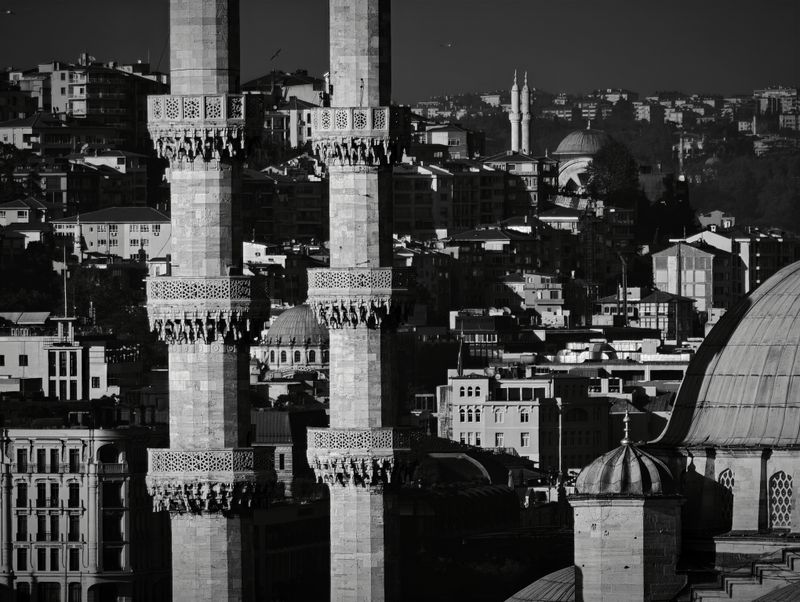
Standing in the heart of Konya's historic bazaar district, Aziziye Mosque was built in 1874 in a rare and theatrical blend of late Ottoman baroque and European rococo styles. Built from pale native cut stone, the mosque features dramatic twin minarets crowned with open balconies resting on miniature Corinthian-style columns. Wide glass arched windows flood the interior with soft daylight, illuminating painted floral plaster ceilings.

7. Konya Tropical Butterfly Garden
Europe’s largest enclosed tropical butterfly sanctuary, spanning over 1,600 square meters under a massive geodesic glass dome maintained at 28°C and 80% humidity. Wander through lush rainforest foliage, cascading indoor waterfalls, and flowering orchids while thousands of exotic free-flying butterflies from Costa Rica, the Philippines, and Kenya flutter around you. The adjoining educational center details butterfly metamorphosis.

8. Çatalhöyük Neolithic UNESCO Site
One of humanity’s most critical prehistoric archaeological sites, dating from 7400 BC to 6200 BC. Inscribed on the UNESCO World Heritage list, Çatalhöyük represents the transition from nomadic foraging to settled agricultural urbanism. Walk under protective shelter domes to view dense mudbrick residential cells built shoulder-to-shoulder with no streets; residents accessed their homes via ladders through flat roof openings.

9. Sahip Ata Mosque Complex
Commissioned between 1258 and 1283 by grand vizier Sahip Ata Fahreddin Ali. The complex originally contained a mosque, dervish lodge (hânegâh), soup kitchen, and bathhouse. Admire the exquisite portal decorated with geometric knot-work and twin niche stalactites (muqarnas), and the minaret base wrapped in brilliant turquoise and manganese brick mosaics. The restored museum section holds medieval Seljuk religious wood carvings.
10. Şems-i Tebrizi Mosque & Tomb
Set in a quiet city park just north of the central bazaar, this serene 14th-century sanctuary honors Shams of Tabriz, the wandering Persian dervish whose meeting with Rumi sparked the spiritual awakening that shaped his poetic masterpiece. The tomb chamber beneath the wooden pyramid roof contains a revered catafalque covered in deep green velvet, visited by seekers drawn to the profound spiritual bond between Rumi and Shams.
03 The Sema ceremony of the Whirling Dervishes.
Understanding the mystical philosophy, symbolic vestments, and movements of Mevlevi worship.
Symbolism of the Sema Ritual
The Sema is not a tourist performance; it is a sacred mystical ritual recognized by UNESCO as an Intangible Cultural Heritage of Humanity. Representing humanity's spiritual ascent through love and truth to divine unity, every gesture and garment carries profound philosophical symbolism. The dervish’s tall camel-hair felt hat (sikke) represents the tombstone of the ego; his wide black cloak (hırka) represents worldly death; and the billowing white skirt (tennure) represents the shroud of rebirth.
As the ceremony begins, accompanied by the mournful tones of the reed flute (ney) and rhythmic drums (kudüm), the dervishes discard their black cloaks, demonstrating spiritual liberation. Whirling counter-clockwise on their left foot around the ceremonial hall, their right palm opens upward toward heaven to receive divine grace, while the left palm points downward toward the earth to bestow that blessing upon all creation without retaining anything for oneself.
How & Where to Witness the Sema in Konya
While small commercial dervish shows are staged in hotels and restaurants in Istanbul and Cappadocia, the definitive and spiritually authentic ceremony takes place in Konya.
• Weekly Saturday Ceremonies: Every Saturday evening at 19:00 (19:30 during summer months), the Mevlana Cultural Centre (Mevlana Kültür Merkezi) hosts a full-scale Sema ceremony performed by authorized Mevlevi ensembles. Admission is inexpensive or free depending on the season, but travelers should arrive by 18:15 to secure good viewing seats.
• The Annual Şeb-i Arus Festival: Held every December 7 to 17, this festival commemorates the anniversary of Rumi’s passing in 1273—celebrated as his "wedding night" with the Divine. Thousands of Sufi scholars, poets, musicians, and pilgrims gather from across the world for nightly ceremonies and poetry recitals. Hotel accommodation and tickets for Şeb-i Arus must be booked several months in advance.
04 The life & seven counsels of Mevlana Rumi.
Understanding the intellectual legacy that transformed Konya into a timeless pilgrimage destination.
From Balkh to Konya: The Journey of a Mystic
Jalaluddin Muhammad Rumi was born in 1207 in Balkh (present-day Afghanistan). As Mongol hordes under Genghis Khan advanced westward across Central Asia, Rumi’s father, Bahauddin Walad—himself an eminent theologian—fled with his young family across Persia and the Levant, performing the pilgrimage to Mecca and Medina before accepting the royal patronage of Seljuk Sultan Alaeddin Keykubad I in Konya in 1228.
In Konya, Rumi initially succeeded his father as an orthodox professor of Islamic theology and jurisprudence. However, in late 1244, an encounter with Shams of Tabriz—a wandering dervish of fierce spiritual radicalism—shattered Rumi’s conventional scholastic existence. For months the two mystics remained locked in private spiritual communion (sohbet), exploring the divine mystery through ecstatically shared love. When Shams mysteriously disappeared in 1248, Rumi channeled his devastating grief into sublime poetry, dictating the 25,000 rhyming couplets of the Masnavi to his disciple Husam al-Din Chalabi while whirling in ecstatic prayer.
The Seven Counsels of Mevlana
Carved in stone across public monuments in Konya are Mevlana Rumi’s famous Seven Counsels, which summarize the practical ethics of the Mevlevi path:
1. In generosity and helping others: be like a running river.
2. In compassion and grace: be like the sun that shines on all.
3. In concealing the faults of others: be like the protective night.
4. In anger and irritability: be like the dead who cannot react.
5. In modesty and humility: be like the receptive earth beneath your feet.
6. In tolerance and broadmindedness: be like the boundless sea.
7. Either appear as you are, or be as you appear.
This universal message of empathy and humility draws travelers of all backgrounds, faiths, and nations to Konya, making a visit to the Mevlana Museum a deeply reflective personal journey rather than a conventional tourist sightseeing checklist.
05 Çatalhöyük: The dawn of human urban settlement.
Walking the 9,000-year-old mudbrick alleys of the world's most famous Neolithic city.
A Society Without Streets or Fortifications
Located 40 kilometers southeast of Konya across the fertile Çumra plain, Çatalhöyük was first discovered in 1958 by British archaeologist James Mellaart and later excavated for decades under Ian Hodder. Inhabited continuously between 7400 BC and 6200 BC by an estimated population of 8,000 people, it is one of the largest and best-preserved Neolithic sites on Earth, inscribed as a UNESCO World Heritage site in 2012.
What makes Çatalhöyük revolutionary is its egalitarian urban layout. There were no public squares, no defensive stone walls, no palaces, and no communal street grids. Houses were constructed directly against one another like honeycomb cells out of sun-dried mud bricks and timber beams. Daily life, social gatherings, cooking, and transit took place entirely across the rooftops, with residents descending into their private, plastered living rooms down wooden ladders via ceiling hatches that also served as smoke vents.
Domestic Life, Art & Sacred Shrines
Inside these ancient homes, Neolithic artists whitewashed their walls with lime plaster and painted dramatic red-ochre murals of leopards, stags, vultures, and running hunters, as well as the earliest known landscape map showing the erupting volcanic peak of Mount Hasan (Hasan Dağı). Plastered bull skulls (bucrania) with intact real horns projected from living room walls as household shrines.
Intriguingly, forensic analysis of skeletal remains buried beneath the sleeping platforms inside the homes showed no signs of violent trauma, and equal nutritional health between men and women, leading anthropologists to view Çatalhöyük as a peaceful, remarkably egalitarian early agricultural society that flourished for over a millennium without warfare or rigid social hierarchy.
06 Konya culinary traditions & vegetarian dining.
Navigating Central Anatolian dough culture, hearth-baked flatbreads, and meatless alternatives.
The Central Anatolian Dough Tradition
Konya sits in the heart of Turkey’s wheat basket, and its culinary heritage revolves around stone-milled flour, fire-hearth ovens, and dairy farming. The city’s signature culinary export is Etli Ekmek—a metre-long, paper-thin flatbread topped with finely minced lamb, onions, and sweet green peppers. Because Konya is unabashedly carnivorous, vegetarian travelers must communicate their dietary requirements clearly at the beginning of any meal.
Vegetarian Alternatives: "Etsiz" in Konya
Fortunately, local bakeries (pide fırını) can prepare meat-free flatbread variations on demand using the same wood-fired stone hearths:
• Peynirli Pide: The same metre-long crispy crust topped with rich, melted local sheep’s milk cheese and butter.
• Bıçak Arası Sebzeli: Request a vegetarian stone flatbread baked with hand-diced tomatoes, sweet green peppers, fresh parsley, and melted yellow kaşar cheese.
• Su Böreği: A savory boiled yufka pastry layered with fresh white cheese, parsley, and golden melted butter, with a texture reminiscent of delicate Italian lasagna.
• Bamya Çorbası: Traditional dried baby okra soup cooked with tomato paste and lemon juice. Confirm with the kitchen that it is prepared without lamb stock ("Et suyu var mı?").
Mevlana Candies & Tea Culture
Konya's most famous sweet confection is Mevlana Şekeri, crystalline white sugar candies that melt gently on the tongue, often flavored with light mint, lemon, or bergamot. Sold in pastel boxes across the bazaar surrounding the Mevlana Museum, they make wonderful travel gifts. Konya also produces delectable Cevizli Helva (tahini halva layered with crunchy Anatolian walnuts).
Dining Around Alaeddin Hill
For lunch and evening dining, wander the pedestrian promenades encircling Alaeddin Hill and the lanes leading toward Aziziye Mosque. Family-run restaurants (lokanta) feature warm glass counters serving slow-cooked vegetable stews, creamy chickpea plates (Nohut Yemeği), fresh yogurt bowls, and piping hot flatbreads pulled straight from wood-fired ovens every few minutes.
Curated Field Dossier & Offline Google Maps Pin Pack
Bypass tourist traps with verified local logistics, exact parking coordinates, and field-tested routes.
- ✓Exact GPS Pin Pack: Unmarked parking spots, best dawn photography vantage points, and hidden trailheads.
- ✓Crowd-Avoidance Timing Matrix: Exact hour-by-hour windows to explore with zero tourist chaos.
- ✓Vetted Local Dhabas: 100% authentic, hygiene-checked regional food stops not on commercial maps.
- ✓Scam & Overcharge Shield: Verified taxi rates, auto fares, and local guide fee guidelines.
🛡️ Personally curated by PK Gupta & the Hidden Routes research desk. Delivered directly to your Email & WhatsApp within 4–8 hours.
05 Konya practical travel FAQs.
Essential details on train schedules, local dress codes, duration, and day excursions.
How do I reach Konya by high-speed rail?
The modern Turkish YHT high-speed rail line makes Konya exceptionally accessible. From Ankara Gar, frequent departures reach Konya in just 1 hour and 45 minutes. From Istanbul (Söğütlüçeşme or Bostancı on the Asian side, with select departures from Halkalı), the train covers the route across the Anatolian plateau in roughly 4 hours and 45 minutes. Book seats in advance via the official TCDD portal. Taxis or the Alaeddin tram line connect Konya Gar with the central historic hotel district in 10 minutes.
What dress code is required in Konya?
Konya is one of Turkey’s more culturally conservative cities. When exploring the Mevlana Museum, Alaeddin Mosque, or local bazaars, modest clothing is both polite and expected. Men should avoid shorts, wearing long trousers and shirts. Women should wear modest clothing that covers shoulders, upper arms, and knees (maxi dresses, linen pants, or long skirts). Women must cover their hair with a headscarf inside the Mevlana shrine; carry your own scarf in your daypack to avoid borrowing communal loaners.
How many days are recommended in Konya?
A stay of 1 to 2 days is ideal. Day 1 allows you to thoroughly explore the Mevlana Museum, Karatay Madrasa, İnce Minareli Madrasa, Alaeddin Mosque, and attend an evening Whirling Dervish ceremony. On Day 2, take a morning excursion to the historic rock-cut village of Sille or make the half-day trip to the Neolithic UNESCO World Heritage site of Çatalhöyük before boarding an onward train or bus.
How does Konya connect with Cappadocia?
Konya lies approximately 235km west of Göreme in Cappadocia along the historic Silk Road caravan route. Comfortable intercity express coaches (such as Kamil Koç and Metro Turizm) depart Konya Otogar several times daily, reaching Göreme or Nevşehir in approximately 3 to 3.5 hours. Along this highway route, coaches pass the monumental 13th-century Seljuk caravanserai of Sultanhani, one of the largest and most magnificent fortress inns on the ancient trade route.