Patan (Lalitpur).
Known historically as Lalitpur ('City of Fine Arts') and called Yala by its indigenous Newari citizens, Patan is the cultural crown of Himalayan artisanal genius. Located just south of Kathmandu across the holy Bagmati River, this ancient royal enclave has nurtured master metalworkers, bronze casters, stone sculptors, and woodcarvers for over fifteen hundred years. Inscribed on the UNESCO World Heritage List, Patan enchants travelers with the monumental stone shikhara of Krishna Mandir, the peerless curatorial beauty of the Patan Museum inside the Keshav Narayan Chowk palace, the radiant repoussé gold of Hiranya Varna Mahavihar, and the rhythmic clink of master bronze casters hand-chiseling deities in courtyard ateliers.
- Combined Palace & Museum Ticket: The entry ticket (NPR 250 for SAARC/Indian, NPR 1,000 for international) covers both the open Durbar Square and full entry into the prestigious Patan Museum inside Keshav Narayan Chowk. Do not lose your ticket stub; guards inspect it at the museum gate.
- Krishna Mandir Protocols: Only practicing Hindus are permitted to ascend the stone stairs into the first-floor sanctum of the 1637 stone Krishna Mandir. Non-Hindus are free to admire the magnificent exterior stone friezes depicting the Mahabharata and Ramayana from the ground plaza.
- Golden Temple (Kwa Bahal) Leather Rule: Remove all leather items (belts, wallets, camera straps, shoes) before crossing the threshold into Hiranya Varna Mahavihar. Shoes are deposited at the shoe stand outside for a nominal NPR 10 fee.
- Courtyard Exploration: Patan's true magic lies hidden behind low wooden doorways leading into tranquil monastic courtyards (*bahals* and *bahis*). Stroll off the main tourist spine into Oku Bahal, Nag Bahal, and Hakha Bahal to witness master craftsmen pouring molten bronze into lost-wax molds.
- Circuit Integration: Patan pairs effortlessly with Kathmandu (5 km north across the Bagmati), the medieval pottery capital of Bhaktapur (12 km northeast), and the sunrise ridge of Nagarkot (25 km east).
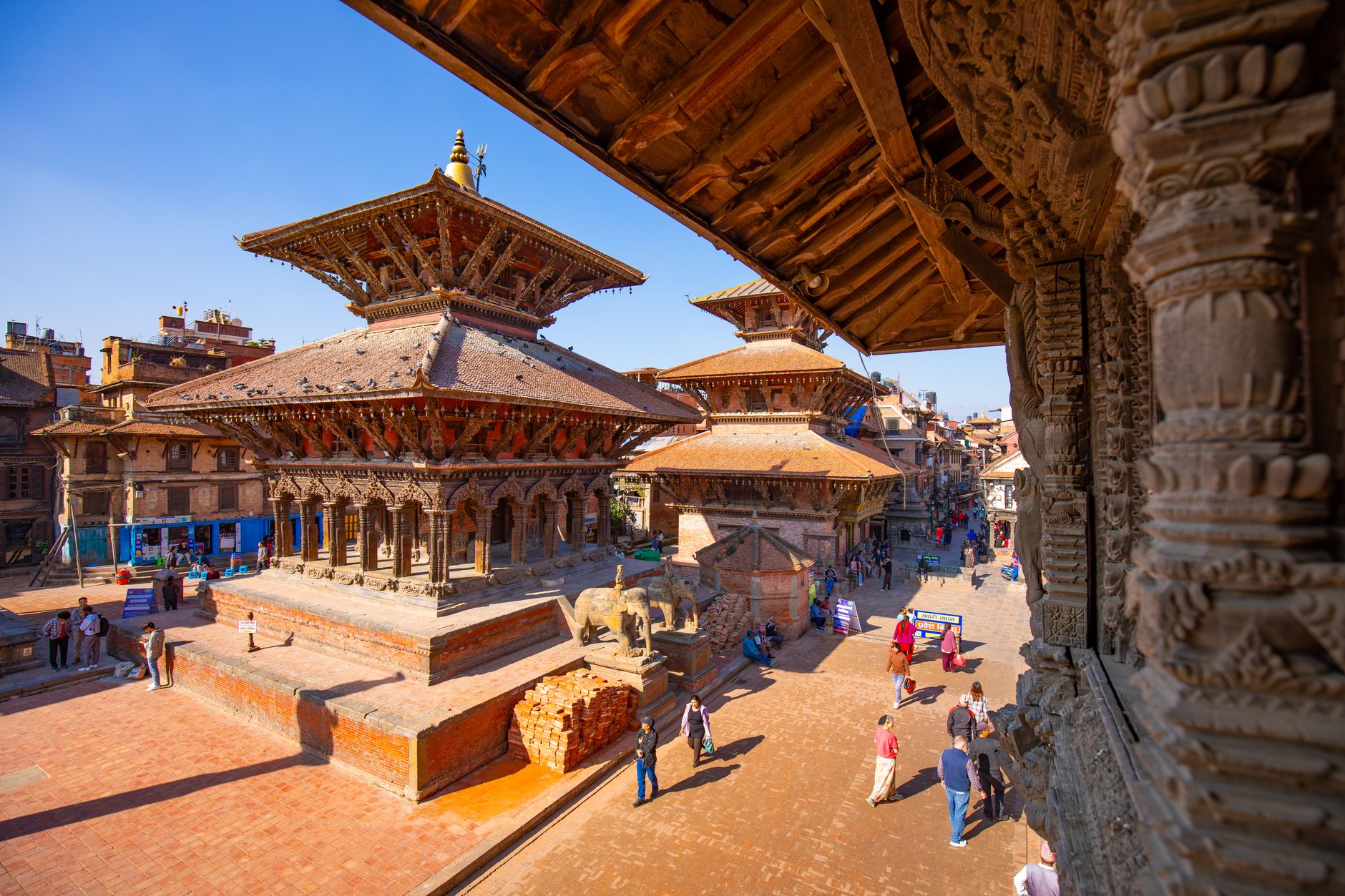 Patan · Krishna Mandir & Royal Chowks
01 Patan Durbar Square & The Stone Wonder of Krishna Mandir.
The crown jewel of Himalayan stone masonry, twenty-one golden spires, and epic friezes chiseled into grey granite.
Patan Durbar Square represents the absolute architectural pinnacle of the Malla royal dynasties. While the sister plazas of Kathmandu and Bhaktapur are composed predominantly of red brick and carved timber pagodas, Patan incorporates a staggering mastery of solid grey stone (*loha*).
The undisputed masterwork of the square is Krishna Mandir, constructed in 1637 CE by King Siddhinarasimha Malla. According to royal legend, the king had an ecstatic vision in which Lord Krishna and Radha appeared standing together in the royal courtyard; the monarch immediately commanded that this three-story stone temple be built on the exact spot.
Unlike conventional multi-tiered Newari pagodas, Krishna Mandir was designed in the classical Indian Granthakara Shikhara architectural style. Supported by a colonnaded ground floor arcade of twenty carved stone pillars, the second floor rises into a graceful stone balcony ringed with miniature stone pavilions, culminating in a soaring central shikhara spire crowned by twenty-one gilded brass pinnacles (*gajurs*).
The Epic Stone Friezes & Garuda Column
The true artistic triumph of Krishna Mandir lies in the microscopic bas-relief friezes chiseled into the stone lintels running continuously around the first and second floor balconies:
- First-Floor Lintel: Depicts the complete narrative arc of the Mahabharata, from the dice game in Hastinapur and the exile of the Pandavas to the colossal battle of Kurukshetra, complete with miniature war chariots, archers, and charging war elephants. Each sequence is labeled with explanatory inscriptions in classical Newari script.
- Second-Floor Lintel: Depicts the full story of the Ramayana, illustrating Sita's abduction, the building of the floating bridge to Lanka by the monkey army, and the vanquishing of Ravana.
Facing the temple on a tall monolithic stone pillar kneels a magnificent bronze statue of Garuda, the man-bird vahana of Vishnu, with hands folded in eternal supplication. On Krishna Janmashtami (August/September), tens of thousands of pilgrims pack the square from midnight until dawn, chanting devotional *bhajans* while the temple bells ring incessantly.
02 The Patan Museum: South Asia's Premier Sacred Gallery.
Masterpieces of tantric bronze, gilt copper, and profound scholarly curation within the restored Keshav Narayan Chowk palace.
Housed within the restored 1734 palace wing of Keshav Narayan Chowk, the Patan Museum is universally celebrated by international art critics and historians as the finest sacred art museum in South Asia. Restored through a visionary twelve-year collaboration between the Nepalese Government and the Austrian Government under the brilliant architectural direction of Götz Hagmüller, the museum successfully marries classical Malla palace brickwork and carved timber beams with contemporary exhibition design.
The museum displays over two hundred exceptional masterworks of Hindu, Buddhist, and tantric art spanning fifteen centuries. Unlike conventional static museums that display statues in isolation, the Patan Museum organizes its treasures thematically, explaining the esoteric philosophical meaning, iconographic symbols, and spiritual purpose behind every deity.
Gallery highlights include a breathtaking 10th-century gilt-bronze seated figure of Avalokiteshvara, fierce multi-armed manifestations of tantric deities Hevajra and Nairatmya locked in divine union (*yab-yum*), and rare repoussé gilt-copper thrones used by Malla kings during royal coronations.
Sundari Chowk & The Royal Tusha Hiti Bath
South of the museum courtyard lies Sundari Chowk ('Beautiful Courtyard'), the most intimately ornate royal compound in Patan. At its center sinks Tusha Hiti, a monumental sunken royal ablution bath constructed in 1647 by King Siddhinarasimha Malla.
Descending stepped stone tiers into the sunken basin, the walls are encrusted with seventy-two masterfully carved miniature stone statues depicting the eight celestial mother goddesses (*Ashta Matrikas*), the eight planetary deities, and various forms of Vishnu and Shiva.
The water spout itself is a dazzling gilt-copper masterpiece of a makara spewing mountain water, crowned by golden statues of Hanuman and Garuda. Enclosing the bath is a pair of colossal intertwining stone cobras (*nagas*) whose raised hoods form a protective stone canopy over the royal bathing basin.
03 Hiranya Varna Mahavihar: The Golden Temple (Kwa Bahal).
The radiant 12th-century gilded monastery, sacred tortoises, silver guardian lions, and the young boy priest tradition.
Located three hundred meters north of Durbar Square down a narrow flagged lane, Hiranya Varna Mahavihar (known colloquially as the Golden Temple or *Kwa Bahal* in Newari) is Patan's most revered Buddhist monastery. Founded in the 12th century by King Bhaskar Deva, this sacred Mahavihar is a dazzling architectural jewel of repoussé gilt copper and silver.
Entering through a modest street gateway flanked by roaring stone lions, you step into a hidden cloistered courtyard that glows with radiant golden luster. Rising from the center of the courtyard stands an ornate silver-and-gold shrine enshrining a self-manifested (*swayambhu*) miniature chaitya, crowned by an elaborate gilt parasol (*chhatra*).
Around the perimeter courtyard, sacred bronze tortoises—venerated as celestial temple guardians—crawl slowly across the cool stone flags, while bronze monkeys perch on roof eaves offering fruit to the Buddha. The three-tiered pagoda roof is clad entirely in sheets of hammered gilded copper, its eaves adorned with hanging brass bells that chime softly with every passing mountain breeze.
The Boy Priest Tradition (Bapa)
The most extraordinary living ritual at the Golden Temple is the institution of the Boy Priest (Bapa). Under ancient monastic code, the supreme ritual custodian of the main Buddha image cannot be an adult monk or Brahmin priest; he must be a pre-pubescent boy under twelve years of age elected from the Shakya monastic community.
For thirty days, the young boy leaves his family, renounces modern clothes, dons pure monastic silks, and resides day and night inside the monastery. Accompanied by an elderly monastic counselor, the boy priest wakes before dawn to bathe the main gilded statue of Shakyamuni Buddha, offer daily food oblations, light sacred butter lamps, and ring the great brass ceremonial bells. After thirty days of faultless service, the boy returns to normal school life, and the next youth is elected.
On the upper floor of the monastery, visitors can view the masterly silver image of Vajrasattva and an extraordinary continuous frieze of Tibetan-style wall frescoes illustrating the life of Lord Buddha.
04 Mahabouddha: The Temple of One Thousand Buddhas.
The astonishing 16th-century terracotta shikhara where every single brick bears the stamped likeness of the Awakened One.
Tucked deep inside a serene residential courtyard southeast of Durbar Square rises the extraordinary terracotta tower of Mahabouddha Temple. Commenced in 1585 CE by a devout Patan Buddhist master craftsman named Abhaya Raj Shakya, the monument took nearly four decades to complete across three generations of his family.
Abhaya Raj had undertaken an arduous pilgrimage across the plains of northern India to Bodh Gaya, where he spent years studying the classical Indian terracotta architecture of the great Mahabodhi Temple. Inspired by his pilgrimage, he returned to Patan determined to recreate the towering Bodh Gaya shikhara in his homeland.
Standing over twenty-five meters high inside a constricted courtyard, Mahabouddha is an engineering and artistic marvel: the entire spire is constructed from more than nine thousand individual handmade terracotta bricks. Astonishingly, every single brick was hand-stamped prior to kiln-firing with a relief image of Shakyamuni Buddha in various mudras, earning the temple its famous epithet: The Temple of the Thousand Buddhas.
Earthquake Resilience & Maya Devi Shrine
During the catastrophic 1934 Nepal-Bihar earthquake, the towering terracotta spire collapsed into a heap of bricks. Remarkably, local master craftsmen meticulously salvaged every intact brick, referenced the original 16th-century architectural drawings, and reconstructed the entire temple exactly as it stood. Following the 2015 earthquake, the temple suffered only minor superficial cracks, attesting to the perfection of its brick interlocking design.
In the corner of the courtyard stands a companion shrine dedicated to Queen Maya Devi, constructed from residual bricks left over from the main temple's 1934 reconstruction. The serene, cloistered atmosphere of the courtyard—filled with the aroma of burning juniper incense and the soft spinning of copper prayer wheels—makes Mahabouddha one of the most spiritually intimate sanctuaries in the Kathmandu Valley.
05 Kumbheshwar: The Five-Tiered Shiva Sanctum & Sacred Springs.
One of only two five-tiered pagodas in Nepal, subterranean glacial waters, and Janai Purnima cord ceremonies.
Five hundred meters north of Durbar Square stands Kumbheshwar Temple, erected in 1392 CE by King Jayasthiti Malla. Kumbheshwar is one of only two surviving five-tiered pagodas in the entire Kathmandu Valley (the other being the famous Nyatapola in Bhaktapur).
Dedicated to Lord Shiva, the temple's soaring proportions, five diminishing wooden roof tiers, and exquisitely carved tantric roof struts make it a magnificent specimen of classical Newari sacred timber architecture. Fronting the temple steps kneels a massive stone sculpture of Nandi, Shiva's divine bull, adorned with garlands of fresh marigolds.
The temple complex encloses two sunken stone water basins fed by perennial natural freshwater springs. According to sacred lore, these subterranean springs are directly connected to the holy high-altitude glacial lake of Gosaikunda (located at 4,380 meters in the Langtang Himalayas), created when Lord Shiva plunged his trident into the mountain to drink freezing water to cool his throat after consuming the cosmic poison *Halahala*.
Janai Purnima Celebrations
During the full moon festival of Janai Purnima in August, Kumbheshwar becomes one of the most vibrant pilgrimage sites in Nepal. Devotees who cannot undertake the grueling week-long high-altitude trek to Gosaikunda Lake gather here to bathe in the sacred courtyard waters, believing the spiritual merit to be identical.
Brahmin and Chhetri men change their sacred cotton thread (*janai*), while priests tie protective yellow and red wrist cords (*rakshya bandhan*) around devotees' wrists. The silver phallic lingam of Kumbheshwar Mahadev is brought out and displayed on an island platform in the center of the stepped water tank, surrounded by thousands of ecstatic singing and dancing worshippers.
06 Living Guilds: Lost-Wax Bronze Casting & Metal Arts.
Inside the courtyard ateliers of the Shakya and Tamrakar clans where sacred statues have been forged for over a millennium.
The Ancient Technique of Cire Perdue
Patan is internationally celebrated as the global capital of lost-wax bronze casting (*cire perdue*), an unbroken metallurgic tradition practiced by the Shakya and Tamrakar castes for over a thousand years. In fact, it was a seven-year-old Newari master sculptor from Patan named Araniko who was chosen in 1260 CE by the Tibetan Sakya Pandita to travel to Beijing, where he became the chief imperial architect and sculptor for Kublai Khan, designing the famous White Stupa (*Baitasi*) that still stands in Beijing today.
The lost-wax process is an extraordinary feat of patience and precision:
- 1. Wax Model Carving: The master sculptor hand-carves every anatomical contour, crown jewel, and facial expression of a deity out of pure Himalayan beeswax mixed with resin.
- 2. Clay Investment: The wax model is coated with multiple layers of fine clay made from black river silt (*dyama*), cow dung, and rice husks, creating a rigid ceramic mold.
- 3. Burnout & Pouring: The mold is fired in a kiln; the beeswax melts and flows out through drain vents, leaving a perfect negative hollow chamber. Molten bronze, copper, or five-metal alloy (*panchadhatu*) heated to over 1,000°C is poured into the mold.
- 4. Chasing & Fire Gilded Finishing: After cooling, the ceramic mold is cracked open. The raw metal cast is hand-chiseled for weeks with fine iron burins, polished, and fire-gilded with pure 24-karat mercury-amalgam gold.
Courtyard Workshops & Singing Bowls
Wandering through the southern courtyards around Oku Bahal, Hakha Bahal, and Mangal Bazaar, you can hear the rhythmic tap-tap of chisels echoing from open ground-floor ateliers. Visitors are welcome to step inside, observe artisans at work, and purchase certified pieces directly from the families who cast them.
Patan is also the premier center for authentic Hand-Beaten Himalayan Singing Bowls. Made from a traditional alloy of seven sacred metals corresponding to the seven astrological planets (gold for Sun, silver for Moon, copper for Venus, iron for Mars, tin for Jupiter, lead for Saturn, mercury for Mercury), these bowls are hand-hammered by teams of four artisans over charcoal fires. The rich, multi-layered harmonic acoustic vibrations produced by these bowls are renowned worldwide for sound therapy, chakra alignment, and deep meditation.
07 Rato Machhindranath: The God of Rain & Nepal's Longest Jatra.
The sacred red Avalokiteshvara, monsoon fertility rituals, and the colossal timber chariot rolling through ancient streets.
The Legend of the Rain Deity
Patan's spiritual calendar is anchored by the worship of Rato Machhindranath (known in Newari as *Bunga Dyah*), venerated by Buddhists as Karunamaya (the Compassionate Avalokiteshvara) and by Hindus as an incarnation of Shiva or Guru Gorakhnath's master.
According to sacred legend, Guru Gorakhnath once visited the Kathmandu Valley. Offended that local citizens failed to accord him proper homage, Gorakhnath gathered all the rain-bearing cosmic serpents (Nagas) and sat atop them in deep meditation, preventing any rain from falling. The valley suffered a catastrophic twelve-year drought.
To break the drought, King Narendra Deva and his tantric advisors journeyed to Kamakhya in Assam to bring Lord Machhindranath to Patan. When Gorakhnath heard that his revered guru had arrived in the city, he immediately rose from his meditation cushion to bow in reverence. Released from his weight, the Nagas flew across the skies, unleashing torrents of life-giving monsoon rain that revitalized the parched valley.
The Monumental Chariot Festival
Commencing in late April or early May (Baisakh), Patan hosts the Rato Machhindranath Jatra, the longest and most physically demanding religious festival in Nepal, lasting anywhere from four weeks to over a month.
Master Newari carpenters construct a colossal forty-eight-foot-high timber chariot (*Rath*) at Pulchowk entirely bound with rattan vines and cane without a single metal nail. The chariot is crowned by a towering spire representing Mount Meru, supported by four massive solid wooden wheels depicting Bhairava. The red-faced sandalwood icon of Machhindranath is enshrined within, accompanied by a smaller companion chariot for Chakuwa Dyah (Minnath).
Hundreds of singing and shouting youths haul the colossal chariot through the narrow cobblestone streets of Patan in stages—passing through Gabahal, Hakha, Sundhara, and Lagankhel. The festival culminates in the historic pasture of Jawalakhel with the display of the Bhoto—a sacred, jewel-encrusted vest gifted to a farmer by a Naga king—presented before the President of Nepal and tens of thousands of cheering devotees.
08 The 24-Hour Patan Fine Arts Masterplan.
A precision tactical schedule balancing morning temple circumambulations, museum curatorial contemplation, and courtyard metallurgy.
From Dawn Temple Bells to Museum Masterpieces & Bronze Forges
07:00 AM — Dawn at Krishna Mandir: Begin your day in Patan Durbar Square as the golden morning sun strikes the 21 golden pinnacles of Krishna Mandir. Devotees circle the stone colonnade, offering marigold petals and incense, while temple pigeons wheel over the carved stone balconies.
08:15 AM — The Gilded Sanctum of Kwa Bahal: Walk north down the cobbled lane to Hiranya Varna Mahavihar (The Golden Temple). Remove all leather items and step inside to watch the young boy priest (Bapa) offer the morning butter lamps to Shakyamuni Buddha amidst sacred tortoises.
09:30 AM — Kumbheshwar Five-Tiered Pagoda: Continue north to Kumbheshwar, one of the valley's two five-tiered pagodas. Admire the colossal stone bull Nandi and view the sunken stone pools fed by underground glacial waters connected to holy Gosaikunda.
10:45 AM — Patan Museum Deep Dive: Return to Durbar Square as the Patan Museum opens inside Keshav Narayan Chowk. Spend two unhurried hours admiring the world's finest curation of tantric gilt bronze and copper sculptures, and relax with espresso in the quiet museum courtyard garden cafe.
01:15 PM — Authentic Newari Lunch: Savor a traditional *Wo* (lentil pancake) and spiced potato curry at a local heritage eatery near Mangal Bazaar.
02:30 PM — Mahabouddha Temple (1,000 Buddhas): Stroll southeast through alleyways to the hidden courtyard of Mahabouddha. Marvel at the 25-meter terracotta tower where every single brick is hand-stamped with a relief image of the Buddha.
04:00 PM — Courtyard Lost-Wax Metallurgy: Wander through the courtyards of Oku Bahal and Hakha Bahal. Listen to the rhythmic tap of iron chisels, observe master Shakya craftsmen pouring glowing molten bronze into ceramic molds, and experience the acoustic resonance of hand-hammered singing bowls.
06:00 PM — Dusk at Sundari Chowk & Rooftop Drinks: Peek into the sunken Tusha Hiti royal bath to admire the seventy-two stone deities sheltered by stone nagas. Conclude with rooftop drinks overlooking the illuminated stone shikharas of Durbar Square as twilight descends over Lalitpur.
09 Field Operations & Travel Logistics.
Getting to Patan, museum timings, walking routes, and optimal schedules.
🚕 Transit from Thamel
Patan is 5 km south of Thamel. A taxi takes 15–25 minutes (approx. NPR 400–600 via InDrive or Pathao). Request drop-off at Patan Dhoka (the ancient town gate) or directly at Mangal Bazaar.
🏛️ Patan Museum Hours
Open daily from 10:30 AM to 5:30 PM (closes at 4:30 PM in winter). The museum garden cafe in the inner courtyard serves delightful espresso, herbal teas, and light Newari snacks in a peaceful setting.
🚶 Walking Strategy
Begin at Patan Durbar Square and Patan Museum. Head north to the Golden Temple (Kwa Bahal) and Kumbheshwar. Loop south through the metalworking courtyards of Hakha Bahal to Mahabouddha Temple and Oku Bahal.
🌤️ Best Time to Visit
Morning hours (8:00–11:00 AM) are ideal for observing morning prayers at the Golden Temple and Krishna Mandir. Late afternoon (3:00–6:00 PM) offers warm golden light illuminating the stone temples of Durbar Square.
10 Frequently Asked Questions.
Actionable answers to practical traveler questions about visiting Patan.
How long should I spend exploring Patan?
Can Indian citizens use Indian Rupees in Patan?
Is photography allowed inside the Patan Museum?
How do I know if a singing bowl in Patan is handmade or machine-made?
11 Connected Nepal Circuits & Regional Travel Guides.
Seamless internal pathways connecting Patan with our capital, heritage, and mountain guides.
Nepal Flagship Travel Guide
Overview of all 11 flagship circuits, 1950 Treaty rights, UPI currency guide, and trekking mandates.
Nepal Entry Guide for Indians
Flight document mandates, why Aadhaar is invalid, Bhansar driving permits, and overland check posts.
Kathmandu Travel Guide
Pashupatinath rituals, Boudhanath Kora, Durbar Square, Asan Tole walking trails, and Thamel dining.
Bhaktapur Travel Guide
55-Window Palace, Nyatapola 5-tier pagoda, Pottery Square, and authentic Juju Dhau King Curd.
Pokhara Travel Guide
Phewa Lake boating, Sarangkot alpine dawn, paragliding, Peace Pagoda, and Annapurna trekking bases.
Nagarkot Travel Guide
2,175m Himalayan sunrise panorama from Annapurna to Everest, and pine forest hiking trails to Changu Narayan.