hiking
Eight 8,000-Meter Giants
From Sagarmatha (Everest) and Lhotse in the Khumbu to the Annapurna massif and Dhaulagiri, Nepal contains the densest concentration of extreme alpine topography on earth.
Nepal is the ultimate high-altitude sanctuary of the earth, where eight of the world's fourteen 8,000-meter peaks—including Mount Everest (Sagarmatha) and Annapurna—rise above subtropical Terai river valleys. For Indian passport holders, travel to Nepal represents a uniquely privileged journey governed by the historic 1950 Treaty of Peace and Friendship: completely visa-free entry, seamless overland borders, a fixed 1:1.60 currency peg, cross-border UPI payments, and profound civilizational resonance spanning Pashupatinath, Janakpur Dham, Muktinath, and Lumbini.
 Kathmandu Valley · Nepal
A sovereign Himalayan nation compressed into four distinct vertical ecological zones across barely 200 kilometers of latitude.
Few territories on planet Earth exhibit the staggering geological compression of Nepal. Within a direct north-to-south distance of less than two hundred kilometers, the topography climbs from the subtropical river basins of the Terai plains—barely sixty meters above sea level—through the pine-clad mid-hills and fertile tectonic bowls of the Kathmandu and Pokhara valleys, before terminating in the jagged, ice-armored crests of the Great Himalaya, crowned by Sagarmatha (Mount Everest) at 8,848.86 meters. This violent verticality, generated by the unrelenting collision of the Indian tectonic plate grinding beneath the Eurasian landmass at forty millimeters per year, creates a mosaic of microclimates and human cultures found nowhere else in Asia.
For centuries, Nepal existed as a constellation of fiercely independent highland kingdoms and secluded valley city-states. The three royal Newari realms of the Kathmandu Valley—Kathmandu (Kantipur), Patan (Lalitpur), and Bhaktapur (Bhadgaon)—competed in artistic, architectural, and religious ostentation, erecting tiered pagoda temples, sunken stone water conduits, and multi-courtyard royal palaces adorned with the world's most intricate timber carving and lost-wax bronze casting. Along the trans-Himalayan trading routes, merchants ferried Tibetan rock salt, musk, and yak wool southward to exchange for Indian grain, cotton, spices, and brass, creating an extraordinarily rich synthesized civilization where Tantric Vajrayana Buddhism and Shaivite and Vaishnavite Hinduism intertwined seamlessly.
To modern travelers, Nepal reveals itself not merely as an adrenaline capital for alpine mountaineering, but as a living sacred landscape. In Kathmandu, the holy Bagmati River courses past the smoking cremation ghats of Pashupatinath—one of the most venerated Shiva shrines in the Hindu universe—while two miles eastward, the colossal whitewashed dome of Boudhanath radiates Tibetan Buddhist mantra wheels beneath the watchful all-seeing eyes of the Buddha. Further south in the alluvial Terai plains, the peaceful archaeological grove of Lumbini marks the exact nativity spot where Prince Siddhartha Gautama took his first steps in the sixth century BCE, while Janakpur preserves the regal Mithila culture and memory of Mata Sita's marriage to Lord Rama.
Whether you are navigating the tranquil waters of Phewa Lake in Pokhara beneath the unclimbed sacred pyramidal peak of Machhapuchhre (Fishtail), tracking greater one-horned rhinoceroses and royal Bengal tigers through the riverine sal forests of Chitwan, tracing the ammonite Shaligram fossils in the windswept rain-shadow desert gorge of Mustang, or sharing steaming butter tea with Sherpa elders in Namche Bazaar, Nepal challenges conventional travel. It is a nation that demands thoughtful planning, logistical respect, and cultural reverence.
The legal architecture of the 1950 Indo-Nepal Treaty, airport passport mandates, and overland ICP vehicular mechanics.
The foundational cornerstone of travel between India and Nepal is the historic 1950 Treaty of Peace and Friendship signed in Kathmandu. Under Articles 6 and 7 of this bilateral treaty, the governments of India and Nepal grant on a reciprocal basis to the nationals of one another the same privileges in the matter of residence, ownership of property, participation in trade and commerce, movement, and other privileges of a similar nature.
In practical travel terms, this means that Indian citizens do not require a tourist visa, entry permit, or work authorization to visit Nepal. There is no stay duration limit, no visa fee, and no requirement for prior consular clearance. However, the legal mechanics of entry differ sharply depending on whether you cross the frontier by air or by land.
When boarding any commercial flight from an Indian airport (DEL, BOM, CCU, VNS) bound for Tribhuvan International Airport (KTM) in Kathmandu or Gautam Buddha Airport (BHW) in Bhairahawa, airline immigration personnel and the Bureau of Immigration Nepal enforce strict statutory rules:
Nepal shares an open 1,751-kilometer frontier with five Indian states (Uttarakhand, Uttar Pradesh, Bihar, West Bengal, and Sikkim). Travelers crossing overland through Integrated Check Posts (ICPs) can use government-issued photo identity cards (Voter ID, Passport, or Aadhaar) for identification at border security checks:
Understanding the 1:1.60 fixed peg, why ₹100 banknotes reign supreme, and how Indian UPI apps work across Nepal.
The monetary system of Nepal is intimately tied to India through a statutory fixed peg: ₹1 Indian Rupee (INR) = 1.60 Nepalese Rupees (NPR). This peg provides absolute exchange-rate predictability for Indian travelers. However, the ground reality of paper currency requires careful navigation:
The most revolutionary development in regional travel logistics is the operationalization of the cross-border UPI network established between the National Payments Corporation of India (NIPL) and Nepal's premier payment clearinghouse, Fonepay.
Indian travelers can now scan Fonepay dynamic and static QR codes displayed at thousands of hotels, supermarkets, restaurants, and adventure counters across Kathmandu, Pokhara, Chitwan, and Lumbini using standard Indian mobile banking apps:
Six defining landscapes and cultural dimensions that anchor every meaningful journey through Nepal.
From Sagarmatha (Everest) and Lhotse in the Khumbu to the Annapurna massif and Dhaulagiri, Nepal contains the densest concentration of extreme alpine topography on earth.
Pashupatinath stands as the patron deity of Nepal; Janakpur celebrates Mata Sita's birthplace; and high in the Mustang mountains, Muktinath offers liberation through 108 sacred spouts.
In Lumbini's sacred garden, the 3rd-century BCE Ashokan pillar and the Nativity Stone inside Maya Devi Temple mark the geographical cradle of world Buddhism.
Chitwan National Park protects one of the planet's greatest conservation triumphs: hundreds of wild greater one-horned rhinoceroses, gharial crocodiles, and elusive Bengal tigers.
The three UNESCO Durbar Squares of Kathmandu, Patan, and Bhaktapur preserve tiered pagodas, repoussé brass shrines, and woodcarvings sculpted by royal master guilds.
Pure vegetarian hospitality at its peak: slow-simmered black lentils tempered with wild Jimbu, fermented Gundruk, mountain Saag, and steaming vegetable momos in sesame broth.
11 comprehensive regional guides — medieval valley capitals, alpine trekking gateways, sacred pilgrimage shrines, and wildlife sanctuaries.
 Kathmandu
The sacred epicenter of Himalayan civilization: Pashupatinath Temple's evening Bagmati Aarti, the colossal spinning prayer wheels of Boudhanath Stupa, hilltop Swayambhunath, Hanuman Dhoka Durbar Square, and the labyrinthine spice alleys of Asan Tole.
 Pokhara
Nepal's premier leisure haven: gliding across Phewa Lake in brightly painted wooden doonga boats to Tal Barahi Temple, watching sunrise light up Machhapuchhre from Sarangkot, Pumdikot Shiva statue, World Peace Pagoda, Davis Falls, and Lakeside dining.
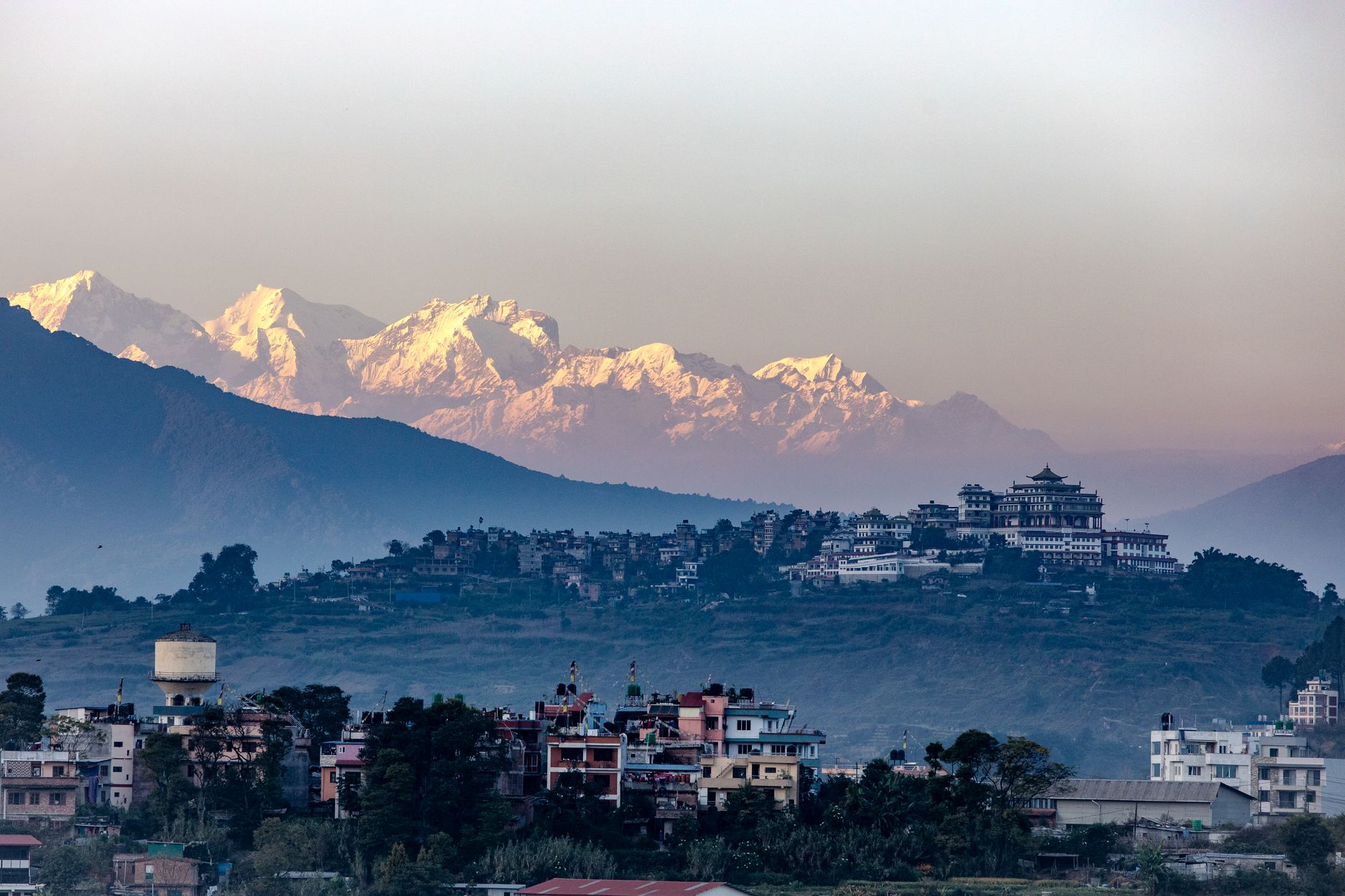 Chitwan
UNESCO World Heritage lowland jungle: close-range tracking of greater one-horned rhinos, open jeep safaris through sal canopy, dugout canoe drift down the Rapti River observing gharial crocodiles, and indigenous Tharu cultural dances in Sauraha.
 Lumbini
The sacred cradle of Buddhism: Maya Devi Temple sheltering the marker stone of Prince Siddhartha's birth (623 BCE), the monolithic Ashoka Pillar with 3rd century BCE Brahmi inscription, and a vast monastic enclave built by thirty Buddhist nations.
 Bhaktapur
The purest surviving Newari medieval city-state: the 55-Window Palace, the five-tiered Nyatapola Temple (highest in Nepal), sunlit Pottery Square where clay vessels cure in public plazas, woodcarving guilds, and the celebrated royal King Curd (Juju Dhau).
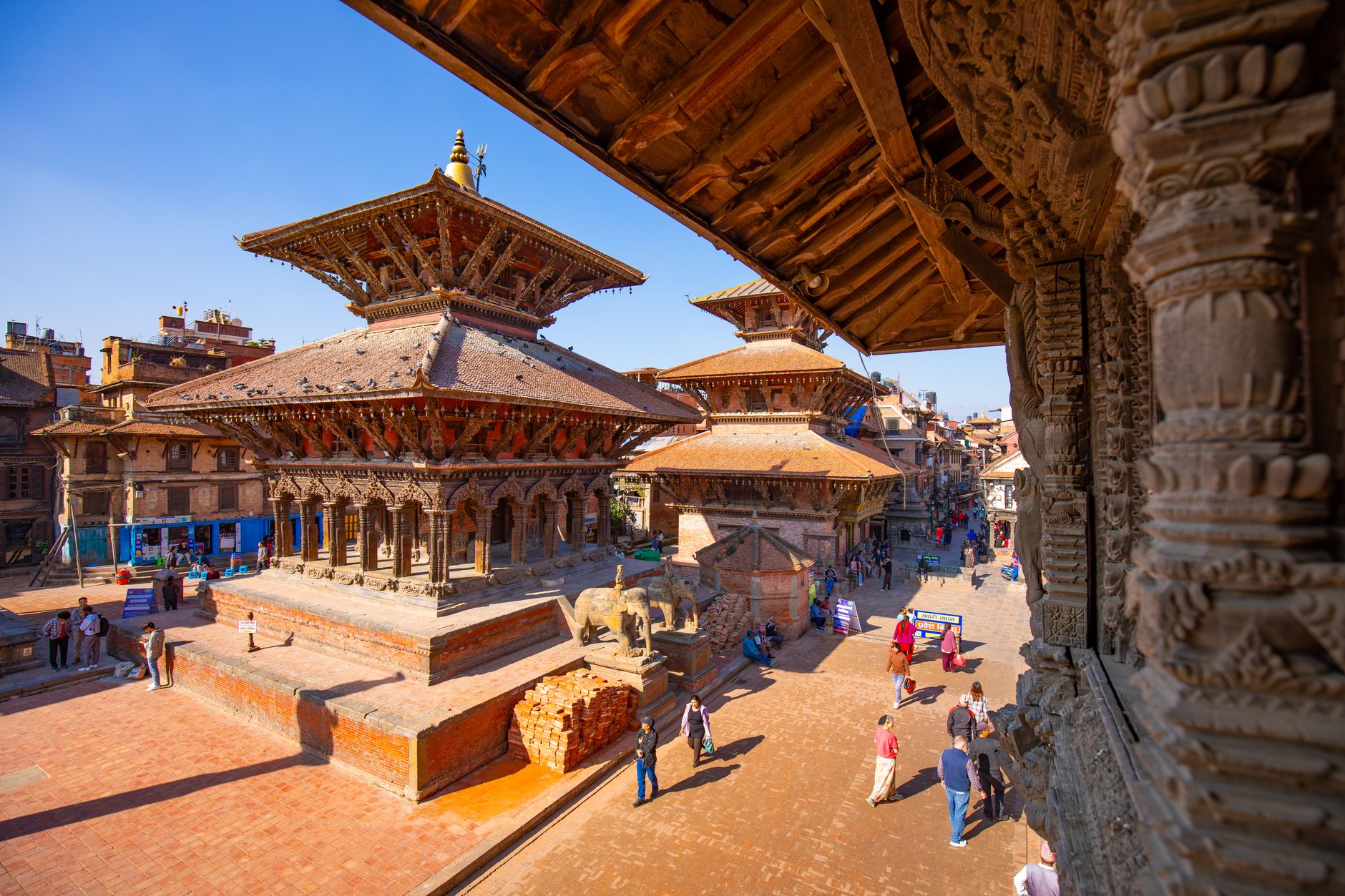 Patan
The artistic heart of the Kathmandu Valley: Patan Durbar Square, the all-stone octagonal Krishna Mandir with 21 golden pinnacles, the Golden Temple (Hiranya Varna Mahavihar), Mahabouddha terracotta shrine, and master lost-wax bronze metalworking bahals.
 Mustang
The arid trans-Himalayan Tibetan plateau world: Muktinath Temple at 3,710m with its 108 icy brass fountains and Jwala Mai natural gas flame, fossilized Shaligram ammonites in the Kali Gandaki River canyon, stone village of Marpha, and medieval Kagbeni.
 Namche Bazaar
The dramatic natural mountain amphitheater of the Khumbu: gateway to Everest Base Camp, flight into thrilling Lukla, high-altitude gear shops and bakeries, Sherpa culture museums, and acclimatization day hikes to Everest View Hotel overlooking Ama Dablam.
 Janakpur
The legendary capital of ancient Mithila: the palatial Janaki Mandir blending Rajput and Mughal domes, Ram Janaki Vivah Mandap, sunset aarti at sacred Ganga Sagar pond, traditional Madhubani/Mithila folk paintings, and the vibrant Vivah Panchami festival.
Nagarkot
Perched at 2,175 meters on the eastern rim of the Kathmandu Valley, Nagarkot offers an unmatched panoramic Himalayan horizon stretching from Dhaulagiri to Everest at dawn, gentle pine forest hiking trails, and peaceful mountain retreats.
Bandipur
A living 18th-century Newari trading town frozen on a scenic saddle ridge between Kathmandu and Pokhara: vehicle-free slate bazaar, neoclassical shuttered merchant facades, Thani Mai sunrise viewpoint, and Siddha Cave, Nepal's largest cavern.
How to logically group Nepal's 11 flagship destinations into seamless travel circuits.
Kathmandu, Patan, Bhaktapur, and Nagarkot form a tightly integrated basin of royal squares, sacred Hindu temples, colossal Buddhist stupas, and eastern rim Himalayan sunrise viewpoints. Stay in Patan or Bhaktapur to experience early morning puja rituals before tourist buses arrive, and spend a night in Nagarkot for dawn mountain horizons.
Starting from the hilltop trading town of Bandipur, this route moves to Pokhara's lakeside leisure, before climbing by jeep or flight through the dramatic Kali Gandaki gorge into the arid Tibetan-plateau desert of Mustang and the sacred shrine of Muktinath at 3,710 meters.
Spanning the lush southern lowlands along the Indian border, this route connects the one-horned rhinos of Chitwan National Park with the profound silence of Lumbini's Sacred Garden, and continues eastward to the grand Janaki Mandir and Mithila culture in Janakpur.
The legendary mountaineering corridor beginning with the thrilling flight to Lukla's Tenzing-Hillary airstrip, trekking up the Dudh Kosi canyon over high suspension bridges to the bustling Sherpa amphitheater of Namche Bazaar, and onwards to Tengboche Monastery and Everest Base Camp.
Twelve genuine architectural and spiritual masterworks that embody Nepal's sacred heritage.
The supreme guardian shrine of Nepal on the Bagmati River: a two-tiered golden pagoda housing the four-faced Mukhalinga. Indian Hindus participate in daily sanctum rituals and witness the evocative evening Bagmati Maha Aarti.
One of the largest spherical stupas in the world, surrounded by fifty Tibetan monasteries. Hundreds of monks and travelers circumambulate clockwise (*Kora*) spinning bronze mantra wheels under strings of wind-whipped prayer flags.
Perched atop a forested conical hill west of the capital, this 5th-century stupa features piercing Buddha eyes, gilded spires, sacred monkey colonies, and panoramic sunrise views overlooking the entire Kathmandu Valley bowl.
Erected in 1702 by King Bhupatindra Malla, this 30-meter architectural marvel is the tallest pagoda in Nepal. Flanked by massive stone wrestlers, elephants, and lions, its engineering genius withstood the 1934 and 2015 earthquakes intact.
Constructed in 1637 by King Siddhinarasimha Malla, this three-tiered stone temple features twenty-one golden pinnacles and intricate relief friezes detailing battle episodes from the Mahabharata and Ramayana.
The archaeological heart of Buddhism, protecting the exact nativity marker stone inside ancient brick ruins and the 249 BCE Ashoka Pillar whose Brahmi inscription affirms: *'Here the Buddha, the sage of the Shakyas, was born.'*
A revered high-altitude pilgrimage sanctuary where pilgrims bathe beneath 108 icy spring spouts shaped like bulls' heads and witness the miraculous natural blue flame of Jwala Mai burning directly above subterranean water springs.
Built in 1910 by Queen Brisabhanu Kunwari of Tikamgarh at a cost of nine lakh silver rupees, this breathtaking white marble palace features sixty rooms, scalloped arches, gilded domes, and the sacred sanctum of Mata Sita.
A two-story pagoda temple dedicated to Goddess Durga (Barahi) situated on a tiny wooded island in the southern waters of Phewa Lake, reached exclusively by colorful wooden passenger doongas.
Erected in 1427 during King Yaksha Malla's reign and embellished by King Bhupatindra Malla, this brick palace displays a continuous upper balcony of 55 intricately openworked black woodcarving window frames.
A 12th-century Buddhist monastery courtyard cloaked in gilded copper repoussé, silver lions, and bronze prayer wheels, where rituals are administered by a young boy priest under the age of twelve.
The ancient royal palace compound guarded by the red-cloaked Hanuman idol, beside the faithfully reconstructed Kasthamandap ('pavilion of wood'), the legendary 7th-century sal timber resthouse from which Kathmandu derives its name.
From the Licchavi golden age and Malla royal rivalries to Gorkha unification, Rana autocracy, and the modern federal republic.
King Manadeva erects the famous Changu Narayan pillar inscription, the earliest dated epigraphic record in Nepal. The Licchavi period flourishes with trans-Himalayan commerce, Sanskrit scholarship, and classical stone iconography.
Under the Malla kings, the Kathmandu Valley fragments into three competitive city-states: Kathmandu, Patan, and Bhaktapur. Royal rivalry fuels an astonishing architectural renaissance, producing the pagoda temples, royal durbar squares, and living festivals celebrated today.
King Prithvi Narayan Shah marches from the western hill fortress of Gorkha to conquer the valley kingdoms. Establishing Kathmandu as the imperial capital, he unifies dozens of principalities into the modern sovereign nation of Nepal.
Fierce conflict between the Gorkha military and the British East India Company ends with the Treaty of Sugauli, delineating Nepal's modern borders along the Mechi and Mahakali rivers while preserving sovereign independence from British colonial rule.
Following the bloody Kot Massacre, Jung Bahadur Rana seizes absolute executive power, instituting a century of hereditary prime ministerial rule that isolates Nepal from the outside world until popular revolution restores royal authority in 1951.
India and Nepal sign the bilateral framework establishing reciprocal national treatment, visa-free travel, unhindered commerce, and permanent mutual security bonds between the two sovereign neighbors.
Following a decade of civil conflict and peaceful democratic movement, Nepal formally abolishes the 240-year-old Shah monarchy in May 2008, enacting a modern constitution in 2015 structured across seven federal provinces.
Rituals that command the streets, bring divine chariots through public squares, and draw millions of pilgrims.
Each year in late winter (Phalguna / February–March), over one million pilgrims and thousands of Naga Sadhus gather from across India and Nepal at Pashupatinath Temple. Bonfires burn along the riverbanks, sacred conches reverberate through stone courtyards, and devotees line up for hours to pour milk, honey, and sacred water over the four-faced Shiva Lingam.
For eight days in September, Kathmandu belongs to the King of the Gods and the Living Goddess. Towering ceremonial wooden chariots carrying the young prepubescent Kumari and Bhairava deities are pulled through the packed cobblestone alleys of Basantapur Durbar Square by hundreds of chanting men, accompanied by masked dancers depicting Lakhey demons and divine spirits.
Commemorating the cosmic wedding of Lord Rama of Ayodhya and Princess Sita of Mithila, Vivah Panchami (November–December) transforms Janakpur into an ecstatic wedding carnival. A ceremonial wedding procession (*Baraat*) journeys overland from Ayodhya to Janakpur, culminating in night-long sacred Vedic wedding rituals at the Ram Janaki Vivah Mandap.
Marking the Nepali Solar New Year in mid-April, Bhaktapur erupts into a dramatic tug-of-war where rival neighborhoods haul the multi-story wooden chariot of Lord Bhairava through brick plazas. A massive 80-foot ceremonial wooden pole (*Yosin*) is erected in Taumadhi Square and felled to symbolically conquer malevolent serpent forces.
The 2023 Nepal Tourism Board regulations, permit logistics, and critical altitude illness medical protocols.
Effective from April 1, 2023, the Nepal Tourism Board (NTB) enacted a nationwide safety regulation officially banning solo independent trekking across all declared national parks, wildlife reserves, and conservation areas in Nepal. All international trekkers—explicitly including Indian passport holders—must be accompanied by a government-licensed trekking guide hired through an authorized Nepal trekking agency.
Police and army checkpoints at Besisahar, Nayapul, Jomsom, Monjo, and Dhunche physically verify guide credentials and permit stamps. Trekkers found unaccompanied without a licensed guide face immediate fines and forced turnarounds.
Above 2,500 meters, atmospheric pressure drops and effective oxygen availability decreases significantly. High-altitude destinations in Nepal—including Muktinath (3,710m), Namche Bazaar (3,440m), and higher trekking passes—require strict physiological respect:
Early symptoms of AMS include persistent throbbing headache, nausea, dizziness, loss of appetite, and disturbed sleep. Never ascend with active AMS symptoms. Immediate descent is the only definitive cure:
Thakali feasts, Newari heritage flavors, mountain momos, and pure vegetarian dining across the kingdom.
Originating from the Thak Khola valley of Mustang along the ancient salt trading route, the Thakali Dal Bhat is Nepal's supreme culinary art form. Unlike ordinary cafeteria rice and lentils, an authentic Thakali thali is an exquisitely balanced gastronomic system served in gleaming brass plates (*Kansa*):
Beyond Dal Bhat, Nepal's indigenous culinary landscape offers exceptional depth:
Route distances, road conditions, customs protocols, and crossing mechanics from Uttar Pradesh, Bihar, Uttarakhand, and West Bengal.
Located ninety kilometers north of the Indian railhead at Gorakhpur (NER), the Sunauli-Belahiya crossing is the single highest-volume overland passenger port between India and Nepal. Gorakhpur Junction provides non-stop superfast rail connections from New Delhi (Vande Bharat, Gorakhdham Express), Lucknow, and Varanasi. From Gorakhpur railway station, regular Uttar Pradesh State Road Transport Corporation (UPSRTC) buses and private shared taxis depart every twenty minutes from the station forecourt, reaching the Sunauli border in approximately two and a half to three hours along National Highway 24.
Upon arriving on the Indian side of Sunauli, walk or drive past the Indian Land Ports Authority terminal to the Nepalese Belahiya customs gate. The Nepal Immigration Office and Nepal Customs (Bhansar) office sit on the left bank of the main boulevard immediately beyond the welcoming archway. Here, motorists register their vehicle details and purchase daily road permits. Immediately outside the customs barrier, the Bhairahawa bypass leads westward directly to Lumbini Sacred Garden (22 km / 30 mins) or northward along the dramatic, winding Siddhartha Highway past Butwal and Tansen toward Pokhara (180 km / 6-7 hours). Gautam Buddha International Airport (BHW) lies just nine kilometers northwest of the border gate, offering quick 25-minute domestic hops to Kathmandu.
Positioned along the northern plains of Bihar directly opposite the bustling commercial hub of Birgunj, Raxaul-Birgunj represents the economic arterial spine connecting the Gangetic basin with the Kathmandu Valley. Handled by a modern Integrated Check Post (ICP) equipped with dedicated freight scanning and electronic passenger immigration terminals, this crossing accommodates heavy commercial vehicular flow alongside private passenger traffic.
From Patna, the capital of Bihar, drive north via Muzaffarpur and Motihari along NH 22 and NH 527D to reach Raxaul in approximately four to five hours. On the Nepalese side, Birgunj provides access to the Tribhuvan Highway (the historic, winding mountain route via Daman) and the faster B.P. Koirala Highway via Hetauda and Sindhuli. In recent years, the opening of the Fast Track transit corridor and regular tourist express coaches make Birgunj the preferred overland entryway for travelers proceeding straight to Kathmandu without visiting the western hill circuits.
Situated along the roaring Sharda (Mahakali) River in the Champawat district of Uttarakhand, the Banbasa-Gadda Chowki crossing is the primary gateway into the pristine, wild far-western territory of Nepal. Approached from Bareilly, Haldwani, or Tanakpur, travelers cross the historic Sharda Barrage—a colonial-era irrigation weir that permits vehicular traffic during designated daytime gate windows—before arriving at the Nepalese frontier outpost of Gadda Chowki, five kilometers west of Mahendranagar (Bhimdatta).
This entry point serves travelers bound for the untamed wilderness of Shuklaphanta National Park (home to the world's largest population of swamp deer) and Bardia National Park, as well as high Himalayan pilgrims undertaking the sacred Kailash Manasarovar yatra through the far-northwestern transit corridors of Humla and Simikot. The East-West Mahendra Highway begins its 1,027-kilometer traverse of Nepal here, tracing the base of the Siwalik foothills all the way across the nation to the eastern border of West Bengal.
On the eastern extremity of Nepal, separated from West Bengal by the gentle Mechi River, lies the tranquil Panitanki-Kakarbhitta crossing. Connected to the major transport hubs of Siliguri (30 km), New Jalpaiguri Railway Station (NJP), and Bagdogra International Airport (IXB), Panitanki is reached in under an hour by taxi via the Asian Highway 2 (AH2) across the handsome Mechi Bridge.
Kakarbhitta is exceptionally well-organized, characterized by clean garden surroundings, efficient immigration counters, and immediate access to the scenic hill roads climbing into Ilam—Nepal's premier organic tea cultivation district, celebrated for misty rolling green estates, red panda sanctuaries in Sandakphu border ridges, and panoramic vistas of Kangchenjunga (8,586m). Buses and private jeeps from Kakarbhitta connect regularly to Biratnagar, Dharan, and westward toward Janakpur.
How seismic resilience, brick technology, timber joinery, and sacred geometry shaped the Kathmandu Valley's medieval monuments.
To walk through the royal Durbar Squares of Kathmandu, Patan, and Bhaktapur is to encounter an indigenous structural engineering tradition that puzzled Western observers for centuries: the Newari tiered pagoda (Dega). While European masonry cathedrals collapsed into catastrophic rubble during Himalayan earthquakes, many multi-tiered Newari temples—most famously the five-story Nyatapola Temple in Bhaktapur, erected in 1702—survived both the devastating 8.1 magnitude Bihar-Nepal earthquake of 1934 and the 7.8 magnitude Gorkha earthquake of 2015 with their primary structural cores virtually intact.
The secret lies in the profound kinetic elasticity of Newari timber joinery. The framework of a Newari pagoda is not rigid, but articulated. Beams and columns of seasoned Shorea robusta (Sal) wood—a heavy, dense tropical timber naturally resistant to rot, termites, and fungal decay—are fitted together using sophisticated mortise-and-tenon joints without a single metallic nail, bolt, or rigid iron brace. During seismic tremors, the timber frame dissipates lateral kinetic shockwaves through controlled micro-deflections at every joint, acting as a flexible shock absorber.
Furthermore, the progressively diminishing tiers create a low center of gravity. Each ascending roof tier rests upon an array of inclined timber diagonal brackets (tunal or struts). These struts, carved with magnificent polychrome representations of multi-armed guardian deities above and playful erotic or pastoral vignettes at their base, transfer the massive deadweight of the overhanging clay-tiled roofs directly downward onto the load-bearing brick masonry core, locking the entire superstructure under natural compressive gravitational force.
The walls of classical Newari palaces and temples are constructed using specialized terracotta bricks known as Dachi Appa. These exterior veneer bricks are manufactured from fine-sieved alluvial clay, pressed into precision molds, and fired at exceptionally high temperatures to produce an intensely dense, glass-hard glazed surface. Crucially, Dachi Appa bricks are beveled along their rear edges; when laid together with an ultra-thin line of traditional resinous clay mortar (silay), the visible joints between bricks are virtually invisible (less than one millimeter), preventing rainwater penetration and frost weathering across centuries.
Every doorway, window, and roof overhang is governed by the principles of the Vastu Shastra and the Manasara architectural treatises, infused with Tantric Newari cosmological geometry. Over every sacred temple portal hangs an arched wooden tympanum known as a Torana. At the zenith of the Torana perches the mythical Chhepu (Kirtimukha), a ferocious guardian monster swallowing serpents (Nagas), flanked by sea-monsters (Makaras), and enclosing the patron deity of the sanctum.
Window frames (Jhyal) vary from the delicate crisscrossed lattice screens of Sanjhya (cantilevered bay windows where royal women could observe public festivals unseen) to the solitary Tiki Jhyal of humble residential townhouses. The pinnacle of every pagoda is crowned by a glistening gilded copper spire known as the Gajur (Kalasha), an esoteric amalgam of lotus vase, umbrella, and jewel symbolizing Mount Meru, the cosmic axis linking the terrestrial plane of mortals with the transcendent celestial sphere.
Geological origin of marine fossils in the high Himalayas, the deepest gorge on earth, and the sacred black stones of Lord Vishnu.
Between the colossal mountain massif of Annapurna I (8,091m) to the east and Dhaulagiri I (8,167m) to the west lies one of the most astonishing geological features on the surface of our planet: the Kali Gandaki River Gorge (Andha Galchi). Measured from the riverbed at Dana (1,200m) to the towering summits soaring eight kilometers on either side, this canyon plummets nearly six thousand vertical meters, earning recognition as the deepest river chasm on earth.
Geologically, the Kali Gandaki is an antecedent river—meaning that the river was flowing along its southward course long before the Himalayan mountains began to rise. When the Indian plate collided with Eurasia fifty million years ago and the ocean floor buckled upward, the relentless cutting power of the river's gravel-laden waters eroded downward at a rate equal to the tectonic uplift. Rather than being deflected by the rising mountain range, the river sliced a titanic slit clean through the Himalayan crest line.
As you ascend the gorge north of Tatopani and Ghasa, the landscape undergoes a dramatic metamorphosis. The lush, humid subtropical forests of bamboo, rhododendron, and rushing waterfalls abruptly cease at Marpha. Here, you cross the Himalayan rain-shadow barrier into the Mustang plateau: a desert of pale ochre, wind-scoured sandstone cliffs, desolate gravel flats, and bone-dry canyon amphitheaters resembling the high Tibetan plateau.
Along the gravel bars and riverbanks of the Kali Gandaki between Kagbeni and Muktinath, pilgrims and geological enthusiasts search for smooth, jet-black rounded stones known as Shaligram Shilas. In Hindu theology, the Shaligram is not merely a symbol of God, but is revered as the direct, self-manifested (swayambhu) aniconic presence of Lord Vishnu. The sacred stones are enshrined in household altars and major Vaishnavite temples across India—most notably in Tirupati, Badrinath, and the Jagannath Temple in Puri.
Scientifically, these stones are fossilized Ammonites—extinct spiral-shelled marine cephalopods related to the modern nautilus and octopus—dating to the Jurassic and Cretaceous periods between 145 and 170 million years ago. In that distant geological epoch, the landmasses of India and Eurasia were separated by the vast, warm tropical waters of the Tethys Ocean. Ammonites flourished on the sea floor; upon dying, their calcium carbonate shells sank into deep marine silt beds.
When the ancient seabed was thrust five vertical miles into the upper atmosphere by continental collision, the fossil-bearing Spiti shale formations were exposed to weathering. As the raging Kali Gandaki cuts through these sedimentary beds, black shale nodules break loose and tumble downstream. The friction of river gravel polishes the exterior nodules, exposing intricate internal spiral chambers (Chakras) that Hindu tradition identifies with Vishnu's divine Sudarshana Chakra. Encountering a wild marine fossil at 3,800 meters elevation in the heart of the world's highest mountains is an unforgettable revelation of the earth's dynamic history.
Selection criteria, royal origins, courtyard rituals, and the living Tantric synthesis of Taleju Bhawani.
Among all the living religious institutions of the Kathmandu Valley, none evokes greater fascination than the Royal Kumari—a prepubescent girl worshiped by both Hindus and Buddhists as the living human manifestation of the fierce goddess Taleju Bhawani (an esoteric Tantric manifestation of Goddess Durga). The tradition traces its roots to the 14th-century Malla dynasty. According to Kathmandu legend, King Jayaprakash Malla regularly played dice (Pasa) with Goddess Taleju in his private palace chambers, receiving celestial counsel on statecraft under the strict condition that no mortal ever glimpse her.
One evening, the Queen, consumed by suspicion, followed the King and peeked through the keyhole. Enraged by this violation, the Goddess vanished, declaring she would never return in divine form, but would henceforth incarnate exclusively within young prepubescent girls of the Buddhist Newari Shakya goldsmith caste. To atone for his folly, the remorseful King constructed the grand three-story Kumari Ghar in Basantapur in 1757, establishing the elaborate rituals, endowments, and state ceremonies that endure to this day.
The selection of a new Royal Kumari is an exacting metaphysical process overseen by senior Vajracharya Buddhist priests and the royal astrologer. A prospective candidate, typically between the ages of three and five, must be drawn from the high-caste Shakya clan and possess immaculate health, flawless skin, and an astrologically compatible horoscope aligned with the national chart of Nepal.
The candidate must exhibit the thirty-two sacred physical attributes (Lakhana) of a bodhisattva—including a neck curved like a conch shell, eyelashes like a cow, thighs like a deer, and a voice as resonant and gentle as a sparrow. In the final esoteric test during Mohani (Dashain), the young girl is placed in a darkened chamber of the Taleju temple surrounded by 108 severed heads of sacrificed buffaloes and rams while masked Tantric dancers leap in demonic attire. A genuine incarnation of Taleju remains serene, fearless, and composed.
Once installed in the Kumari Ghar, the child lives as a sovereign deity. Her feet never touch the ground outside her palace; whenever she travels to public festivals, she is carried in an ornate wooden palanquin. She dresses exclusively in regal red garments, her forehead painted with the fiery third eye of divine perception (Agni Chakshu). When she appears for a few solemn moments at the second-story carved timber windows of the Kumari Ghar courtyard, silence falls over the gathering below. Her reign continues until her first menstruation or any accidental skin puncture causing loss of blood, at which point the goddess spirit departs and she returns to civilian life with a lifelong state pension.
Practical high-altitude life, Lukla flight dynamics, teahouse dining economics, and the Sherpa hospitality ethic.
Every journey into the Everest region begins with the heart-stopping flight into Tenzing-Hillary Airport (LUK) at Lukla. Situated on a suspended mountain shelf at 2,840 meters, Lukla's single asphalt runway measures a mere 527 meters in length with an upward 12% incline designed to decelerate incoming STOL (Short Takeoff and Landing) Twin Otter and Dornier aircraft before they impact the sheer rock face at the runway's head.
Because meteorological conditions in the Dudh Kosi canyon shift rapidly by midday—as thermal winds pull thick valley clouds up from the lowlands—all commercial passenger flights depart Tribhuvan Airport or Ramechhap Airport (MTH) during early morning hours between 6:00 AM and 10:30 AM. Weather cancellations are common; smart travelers always build two buffer days into their international flight departure itineraries to absorb weather-related flight holds in Lukla.
The trekking infrastructure of the Khumbu is built upon family-run mountain lodges known as Teahouses (Bhatti). In Sherpa villages like Phakding, Namche Bazaar, Tengboche, and Dingboche, teahouses offer simple twin-bedded pine rooms with communal dining halls heated by central cast-iron stoves burning dried yak dung cakes (clean, odorless, and remarkably efficient at high altitudes).
Teahouse economics operate on a mutual agreement: room charges are kept remarkably low (often just NPR 500 to 1,000 per night), provided trekkers consume both dinner and breakfast at the lodge. The golden rule of high-altitude mountain endurance is encapsulated in the legendary trail motto: 'Dal Bhat Power, 24 Hour!' Steamed rice, hearty lentil soup, and boiled potatoes provide easily digestible complex carbohydrates that metabolize cleanly in thin air. Avoid meat above Namche Bazaar; because Sagarmatha National Park is a Buddhist sanctuary where animal slaughter is forbidden, all meat is carried up on foot by porters from low elevations over several days without refrigeration. Stick to vegetarian dal bhat, garlic soup (celebrated locally for combating altitude sickness), Sherpa vegetable stew (Shyakpa), and hot lemon ginger tea.
How joint community forestry and anti-poaching military patrols saved the greater one-horned rhino from regional extinction.
In the mid-20th century, the future of wildlife in the southern Terai of Nepal appeared bleak. The fertile Chitwan valley, historically protected by deadly virulent malaria strains that deterred lowland settlement, was cleared following extensive DDT anti-malaria campaigns in the 1950s. Tens of thousands of farmers migrated into the river basin, converting pristine alluvial riverine grasslands into agricultural paddy fields.
Compounded by widespread commercial poaching for rhino horn and tiger skins, the population of the greater one-horned rhinoceros (Rhinoceros unicornis) plummeted from an estimated 1,000 animals in 1950 to fewer than one hundred individuals by 1968. Alarmed by this catastrophic collapse, King Mahendra declared Chitwan Nepal's first national park in 1973, enlisting the Nepal Army to establish armed anti-poaching checkpoints throughout the 952-square-kilometer reserve. In 1984, UNESCO inscribed Chitwan as a World Heritage Site.
What transformed Chitwan into one of the world's greatest ecological success stories was not merely armed enforcement, but the revolutionary concept of Buffer Zone Community Forestry. Under innovative legislative reforms enacted in the 1990s, the Government of Nepal decreed that 30% to 50% of all tourism revenues generated by national park entrance fees must be channeled directly back into local buffer zone village user groups.
Local communities, particularly indigenous Tharu populations who had inhabited the malaria forests for millennia, were granted legal stewardship over degraded community forests bordering the core park. As local villages realized that living rhinos, wild elephants, and Bengal tigers generated sustainable income through eco-lodges, jeep guiding, homestays, and handicraft sales, poaching collapsed. Community members formed voluntary anti-poaching youth patrols, collaborating closely with park rangers and the military. Today, Chitwan boasts over 690 wild rhinoceroses and an expanding population of 128 Royal Bengal tigers, achieving multiple consecutive 'Zero Poaching Years' that stand as an international benchmark in wildlife conservation.
How communal trust trusts, clan obligations, and endowment lands preserved centuries of art and architecture.
Western visitors frequently marvel at how the medieval cities of the Kathmandu Valley maintained thousands of ornate temples, sunken stone fountains (Dhunge Dhara), resthouses (Pati and Sattal), and annual chariot festivals across centuries without modern municipal tax departments. The answer lies in the ancient Newari institution of the Guthi.
A Guthi is a perpetual socio-religious trust or cooperative founded upon dedicated endowments of agricultural land. Centuries ago, kings, noble merchants, and ordinary families donated parcels of fertile valley farmland to specific Guthis. The rental income and grain harvest from these lands were legally ring-fenced to finance specific civic, cultural, or religious obligations: funding the daily oil lamps of a neighborhood shrine, purchasing timber and ropes to rebuild the massive chariot of Rato Machhendranath every twelve years, or maintaining the musical instruments (Dhimay drums and Bhubhsyah cymbals) of traditional youth orchestras.
Perhaps the most profound expression of this social architecture is the Sana Guthi (death-care society). In classical Newari society, no family bears the burden of bereavement alone. When a family member passes away, the members of the Sana Guthi immediately take charge: preparing the bamboo bier, providing white shroud cloths, escorting the funeral procession through designated neighborhood gates to the cremation ghats, and performing the ritual cleansing rites.
Similarly, the Si Guthi manages community grain reserves and emergency reconstruction. When earthquakes strike the Kathmandu Valley, it is the resilience of these grassroots Guthi networks that mobilizes local stone masons, woodcarvers, and community volunteers long before central government machinery reaches disaster zones. Understanding the Guthi system reveals that the tangible heritage of Nepal—its brick palaces, gilded spires, and paved squares—is inextricably anchored to an intangible network of communal solidarity and duty.
Thorong La, Cho La, Kongma La, and Larkya La: the supreme high-altitude trekking crossings of the Great Himalaya.
Connecting the lush, forested valley of Manang with the windswept arid plateau of Mustang, Thorong La (5,416m / 17,769ft) is the undisputed physical pinnacle of the world-famous Annapurna Circuit. The crossing represents one of the most grueling single-day altitude pushes in commercial trekking: departing Thorong Phedi (4,450m) or High Camp (4,850m) at 4:00 AM under a freezing dome of stars, headlamps flickering along the steep scree switchbacks.
Trekkers battle sub-zero temperatures, howling katabatic headwinds, and razor-thin air to crest the prayer-flag-strewn summit cairn at sunrise. From the pass, panoramic views stretch across the colossal limestone amphitheater of the Annapurna and Damodar Himal to the north, before a knee-punishing 1,600-meter descent drops directly into the sacred precinct of Muktinath.
In the Khumbu, Cho La (5,420m) serves as the icy, glaciated bridge linking the turquoise glacial waters of the Gokyo Lakes with the Everest Base Camp highway at Dzongla. Negotiating Cho La requires microspikes or crampons as trekkers traverse a gently sloping permanent summit glacier, surrounded by the soaring vertical granite faces of Cholatse and Ama Dablam.
Farther west in the Gorkha district, Larkya La (5,106m) crowns the remote Manaslu Circuit, offering an uncommercialized wilderness alternative to the Annapurna trail. Flanked by Mount Manaslu (8,163m)—the 'Mountain of the Spirit'—the traverse over Larkya La leads past massive moraines and tumbling seracs into the alpine pine forests of Bimthang, reminding travelers that Nepal's greatest rewards lie where motorable roads completely cease.
Four field-tested itineraries calibrated for heritage, pilgrimage, mountain vistas, and wildlife safaris.
Days 1–2: Pashupatinath Temple morning darshan & evening Bagmati Aarti; Boudhanath Stupa circumambulation and rooftop monastery cafes; Asan Tole walking bazaar.
Day 3: Patan Durbar Square, Krishna Mandir, and master metalworking bahals; Swotha square dining.
Day 4: Bhaktapur 55-Window Palace, Nyatapola Temple, Pottery Square; late afternoon drive to Nagarkot.
Day 5: Panoramic dawn sunrise over Himalayan peaks from Nagarkot; return flight from Kathmandu.
Days 1–2: Kathmandu highlights (Pashupatinath, Swayambhunath, Durbar Square).
Days 3–4: Scenic drive or 25-min flight to Pokhara; Phewa Lake wooden boats to Tal Barahi; Sarangkot sunrise over Fishtail; Peace Pagoda hike and Lakeside dining.
Days 5–6: Descend to Chitwan National Park (Sauraha); open jeep safari tracking rhinos; Rapti River canoe ride watching gharials; Tharu stick dance.
Day 7: Return to Kathmandu for departure.
Days 1–2: Arrival in Kathmandu; Pashupatinath special Rudrabhishek puja.
Day 3: Travel to Pokhara via scenic Prithvi Highway.
Days 4–6: Morning flight or 4x4 jeep to Jomsom; ascend to Muktinath (3,710m) for bath under 108 spouts and Jwala Mai darshan; collect sacred Shaligram fossils; explore Marpha apple village.
Day 7: Return to Pokhara; relax by Phewa Lake.
Days 8–9: Fly or drive to Janakpur; Janaki Mandir darshan, Vivah Mandap, Ganga Sagar aarti.
Day 10: Return to Kathmandu or exit overland via Jayanagar/Sitamarhi border.
Day 1: Kathmandu preparation, TIMS and SNP permits, licensed guide briefing.
Days 2–3: Flight to Lukla (2,840m); trek along Dudh Kosi to Phakding and Namche Bazaar (3,440m).
Day 4: Mandatory acclimatization day in Namche; hike to Everest View Hotel for Ama Dablam & Everest vistas.
Days 5–9: Trek through Tengboche Monastery, Dingboche (acclimatization), Lobuche, and Gorak Shep; reach Everest Base Camp (5,364m) and Kala Patthar dawn summit (5,545m).
Days 10–14: Descend back through Pheriche, Namche, Lukla; fly back to Kathmandu.
Visual impressions of sacred temple squares, tranquil lakes, and timeless mountain valleys.
Essential traveler information for smooth daily navigation across Nepal.
Autumn (Oct–Nov): Post-monsoon crystal skies, supreme Himalayan visibility, and major festivals (Dashain, Tihar). Peak trekking season.
Spring (Mar–Apr): Blooming rhododendron forests, warming temperatures, clear mountain dawns.
Winter (Dec–Feb): Crisp sunny days in valleys; cold nights; ideal for Chitwan wildlife safaris.
Monsoon (Jun–Aug): Heavy rains and landslides in hills; however, Upper Mustang lies in rain shadow and remains dry!
Prepaid tourist SIM cards are available immediately outside customs at Tribhuvan Airport or border towns. The two major operators are Ncell and state-owned Nepal Telecom (NTC / Namaste). Indian passport holders need only their passport/voter ID and a passport photo. NTC offers the best coverage in high-altitude trekking routes (Khumbu and Annapurna).
Inside Kathmandu and Pokhara, local ride-hailing apps Pathao and InDrive offer metered car rides and motorcycle taxis at fixed transparent rates, eliminating street cab bargaining. For intercity transit, tourist coaches (Greenline, Swift Holidays) provide comfortable air-conditioned service between Kathmandu, Pokhara, and Chitwan.
Electricity is supplied at 230V, 50Hz. Standard Indian plug types (Type C, D, and M with 2 or 3 round pins) fit standard wall sockets throughout Nepal without needing adapters. Power cuts (*load shedding*) have been largely eradicated across major cities, though mountain teahouses rely on solar battery banks and charge small fees for device charging.
Actionable answers to the most common queries regarding travel to Nepal in 2026.
Seamless internal pathways connecting Nepal with our regional guides and consular documentation.
Authoritative breakdown of 1950 Treaty rights, flight document mandates, Bhansar permits, and border crossings.
Pashupatinath rituals, Boudhanath Kora, Durbar Square, Asan Tole walking trails, and Thamel dining.
Phewa Lake wooden boats, Sarangkot dawn viewpoints, Pumdikot Shiva, Peace Pagoda, and paragliding.
One-horned rhino tracking, open jeep safaris, Rapti river canoe trips, and Tharu indigenous culture.
Maya Devi Temple, 3rd-century BCE Ashokan pillar, sacred Puskarini pond, and world monastic zones.
Muktinath 108 spouts, Shaligram ammonite fossils, Jomsom desert winds, Marpha stone village, and ACAP permits.
Browse our complete global directory of country guides, flight routes, and visa rules for Indian travelers.
Design custom day-by-day itineraries with integrated distances, budget calculators, and temple timings.
Bypass tourist traps with verified local logistics, exact parking coordinates, and field-tested routes.
🛡️ Personally curated by PK Gupta & the Hidden Routes research desk. Delivered directly to your Email & WhatsApp within 4–8 hours.