
The Divine Seat: Swamiji Maharaj and the Founding of Pitambara Peeth
Located in the historic town of Datia in northern Bundelkhand, Shri Pitambara Peeth is universally recognized as one of the most powerful and revered Tantric Shakti sanctuaries in India. Established in 1935 by the enigmatic spiritual ascetic revered as 'Swamiji Maharaj' (who never disclosed his worldly name or background, living a life of absolute spiritual austerity), the shrine has developed into a premier epicenter of Shakta and Tantric worship.
The primary presiding deity of the complex is Goddess Bagalamukhi, the eighth of the Ten Mahavidyas (Great Wisdom Goddesses) in Hindu Tantric cosmology. Revered as Pitambara ('She who wears yellow garments'), Bagalamukhi is celebrated as the cosmic force of Stambhana—the divine power to paralyze evil, silence falsehood, conquer internal enemies, and turn adversity into triumph.
Over the decades, Pitambara Peeth has attracted prominent national political leaders, military commanders, chief justices, and spiritual seekers, particularly during times of national crises. In 1962 during the Indo-China war and again in 1965 during the Indo-Pakistan war, Swamiji Maharaj conducted immense national yajnas (sacrificial fire rituals) at the shrine, which believers credit with influencing geopolitical turnarounds.
- Founded in 1935: Established by the revered ascetic saint Shri Swamiji Maharaj.
- Eighth Mahavidya: Dedicated to Goddess Bagalamukhi, embodying the supreme power of paralysis of evil (Stambhana).
- The Yellow Mother: Pitambara signifies golden-yellow garments, turmeric offerings, and yellow flora.
- National Yajna Legacy: Celebrated for historic collective rituals conducted during the 1962 and 1965 national conflicts.
Goddess Bagalamukhi is revered as Pitambara ('The Yellow-Clad Mother'). Devotees customarily wear yellow clothing (kurtas, dhotis, sarees) and offer yellow flowers, yellow turmeric, and yellow sweets (besan laddoos) to the goddess. The shrine operates from 5:00 AM to 10:00 PM daily. Photography is strictly prohibited within the temple premises.
The Rare Enclave: The Sanctum of Mahavidya Dhumavati
What makes Pitambara Peeth extraordinary among all pilgrimage sites in India is the presence of a dedicated sanctum for Goddess Dhumavati, the seventh Mahavidya. Across the entire Indian subcontinent, temples dedicated to Dhumavati are vanishingly rare, as orthodox temple traditions generally avoid consecrating her form.
Dhumavati represents the smoke (Dhuma) that remains after the destruction of the universe, embodying the ultimate non-manifest void, divine widowhood, poverty, and hunger. Far from being considered inauspicious, in esoteric Tantra she is worshipped as the supreme compassionate Mother who reveals the illusory nature of worldly wealth and bestows ultimate spiritual liberation (moksha).
At Pitambara Peeth, Goddess Dhumavati is depicted riding a chariot drawn by crows, holding a winnowing basket. Darshan is permitted only on Saturdays, when thousands of devotees line up to offer salty snacks, black sesame seeds, and white flowers, praying for relief from chronic illnesses, poverty, and intractable legal disputes.
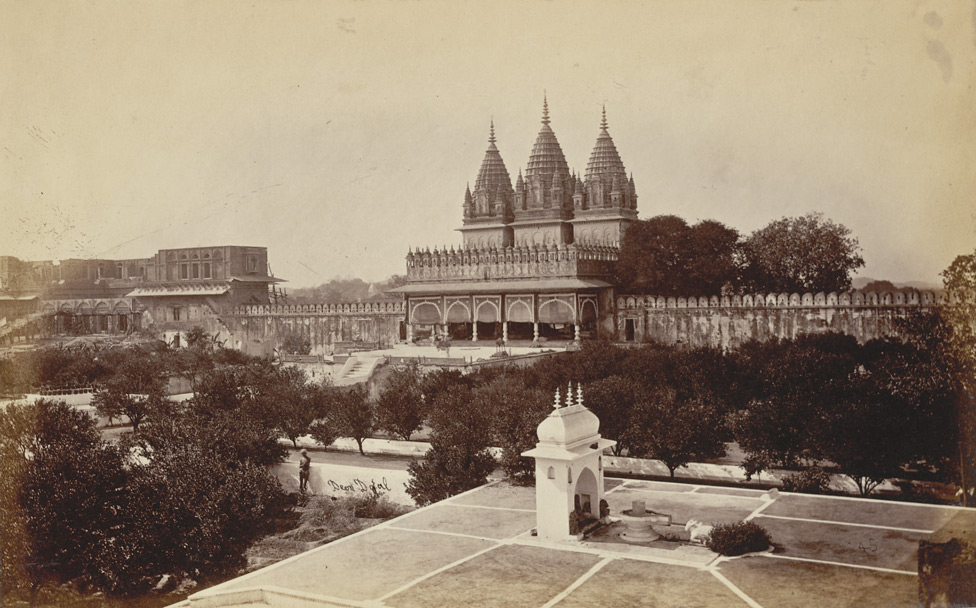
The Ashram Complex: Vana Durga, Parashurama and the Yajnashala
Beyond the primary sanctums of Bagalamukhi and Dhumavati, the sprawling walled ashram complex of Pitambara Peeth encompasses several other consecrated shrines. These include the Vana Durga Temple, the Kal Bhairav Shrine (the fierce protector of the peeth), the Lord Parashurama Temple, and a revered Hanuman shrine known as Sankat Mochan.
At the heart of the ashram stands the massive Yajnashala (sacrificial fire hall), where consecrated Vedic and Tantric havans (fire rituals) are conducted daily with pure cow ghee and fragrant forest woods. The atmosphere resonates with the continuous chanting of the sacred Bagalamukhi Gayatri and Beej mantras by initiated priests.
The complex also preserves the simple subterranean meditation room and samadhi of Swamiji Maharaj, who attained Mahasamadhi in 1979. The room remains filled with an atmosphere of profound stillness, where pilgrims sit in silent meditation, absorbing the spiritual vibrations nurtured over decades of rigorous ascetic discipline.
The Dhumavati temple located within the complex is one of the only shrines in India dedicated to this seventh Mahavidya. Darshan of Goddess Dhumavati is permitted only on Saturday mornings and evenings; married women are traditionally cautioned from entering the inner sanctum of Dhumavati due to her ascetic widow persona. Obey all temple board guidelines.
Navratri Mahotsav: An Ocean of Yellow Devotion
The peak spiritual periods at Pitambara Peeth occur during the Chaitra Navratri (March-April) and Sharad Navratri (September-October) festivals, along with the annual Bagalamukhi Jayanti and Guru Purnima. During these nine-day celebrations, Datia transforms into an undulating sea of yellow.
Hundreds of thousands of pilgrims from across India converge upon the temple, nearly all dressed in bright yellow garments. The entire complex is decorated with thousands of fresh yellow marigold garlands, brass lamps, and fluttering yellow flags. Special akhand path (continuous recitation) of the Devi Mahatmya and Durga Saptashati continues day and night.
Community kitchens (annakshetras) operate continuously throughout the festival, serving free sanctified vegetarian prasad to tens of thousands of pilgrims daily, reflecting the compassionate social ethos established by Swamiji Maharaj.

- Chaitra & Sharad Navratri: Nine days of round-the-clock fire rituals, mantra chanting, and floral decor.
- The Sea of Yellow: Devotees adorned in yellow kurtas and sarees offering yellow turmeric and marigolds.
- Free Annakshetra: Large-scale community kitchens serving sanctified food to all pilgrims regardless of caste.
- Guru Purnima Celebrations: Annual tribute honoring the spiritual lineage and teachings of Swamiji Maharaj.
Transit Infrastructure, Basecamp Datia, and Seasons
Datia is situated along the main railway corridor connecting Delhi to Mumbai and Chennai, just two kilometers from Datia Railway Station (station code: DAA). Major express trains halt at Datia, while Jhansi Railway Junction (30 km south) and Gwalior Junction (75 km north) serve as major transit hubs with connections to every major Indian city.
The temple is situated right in the center of Datia town along the main road, easily reached by auto-rickshaw or cycle rickshaw from the railway station. A variety of dharamsalas, ashram guest houses, and modern budget hotels are available around the temple complex.
The best time to visit spans from October through March, when the Bundelkhand winter brings cool, pleasant days. Pitambara Peeth is universally combined with the historic seven-story Bir Singh Palace in Datia and the sacred white-spire Jain temple hill of Sonagir located just fifteen kilometers to the south.
Curated Field Dossier & Offline Google Maps Pin Pack
Bypass tourist traps with verified local logistics, exact parking coordinates, and field-tested routes.
- ✓Exact GPS Pin Pack: Unmarked parking spots, best dawn photography vantage points, and hidden trailheads.
- ✓Crowd-Avoidance Timing Matrix: Exact hour-by-hour windows to explore with zero tourist chaos.
- ✓Vetted Local Dhabas: 100% authentic, hygiene-checked regional food stops not on commercial maps.
- ✓Scam & Overcharge Shield: Verified taxi rates, auto fares, and local guide fee guidelines.
🛡️ Personally curated by PK Gupta & the Hidden Routes research desk. Delivered directly to your Email & WhatsApp within 4–8 hours.
Frequently Asked Questions
What is the spiritual significance of Pitambara Peeth in Datia?
It is one of India's most powerful Tantric Shakti shrines, dedicated to Goddess Bagalamukhi (Pitambara), the eighth Mahavidya, established in 1935 by the saint Shri Swamiji Maharaj.
Why do devotees wear yellow at Pitambara Peeth?
Goddess Bagalamukhi is revered as 'Pitambara' (the yellow-clad deity). Devotees wear yellow garments and offer yellow flowers, turmeric, and sweets to align with her divine energy.
Why is the Dhumavati temple at Datia so rare?
Dhumavati is the seventh Mahavidya, representing the cosmic void and divine widowhood. Temples dedicated to her are almost nonexistent across India; she is worshipped here specifically on Saturdays.
How far is Pitambara Peeth from Gwalior and Jhansi?
Pitambara Peeth is 75 km south of Gwalior and 30 km north of Jhansi along the four-lane NH 44 highway, reachable by train or car in under 45 minutes from Jhansi.
Is photography allowed inside Pitambara Peeth?
No, photography and mobile phone use are strictly prohibited inside the temple ashram complex to maintain sanctity and spiritual focus.