
Raja Bir Singh Deo and the Historic Bond with Prince Salim
Situated on a rocky seasonal island formed by the looping channels of the Betwa River in Niwari district, the Orchha Fort Complex is the crowning architectural jewel of the Bundela Rajput dynasty. Founded in 1531 CE by Maharaja Rudra Pratap Singh, Orchha flourished as the proud capital of Bundelkhand for more than two centuries, resisting subjugation by the imperial armies of Delhi through tactical guerrilla warfare and diplomatic statecraft.
The most magnificent edifice within the citadel is Jahangir Mahal, commissioned around 1605 CE by Orchha's greatest monarch, Raja Bir Singh Deo. The palace was constructed to honor the royal visit of Mughal Prince Salim (who had recently ascended the imperial throne as Emperor Jahangir). The two rulers shared a deep, fateful friendship forged when Bir Singh Deo, at Salim’s behest, assassinated Akbar's court historian and chief advisor, Abul Fazl, in 1602.
According to historical chronicles, Emperor Jahangir stayed at the palace for just a single night during his royal tour of central India. Yet, this single imperial encounter bequeathed to posterity one of the most harmonious and visually dazzling syntheses of Rajput and Mughal architecture ever constructed.
- Historic Alliance: Commemorates the friendship between Raja Bir Singh Deo and Mughal Emperor Jahangir.
- Betwa River Citadel: Erected on an easily defensible natural rocky river island surrounded by water channels.
- Single-Night Royal Visit: Built as a lavish imperial guest palace for Jahangir's solitary overnight halt.
- Composite Monument Ticket: Covers access to Jahangir Mahal, Raja Mahal, and the royal cenotaphs.
A single composite entry ticket (valid for one day) issued by the MP Archaeology Department covers entry to Jahangir Mahal, Raja Mahal, Sheesh Mahal, and the Royal Chhatris. Indian citizens pay 40 INR; international visitors pay 400 INR (cashless UPI/card preferred). The fort island is open daily from 9:00 AM to 5:00 PM. A magnificent Light and Sound Show takes place every evening in the palace courtyard.
Architectural Mastery: Symmetry, Chhatris and Stone Jharokhas
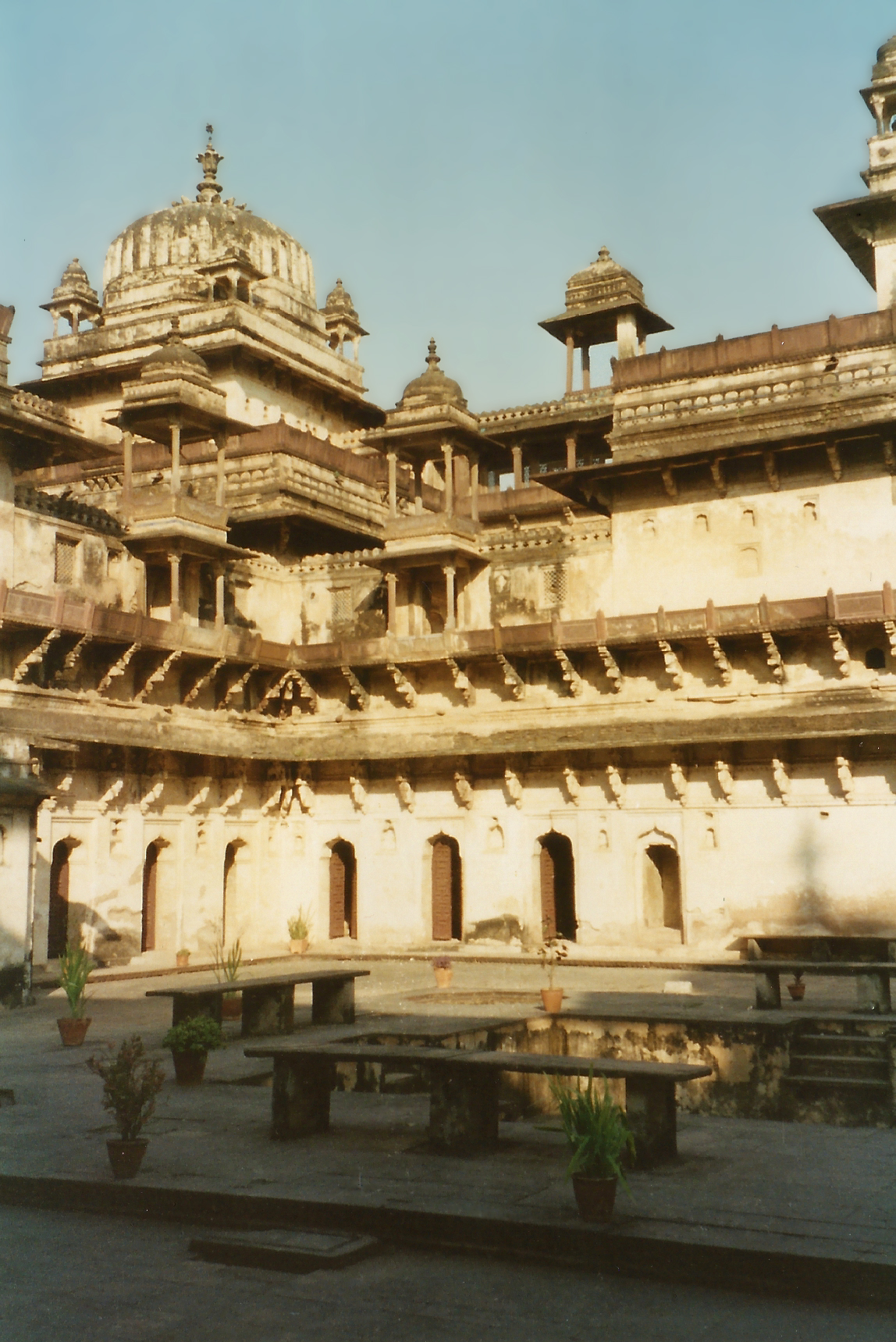
Jahangir Mahal is laid out on a rigorously geometric square plan measuring sixty-six meters on each side, enclosing a vast central stone courtyard. Built primarily of durable buff and red sandstone, the palace rises through three above-ground stories and two subterranean cooling levels, creating an intricate three-dimensional maze of over two hundred chambers, pillared arcades, and vaulted corridors.
The palace's exterior facade is crowned by eight monumental fluted domed pavilions (chhatris) stationed at the corners and centers of the rooflines, which break the horizontal symmetry and give the fortress an airy, palatial silhouette. Projecting stone oriel balconies (jharokhas), carved brackets depicting trumpeting elephants, and delicate pierced stone lattice (jali) screens provide shade and filtered natural breeze throughout the chambers.
At the main eastern ceremonial entrance, two life-sized sculpted sandstone elephants hold bells in their curved trunks, flanking the grand arched gateway. Traces of vibrant turquoise, cobalt blue, and golden-yellow glazed Persian tiles remain embedded in the outer cornice friezes, hinting at the dazzling chromatic brilliance the palace once possessed in the early seventeenth century.
Raja Mahal Frescoes and the Heritage of Sheesh Mahal
Connected to Jahangir Mahal by a stone causeway is the older Raja Mahal, constructed by Maharaja Madhukar Shah in the late sixteenth century. While its fortified stone exterior appears austere and forbidding, its royal residential apartments contain some of the finest surviving Bundeli mural paintings in India.
The interior walls and vaulted ceilings of the Durbar Hall and royal bedchambers are covered in brilliant mineral-pigment frescoes executed between 1575 and 1600 CE. These murals depict vibrant scenes from the Ramayana, the Bhagavata Purana, celestial avatars of Vishnu, and royal court processions, painted with natural vegetable dyes, lapis lazuli blue, and real gold leaf that retain astonishing vividness.
Situated between the two palaces is the Sheesh Mahal ('Palace of Mirrors'), built in the early eighteenth century as a royal summer villa by Maharaja Udait Singh. Today, this historic mansion has been converted into a celebrated heritage hotel operated by the MP State Tourism Development Corporation, allowing modern travelers to sleep within the ancient stone walls of Bundela royalty.
Jahangir Mahal features multi-tiered roof terraces, steep internal stairwells without handrails, and open jharokha balconies overlooking vertical drops. Exercise caution when exploring upper chambers, especially with young children. Bats inhabit some unlit subterranean chambers; carry a flashlight when touring lower levels.
Rooftop Vistas: The Wilderness of the Betwa and Orchha Spire Skyline
Climbing the narrow stone stairwells to the highest roof terrace of Jahangir Mahal rewards visitors with one of the most breathtaking historical panoramas in central India. From this commanding vantage point, the entire architectural landscape of Orchha unfolds across the forested river plains.
Looking west, the colossal ninety-meter-high spire of the Chaturbhuj Temple rises like a medieval European cathedral against the sky, while the red-and-white battlements of Ram Raja Temple anchor the vibrant town square below. To the south, the serene, multi-tiered royal cenotaphs (Chhatris) stand in dignified silence along the tranquil waters of the Betwa River.
The surrounding landscape is blanketed in the dense teak and palash forests of the Orchha Wildlife Sanctuary, where vultures nest along the upper palace cornices and herds of spotted deer graze along the riverbanks at twilight. As sunset approaches, the golden hour light transforms the red sandstone battlements into glowing amber monuments.

- Chaturbhuj Temple Alignment: Direct visual axis connecting the palace balcony to the towering temple spire.
- Betwa Wildlife Sanctuary: Forested river corridor home to jackals, blue bulls, and riverine birdlife.
- Vulture Nesting Spires: Historic palace towers provide protected cliff-like nesting sites for wild vultures.
- Son-et-Lumiere: Evening sound and light spectacle narrating Bundela history in Hindi and English.
Transit Infrastructure, Basecamp Orchha, and Seasons
Orchha is exceptionally accessible due to its close proximity to Jhansi, a major railway junction situated just eighteen kilometers north in Uttar Pradesh. Jhansi Junction is connected to Delhi, Mumbai, Bengaluru, and Chennai via numerous superfast express and Shatabdi trains (taking less than five hours from New Delhi). From Jhansi railway station, shared autos, app-cabs, and private taxis reach Orchha in under thirty minutes.
For air travel, Rajmata Vijaya Raje Scindia Airport in Gwalior (130 km north, approx. 2.5 hours driving time) and Khajuraho Airport (170 km east, approx. 3.5 hours driving time) serve as the nearest commercial aviation gateways via National Highway 39.
The best time to visit Orchha is during the cooler months from October to March. Winter days are pleasantly sunny (20°C to 25°C) and evenings are cool. Exploring the fort complex requires approximately three to four hours, and is ideally paired with the evening aarti at Ram Raja Temple and sunrise photography at the Betwa Chhatris.
Curated Field Dossier & Offline Google Maps Pin Pack
Bypass tourist traps with verified local logistics, exact parking coordinates, and field-tested routes.
- ✓Exact GPS Pin Pack: Unmarked parking spots, best dawn photography vantage points, and hidden trailheads.
- ✓Crowd-Avoidance Timing Matrix: Exact hour-by-hour windows to explore with zero tourist chaos.
- ✓Vetted Local Dhabas: 100% authentic, hygiene-checked regional food stops not on commercial maps.
- ✓Scam & Overcharge Shield: Verified taxi rates, auto fares, and local guide fee guidelines.
🛡️ Personally curated by PK Gupta & the Hidden Routes research desk. Delivered directly to your Email & WhatsApp within 4–8 hours.
Frequently Asked Questions
Why was Jahangir Mahal in Orchha built?
It was built around 1605 CE by Bundela King Raja Bir Singh Deo to honor the royal visit of Mughal Emperor Jahangir (Prince Salim), commemorating their close friendship and political alliance.
How long did Emperor Jahangir actually stay at Jahangir Mahal?
Historical chronicles record that Emperor Jahangir stayed in the palace for only a single night during his royal tour of central India.
How far is Orchha from Jhansi Railway Station?
Orchha is just 18 km (approximately 25 to 30 minutes by taxi or auto-rickshaw) from Jhansi Junction, making it one of the easiest heritage destinations to reach in MP.
Can you stay inside Orchha Fort Complex?
Yes. Sheesh Mahal, situated between Jahangir Mahal and Raja Mahal inside the fort walls, is operated as a heritage hotel by the MP Tourism Development Corporation.
What are the famous murals inside Raja Mahal?
The 16th-century murals inside Raja Mahal depict scenes from the Ramayana, Bhagavata Purana, and courtly life, painted with natural mineral pigments and real gold leaf that remain vibrant today.