
The City of Joy: Sultan Ghiyas-ud-din and the Floating Vision
Perched majestically upon an isolated spur of the Vindhyan Range in Dhar district, sixty kilometers south of Indore, the medieval citadel of Mandu (historically Shadiabad, or the 'City of Joy') represents one of the most romantic and architecturally sublime ruined fortress cities on earth. Rising six hundred and thirty meters above sea level and encircled by forty-five kilometers of battlements, Mandu served as the proud capital of the Malwa Sultanate during the fifteenth and sixteenth centuries.
The undisputed crown jewel of Mandu is Jahaz Mahal ('Ship Palace'), constructed between 1469 and 1500 CE during the reign of Sultan Ghiyas-ud-din Khilji. Renowned for his devotion to peace, art, and sensual pleasures following decades of exhausting warfare under his warlike father, Ghiyas-ud-din created Jahaz Mahal as a private royal sanctuary for his extensive household, which historical chronicles record included thousands of royal ladies, musicians, court artisans, and foreign guards.
Measuring one hundred and ten meters in length and fifteen meters in width, this slender, double-story sandstone palace was constructed upon a narrow tongue of land deliberately engineered between two immense artificial water reservoirs: Kapur Talao ('Camphor Lake') to the east and Munja Talao to the west. When the monsoon rains fill both lakes, the long stone palace appears to float upon the water like a colossal royal galley ship anchored in an inland sea.
- Sultan Ghiyas-ud-din Khilji: Consecrated in the late 15th century as a private pleasure palace.
- Twin Lake Setting: Flanked symmetrically by Kapur Talao and the ancient Munja Talao.
- 110-Meter Proportions: Slender, elongated double-story structure designed to resemble an imperial ship.
- City of Joy (Shadiabad): Historical name bestowed by medieval sultans celebrating its natural beauty.
Jahaz Mahal is the centerpiece of Mandu's Royal Enclave. A single ASI admission ticket (40 INR for Indian citizens, 600 INR for international visitors) provides access to Jahaz Mahal, Hindola Mahal, Champa Baoli, and the Royal Palace ruins. The monument is open daily from sunrise to sunset. Mandu is renowned across India as the 'City of Joy', particularly spectacular during the monsoon months (July to September) when the lakes are brimming with water.
Ingenious Hydraulics: Serpent Aqueducts, Baolis and Stepped Pools
Beyond its poetic exterior, Jahaz Mahal is an engineering triumph of medieval hydraulic cooling and water management. Built in an era before mechanical ventilation, the palace incorporated an extraordinary system of subterranean cisterns, open-air cascades, and decorative swimming pools designed to cool the ambient air naturally during scorching Malwa summers.
On the upper roof terrace, water was raised from the lakes using Persian wheels (saqiya) and channeled through an exquisite series of serpentine stone aqueducts. The water tumbled through ornamental floral basins shaped like open lotus rosettes into stepped cooling baths. One celebrated rooftop bath—the Lotus Pool—features scalloped lobed steps carved with such optical precision that ripples of water created shimmering reflections across the open ceiling cupolas.
Adjoining the palace is Champa Baoli, an ancient subterranean stepwell featuring cool, vaulted underground chambers (tahkhanas) interconnected by cold-air shafts. During the peak of summer, the royal family retreated to these subterranean rooms, which were kept permanently chilled by the cool subterranean water table.
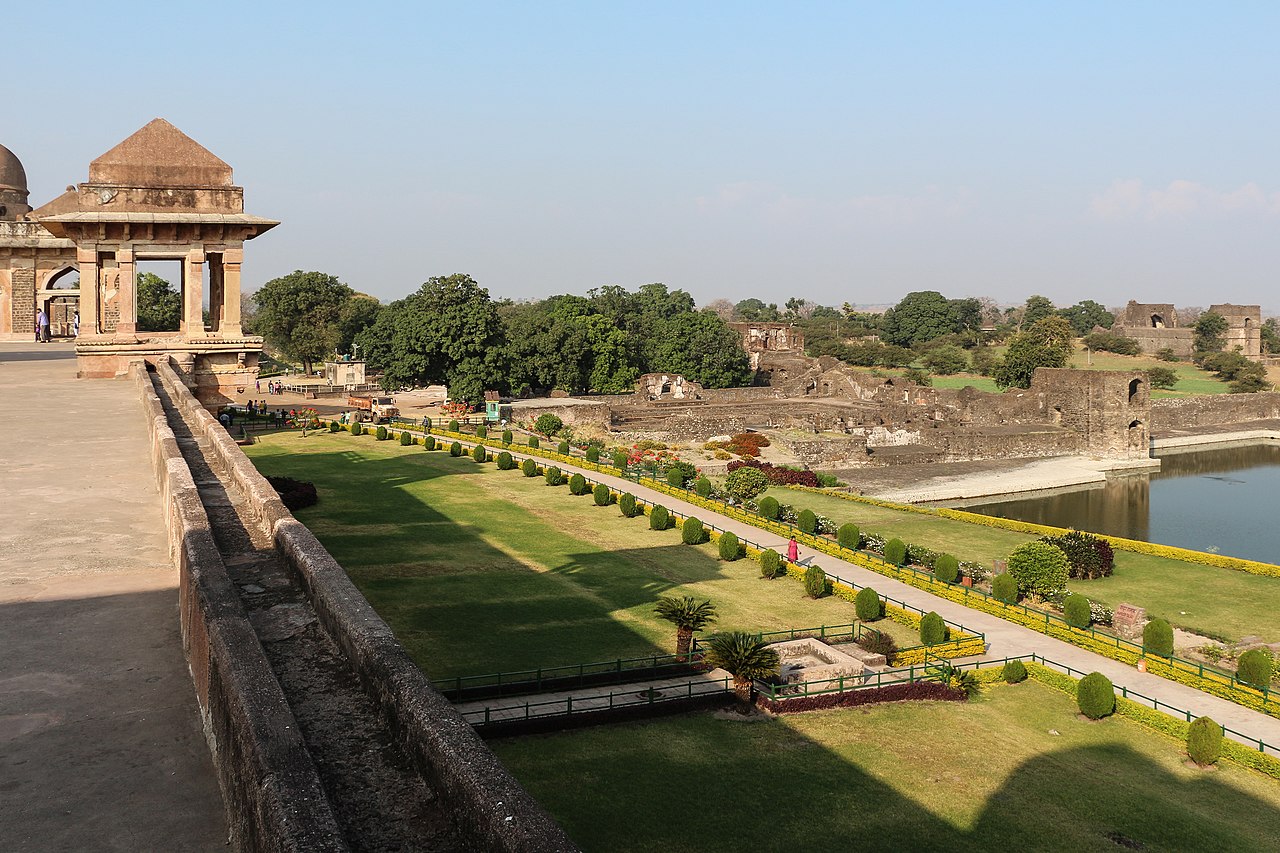
Rooftop Pavilions, Cupolas and Mandu Monsoons
Climbing the stone stairs to the upper terrace of Jahaz Mahal reveals an open-air world of extraordinary architectural elegance. The terrace is punctuated by domed kiosks, arched balconies, fluted stone chhatris, and pyramid-roofed pavilions that provided shaded relaxation for the royal court.
From these airy rooftop chhatris, the views across the Royal Enclave are mesmerizing. To the east, the waters of Kapur Talao reflect the arched colonnades and bathing ghats; to the west, Munja Talao stretches toward the ancient stone embankments of Hindola Mahal; to the north, the forested valleys and ravines of the Malwa plateau roll toward the horizon.
During the monsoon season from July to September, Mandu experiences an almost mythical transformation. Dense white rain clouds sweep in from the Arabian Sea, snagging on the high Vindhyan cliffs and blanketing the sandstone ruins in swirling mist, while waterfalls tumble into deep gorges and the surrounding teak forests burst into luminous emerald green.
Exploring the upper rooftop terraces of Jahaz Mahal requires climbing open spiral stone stairs without modern handrails; hold onto inner walls. The palace walls drop directly into the deep waters of Munja Talao and Kapur Talao; stay well clear of unbarricaded water verges, especially during rainy conditions when stone slabs become slick.
Botanical Curiosities: The Khurasani Imli (Baobab Trees) of Mandu
Scattered throughout the Royal Enclave around Jahaz Mahal are massive, bizarre-looking trees that appear utterly alien to the Indian subcontinent: Adansonia digitata, commonly known as the African Baobab, or locally as 'Khurasani Imli'. With colossal bulbous grey trunks measuring up to ten meters in circumference and stunted, root-like branches, these ancient trees have lived in Mandu for over five centuries.
Historical botanists reveal that these baobabs were brought to Mandu by medieval traders and mercenaries from East Africa, Abyssinia, and Khorasan who served in the armies and royal bodyguards of the Malwa Sultans. The seeds found a hospitable home in the rocky, well-drained volcanic soil of the plateau.
The large, velvety gourd-like fruits of the baobab contain a dry, tart white pulp that local tribal villagers sell along the roadsides around Jahaz Mahal. Known as Mandu's signature botanical delicacy, the pulp is rich in vitamin C and is traditionally blended into refreshing sweet-and-sour sherbets by travelers.

- African Baobab Legacy: Introduced in the 15th century by Abyssinian and Khorasani mercenaries.
- Colossal Bulbous Trunks: Girths exceeding 10 meters, with several trees documented at over 500 years old.
- Khurasani Imli Sherbet: Tart, nutrient-dense fruit pulp traditionally sold by local tribal vendors.
- Unique Micro-Biome: Mandu is one of the only regions in mainland India where wild baobabs flourish.
Access Gateways, Basecamp Mandu, and Seasons
Mandu is located in Dhar district, thirty-five kilometers south of Dhar town and ninety-eight kilometers southwest of Indore city. Devi Ahilyabai Holkar Airport in Indore (IATA: IDR) is the closest commercial airport, offering daily flights from Delhi, Mumbai, Bengaluru, and Hyderabad. Indore Railway Junction is a major broad-gauge rail terminus with trains connecting across India.
From Indore, private taxis and regular state buses reach Mandu in approximately two to two and a half hours via Mhow and Gujri along scenic, winding mountain roads. Accommodations in Mandu include the heritage Malwa Resort and Malwa Retreat operated by MP Tourism, alongside boutique eco-lodges near the Sagar Talao lake.
While winter (October to March) offers cool, sunny weather ideal for walking across the archaeological ruins, the monsoon (July to September) is considered the most romantic and visually enchanting season to visit Jahaz Mahal. Exploring the Royal Enclave requires three to four hours, and is paired with Rani Roopmati's Pavilion and Hoshang Shah's Tomb.
Curated Field Dossier & Offline Google Maps Pin Pack
Bypass tourist traps with verified local logistics, exact parking coordinates, and field-tested routes.
- ✓Exact GPS Pin Pack: Unmarked parking spots, best dawn photography vantage points, and hidden trailheads.
- ✓Crowd-Avoidance Timing Matrix: Exact hour-by-hour windows to explore with zero tourist chaos.
- ✓Vetted Local Dhabas: 100% authentic, hygiene-checked regional food stops not on commercial maps.
- ✓Scam & Overcharge Shield: Verified taxi rates, auto fares, and local guide fee guidelines.
🛡️ Personally curated by PK Gupta & the Hidden Routes research desk. Delivered directly to your Email & WhatsApp within 4–8 hours.
Frequently Asked Questions
Why is Jahaz Mahal called the Ship Palace?
It is called Jahaz Mahal because it is a long, slender, double-story sandstone palace built between two large artificial lakes (Kapur Talao and Munja Talao). When the lakes fill during monsoon, the palace appears to float like a ship.
Who built Jahaz Mahal in Mandu?
Jahaz Mahal was built between 1469 and 1500 CE by Sultan Ghiyas-ud-din Khilji of the Malwa Sultanate as a private royal retreat and harem residence.
What is the best season to visit Jahaz Mahal?
Monsoon (July to September) is the most famous season, as rains fill both lakes and mist envelopes the ruins. Winter (October to March) is also very pleasant for exploring on foot.
What are the strange, giant trees growing around Jahaz Mahal?
They are African Baobab trees (Adansonia digitata), locally called Khurasani Imli, brought to Mandu in the 15th century by Abyssinian traders and guards serving the Malwa Sultans.
How far is Jahaz Mahal from Indore and Dhar?
Jahaz Mahal is 35 km south of Dhar town and 98 km southwest of Indore city, reachable by taxi or bus in about 2 to 2.5 hours from Indore Airport.