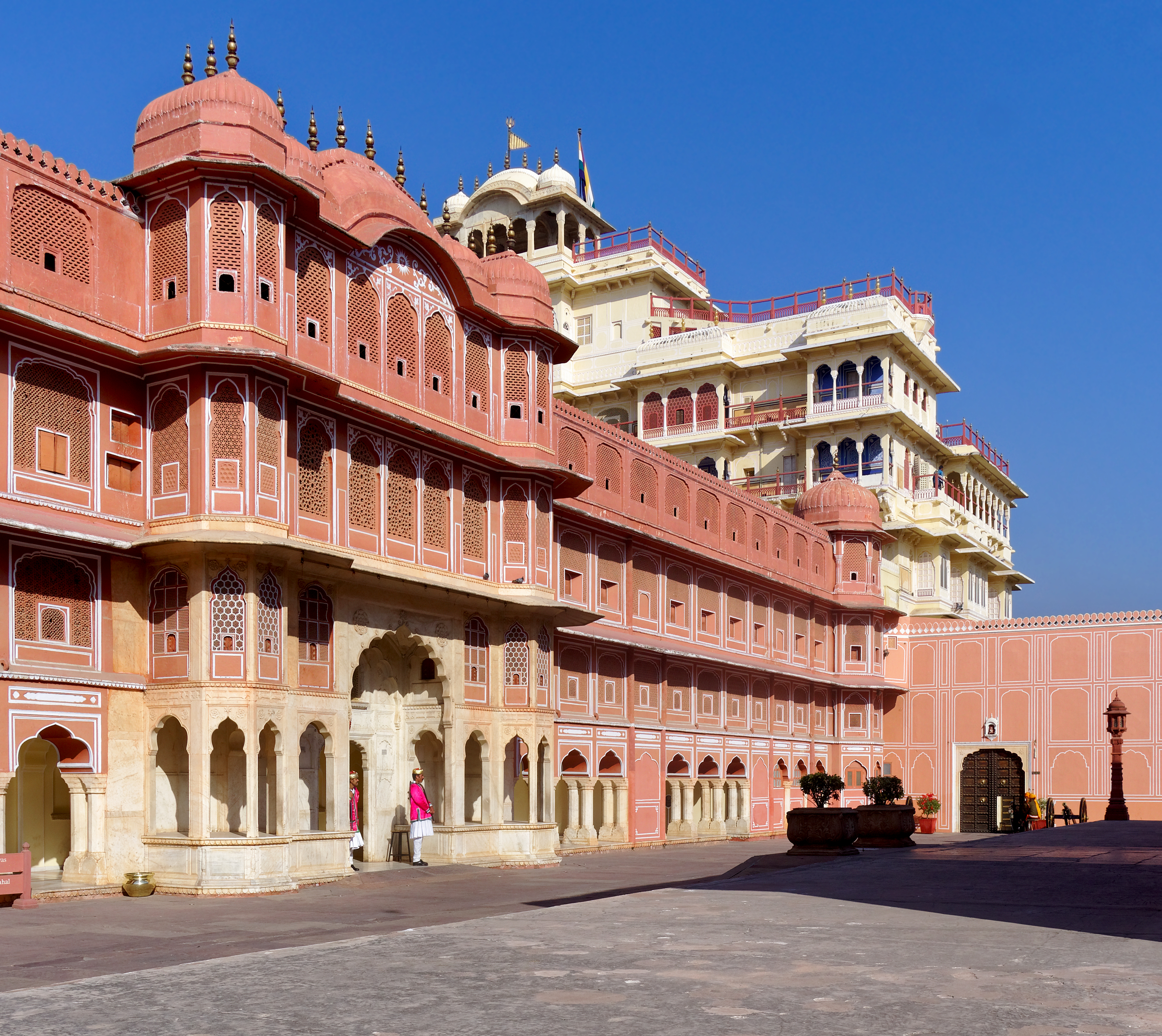
1. Overview & Archaeological Significance
The Tripolia Gate (meaning 'The Triple Gateway'), commanding the southern imperial axis of the City Palace along Tripolia Bazaar in the heart of the UNESCO World Heritage Walled City of Jaipur, Rajasthan, is celebrated as the grandest, most prestigious, and ceremonial royal gateway in the Pink City. Erected in 1734 CE by Maharaja Sawai Jai Singh II during the founding of Jaipur, this monumental triple-arched portal was designed as the exclusive sovereign entrance through which only the Maharaja of Jaipur, his royal family, and honored heads of state are permitted to enter and exit the City Palace.
Located in the Jaipur district of Rajasthan, Tripolia Gate City Palace Jaipur is centrally protected by the Archaeological Survey of India (ASI) as an irreplaceable landmark of South Asian civilization. Recognized for its kachhwaha rajput-mughal gateway architecture, triple pointed arches, pink sandstone & brass-studded teak doors, the site provides profound insights into the technological prowess, cosmological beliefs, and cultural aesthetics of its ancient builders.
2. Dynastic Origins, Royal Patrons & Chronology
Under centuries-old royal protocol that continues to this day, the massive central arch of Tripolia Gate remains locked to the general public throughout the year. It opens only for the reigning Maharaja's royal motorcade and during the two grandest annual religious festivals of Jaipur: the colorful royal processions of *Teej* (celebrating the monsoon and Goddess Parvati in July/August) and *Gangaur* (celebrating marital devotion in March/April). On these festival days, the golden palanquin of the Goddess emerges ceremonially through the central arch of Tripolia Gate, accompanied by decorated elephants, camel cavalry, royal guards, and dancing folk troupes.
Centrally protected as an integral heritage component of the City Palace and the UNESCO World Heritage site of Jaipur City, Tripolia Gate anchors the historic street grid planned by Vidyadhar Bhattacharya, recognized as one of the finest surviving examples of 18th-century Rajput ceremonial gate architecture.
3. Structural Engineering & Architectural Design
Tripolia Gate is a monumental two-storeyed gateway constructed of local pink-buff sandstone washed with traditional terracotta-pink lime. The gateway measures 22 metres in width and 15 metres in height, featuring three grand pointed archways: a towering central royal arch flanked by two slightly smaller side arches.

The central arch is secured by colossal double-leaf teakwood doors reinforced with hundreds of heavy hand-forged brass spikes (*gaja-kanta*), historically engineered to prevent charging war elephants from battering the gate during sieges. Above the archways runs a projecting balcony (*jharokha*) supported by carved stone brackets and crowned with fluted domes and chhatris.
The upper storey houses an imperial ceremonial drum chamber (*Naqqar Khana*), where royal musicians played large kettledrums and shehnais to sound the royal salute whenever the Maharaja departed or returned through the portal, establishing an acoustic announcement heard across the entire walled city.
4. Archaeological Excavations, Epigraphy & Conservation
Restoration campaigns by the Jaipur Development Authority (JDA) in 2018 consolidated the pink lime-wash facade and restored antique brass fittings on the ceremonial teak doors.
Pedestrianization projects along Tripolia Bazaar enhanced the street viewing promenade, providing unobstructed views of the gate's classical symmetry.
Structural monitoring by heritage engineers verified the stability of the foundation masonry against urban traffic vibrations.
The exterior of Tripolia Gate can be viewed and photographed freely from Tripolia Bazaar. General public tourists enter the City Palace via the Virendra Pol and Udai Pol gates on the northern and eastern sides.
5. Master Highlights & Archaeological Marvels
The exclusive royal privilege: the central gate opens only for the Maharaja of Jaipur and the sacred palanquins of Teej and Gangaur.

The elephant-spike brass doors: massive defensive teak portals studded with hand-beaten anti-elephant brass spikes.
The Naqqar Khana drum house: the elevated gallery from which royal heralds sounded the royal salute across Jaipur.
6. Visiting Hours, Entry Permits & Visitor Guidelines
Viewable from the public street 24 hours daily. The surrounding bazaar shops operate from 10:00 AM to 8:30 PM.
Early morning visits (7:00 AM to 9:00 AM) offer peaceful street photography before market traffic begins, with soft morning light illuminating the pink arches.
The gate itself is an active royal entrance; tourists must not attempt to enter the City Palace through Tripolia Gate.
Photography of the gate from the street is unrestricted; follow standard traffic rules along Tripolia Bazaar.
Tripolia Bazaar is one of Jaipur's busiest commercial street markets with heavy e-rickshaw and scooter traffic. Walk along the covered colonnaded footpaths.
7. Site Museum & Interpretation Centers
The City Palace Museum (accessible via the tourist entrance at Sireh Deori) displays the royal carriages and arms of the Kachhwahas.
The nearby Isarlat (Swargasuli Tower, 300 metres west) is a 1749 CE seven-storeyed minaret offering panoramic aerial views over Tripolia Gate.
8. Climate, Best Seasons & Ideal Visiting Hours
October to March offers ideal weather, with pleasant daytime temperatures between 16°C and 28°C.
The Teej Festival in July/August and Gangaur Festival in March/April are the absolute pinnacle times to see the gate opened for the grand royal procession.
9. Transit Logistics, Rail, Air & Road Access
Located on Tripolia Bazaar Road, Walled City, Jaipur. Chhoti Chaupar Metro Station (Pink Line) is 400 metres away.
Jaipur Junction Railway Station is 4.5 km away; Jaipur Airport (JAI) is 12 km away. Readily accessible via e-rickshaw or taxi.
10. Regional Heritage Circuits & Sibling Monuments
Tripolia Gate is the ceremonial anchor of the Jaipur UNESCO World Heritage Bazaars & Gateways Trail:
Sacred Architecture & Darshan Protocol Guide
Maximize your spiritual journey: VIP vs Sugam Darshan line reality, locker rules, and historical truth.
- ✓Sugam Darshan & Token Blueprint: Accurate online booking rules, pre-dawn passes, and entry lane realities.
- ✓Zero Commercialization Guard: Avoid bogus intermediaries, fake priest fees, and paid blessing scams.
- ✓Locker, Footwear & Mobile Safety: Verified cloakroom locations, authorized phone lockers, and security rules.
- ✓Hidden Architectural Marvels: Inscriptions, subterranean sanctums, and forgotten stone carvings.
🛡️ Personally curated by PK Gupta & the Hidden Routes research desk. Delivered directly to your Email & WhatsApp within 4–8 hours.
11. Frequently Asked Questions
Why is Tripolia Gate locked to the general public?
Under 300-year-old royal protocol, the central arch of Tripolia Gate is reserved exclusively for the Maharaja of Jaipur and the sacred annual processions of the goddesses Teej and Gangaur.
Where do tourists enter the City Palace of Jaipur?
General tourists enter the City Palace via the Atish Pol and Virendra Pol gates located on the eastern and northern sides of the complex, not through Tripolia Gate.
What festivals are celebrated at Tripolia Gate?
The grand royal festivals of Teej (monsoon) and Gangaur (spring), when the Maharaja leads the golden idol of the goddess through the opened central arch in a magnificent procession.
What is the meaning of the name 'Tripolia'?
Tripolia means 'Triple Gate' (tri-pol), referring to the three grand pointed archways that comprise the facade of the gateway.
What is Tripolia Bazaar famous for?
Tripolia Bazaar, extending outside the gate, is world-famous for traditional Rajasthani lac bangles, brassware, iron utensils, and textiles.