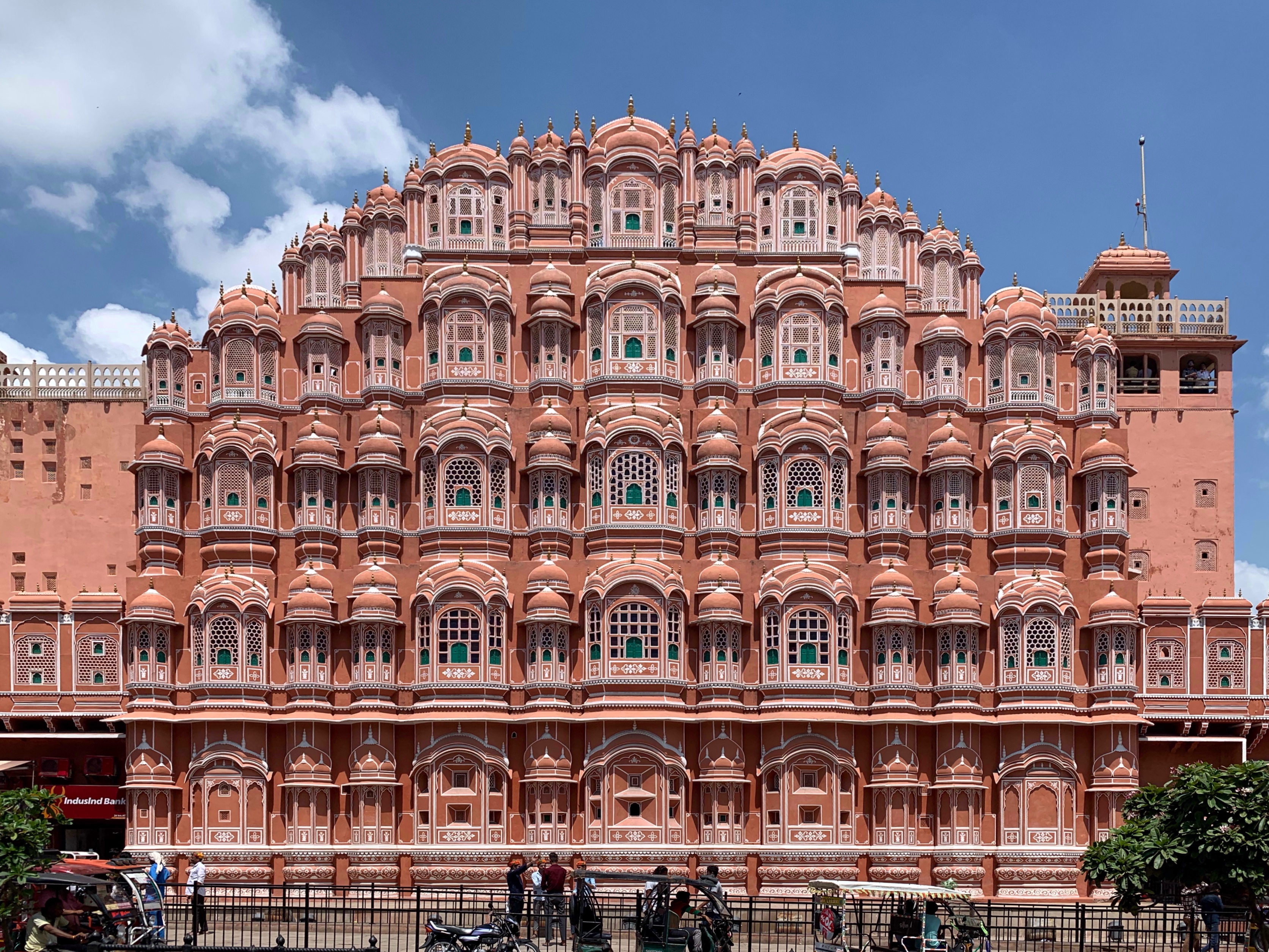
1. Overview & Archaeological Significance
Hawa Mahal ('The Palace of Winds'), soaring with fairy-tale grace above Badi Chaupar in the heart of the UNESCO World Heritage Walled City of Jaipur, Rajasthan, is universally celebrated as the most recognizable, visually iconic, and architecturally dazzling monument of Rajput civilization. Commissioned in 1799 CE by the poet-king Maharaja Sawai Pratap Singh (a profound devotee of Lord Krishna) and designed by master architect Lal Chand Ustad, the palace was conceived as an extension of the City Palace complex, shaped in the celestial form of the *Mukut* (jeweled feather-crown) of Lord Krishna.
Located in the Jaipur district of Rajasthan, Hawa Mahal Palace of Winds Jaipur is centrally protected by the Archaeological Survey of India (ASI) as an irreplaceable landmark of South Asian civilization. Recognized for its rajput-mughal fusion architecture, 5-storeyed pyramidal facade, venturi effect natural airflow, pink sandstone, the site provides profound insights into the technological prowess, cosmological beliefs, and cultural aesthetics of its ancient builders.
2. Dynastic Origins, Royal Patrons & Chronology
Hawa Mahal was engineered primarily to allow the royal ladies of the court (*zenana*), who observed strict customs of *purdah* (veiling from public view), to witness the vibrant daily life, colourful street festivals, royal processions, and bustling bazaars of Jaipur without ever being seen by passersby on the street. Master architect Lal Chand Ustad solved this cultural and climatic requirement through a triumph of thermodynamic physics: by incorporating 953 miniature carved stone casements (*jharokhas*), the structure harnesses the *Venturi effect*, where breezes passing through the tiny pierced openings accelerate, cool naturally, and circulate through the interior chambers, keeping the palace refreshingly cool even during scorching 45°C Rajasthani summers.
Centrally protected by the Department of Archaeology and Museums, Government of Rajasthan, and recognized globally as the premier symbol of Jaipur's Pink City, Hawa Mahal is uniquely famous as the tallest building in the world constructed without a deep foundation, standing five storeys high upon a narrow curved plinth.
3. Structural Engineering & Architectural Design
Hawa Mahal is a five-storeyed pyramidal honeycomb facade measuring 15 metres (50 feet) in height, constructed entirely of red and pink sandstone washed with lime. Uniquely, the building is only one room deep—the upper three storeys have the width of a single room, while the top two floors are only about a foot wide, giving the monument an ethereal, theatrical screen-like quality.

The eastern facade features an astonishing 953 small casements (*jharokhas*), each embellished with miniature fluted stone domes, delicate hanging cornices (*chhadya*), and fine sandstone lattice screens (*jali*). Many windows retain their original 18th-century European colored stained-glass panels, which cast vibrant kaleidoscope patterns of red, green, and golden light across the interior marble chambers as the morning sun rises.
Remarkably, there are no staircases inside Hawa Mahal to connect its five floors: instead, floors are accessed exclusively via gentle sloping ramps (*dhālus*), designed to allow royal queens in heavy embroidered silk lehengas and palanquins carried by attendants to glide effortlessly between the levels without exertion.
4. Archaeological Excavations, Epigraphy & Conservation
Restoration projects by the Rajasthan State Archaeology Department in 2005 consolidated the lime-wash pigments and replaced fractured sandstone jalis using traditional artisanal methods.
A dedicated archaeological site museum was established inside the ground-floor courtyard, exhibiting excavated 10th-century sculptures, royal arms, and miniature paintings.
Structural engineering studies verified that the inward slope of the five-storey facade (inclined at 87 degrees) provides natural structural equilibrium against strong wind shear.
Entry ticket is ₹50 for Indian citizens and ₹200 for foreign tourists (or covered under the Jaipur Composite 2-Day Ticket: ₹300 / ₹1,000). Free for children under 7.
5. Master Highlights & Archaeological Marvels
The 953 jharokha casements: creating the famous honeycomb screen that accelerates airflow through the Venturi principle.

The sloping ramps: wide stone-paved inclined corridors that replace traditional stairs between all five storeys.
The five poetic levels: *Sharad Mandir* (autumn hall), *Ratan Mandir* (glass hall), *Vichitra Mandir* (hall of surprises), *Prakash Mandir* (hall of light), and *Hawa Mandir* (hall of wind).
6. Visiting Hours, Entry Permits & Visitor Guidelines
Open daily from 9:00 AM to 5:00 PM throughout the year. The ticket counter closes at 4:30 PM.
The eastern exterior facade is best photographed at early morning sunrise (7:00 AM to 8:30 AM), when the rising sun illuminates the pink sandstone in golden radiance.
Visitors enter through the royal rear courtyard gate from the City Palace side, not from the main road facade.
Leaning out of upper jharokha windows or sitting on stone sills is strictly prohibited for visitor safety.
The upper ramps and doorways are low and narrow. Watch your head when moving between the top two levels.
7. Site Museum & Interpretation Centers
The Hawa Mahal Museum on the ground floor displays miniature paintings, ceremonial swords, and 18th-century royal costumes.
The Jantar Mantar UNESCO Observatory and the City Palace are located just 200 metres behind Hawa Mahal.
8. Climate, Best Seasons & Ideal Visiting Hours
October to March offers ideal weather, with pleasant daytime temperatures between 16°C and 28°C.
The winter months feature clear blue skies and comfortable weather ideal for exploring the bustling surrounding bazaars (Sireh Deori and Johari Bazaar).
9. Transit Logistics, Rail, Air & Road Access
Located on Hawa Mahal Road, Badi Chaupar, Walled City, Jaipur. Badi Chaupar Metro Station (Pink Line) is just 150 metres away.
Jaipur Junction Railway Station is 5 km away; Jaipur International Airport (JAI) is 12 km south. Readily accessible via e-rickshaw or taxi.
10. Regional Heritage Circuits & Sibling Monuments
Hawa Mahal is the premier visual landmark of the Jaipur UNESCO World Heritage Walled City Trail:
Sacred Architecture & Darshan Protocol Guide
Maximize your spiritual journey: VIP vs Sugam Darshan line reality, locker rules, and historical truth.
- ✓Sugam Darshan & Token Blueprint: Accurate online booking rules, pre-dawn passes, and entry lane realities.
- ✓Zero Commercialization Guard: Avoid bogus intermediaries, fake priest fees, and paid blessing scams.
- ✓Locker, Footwear & Mobile Safety: Verified cloakroom locations, authorized phone lockers, and security rules.
- ✓Hidden Architectural Marvels: Inscriptions, subterranean sanctums, and forgotten stone carvings.
🛡️ Personally curated by PK Gupta & the Hidden Routes research desk. Delivered directly to your Email & WhatsApp within 4–8 hours.
11. Frequently Asked Questions
Why is it called Hawa Mahal (Palace of Winds)?
Because its 953 carved stone jharokhas were engineered using the Venturi effect to accelerate natural breezes through the palace, keeping the interior cool like natural air-conditioning.
Why does Hawa Mahal have 953 windows?
To allow royal ladies in purdah to observe daily street life and royal processions on the streets below without being seen by anyone outside.
Why are there no stairs inside Hawa Mahal?
The five storeys are connected by gentle sloping stone ramps (dhalus) instead of stairs, so royal queens wearing heavy ceremonial attire could be transported effortlessly.
What is the shape of Hawa Mahal inspired by?
It was designed by architect Lal Chand Ustad to resemble the jeweled feather-crown (Mukut) of Lord Krishna, to whom Maharaja Sawai Pratap Singh was deeply devoted.
Where is the entrance to Hawa Mahal?
The entrance is not from the famous front facade on the street, but through the rear imperial gate accessed via Sireh Deori Bazaar behind the City Palace.