1. Overview & Archaeological Significance
The Luna Vasahi Temple (also known as the Neminatha Temple), standing proudly alongside Vimal Vasahi within the celebrated Dilwara temple complex at Mount Abu in Sirohi district, Rajasthan, represents the second glorious artistic summit of medieval Indian marble architecture. Commissioned in 1230 CE by the legendary Porwad brothers, Vastupala and Tejapala—the illustrious prime ministers and commanders of the Vaghela rulers of Gujarat—the temple was erected in loving memory of their deceased brother, Lunigakumara (Luna), after whom the monument is named.
Located in the Sirohi district of Rajasthan, Dilwara Luna Vasahi Temple Abu is centrally protected by the Archaeological Survey of India (ASI) as an irreplaceable landmark of South Asian civilization. Recognized for its high classical māru-gurjara white marble architecture, deeply undercut filigree marble domes, hathishala & black marble neminatha, the site provides profound insights into the technological prowess, cosmological beliefs, and cultural aesthetics of its ancient builders.
2. Dynastic Origins, Royal Patrons & Chronology
Tejapala and Vastupala were renowned across medieval India not only as brilliant statesmen who defended Western India against northern invasions, but as peerless cultural patrons who built hundreds of libraries, stepwells, and shrines. Directed by master architect Shobhanadeva, thousands of elite artisans worked for decades to surpass even the legendary carving of Vimal Vasahi. In their dedication to perfection, the brothers rewarded artisans with bags of gold matching the weight of the fine marble dust carved out from the stone.
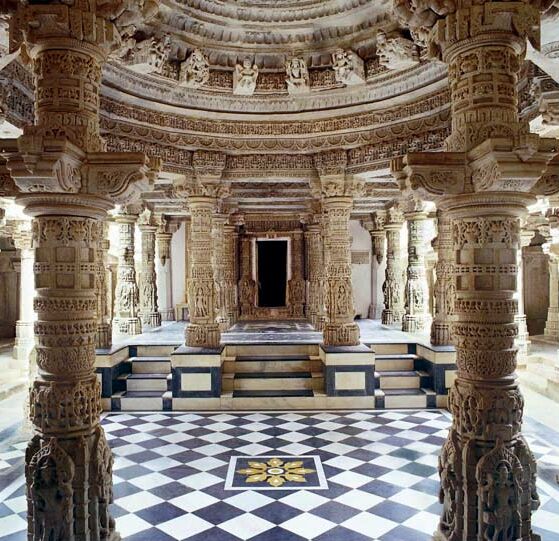
Dedicated to Lord Neminatha, the 22nd Tirthankara of Jainism (who is spiritually linked with Lord Krishna), Luna Vasahi is famous for its breathtaking central marble dome. Featuring a multi-tiered lotus pendant so microscopically undercut that it resembles frosted crystal or delicate lace, the ceiling is hailed by international art historians as the absolute perfection of decorative stonework. Conserved by the Anandji Kalyanji Trust, Luna Vasahi is an unmissable world wonder.
3. Structural Engineering & Architectural Design
The architectural layout of Luna Vasahi mirrors the classic Māru-Gurjara courtyard plan, featuring a central sanctum (*Garbhagriha*), an enclosed hall (*Gudhamandapa*), a spectacular open dance hall (*Rangamandapa*), and an enclosing cloister of seventy-two subsidiary shrines.

The Rangamandapa is a structural and aesthetic miracle. Its circular corbelled ceiling dome descends through concentric carved rings depicting sixteen graceful *Vidyadevis* (goddesses of learning and arts). In the center hangs the world-famous carved marble lotus pendant (*Padmadala*), featuring layered, paper-thin petals that seem to float weightlessly in mid-air.
Behind the main sanctum stands the celebrated *Hathishala* (Elephant Hall), added by Tejapala. This hall preserves ten life-sized, exquisitely carved white marble statues of caparisoned royal elephants, originally mounted by statues of the family of Vastupala and Tejapala. The perimeter cells also feature the celebrated *Devraniji-Jethaniji ki Gokh*—two ornate marble niches carved by the wives of the two brothers, competing in delicate ornamental lace-carving.
4. Archaeological Excavations, Epigraphy & Conservation
Maintained by the Anandji Kalyanji Trust with regular non-invasive conservation and marble preservation.
Microscopic cleaning using gentle clay poultices preserves the natural translucent glow of the Makrana marble.
Modern lighting and climate-monitoring sensors ensure the fragile 800-year-old marble pendants remain protected.
Entry to Luna Vasahi is free. Covered by the general admission of the Dilwara Temples complex.
5. Master Highlights & Archaeological Marvels
Filigree Marble Lotus Pendant: Universally acclaimed as the most delicate undercut stone ceiling in human history.

Hathishala Elephant Hall: Ten life-sized white marble elephants carved with ornate saddlecloths and bells.
Vastupala & Tejapala Legacy: Built in 1230 CE by the legendary prime ministers of Gujarat in memory of their brother Luna.
6. Visiting Hours, Entry Permits & Visitor Guidelines
Open for tourists from 12:00 PM to 5:00 PM daily. Touring Luna Vasahi and the Hathishala takes about 1 hour.
Visiting between 1:00 PM and 3:00 PM offers the best natural ambient light illuminating the intricate ceiling carvings.
Dress code strictly enforced: shoulders and knees must be covered; no footwear or leather goods permitted inside.
Photography and videography are strictly prohibited throughout the entire Dilwara complex.
Do not touch or reach up toward the delicate marble pendants; security staff strictly monitor visitor conduct.
7. Site Museum & Interpretation Centers
Vimal Vasahi Temple is located right next door in the same sacred Dilwara precinct.
The 15th-century Pittalhar Temple (featuring a colossal 4-ton bronze idol) is located 50 meters away.
8. Climate, Best Seasons & Ideal Visiting Hours
October through March is the premier season, featuring pleasant, cool hill station weather between 12°C and 25°C.
Winter months offer crisp mountain air and clear skies ideal for touring Mount Abu's sacred sites.
9. Transit Logistics, Rail, Air & Road Access
Located in Dilwara village, 2.5 km north of Mount Abu town center in Sirohi district, Rajasthan.
Easily reached by taxi, auto-rickshaw, or private car from Mount Abu bus station or hotels (approx. 10 minutes).
10. Regional Heritage Circuits & Sibling Monuments
Luna Vasahi is the artistic twin of Vimal Vasahi on the Dilwara Sacred Circuit:
Sacred Architecture & Darshan Protocol Guide
Maximize your spiritual journey: VIP vs Sugam Darshan line reality, locker rules, and historical truth.
- ✓Sugam Darshan & Token Blueprint: Accurate online booking rules, pre-dawn passes, and entry lane realities.
- ✓Zero Commercialization Guard: Avoid bogus intermediaries, fake priest fees, and paid blessing scams.
- ✓Locker, Footwear & Mobile Safety: Verified cloakroom locations, authorized phone lockers, and security rules.
- ✓Hidden Architectural Marvels: Inscriptions, subterranean sanctums, and forgotten stone carvings.
🛡️ Personally curated by PK Gupta & the Hidden Routes research desk. Delivered directly to your Email & WhatsApp within 4–8 hours.
11. Frequently Asked Questions
Who built the Luna Vasahi Temple and when?
It was commissioned in 1230 CE by the famous merchant-statesmen brothers Vastupala and Tejapala, dedicated in memory of their brother Luna.
Which Tirthankara is enshrined in Luna Vasahi?
The temple is dedicated to Lord Neminatha, the 22nd Tirthankara, enshrined as an idol carved from polished black marble.
What is the Hathishala inside Luna Vasahi?
The Hathishala (Elephant Hall) is an impressive gallery housing ten life-sized white marble statues of caparisoned elephants.
What are the Devraniji-Jethaniji niches?
They are two exquisitely carved marble niches created by the wives of the builder brothers, competing in delicate ornamental filigree carving.
Are cameras and mobile phones permitted inside Luna Vasahi?
No, all cameras, phones, and leather items must be deposited in secure lockers outside the temple before entry.