1. Overview & Archaeological Significance
Achalgarh Fort and the sacred Achaleshwar Mahadev Temple, situated 11 km north of Mount Abu town in Sirohi district, Rajasthan, is one of the most historically formidable, mythologically hallowed, and topographically dramatic hill fortresses in Western India. Originally founded in the 9th century CE by the classical Paramara dynasty of Malwa (who ruled Abu as their sacred feudatory domain), the citadel was extensively reconstructed, reinforced, and expanded in 1452 CE by the great warrior-monarch Maharana Kumbha of Mewar to guard his western frontier against Gujarat invasions.
Located in the Sirohi district of Rajasthan, Achalgarh Fort and Achaleshwar Mahadev Temple is centrally protected by the Archaeological Survey of India (ASI) as an irreplaceable landmark of South Asian civilization. Recognized for its imperial rajput mountain fortification, natural granite bastions, battlements & ancient shaivite temple with yoni chasm, the site provides profound insights into the technological prowess, cosmological beliefs, and cultural aesthetics of its ancient builders.
2. Dynastic Origins, Royal Patrons & Chronology
At the base of the fort lies the ancient *Achaleshwar Mahadev Temple*, revered as the supreme spiritual guardian shrine of Mount Abu. What makes this temple completely unique in the Hindu world is that instead of a traditional phallic Shiva Lingam, the sanctum sanctorum houses a natural subterranean fissure (*Brahmarandhra*) where the sacred right great toe of Lord Shiva is worshipped. Legend recounts that when the holy Mount Abu was shaking due to subterranean tectonic instability, Lord Shiva extended his foot from Mount Kailash to stabilize the mountain for eternity (hence the name *Achal-garh*, meaning 'The Immovable Fort').
Guarding the entrance of the temple is a titanic, four-ton statue of Nandi the Bull cast from *Panchadhatu* (an alloy of five sacred metals: gold, silver, copper, brass, and zinc), celebrated for miraculously withstanding Mughal cannonballs during the campaigns of Emperor Aurangzeb. Conserved today as a living pilgrimage center and historical monument, Achalgarh offers an extraordinary combination of raw martial defense and ancient spiritual mysticism.
3. Structural Engineering & Architectural Design
The architectural layout of Achalgarh Fort spans a rugged granite ridge rising over 4,200 feet above sea level. The fortress is entered through two massive defensive gateways constructed of heavy granite ashlar: the outer *Hanuman Pol* and the inner *Champa Pol*, flanked by high cylindrical watchtowers and loopholed parapets.

On the upper citadel plateau stand the ruined royal residences of Maharana Kumbha, deep rock-cut grain silos, and water cisterns known as the *Sawan-Bhadon Tanks*, which guaranteed self-sufficiency during blockades. Crowning the highest ridge is the 15th-century *Kantinath Jain Temple*, renowned for its white marble sculptures and panoramic views stretching across the Aravalli peaks.
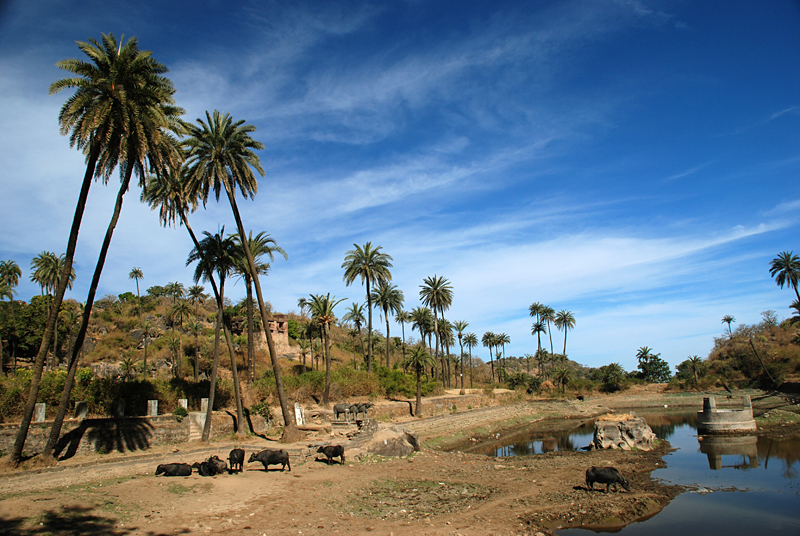
The Achaleshwar Mahadev Temple complex at the base features classical Paramara stone carvings. Adjacent to the temple lies the sacred *Mandakini Kund*, a picturesque stone water reservoir surrounded by carved steps. On its rocky embankment stand carved stone statues of King Adi Pal of the Paramara dynasty poised with a bow, commemorating the legendary slaying of three mythological water demons.
4. Archaeological Excavations, Epigraphy & Conservation
The State Archaeology Department stabilized the ancient Hanuman Pol gateway and pointed shifting granite masonry joints.
Cleaned the Mandakini Kund, desilted ancient water channels, and secured the stone statues of King Adi Pal.
Paved the mountain access trail leading from the temple base to the upper Kumbha palace ruins.
Entry to Achalgarh Fort and Achaleshwar Mahadev Temple is free. Voluntary temple offerings are accepted.
5. Master Highlights & Archaeological Marvels
Maharana Kumbha's Frontier Citadel: Reconstructed in 1452 CE atop an ancient 9th-century Paramara mountain stronghold.

Toe of Lord Shiva Sanctum: The only temple in India where the right great toe of Lord Shiva is worshipped in a subterranean chasm.
Colossal Panchadhatu Nandi: A massive 4-ton bull statue cast of five sacred metals that withstood historical cannonballs.
6. Visiting Hours, Entry Permits & Visitor Guidelines
Open daily from 6:00 AM to 7:00 PM. Visiting Achaleshwar temple and hiking to the upper fort requires 2 to 3 hours.
Morning visits allow peaceful participation in the sacred Aarti at Achaleshwar and cooler temperatures for the uphill fort hike.
Remove footwear before entering the Achaleshwar Mahadev Temple compound.
Exercise caution when exploring the ruined fort ramparts; stay away from steep cliff edges.
The hike to the upper fort is steep and rocky; wear comfortable walking shoes and carry drinking water.
7. Site Museum & Interpretation Centers
The Dilwara Jain Temples are situated 8 km southwest along the scenic forest road.
Guru Shikhar, the highest peak in the Aravalli Range (5,650 feet), lies 7 km northeast.
8. Climate, Best Seasons & Ideal Visiting Hours
October through March is the premier season to visit, featuring cool, pleasant weather and clear mountain skies.
Monsoon months (July–September) bring lush green vegetation, flowing mountain springs, and dramatic drifting mist.
9. Transit Logistics, Rail, Air & Road Access
Located in Achalgarh village, 11 km north of Mount Abu town in Sirohi district, Rajasthan.
Easily reached by private taxi, rental car, or shared jeep from Mount Abu town center in approximately 20 minutes.
10. Regional Heritage Circuits & Sibling Monuments
Achalgarh is the high mountain bastion of the Mount Abu Royal Heritage Circuit:
Sacred Architecture & Darshan Protocol Guide
Maximize your spiritual journey: VIP vs Sugam Darshan line reality, locker rules, and historical truth.
- ✓Sugam Darshan & Token Blueprint: Accurate online booking rules, pre-dawn passes, and entry lane realities.
- ✓Zero Commercialization Guard: Avoid bogus intermediaries, fake priest fees, and paid blessing scams.
- ✓Locker, Footwear & Mobile Safety: Verified cloakroom locations, authorized phone lockers, and security rules.
- ✓Hidden Architectural Marvels: Inscriptions, subterranean sanctums, and forgotten stone carvings.
🛡️ Personally curated by PK Gupta & the Hidden Routes research desk. Delivered directly to your Email & WhatsApp within 4–8 hours.
11. Frequently Asked Questions
Who built Achalgarh Fort in Mount Abu?
The fort was originally founded in the 9th century by the Paramara rulers and extensively reconstructed in 1452 CE by Maharana Kumbha of Mewar.
What is unique about the deity at Achaleshwar Mahadev Temple?
Instead of a traditional Shiva Lingam, the temple enshrines and worships the sacred right great toe of Lord Shiva within a natural rock fissure.
What is the Nandi statue at Achaleshwar made of?
The colossal 4-ton Nandi statue is cast from *Panchadhatu* (an alloy of five sacred metals: gold, silver, copper, brass, and zinc).
What is Mandakini Kund?
Mandakini Kund is a sacred historic water tank beside the temple, flanked by carved stone statues of Paramara King Adi Pal with his bow.
How high is Achalgarh Fort?
The upper fort stands on a rugged mountain ridge over 4,200 feet above sea level, offering 360-degree views across Mount Abu.