1. Overview & Archaeological Significance
The Badami Cave Temples, sculpted into the towering red sandstone cliffs of Bagalkot district in northern Karnataka, represent the cradle and fountainhead of rock-cut and structural temple architecture in peninsular India. Founded in the 6th century CE by the Early Chalukya dynasty under King Pulakeshin I, who established his imperial capital at *Vatapi* (modern Badami) in 543 CE, the caves were commissioned by his royal sons, King Kirtivarman I and King Mangalesha. A foundational Kannada and Sanskrit inscription in Cave 3 precisely dates its consecration to 578 CE ('Saka 500'), making it the earliest securely dated rock-cut cave temple in India.
Located in the Bagalkot district of Karnataka, Badami Cave Temples Bagalkot is centrally protected by the Archaeological Survey of India (ASI) as an irreplaceable landmark of South Asian civilization. Recognized for its early chalukyan rock-cut architecture, red sandstone cliff excavation, monolithic relief panels, the site provides profound insights into the technological prowess, cosmological beliefs, and cultural aesthetics of its ancient builders.
2. Dynastic Origins, Royal Patrons & Chronology
Vatapi was engineered as a natural mountain fortress protected on three sides by rugged cliff chasms and centered upon the sacred man-made water reservoir of Agastya Lake (*Agastya Tirtha*). The four cave temples progress chronologically and theologically up the cliffside: Cave 1 is dedicated to Lord Shiva; Caves 2 and 3 are dedicated to Lord Vishnu; and Cave 4 is dedicated to the Jain Tirthankaras. This harmonious juxtaposition reflects the ecumenical religious tolerance and cultural syncretism championed by the Early Chalukya monarchs.
Centrally protected as monuments of national importance by the Archaeological Survey of India (ASI) and featured on India's UNESCO Tentative List, the Badami caves stand as the direct stylistic progenitor that inspired the rock-cut wonders of Ellora, Elephanta, and the Pallava monuments at Mamallapuram.
3. Structural Engineering & Architectural Design
The four cave temples are excavated directly into the soft horizontal strata of the Badami sandstone formation. Each cave temple follows a consistent architectural plan: an open entrance verandah (*mukha mandapa*) supported by massive square stone pillars, leading into an inner columned hall (*maha mandapa*), and culminating in a small dark cubical sanctum (*garbhagriha*) carved into the heart of the mountain bedrock.

Cave 1 features the celebrated high-relief sculpture of an 18-armed dancing Shiva (*Nataraja*). Carved with astounding anatomical dynamism, each pair of arms demonstrates combinations of gestures depicting 81 distinct poses of classical *Natya Shastra* dance. The cave also shelters magnificent reliefs of Harihara and Ardhanarishvara flanked by celestial attendants.
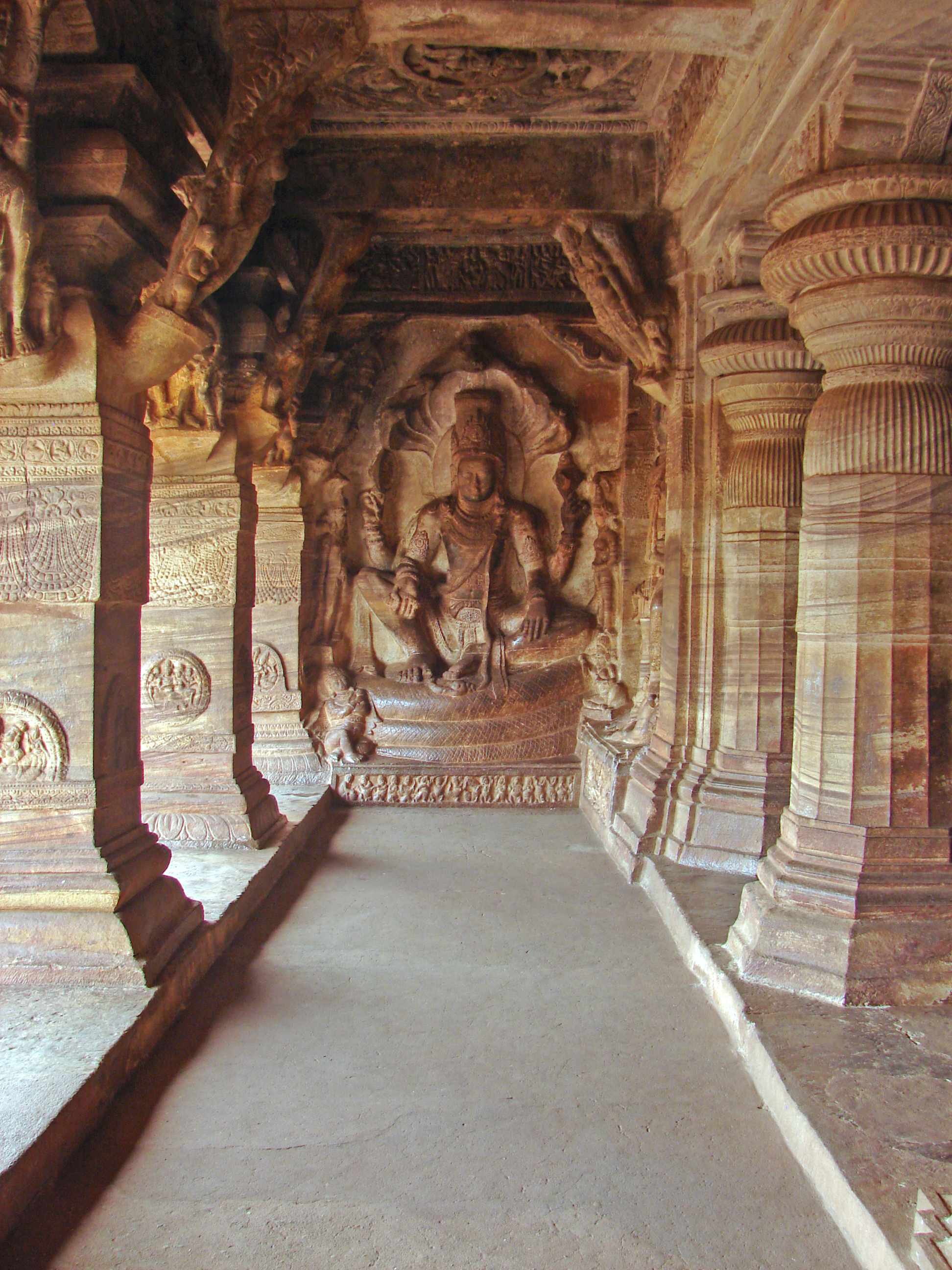
Cave 3 is the largest, most ornate, and artistically sophisticated cave in the complex, measuring nearly 21 metres wide. Its verandah features colossal relief panels of Vishnu seated upon the cosmic serpent Shesha (*Anantasayana*), a monumental standing Narasimha, Trivikrama (the cosmic stride spanning the heavens), and Varaha the boar avatar rescuing Bhudevi. The verandah ceiling preserves fragments of 6th-century royal frescoes, representing India's earliest surviving Hindu painted murals.
4. Archaeological Excavations, Epigraphy & Conservation
The famous Saka 500 (578 CE) inscription of King Mangalesha carved on the verandah pillar of Cave 3 provided modern historians with the anchor point for Chalukyan chronology.
ASI restoration works in the 1970s stabilized the stone steps cut into the rock face and created protective drainage channels to redirect monsoon runoff away from the cave facades.
Excavations along the northern banks of Agastya Lake uncovered 7th-century foundations of the Bhutanatha temple group and ancient Chalukya fortified watchtowers.
ASI entry ticket is ₹20 for Indian, SAARC, and BIMSTEC visitors via online booking (₹25 at counter), and ₹250 for foreign tourists (₹300 at counter). Free entry for children under 15.
5. Master Highlights & Archaeological Marvels
Cave 4, carved in the late 6th to early 7th century, is a Jain sanctuary enshrining a serene seated idol of Mahavira alongside relief panels of Parshvanatha sheltered by a multi-headed serpent.

A small, newly numbered fifth cave (Cave 5), located slightly beyond Cave 4, preserves a natural cave sanctum with a 6th-century relief of Lord Buddha or early Jain deity.
Agastya Lake, situated directly below the caves, provides a mesmerizing mirror reflection of the red cliff temples, flanked on the eastern bank by the scenic Bhutanatha temple complex.
6. Visiting Hours, Entry Permits & Visitor Guidelines
Open daily from 6:00 AM to 6:00 PM. The ticket counter opens at 6:00 AM and closes at 5:30 PM.
Late afternoons (4:00 PM to 6:00 PM) offer golden-hour illumination across the western-facing cave facades and dramatic sunset views over Agastya Lake.
Footwear is allowed on the outdoor rock pathways but should be removed when entering the inner cave sanctums.
Commercial video shooting and drone flights are prohibited without prior written ASI authorization.
Monkeys (bonnet macaques) are numerous and bold along the cliff steps. Keep sunglasses, water bottles, and mobile phones securely zipped inside bags.
7. Site Museum & Interpretation Centers
The ASI Archaeological Museum Badami, situated near the Bhutanatha temple on the northern lake bank, displays 6th-century sculptures, hero stones, and an ancient model of Vatapi.
The nearby Badami Fort crowns the northern cliff, preserving cannon bastions, granaries, and the Upper Shivalaya structural temple.
8. Climate, Best Seasons & Ideal Visiting Hours
October to March offers ideal weather, with pleasant daytime temperatures between 18°C and 30°C.
The monsoon season (July to September) fills Agastya Lake and creates cascading waterfalls down the red sandstone cliffs.
9. Transit Logistics, Rail, Air & Road Access
Badami is located 30 km from Bagalkot and 130 km from Hubballi (Hubli), which has the nearest domestic airport (HBX).
Badami Railway Station (BDM) is 4 km from the town center, connected by regular express trains to Bengaluru, Hyderabad, and Mumbai.
10. Regional Heritage Circuits & Sibling Monuments
Badami is the historic capital anchor of the Early Chalukya Heritage Trail:
Sacred Architecture & Darshan Protocol Guide
Maximize your spiritual journey: VIP vs Sugam Darshan line reality, locker rules, and historical truth.
- ✓Sugam Darshan & Token Blueprint: Accurate online booking rules, pre-dawn passes, and entry lane realities.
- ✓Zero Commercialization Guard: Avoid bogus intermediaries, fake priest fees, and paid blessing scams.
- ✓Locker, Footwear & Mobile Safety: Verified cloakroom locations, authorized phone lockers, and security rules.
- ✓Hidden Architectural Marvels: Inscriptions, subterranean sanctums, and forgotten stone carvings.
🛡️ Personally curated by PK Gupta & the Hidden Routes research desk. Delivered directly to your Email & WhatsApp within 4–8 hours.
11. Frequently Asked Questions
What makes the Badami Cave Temples historically important?
Consecrated around 578 CE by the Early Chalukya dynasty at their capital Vatapi, Cave 3 contains the earliest precisely dated Hindu rock-cut cave inscription in India (Saka 500 / 578 CE).
What is depicted in the 18-armed Nataraja sculpture in Cave 1?
It depicts Lord Shiva in a cosmic dance with 18 arms demonstrating combinations of hand gestures that illustrate 81 distinct poses of classical Bharatanatyam and Natya Shastra dance.
What religions are represented across the four caves?
Cave 1 is Shaivite (Shiva), Caves 2 and 3 are Vaishnavite (Vishnu), and Cave 4 is Jain (Tirthankaras), demonstrating the profound religious pluralism of the Early Chalukya Empire.
What is Agastya Lake located below the caves?
It is an ancient sacred man-made reservoir dating from the 6th century, surrounded by the red sandstone cliffs of Badami, ancient ghats, and the Bhutanatha temple complex.
Can Badami, Pattadakal, and Aihole be covered together?
Yes, Badami, Pattadakal (22 km away), and Aihole (35 km away) form the premier Early Chalukya heritage triangle and are easily explored over a two-day itinerary.