1. Overview & Archaeological Significance
Aihole (ancient *Aryapura*), situated along the Malaprabha River in Bagalkot district of northern Karnataka, is universally venerated by architectural historians as the *'Cradle of Indian Temple Architecture'*. Spanning an astonishing concentration of over 120 stone temples, monastic viharas, and rock-cut caves constructed between the 5th and 8th centuries CE under the Early Chalukya dynasty, Aihole served as the supreme experimental laboratory and training ground for medieval Indian guilds of architects, stone carvers, and engineers (*Ayyavole-500* merchant guilds).
Located in the Bagalkot district of Karnataka, Aihole Temple Complex & Durga Temple is centrally protected by the Archaeological Survey of India (ASI) as an irreplaceable landmark of South Asian civilization. Recognized for its experimental early chalukyan architecture, apsidal (gajaprishtha) plan, rock-cut caves & structural masonry, the site provides profound insights into the technological prowess, cosmological beliefs, and cultural aesthetics of its ancient builders.
2. Dynastic Origins, Royal Patrons & Chronology
Here, master craftsmen experimented with structural forms, ceiling arches, sanctum ventilation, and stone joinery—testing the transition from ancient Buddhist wooden chaityas to permanent rock-cut caves, and ultimately to free-standing sandstone structural temples. On the crest of Meguti Hill stands the Meguti Jain Temple, which preserves the world-famous *Aihole Inscription* composed in 634 CE by court poet Ravikirti. Written in flawless Sanskrit in the Old Kannada script, the inscription records the genealogy of the Early Chalukyas and details Emperor Pulakeshin II's epochal military victory over Emperor Harshavardhana of Kannauj on the banks of the Narmada River in 618 CE.
Centrally protected by the Archaeological Survey of India (ASI) and featured on India's UNESCO Tentative List, the monuments of Aihole provide an unmatched chronological timeline charting the birth, experimentation, and flourishing of classical Hindu, Buddhist, and Jain architecture in peninsular India.
3. Structural Engineering & Architectural Design
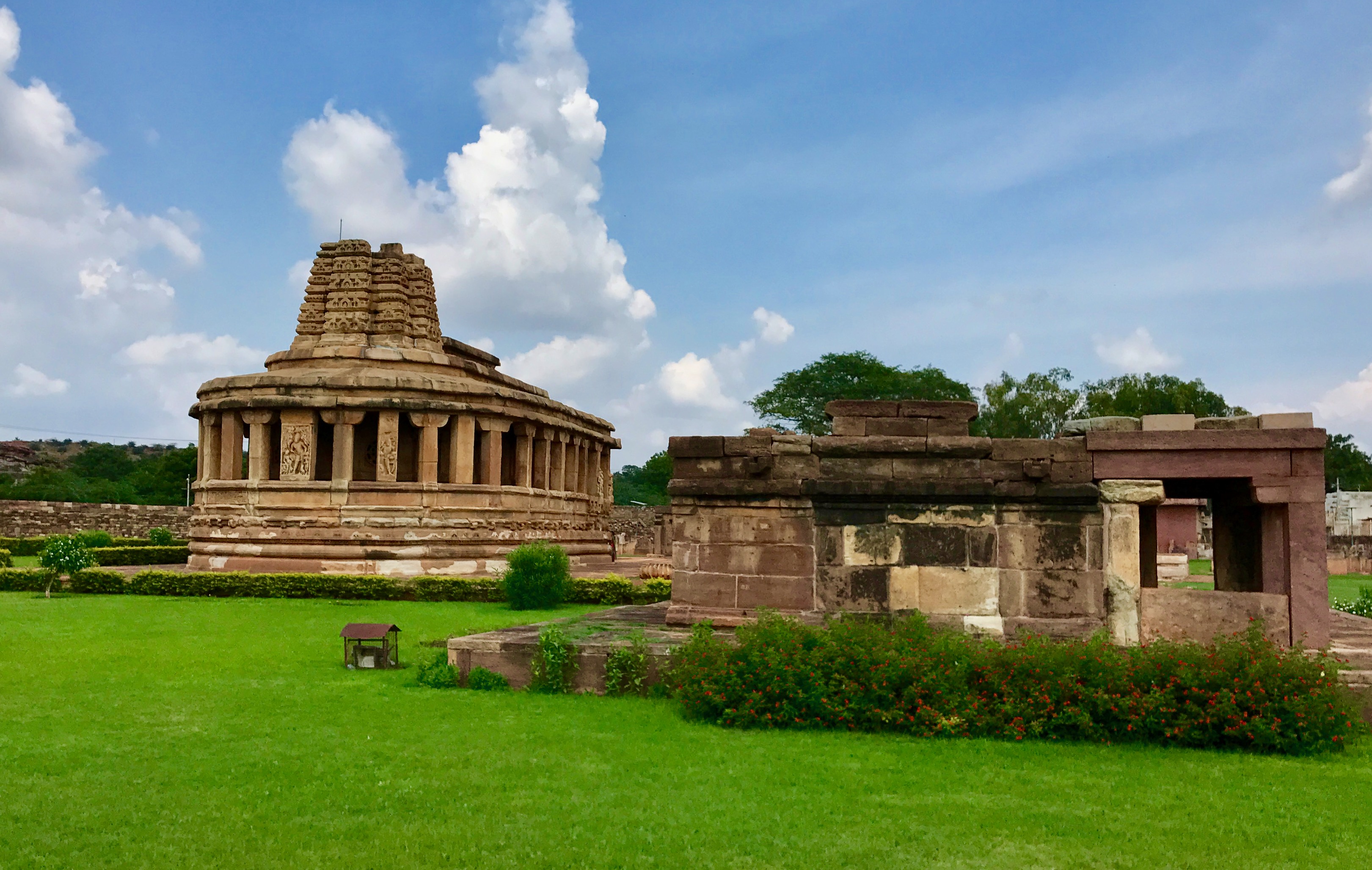
The architectural jewel of Aihole is the *Durga Temple* (built c. late 7th to early 8th century CE). Despite its modern name (derived from *durg*, meaning fortress, due to its proximity to an ancient rubble fortification), the temple was originally dedicated to Lord Surya or Vishnu. The monument is built on an extraordinary *apsidal* (horseshoe or elephant-back, *gajaprishtha*) ground plan, featuring a semicircular rounded sanctum surrounded by an open colonnaded circumambulatory corridor resting on richly carved square pillars.

The *Lad Khan Temple* (c. 6th century CE), named after a Muslim mendicant who lived in the ruined structure during the 19th century, represents the earliest surviving phase of structural temple development: an adaptation of an ancient wooden village council hall (*sabha*) into a stone temple, featuring a central square hall with pierced stone lattice windows (*jali*) and a raised roof shrine.
The sculptural art of the Durga Temple's outer peristyle represents a zenith of Early Chalukya dynamic relief carving. Niches shelter monumental sculptures of eight-armed Durga slaying the buffalo demon Mahishasura, Harihara, Varaha rescuing Bhudevi, and Narasimha, rendered with muscular vitality, serene facial expressions, and sophisticated drapery.
4. Archaeological Excavations, Epigraphy & Conservation
The Meguti Hill inscription discovered in the 1870s by J.F. Fleet established the precise dates of Kalidasa and Bharavi, providing the definitive baseline for classical Sanskrit literature chronology.
ASI excavations in the 1990s uncovered ancient iron smelting kilns, stone carving workshops, and practice blocks used by apprentice sculptors in medieval Aihole.
Structural conservation dismantled and re-erected sinking sections of the Huchimalli and Gaudara temples, stabilizing ancient stone lintels with stainless steel dowels.
ASI entry ticket is ₹20 for Indian citizens and ₹250 for foreign tourists via online booking (₹25 / ₹300 at counter). Free entry for children under 15.
5. Master Highlights & Archaeological Marvels
The Ravana Phadi Cave, carved into an isolated rock cliff north of the village, is a 6th-century Shaivite rock-cut cave featuring a monumental dancing Nataraja accompanied by the Saptamatrikas.

The Suryanarayana Temple houses an exquisite 7th-century seated stone idol of Surya driving his seven-horse chariot beneath an intact rekha-nagara shikhara.
The Meguti Jain Temple offers sweeping 360-degree panoramic vistas over the ancient river valley, ancient megalithic dolmens, and the 120 stone temples of Aihole.
6. Visiting Hours, Entry Permits & Visitor Guidelines
The main ticketed complex is open daily from 6:00 AM to 6:00 PM. Peripheral monuments across the village can be explored freely during daylight hours.
Visiting between 7:00 AM and 10:00 AM allows travelers to walk through the temple gardens before the midday sun heats the sandstone paving.
Footwear must be deposited at the shoe counter outside the main Durga Temple compound gate.
Climbing upon the delicate apsidal parapets or historic stone lattice screens is strictly prohibited.
Aihole's monuments are dispersed across a working rural agricultural village. Wear sturdy walking shoes and hire an official ASI guide to navigate between the scattered temple groups.
7. Site Museum & Interpretation Centers
The ASI Archaeological Museum Aihole, located directly behind the Durga Temple, displays rare 6th-century sculptures, architectural models, and hero stones.
The nearby Meguti Hill preserves prehistoric megalithic stone dolmens dating back over 3,000 years, illustrating Aihole's ancient human habitation.
8. Climate, Best Seasons & Ideal Visiting Hours
October to March offers cool, pleasant weather with temperatures between 18°C and 28°C and low humidity.
The post-monsoon months of August and September display scenic green agrarian landscapes surrounding the ancient red stone temples.
9. Transit Logistics, Rail, Air & Road Access
Aihole is located 35 km northeast of Badami, 13 km northeast of Pattadakal, and 145 km from Hubballi Airport (HBX).
Regular buses connect Aihole with Badami, Pattadakal, and Bagalkot. Taxis can be hired in Badami for a combined day tour.
10. Regional Heritage Circuits & Sibling Monuments
Aihole is the indispensable historical genesis of the Early Chalukya Heritage Trail:
Sacred Architecture & Darshan Protocol Guide
Maximize your spiritual journey: VIP vs Sugam Darshan line reality, locker rules, and historical truth.
- ✓Sugam Darshan & Token Blueprint: Accurate online booking rules, pre-dawn passes, and entry lane realities.
- ✓Zero Commercialization Guard: Avoid bogus intermediaries, fake priest fees, and paid blessing scams.
- ✓Locker, Footwear & Mobile Safety: Verified cloakroom locations, authorized phone lockers, and security rules.
- ✓Hidden Architectural Marvels: Inscriptions, subterranean sanctums, and forgotten stone carvings.
🛡️ Personally curated by PK Gupta & the Hidden Routes research desk. Delivered directly to your Email & WhatsApp within 4–8 hours.
11. Frequently Asked Questions
Why is Aihole called the 'Cradle of Indian Temple Architecture'?
Because over 120 stone temples were built here between the 5th and 8th centuries by Chalukyan guilds experimenting with structural forms, ceiling domes, and stone carving techniques that defined later Indian architecture.
What is unique about the Durga Temple at Aihole?
It is built on a rare apsidal (horseshoe or elephant-back) ground plan inspired by ancient Buddhist chaitya halls, featuring an open peristyle corridor with magnificent high-relief sculptures.
What is the famous Aihole Inscription on Meguti Hill?
It is a 634 CE Sanskrit poetic inscription composed by court poet Ravikirti recording Emperor Pulakeshin II's historic military defeat of King Harshavardhana, while also confirming the dates of Kalidasa.
Why is the Lad Khan Temple named after a person?
It was named after a Muslim Sufi mendicant named Lad Khan who temporarily resided in the ruined 6th-century temple during the 19th century before archaeological clearance.
Is entry to the Aihole monument complex ticketed?
The central Durga Temple complex is ticketed (ASI online ₹20 Indians / ₹250 foreigners), while many peripheral temples scattered across the village are freely accessible.