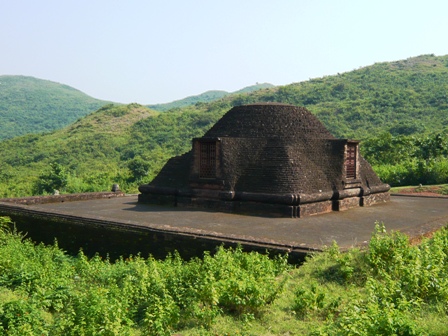
1. Overview & Archaeological Significance
Udayagiri ('The Hill of the Rising Sun'), located in the Jajpur district of coastal Odisha along the Birupa River valley, is the largest monastic settlement in the celebrated Buddhist 'Diamond Triangle' (comprising Ratnagiri, Lalitgiri, and Udayagiri). Flanked by the scenic backdrop of the Assia hill range, Udayagiri was known in ancient epigraphs as *Madhavapura Mahavihara* and *Simhaprashtha Mahavihara*. Flourishing from the 7th to the 12th century CE under the patronage of the Bhauma-Kara and Somavamshi kings, the university served as an expansive residential academy and tantric meditation sanctuary.
Located in the Jajpur district of Odisha, Udayagiri Buddhist Monastery is centrally protected by the Archaeological Survey of India (ASI) as an irreplaceable landmark of South Asian civilization. Recognized for its vast brick monastic complexes, monumental stone stepwell & rock-cut sculptures, the site provides profound insights into the technological prowess, cosmological beliefs, and cultural aesthetics of its ancient builders.
2. Dynastic Origins, Royal Patrons & Chronology
The site was documented in the late 19th century by British civil servant John Beames and later excavated in two major campaigns by the Archaeological Survey of India: Udayagiri-1 (excavated 1985–1989 under B.K. Ratha) and Udayagiri-2 (excavated 1997–2003 under P.K. Trivedi). These excavations brought to light a vast campus covering hundreds of acres, complete with two monumental brick monasteries, soaring stupas, a monumental ancient stepwell (*vapi*), and rock-cut cave sanctuaries.
Inscribed terracotta sealings discovered in situ bearing the legend *Sri Madhavapura Mahavihariya Arya Bhikshu Sanghasya* definitively confirmed the monastic identity of the ruins. The site is uniquely celebrated for its monumental stone stepwell—one of the earliest and largest stone-cut stepwells in eastern India—and its colossal rock-cut sculptures of Buddhist deities chiseled into the living hillside.
3. Structural Engineering & Architectural Design
The architectural layout of Udayagiri is organized into two primary sectors: Udayagiri-1 and Udayagiri-2. Udayagiri-1 is dominated by a massive brick-built Maha Stupa rising 7 metres high on a square plinth, surrounded by four cardinal niches housing colossal seated stone sculptures of the Dhyani Buddhas (Akshobhya, Amitabha, Amoghasiddhi, and Ratnasambhava), carved with exquisite spiritual poise.

Udayagiri-2 (Madhavapura Mahavihara) is an immense brick monastery complex measuring 35 metres square. Entered through an imposing stone gateway adorned with dynamic dvarapalas, it features an open central courtyard paved with stone flags, surrounded by a pillared verandah giving access to 18 residential monk cells. At the rear sanctum stands a colossal 3-metre seated Buddha in Bhumisparsha mudra, resting on an ornate stone throne carved with lions and elephants.
The engineering triumph of Udayagiri is its monumental rock-cut Stepwell (*vapi*), measuring 9.4 metres square and 7 metres deep, approached by a grand descending flight of 31 stone steps chiseled through living rock. A 10th-century stone inscription carved on the rock wall records the dedication of the well by a devout Buddhist monk named Ranaka Vajranaga for the merit of all living beings.
4. Archaeological Excavations, Epigraphy & Conservation
P.K. Trivedi's excavations between 1997 and 2003 at Udayagiri-2 uncovered a dedicated residential hospital complex, an Ayurvedic stone grinding trough, medicine storage pits, and brass surgical implements.
Excavations yielded over 100 stone sculptures of Tantric Vajrayana deities, including rare representations of Aparajita trampling Ganesha, Marichi riding a chariot pulled by seven boars, Kurukulla, and multi-armed Avalokiteshvara.
Along the northern ridge, excavators uncovered rock-cut cliff sanctuaries with relief panels of twelve standing Bodhisattvas, proving that the monks utilized the secluded natural rock shelters for esoteric meditation.
Udayagiri Buddhist Monastery is a Centrally Protected Monument under the Archaeological Survey of India (Bhubaneswar Circle). Admission is free for all visitors.
5. Master Highlights & Archaeological Marvels
The ancient stone stepwell (vapi) is an unforgettable architectural highlight, allowing visitors to walk down the ancient stairs into the cool stone cistern.

The central sanctum of Udayagiri-2 with its colossal seated Buddha figure retains its ancient spiritual grandeur in a quiet valley setting.
The rock-cut carvings on the upper hillside offer an evocative outdoor gallery of medieval Tantric Buddhist sculpture.
6. Visiting Hours, Entry Permits & Visitor Guidelines
Udayagiri is open daily from sunrise to sunset (6:00 AM to 6:00 PM). Accessible all days of the year.
Admission is completely free for all domestic and foreign visitors. Free parking is available near the entrance gate.
Visitors must not walk on or dislodge bricks from the monastery walls or deface the rock-cut carvings.
Personal photography without tripods is permitted; commercial filming and drones require prior written ASI authorization. Wear comfortable walking shoes.
Udayagiri is a Centrally Protected archaeological reserve. Vandalism, defacing stone carvings, or unauthorized digging is strictly punishable under the AMASR Act 1958.
7. Site Museum & Interpretation Centers
Antiquities excavated from Udayagiri are preserved in the ASI Archaeological Museum at nearby Ratnagiri and the Odisha State Museum in Bhubaneswar.
Informational signboards installed across the site provide architectural plans and translations of the Ranaka Vajranaga stepwell inscription.
8. Climate, Best Seasons & Ideal Visiting Hours
The best time to visit Udayagiri is from October to March, with pleasant winter weather and temperatures between 16°C and 28°C.
Summers (April to June) are hot and humid. Early mornings offer peaceful exploration accompanied by birdsong in the valley.
9. Transit Logistics, Rail, Air & Road Access
Udayagiri is located in Jajpur district of Odisha, 10 kilometres from Ratnagiri, 65 kilometres northeast of Cuttack, and 90 kilometres northeast of Bhubaneswar.
Easily accessible by taxi via NH 16 and Chandikhole in about 2 hours from Bhubaneswar. Biju Patnaik International Airport (BBI, 90 km) provides air connectivity.
10. Regional Heritage Circuits & Sibling Monuments
Udayagiri completes the famous Diamond Triangle Buddhist Circuit of Odisha:
Sacred Architecture & Darshan Protocol Guide
Maximize your spiritual journey: VIP vs Sugam Darshan line reality, locker rules, and historical truth.
- ✓Sugam Darshan & Token Blueprint: Accurate online booking rules, pre-dawn passes, and entry lane realities.
- ✓Zero Commercialization Guard: Avoid bogus intermediaries, fake priest fees, and paid blessing scams.
- ✓Locker, Footwear & Mobile Safety: Verified cloakroom locations, authorized phone lockers, and security rules.
- ✓Hidden Architectural Marvels: Inscriptions, subterranean sanctums, and forgotten stone carvings.
🛡️ Personally curated by PK Gupta & the Hidden Routes research desk. Delivered directly to your Email & WhatsApp within 4–8 hours.
11. Frequently Asked Questions
What is Udayagiri in the Diamond Triangle known for?
Udayagiri is the largest of the three Diamond Triangle sites in geographic area, known for its monumental stone stepwell (vapi), two vast brick monasteries, soaring brick stupas, and rock-cut Buddhist sculptures.
What was the ancient name of Udayagiri Monastery?
Ancient clay sealings recovered during excavations confirm its name as Madhavapura Mahavihara (and Simhaprashtha Mahavihara), dating from the 7th to 12th century CE.
What is unique about the stepwell at Udayagiri?
The stepwell (vapi) is one of the oldest and largest rock-cut stone stepwells in eastern India, approached by 31 stone steps and bearing a 10th-century inscription by a Buddhist monk named Ranaka Vajranaga.
What are the visiting hours and entry fees for Udayagiri?
The archaeological site is open daily from sunrise to sunset with free entry for all visitors.
How far is Udayagiri from Ratnagiri and Lalitgiri?
Udayagiri is just 10 km from Ratnagiri and 14 km from Lalitgiri, making it effortless to visit all three sites together in a single day.