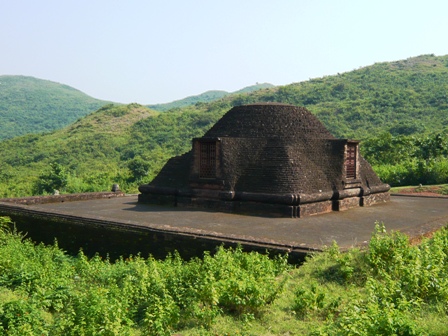
1. Overview & Archaeological Significance
Lalitgiri (ancient Chandraditya-giri), located in the Mahanga tahsil of Cuttack district in coastal Odisha, is the oldest and most continuous Buddhist establishment in Odisha, forming a vital anchor of the historic 'Diamond Triangle'. With an unbroken architectural and cultural history spanning an astonishing 1,600 years—from the Mauryan period in the 3rd century BCE under Emperor Ashoka, through the Kushana and Gupta epochs, to its zenith under the Bhauma-Kara kings in the 9th to 12th centuries CE—Lalitgiri provides physical testimony to the genesis, classical development, and Tantric evolution of Buddhist monasticism.
Located in the Cuttack district of Odisha, Lalitgiri Buddhist Complex is centrally protected by the Archaeological Survey of India (ASI) as an irreplaceable landmark of South Asian civilization. Recognized for its hilltop stone stupa, apsidal brick chaitya-griha & four quadrangular monasteries, the site provides profound insights into the technological prowess, cosmological beliefs, and cultural aesthetics of its ancient builders.
2. Dynastic Origins, Royal Patrons & Chronology
In 1985, during scientific excavations conducted by the Archaeological Survey of India under G.C. Chauley, Lalitgiri yielded one of the most sensational sacred discoveries in modern Buddhist history. Sinking trenches into the core of the hilltop Maha Stupa, archaeologists unearthed three nested, puzzle-like relic caskets. The outer casket was carved of local khondalite stone, enclosing an inner steatite box, which held a silver casket, which in turn protected a delicate gold capsule containing tiny charred bone fragments, believed to be the sacred relics of Lord Gautama Buddha or his chief disciples.
Lalitgiri was described by Chinese pilgrim Xuanzang in 639 CE as the monastery of *Pushpagiri* ('Hill of Flowers'), whose stupa emitted miraculous rays of divine light. Excavations revealed a vibrant academic and monastic campus featuring four monumental monasteries (Monasteries 1 through 4), an ancient apsidal brick Chaitya-griha, and a state-of-the-art site museum inaugurated by the Government of India in 2018 to enshrine the holy relic caskets.
3. Structural Engineering & Architectural Design
The architectural layout of Lalitgiri is arranged harmoniously across the gentle slopes of the Landa hill. Crowning the highest summit stands the Maha Stupa, constructed entirely of local khondalite stone blocks. Built on a circular plan with a diameter of 15 metres, the stupa was designed as an unadorned solid dome resting on a stepped plinth, evoking the classical simplicity of early Hinayana stupa architecture.

On the western terrace stands the magnificent apsidal Chaitya-griha, measuring 33 metres long and 11 metres wide. Built of high-fired bricks, the hall features an apsidal (semi-circular) rear end enclosing a circular stone stupa base, with a central nave separated from side aisles by a row of carved pillars—reminiscent of the great rock-cut chaitya halls of western India translated into structural brick masonry.
The four monastic quadrangles (Monasteries 1–4) exhibit classic vihara architecture: central stone-flagged courtyards surrounded by residential cells, porticos, storehouses, dining halls, and underground drainage channels. Monastery 4 features a unique double-storey brick construction with stone pillar bases and an ornate entrance gateway.
4. Archaeological Excavations, Epigraphy & Conservation
Comprehensive excavations conducted by the ASI between 1985 and 1991 under G.C. Chauley brought to light the three nested relic caskets, along with Kushana-era Brahmi inscriptions, proving that Lalitgiri had direct patronage from the 1st century CE.
Antiquities recovered include over 150 colossal stone sculptures of Gautama Buddha, Bodhisattvas (Manjusri, Avalokiteshvara, Vajrapani), Maitreya, and Tara, carved with sublime Gupta-Bhauma stylistic grace.
Inscribed terracotta sealings reading *Sri Chandraditya Vihara Samagragrya Bhikshu Sanghasya* were uncovered, definitively confirming the ancient monastic name of the university.
Lalitgiri is a Centrally Protected Monument under the ASI (Bhubaneswar Circle). Online tickets cost ₹20 for Indian, SAARC, and BIMSTEC visitors (₹25 at counter), and ₹250 for foreign tourists (₹300 at counter). The ticket includes entry to the Lalitgiri Archaeological Site Museum.
5. Master Highlights & Archaeological Marvels
Visitors can climb the stone pathway to the hilltop Maha Stupa, taking in panoramic vistas of the surrounding coastal rivers and hills.

The excavated apsidal Chaitya-griha allows visitors to walk through ancient prayer aisles and admire the brick engineering of early Buddhist architecture.
The world-class Lalitgiri Archaeological Museum displays the original gold, silver, and steatite relic caskets in a secure, climate-controlled sanctum gallery.
6. Visiting Hours, Entry Permits & Visitor Guidelines
Lalitgiri is open daily from sunrise to sunset (6:00 AM to 6:00 PM). Accessible all days of the year.
Online ticket costs are ₹20 for Indian and SAARC visitors, and ₹250 for foreign tourists. Children under 15 enter free. The museum is open 10:00 AM to 5:00 PM, closed on Fridays.
Visitors must not touch or climb upon the brick walls of the monasteries or the stone stupa.
Personal photography without tripods is permitted; drones require prior written ASI authorization.
Lalitgiri is an internationally sacred Buddhist relic sanctuary. Any vandalism, defacement of stone walls, or unauthorized digging will attract severe prosecution under the AMASR Act 1958.
7. Site Museum & Interpretation Centers
The state-of-the-art Lalitgiri Archaeological Site Museum, inaugurated in December 2018, is one of the finest Buddhist museums in India, holding the sacred relic caskets in a dedicated central rotunda.
The museum also displays colossal stone statues of Buddha in diverse mudras, exquisite Tara sculptures, Kushana coins, and inscribed sealings. Closed on Fridays.
8. Climate, Best Seasons & Ideal Visiting Hours
The best time to visit Lalitgiri is from October to March, with pleasant winter temperatures between 16°C and 28°C.
Summers (April to June) are hot and humid. Late afternoons offer cool river breezes and soft photography light.
9. Transit Logistics, Rail, Air & Road Access
Lalitgiri is located in Cuttack district of Odisha, approximately 55 kilometres northeast of Cuttack Junction and 80 kilometres northeast of Bhubaneswar.
Easily reached by car or taxi along NH 16 via Cuttack, Tangi, and Chandikhole in about 2 hours from Bhubaneswar. Biju Patnaik International Airport (BBI, 85 km) connects all major metros.
10. Regional Heritage Circuits & Sibling Monuments
Lalitgiri forms the historical beginning of the Odisha Diamond Triangle Circuit:
Sacred Architecture & Darshan Protocol Guide
Maximize your spiritual journey: VIP vs Sugam Darshan line reality, locker rules, and historical truth.
- ✓Sugam Darshan & Token Blueprint: Accurate online booking rules, pre-dawn passes, and entry lane realities.
- ✓Zero Commercialization Guard: Avoid bogus intermediaries, fake priest fees, and paid blessing scams.
- ✓Locker, Footwear & Mobile Safety: Verified cloakroom locations, authorized phone lockers, and security rules.
- ✓Hidden Architectural Marvels: Inscriptions, subterranean sanctums, and forgotten stone carvings.
🛡️ Personally curated by PK Gupta & the Hidden Routes research desk. Delivered directly to your Email & WhatsApp within 4–8 hours.
11. Frequently Asked Questions
What famous discovery was made at Lalitgiri in 1985?
In 1985, ASI archaeologists excavated the hilltop Maha Stupa and discovered three nested relic caskets of khondalite, steatite, silver, and gold containing sacred bone relics believed to be of Gautama Buddha.
How old is Lalitgiri compared to Ratnagiri and Udayagiri?
Lalitgiri is the oldest of the Diamond Triangle sites, with cultural and architectural history dating back to the Mauryan period (3rd century BCE), spanning over 1,600 years of continuous Buddhist veneration.
Where are the sacred Lalitgiri relic caskets displayed today?
The sacred relic caskets are safely enshrined and displayed in the modern on-site Lalitgiri Archaeological Site Museum, inaugurated by the Government of India in 2018.
What are the visiting hours and entry fees for Lalitgiri?
The ruins are open daily from sunrise to sunset. Online ASI tickets cost ₹20 for Indian, SAARC, and BIMSTEC visitors, and ₹250 for foreign tourists. Children under 15 enter free. The museum is closed on Fridays.
How can I visit all three Diamond Triangle sites (Lalitgiri, Ratnagiri, Udayagiri) in one day?
All three sites are located within 15 km of each other in Jajpur and Cuttack districts. A day trip by taxi from Bhubaneswar (departing at 8:00 AM) allows comfortable, thorough exploration of all three sites and their museums.