1. Overview & Archaeological Significance
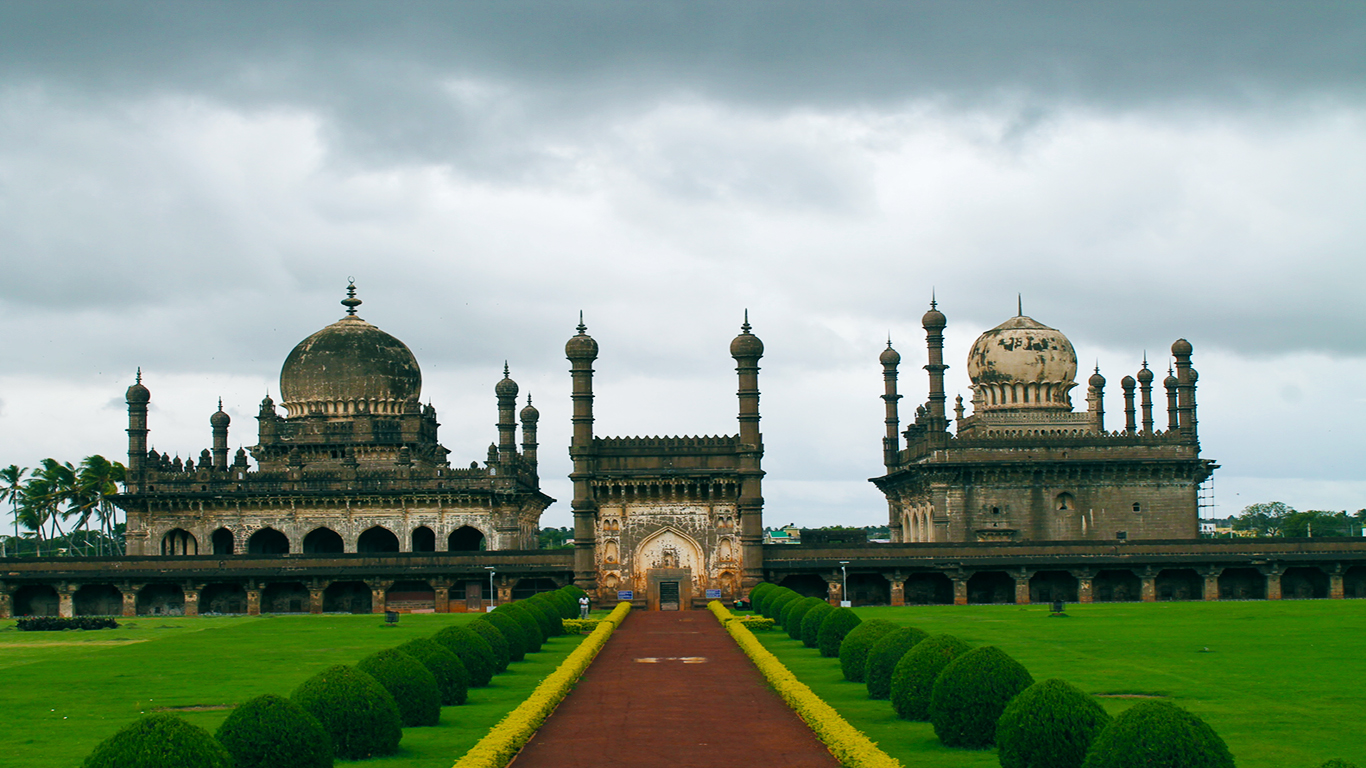
The Ibrahim Rauza (popularly celebrated as the 'Taj Mahal of the South'), serenely situated just outside the western ramparts of Vijayapura (Bijapur) in northern Karnataka, is universally regarded as one of the most artistically refined, harmoniously proportioned, and exquisitely decorated funerary complexes in the Islamic world. Commissioned by Sultan Ibrahim Adil Shah II (reigned 1580–1626 CE), the most enlightened, cultured, and religiously tolerant monarch of the Adil Shahi dynasty, the complex was originally intended as a mausoleum for his beloved queen, Taj Sultana.
Located in the Vijayapura district of Karnataka, Ibrahim Rauza Bijapur is centrally protected by the Archaeological Survey of India (ASI) as an irreplaceable landmark of South Asian civilization. Recognized for its deccan adil shahi baroque architecture, basalt stone lattice jalis & hanging stone chains, the site provides profound insights into the technological prowess, cosmological beliefs, and cultural aesthetics of its ancient builders.
2. Dynastic Origins, Royal Patrons & Chronology
However, in a twist of fate, Sultan Ibrahim Adil Shah II passed away in 1626 CE before his queen, and was interred within the grand central tomb chamber alongside his queen, his mother Haji Badi Sahiba, and his four royal sons. Designed by the visionary Iranian royal architect Malik Sandal, whose own modest tomb rests nearby within the precinct, the complex took over four decades to execute. The celebrated architectural historian James Fergusson praised Ibrahim Rauza as 'superior in its poetic grace and ornamental execution to anything built by the Mughals in Delhi or Agra'.
Centrally protected by the Archaeological Survey of India (ASI), Ibrahim Rauza is renowned for its extraordinary stone masonry: entire walls are chiseled into perforated stone jalis that form complete Quranic chapters (*surahs*), while decorative stone chains hanging from the eaves are miraculously carved from single, unbroken blocks of dark basalt rock.
3. Structural Engineering & Architectural Design
Ibrahim Rauza is designed as a perfectly balanced architectural ensemble standing upon a colossal raised stone platform measuring 110 metres (360 feet) in length and 46 metres in width. Facing each other across an ornamental sunken pool and fountain basin are two magnificent basalt structures: the grand Mausoleum (*Rauza*) on the east and the elegant Friday Mosque on the west.

The mausoleum is encircled by a double colonnade of pointed arches featuring deeply projecting eaves (*chhajjas*) supported by elaborately carved stone corbelled brackets. Hanging from the corners of these eaves are ornamental stone chains (*sangtarash zanjeer*), each link carved entirely from a continuous basalt stone block. Crowned above the central chamber is a bulbous, ribbed hemispherical dome resting on a petal-like lotus calyx, flanked at the corners by four soaring, four-tiered minarets rising 24 metres high.
The walls of the tomb chamber are an astonishing marvel of the lapidary arts: the stone windows and doors are composed of perforated stone lattice screens (*jalis*) chiseled into flowing Arabic and Persian calligraphy containing the complete text of Quranic verses, interspersed with floral arabesques and geometric tessellations. The flat ceiling of the central hall is a structural wonder, constructed of interlocking stone slabs held together without rafters, mortar, or supporting beams.
4. Archaeological Excavations, Epigraphy & Conservation
The ASI Dharwad Circle completed comprehensive micro-cleaning of the basalt calligraphic jali screens using non-invasive chemical poultices to treat atmospheric lichens.
Architectural engineers structurally consolidated the interlocking stone flat ceiling using internal stainless steel tension anchors.
The central reflecting pool and historic fountain channels were restored, surrounded by manicured lawn terraces and flowering frangipani trees.
Ibrahim Rauza is an ASI centrally protected monument. Online tickets cost ₹25 for Indian, SAARC, and BIMSTEC visitors (₹30 at counter), and ₹300 for foreign tourists (₹350 at counter). Free entry for children under 15.
5. Master Highlights & Archaeological Marvels
The breathtaking stone calligraphy screens where entire Quranic verses are carved directly into light-admitting perforated basalt stone windows.

The extraordinary hanging stone chains carved from single unbroken basalt stone blocks suspended from the roof eaves.
The flat masonry ceiling constructed of interlocking stone slabs that seemingly defies gravity without central pillars or rafters.
6. Visiting Hours, Entry Permits & Visitor Guidelines
Ibrahim Rauza is open daily from 6:00 AM to 6:00 PM throughout the year. Accessible on all days.
Online ticket costs are ₹25 for Indian and SAARC visitors, and ₹300 for foreign tourists. Children under 15 enter free.
Visitors must remove footwear before ascending the central stone terrace surrounding the tomb and mosque.
Personal photography without tripods is allowed; drones and commercial filming require prior written ASI authorization.
Ibrahim Rauza is a protected national monument under the AMASR Act 1958. Touching, pulling, or hanging from the delicate monolithic stone chains or defacing calligraphic screens will attract immediate criminal prosecution.
7. Site Museum & Interpretation Centers
The Gol Gumbaz Site Museum (3 km east) displays illuminated manuscripts of Ibrahim Adil Shah II's famous musical treatise *Kitab-i-Navras*.
Explanatory ASI signage at the entrance documents Malik Sandal's architectural career and the poetic inscriptions praising Ibrahim II's tolerance.
8. Climate, Best Seasons & Ideal Visiting Hours
The best time to visit Ibrahim Rauza is from October to March, with cool morning breezes and temperatures between 15°C and 28°C.
Late afternoons (4:00 PM to 5:45 PM) offer spectacular golden sunlight casting geometric shadows through the calligraphic stone jali screens.
9. Transit Logistics, Rail, Air & Road Access
Ibrahim Rauza is situated just outside the western Mecca Gate in Vijayapura (Bijapur), Karnataka, 2 km from Vijayapura Railway Station.
Easily reached via taxi, auto-rickshaw, or city bus in 10 minutes. Belagavi Airport (IXG, 200 km) and Hubballi Airport (HBX, 200 km) are the nearest commercial airports.
10. Regional Heritage Circuits & Sibling Monuments
Ibrahim Rauza is the artistic pinnacle of the Vijayapura Adil Shahi Heritage Trail:
Sacred Architecture & Darshan Protocol Guide
Maximize your spiritual journey: VIP vs Sugam Darshan line reality, locker rules, and historical truth.
- ✓Sugam Darshan & Token Blueprint: Accurate online booking rules, pre-dawn passes, and entry lane realities.
- ✓Zero Commercialization Guard: Avoid bogus intermediaries, fake priest fees, and paid blessing scams.
- ✓Locker, Footwear & Mobile Safety: Verified cloakroom locations, authorized phone lockers, and security rules.
- ✓Hidden Architectural Marvels: Inscriptions, subterranean sanctums, and forgotten stone carvings.
🛡️ Personally curated by PK Gupta & the Hidden Routes research desk. Delivered directly to your Email & WhatsApp within 4–8 hours.
11. Frequently Asked Questions
Why is Ibrahim Rauza called the 'Taj Mahal of the South'?
Because of its supreme architectural harmony, exquisite proportions, delicate minarets, and ornamental stone carving, which art historians compare favorably with the Taj Mahal of Agra.
Who was Ibrahim Adil Shah II?
Ibrahim Adil Shah II was the enlightened 16th-century Sultan of Bijapur, a celebrated poet, musician, and author of Kitab-i-Navras, renowned for his secular patronization of Hindu and Muslim arts.
What is unique about the stone chains at Ibrahim Rauza?
The stone chains hanging from the corners of the eaves are carved entirely from single, unbroken blocks of dark basalt stone, demonstrating astonishing medieval stone-carving craftsmanship.
What makes the ceiling of Ibrahim Rauza a structural wonder?
The central hall features a flat stone ceiling constructed of interlocking stone slabs that holds together by sheer compression and balance without rafters, beams, or supporting pillars.
What are the visiting hours and entry ticket prices?
Open daily from 6:00 AM to 6:00 PM. Online ASI tickets cost ₹25 for Indian, SAARC, and BIMSTEC visitors, and ₹300 for foreign tourists. Children under 15 enter free.