1. Overview & Archaeological Significance
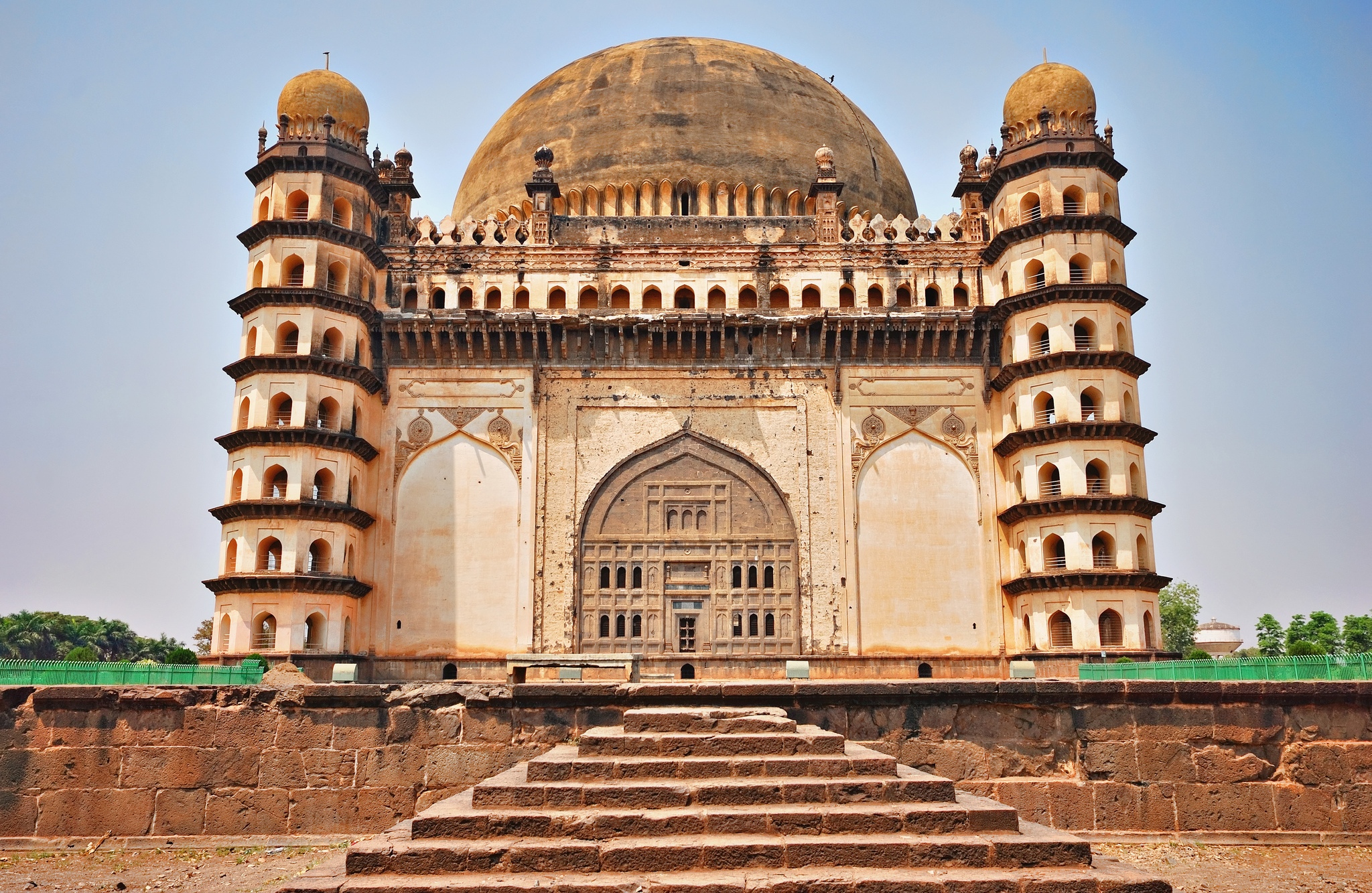
Gol Gumbaz (literally 'Circular Dome' or 'Rose Dome'), majestically dominating the historic horizon of Vijayapura (Bijapur) in northern Karnataka, is universally celebrated as one of the greatest structural and acoustic engineering triumphs of the medieval world. Commissioned in 1626 CE by Sultan Muhammad Adil Shah, the seventh monarch of the Adil Shahi dynasty of Bijapur, upon his accession to the throne, the colossal mausoleum was conceived to surpass all preexisting sepulchral monuments in the Islamic world in sheer volumetric scale.
Located in the Vijayapura district of Karnataka, Gol Gumbaz Bijapur is centrally protected by the Archaeological Survey of India (ASI) as an irreplaceable landmark of South Asian civilization. Recognized for its deccan adil shahi architecture, dark basalt, interlocking squinch arches & acoustic whispering gallery, the site provides profound insights into the technological prowess, cosmological beliefs, and cultural aesthetics of its ancient builders.
2. Dynastic Origins, Royal Patrons & Chronology
Designed by the celebrated master architect Yaqut of Dabul, the monument took thirty years of uninterrupted construction to complete, reaching completion around 1656 CE when the Sultan passed away. Housing the subterranean tombs of Sultan Muhammad Adil Shah, his senior wife Queen Taj Jahan, his younger wife Aroos Bibi, his mistress Rambha, his daughter, and his grandson, Gol Gumbaz stands as an enduring monument to the height of Deccani Sultanate power, culture, and mathematical ingenuity.
Centrally protected by the Archaeological Survey of India (ASI), Gol Gumbaz is globally renowned for its extraordinary acoustic properties: its elevated Whispering Gallery can amplify the faintest human whisper across its 38-metre circular span and echo single claps distinctly between seven and ten times. The monument underwent comprehensive acoustic and structural preservation by the ASI Dharwad Circle.
3. Structural Engineering & Architectural Design
The architectural plan of Gol Gumbaz is a colossal single-room cube measuring 47.5 metres (156 feet) on each side, constructed of local dark grey basalt and mortar. The walls are an astonishing 3 metres (10 feet) thick to withstand the tremendous lateral thrust of the masonry superstructure. The total height of the building from ground to the crowning bronze finial is 51 metres (167 feet).

Crowning this colossal cube is an immense hemispherical masonry dome measuring 44 metres (144 feet) in external diameter and 38 metres (124 feet) internally—the second largest free-standing unsupported dome in the world, surpassed only by St. Peter's Basilica in Rome. What makes this dome an engineering marvel is that it rests entirely without central pillars or columns: the weight is distributed seamlessly across eight intersecting squinch arches that form an eight-pointed star supporting the circular drum.
At a height of 33.5 metres above the floor runs the world-famous Whispering Gallery, accessible via steep spiral stone stairs inside the four corner towers. The four corner towers themselves are monumental seven-storeyed octagonal minarets rising 44 metres high, capped by domed pavilions. The acoustic resonance of the dome creates multiple echoes where every sound reflects continuously against the curved basalt vaulting.
4. Archaeological Excavations, Epigraphy & Conservation
Structural vibration monitoring conducted by the National Geophysical Research Institute (NGRI) confirmed that the 44-metre masonry dome maintains excellent seismic stability.
The ASI Dharwad Circle chemically treated the basalt surfaces of the whispering gallery and restored historic wooden door frames in the Naqqar Khana gateway.
The surrounding gardens were re-landscaped with drip-irrigated lawns and flowering bougainvillea hedges, enhancing the approach axis.
Gol Gumbaz is an ASI centrally protected monument. Online tickets cost ₹25 for Indian, SAARC, and BIMSTEC visitors (₹30 at counter), and ₹300 for foreign tourists (₹350 at counter). Free entry for children under 15.
5. Master Highlights & Archaeological Marvels
Whispering softly along the curved wall of the 38-metre gallery and having a friend hear every word clearly from the opposite side.

Clapping your hands inside the gallery and counting up to ten distinct acoustic echoes bouncing off the colossal dome.
Climbing the 7-storey corner minaret to step out onto the rooftop terrace for panoramic vistas across the historic city of Vijayapura.
6. Visiting Hours, Entry Permits & Visitor Guidelines
Gol Gumbaz is open daily from 6:00 AM to 6:00 PM throughout the year. Accessible on all days.
Online ticket costs are ₹25 for Indian and SAARC visitors, and ₹300 for foreign tourists. Children under 15 enter free.
To preserve the historic acoustic wonder, excessive screaming or shouting inside the whispering gallery is discouraged.
The narrow spiral staircases to the whispering gallery are steep; elderly visitors and children should exercise caution.
Gol Gumbaz is a Centrally Protected Monument under the AMASR Act 1958. Defacing walls, scratching graffiti on the whispering gallery balustrades, or littering will attract severe criminal penalties.
7. Site Museum & Interpretation Centers
The ASI Site Museum housed inside the historic Naqqar Khana (Drum House) gateway contains rare Adil Shahi miniature paintings, Arabic calligraphy, weapons, and stone inscriptions.
Explanatory signboards detail the mathematical principles of the intersecting squinch arches and comparisons with St. Peter's Basilica.
8. Climate, Best Seasons & Ideal Visiting Hours
The best time to visit Gol Gumbaz is from October to March, with pleasant winter weather and temperatures between 16°C and 29°C.
Early morning visits (6:30 AM to 8:30 AM) are ideal for experiencing the Whispering Gallery in relative silence before tour groups arrive.
9. Transit Logistics, Rail, Air & Road Access
Gol Gumbaz is located on Station Road in Vijayapura (Bijapur), Karnataka, just 1 km east of Vijayapura Railway Station.
Vijayapura is well connected by express trains from Bengaluru, Mumbai, and Hyderabad. Belagavi Airport (IXG, 200 km) and Hubballi Airport (HBX, 200 km) are the nearest commercial airports.
10. Regional Heritage Circuits & Sibling Monuments
Gol Gumbaz is the crown jewel of the Vijayapura Adil Shahi Heritage Trail:
Sacred Architecture & Darshan Protocol Guide
Maximize your spiritual journey: VIP vs Sugam Darshan line reality, locker rules, and historical truth.
- ✓Sugam Darshan & Token Blueprint: Accurate online booking rules, pre-dawn passes, and entry lane realities.
- ✓Zero Commercialization Guard: Avoid bogus intermediaries, fake priest fees, and paid blessing scams.
- ✓Locker, Footwear & Mobile Safety: Verified cloakroom locations, authorized phone lockers, and security rules.
- ✓Hidden Architectural Marvels: Inscriptions, subterranean sanctums, and forgotten stone carvings.
🛡️ Personally curated by PK Gupta & the Hidden Routes research desk. Delivered directly to your Email & WhatsApp within 4–8 hours.
11. Frequently Asked Questions
How large is the dome of Gol Gumbaz?
The dome has an external diameter of 44 metres (144 feet) and an internal diameter of 38 metres. It is the second-largest unsupported free-standing dome in the world after St. Peter's Basilica in Rome.
How does the Whispering Gallery at Gol Gumbaz work?
Located 33.5 metres above the floor beneath the dome, its circular concave masonry reflects sound waves without absorption. A gentle whisper is clearly heard across the 38-metre span, and any sound echoes 7 to 10 times.
Who built Gol Gumbaz and who is buried here?
It was built between 1626 and 1656 CE by Sultan Muhammad Adil Shah of Bijapur. Interred here are the Sultan, his wives Queen Taj Jahan and Aroos Bibi, his mistress Rambha, his daughter, and grandson.
What are the visiting hours and entry fees for Gol Gumbaz?
Open daily from 6:00 AM to 6:00 PM. Online ASI tickets cost ₹25 for Indian, SAARC, and BIMSTEC visitors, and ₹300 for foreign tourists. Children under 15 enter free.
How many storeys do the corner towers have?
The four corner towers are octagonal minarets rising seven storeys high (44 metres), containing spiral stone staircases that lead to the Whispering Gallery and rooftop terrace.