1. Overview & Archaeological Significance
The Barid Shahi Tombs, serenely set within a lush 55-acre botanical heritage garden on the western outskirts of Bidar city in northern Karnataka, constitute one of the most charming, ecologically rich, and architecturally distinctive funerary complexes in the Deccan. Erected between 1504 and 1619 CE, the site contains the mausoleums of the rulers of the Barid Shahi dynasty, who succeeded the crumbling Bahmani Sultanate and governed the sovereign Sultanate of Bidar for over a century until its annexation by the Adil Shahis of Bijapur.
Located in the Bidar district of Karnataka, Barid Shahi Tombs Bidar is centrally protected by the Archaeological Survey of India (ASI) as an irreplaceable landmark of South Asian civilization. Recognized for its deccan barid shahi architecture, open four-arched pavilions, granite masonry & stucco inlays, the site provides profound insights into the technological prowess, cosmological beliefs, and cultural aesthetics of its ancient builders.
2. Dynastic Origins, Royal Patrons & Chronology
The dynasty was founded by Qasim Barid I, a skilled Georgian-Turk nobleman who had served as the Prime Minister (*Mir Jumla*) of the Bahmani Empire. The Barid Shahi kings were enthusiastic patrons of the arts, literature, and the celebrated indigenous Bidri metalware craft. Unlike their predecessors who built massive enclosed mausoleums, the Barid Shahi rulers pioneered a radically different concept: open-sided garden pavilions that harmoniously integrated royal memorials into natural orchard landscapes.
Administered by the Department of Archaeology, Museums and Heritage Karnataka, the Barid Shahi park underwent extensive revitalization, integrating botanical conservation with monument preservation. Today, the 55-acre sanctuary is home to over 2,000 species of medicinal plants, ancient mango groves, and tranquil paved walking trails, making it both a premier heritage destination and a cherished urban lung for Bidar.
3. Structural Engineering & Architectural Design
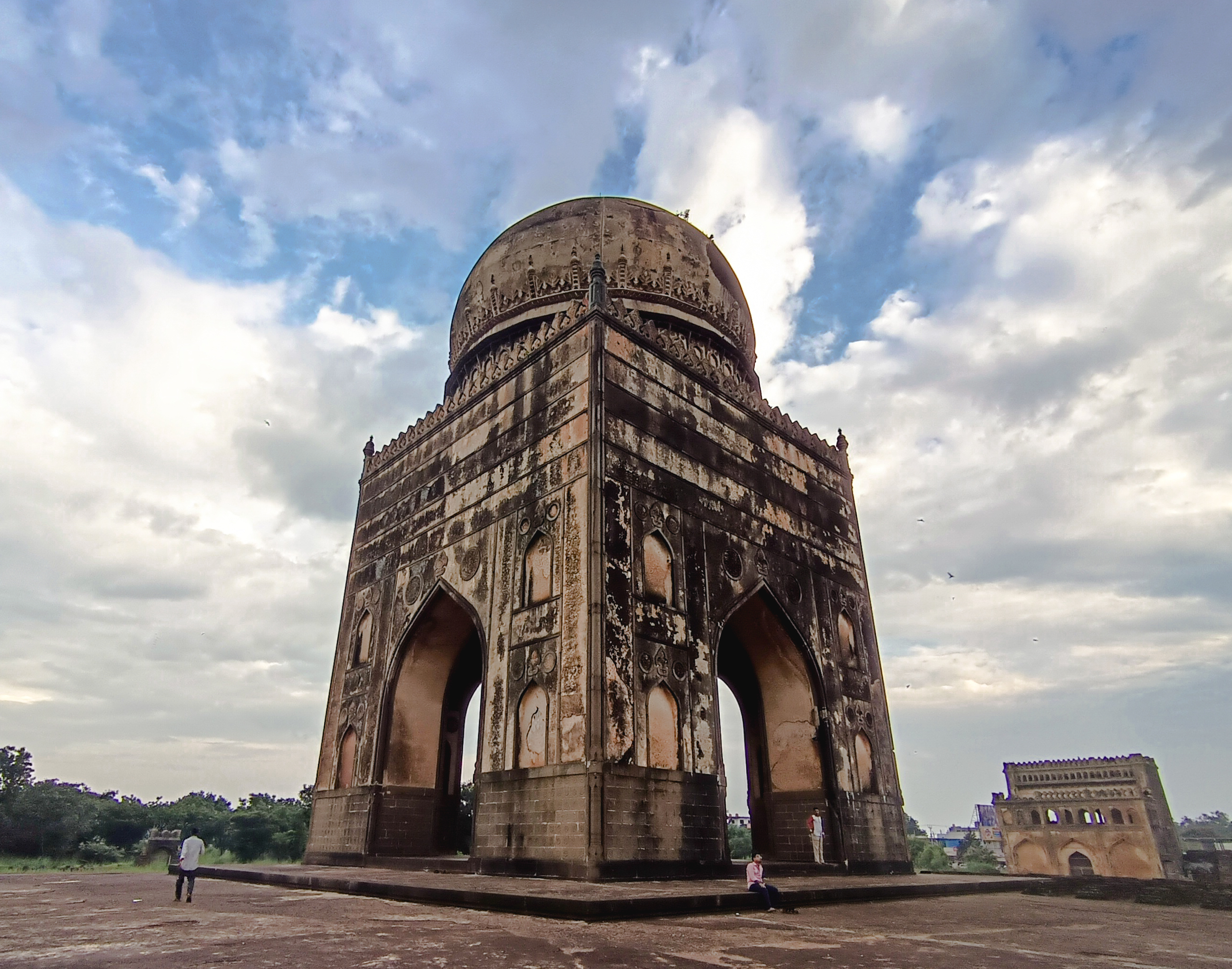
The Barid Shahi tombs represent a unique stylistic evolution in Deccani sepulchral architecture known as the 'open-pavilion' tomb. Instead of solid masonry walls with narrow doorways, the central tomb chamber is completely open on all four sides through colossal pointed arches, allowing continuous breezes and sunlight to illuminate the royal sarcophagi.

The architectural crown of the complex is the grand Mausoleum of Sultan Ali Barid Shah I (completed in 1577 CE). Rising to a height of 23 metres (75 feet) from a high two-storeyed terraced plinth, it features four soaring arched gateways supporting a colossal hemispherical dome. The interior dome is embellished with Persian glazed ceramic tiles in shades of turquoise, emerald green, and cobalt blue, interspersed with mother-of-pearl stucco inlays and Persian calligraphic poems reflecting on the transience of earthly power.
Surrounding Ali Barid's tomb are the smaller open pavilions of Sultan Ibrahim Barid and Qasim Barid II, alongside the celebrated Tomb of the Dogs, an octagonal kiosk honoring royal hunting hounds. The monument is enveloped by formal Persian Charbagh garden terraces, stone water channels, and ancient baoli stepwells.
4. Archaeological Excavations, Epigraphy & Conservation
Karnataka State Archaeology restored the two-storeyed arcaded plinth of Ali Barid's tomb in 2021, repointing basalt masonry with traditional lime mortar.
The horticulture department cataloged over 2,000 rare medicinal and indigenous Deccan trees, establishing an interpretive botanical walking trail.
Restoration of the historic stone baoli stepwell inside the park revived traditional rainwater harvesting to irrigate the 55-acre park.
The Barid Shahi Heritage Park is administered by the Karnataka State Department of Archaeology. Entry ticket costs ₹20 for Indian citizens and ₹100 for foreign tourists. Free entry for children under 5.
5. Master Highlights & Archaeological Marvels
The majestic 23-metre open-arched tomb of Ali Barid Shah, catching the cool afternoon breezes from all four cardinal directions.

Admiring the remaining patches of 16th-century Persian turquoise ceramic tiles and Quranic calligraphy on the inner dome.
Strolling along tranquil shaded pathways through the 55-acre botanical park, spotting parakeets, hornbills, and peacocks.
6. Visiting Hours, Entry Permits & Visitor Guidelines
Barid Shahi Heritage Park is open daily from 8:00 AM to 6:30 PM throughout the year. Accessible on all days.
Entry ticket costs are ₹20 for Indian visitors, and ₹100 for foreign tourists. Morning walkers are permitted from 6:00 AM to 8:00 AM.
Footwear must be removed before ascending onto the central plinth of Ali Barid's tomb.
Plucking flowers, disturbing birdlife, or littering on the garden lawns is strictly prohibited.
The Barid Shahi Tombs are protected heritage monuments under the Karnataka Ancient Monuments Act. Defacing stone arches or writing on glazed tiles will attract strict legal prosecution.
7. Site Museum & Interpretation Centers
The Bidar Fort Museum (2.5 km northeast) displays royal Barid Shahi copper plates, weapons, and historic Bidri craft items.
Botanical label plaques accompany major tree species throughout the park, detailing their Ayurvedic and ecological importance.
8. Climate, Best Seasons & Ideal Visiting Hours
The best time to visit the Barid Shahi Tombs is from October to March, with pleasant winter weather and temperatures between 16°C and 29°C.
Monsoon months (July to September) make the 55-acre garden extraordinarily green, fresh, and aromatic.
9. Transit Logistics, Rail, Air & Road Access
The tombs are located along the Udgir–Bidar Road, 2 km west of Bidar city center and 3 km from Bidar Railway Station.
Easily reached by auto-rickshaw or taxi in 10 minutes. Bidar is 140 km from Hyderabad International Airport (HYD) via NH-65.
10. Regional Heritage Circuits & Sibling Monuments
The Barid Shahi Tombs anchor the Bidar Garden & Sultanate Heritage Trail:
Sacred Architecture & Darshan Protocol Guide
Maximize your spiritual journey: VIP vs Sugam Darshan line reality, locker rules, and historical truth.
- ✓Sugam Darshan & Token Blueprint: Accurate online booking rules, pre-dawn passes, and entry lane realities.
- ✓Zero Commercialization Guard: Avoid bogus intermediaries, fake priest fees, and paid blessing scams.
- ✓Locker, Footwear & Mobile Safety: Verified cloakroom locations, authorized phone lockers, and security rules.
- ✓Hidden Architectural Marvels: Inscriptions, subterranean sanctums, and forgotten stone carvings.
🛡️ Personally curated by PK Gupta & the Hidden Routes research desk. Delivered directly to your Email & WhatsApp within 4–8 hours.
11. Frequently Asked Questions
Who were the Barid Shahis?
The Barid Shahis were the rulers of the sovereign Sultanate of Bidar (1504–1619 CE), who succeeded the Bahmani Sultans and governed Bidar for over a century, patronizing arts and the famous Bidri metalware craft.
How do Barid Shahi tombs differ from earlier Bahmani tombs?
Unlike the enclosed dark masonry vaults of Bahmani tombs, Barid Shahi tombs are unique 'open-pavilion' mausoleums open on all four sides through massive pointed arches, letting breezes and light flow through freely.
Which is the largest tomb in the complex?
The grandest tomb belongs to Sultan Ali Barid Shah I (built 1577 CE), rising 23 metres high on a two-storeyed terraced plinth, adorned with Persian turquoise glazed tiles.
What is unique about the surrounding park?
The tombs are set within a 55-acre botanical heritage park containing over 2,000 species of medicinal plants, ancient mango orchards, and thriving birdlife.
What are the visiting hours and entry fees?
Open daily from 8:00 AM to 6:30 PM. Entry tickets cost ₹20 for Indian citizens and ₹100 for foreign visitors.