1. Overview & Archaeological Significance
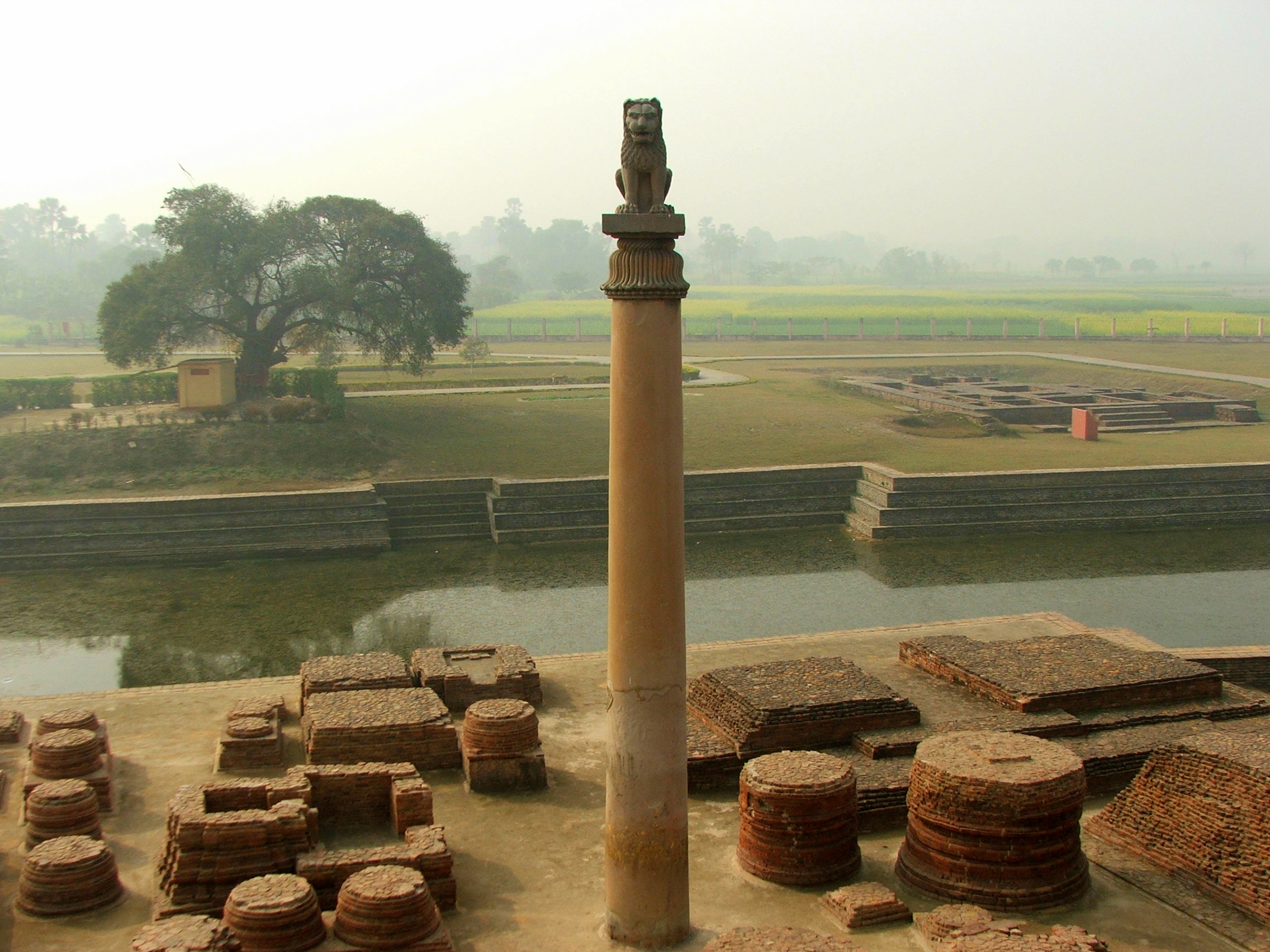
The Ashoka Pillar at Kolhua, near Vaishali in Bihar, is one of the rare surviving Mauryan monolithic columns that remains standing completely intact with its original lion capital in situ. Erected by Emperor Ashoka the Great in the 3rd century BCE, the pillar marks Kolhua as the hallowed ground where Lord Buddha preached his last sermon, formally announced his approaching Mahaparinirvana, and ordained the first Buddhist nuns, including his foster mother Mahapajapati Gotami. Vaishali was the celebrated capital of the Vajji confederacy (the world's earliest known republic governed by the Licchavis).
Located in the Vaishali district of Bihar, Ashoka Pillar Vaishali is centrally protected by the Archaeological Survey of India (ASI) as an irreplaceable landmark of South Asian civilization. Recognized for its monolithic polished chunar sandstone, bell-shaped lotus & seated lion facing north, the site provides profound insights into the technological prowess, cosmological beliefs, and cultural aesthetics of its ancient builders.
2. Dynastic Origins, Royal Patrons & Chronology
Unlike the four back-to-back lions of Sarnath, the Kolhua column is surmounted by a single, life-sized seated lion facing north—the precise direction taken by Gautama Buddha on his final terrestrial journey from Vaishali to Kushinagar. Standing 18.3 metres (60 feet) high, the column is carved from a single colossal block of buff Chunar sandstone with a mirror-smooth Mauryan polish that remains intact across its upper shaft despite over two millennia of monsoonal exposure.
Directly adjacent to the pillar stands the Anand Stupa (Asoka Stupa), built of burnt bricks over the holy relics of Ananda, the Buddha's foremost disciple and personal attendant. Beside it lies the sacred Ramkund (Markata-hrada or Monkey Tank), an ancient stepped reservoir excavated by a troop of monkeys who offered a bowl of wild honey to the Buddha—a celebrated miracle depicted frequently in classical Buddhist art. Rediscovered by Alexander Cunningham in 1861, Kolhua was systematically excavated by the ASI in multiple campaigns.
3. Structural Engineering & Architectural Design
The pillar shaft is an extraordinary monolithic cylinder rising out of a subterranean square stone base, gently tapering as it ascends toward the capital. The shaft does not bear any of Ashoka's Major Pillar Edicts, leading historians to deduce that it was erected during the earliest phase of Ashoka's reign before the standardization of imperial edict carving, or that it was purely commemorative of Buddha's last steps.

The capital comprises a bell-shaped inverted lotus crowned by a square abacus adorned with a relief frieze of sacred geese (hamsa) pecking grains while walking in pradakshina order. Surmounting the abacus is a powerful, muscular sculpture of an Asiatic lion, seated upright with bared claws and open jaws, displaying sophisticated anatomical realism. The column does, however, bear numerous later pilgrim graffiti and inscriptions in Brahmi and Shankhalipi (shell script) from the Gupta and post-Gupta eras.
Surrounding the pillar is an extensive archaeological complex encompassing an apsidal brick chaitya, a cluster of votive stupas of diverse geometric forms (circular, square, octagonal), and a monastic vihara consisting of residential dormitory cells surrounding an open brick-paved courtyard with integrated drainage channels.
4. Archaeological Excavations, Epigraphy & Conservation
Archaeological excavations at Kolhua directed by K.P. Poonacha and the Patna Circle of the ASI between 1989 and 1993 uncovered the brick foundations of Monastery 1, along with the lower brick casing of the Anand Stupa which had undergone four successive enlargements between the Mauryan and Pala epochs.
Excavations around the Ramkund pond revealed brick retaining walls, stepped bathing ghats, and inlet channels. Antiquities unearthed include terracotta sealings reading 'Vesali Anusamyaka' (Vaishali administrative seals), votive clay plaques depicting Buddha, copper coins, and NBPW (Northern Black Polished Ware) ceramic fragments.
Stratigraphic analysis of the foundation trench revealed that Ashoka's engineers stabilized the base of the massive 50-ton monolithic column by anchoring it into a deep underground bed of river sand and massive unworked boulders, explaining why it survived severe North Bihar earthquakes including the devastating 1934 seismic event.
Entry to the Kolhua Ashoka Pillar complex requires an ASI ticket. Book online via the official portal for ₹20 (Indian, SAARC, BIMSTEC) or ₹250 (foreign nationals). Counter tickets are ₹25 and ₹300 respectively. E-ticket booking is recommended to bypass queues.
5. Master Highlights & Archaeological Marvels
The undisputed highlight is the standing Ashoka Pillar, admired for its monolithic scale, intact single lion capital, and gleaming polish that catches golden hues during sunset.

The neighboring Anand Stupa reveals layered brick construction spanning centuries, with deep niches that once housed terracotta Buddha images.
The ancient Ramkund (Markata-hrada) water tank, surrounded by shaded brick walkways, evokes the miraculous legend of the honey offering by the forest monkeys.
6. Visiting Hours, Entry Permits & Visitor Guidelines
The Kolhua Archaeological Complex is open daily from 6:00 AM to 6:00 PM throughout the year. The site remains accessible on all national and public holidays.
Online ticket rates are ₹20 for Indian, SAARC, and BIMSTEC visitors, and ₹250 for foreign nationals. Children under 15 enter free. Free parking is available near the entrance gate.
Visitors must not touch the polished sandstone surface of the pillar or climb on the brick foundations of the Anand Stupa or votive stupas.
Photography is permitted without tripod or flash; commercial filming and drones require prior written ASI permissions. Please maintain silence within this active Buddhist pilgrimage site.
The Ashoka Pillar at Vaishali is a national archaeological monument of paramount importance. Defacing the column, walking across fragile brick ruins, or littering plastic will result in prosecution under the AMASR Act.
7. Site Museum & Interpretation Centers
The ASI Archaeological Museum at Vaishali, located 3 km away near the Relic Stupa of Lord Buddha, houses over 2,000 antiquities discovered across the Vaishali valley.
Notable exhibits include terracotta figurines of the Licchavi mother goddess, stone seals inscribed in Gupta Brahmi, copper implements, and a photographic record of the excavations. Open 10:00 AM to 5:00 PM, closed Fridays.
8. Climate, Best Seasons & Ideal Visiting Hours
The best time to visit Vaishali is from October to March, when winter temperatures range from 12°C to 26°C, offering pleasant sightseeing conditions.
Summers from April to June are hot (up to 42°C). Monsoons (July to September) bring refreshing rains and verdant lotus ponds, but high humidity.
9. Transit Logistics, Rail, Air & Road Access
Kolhua is situated 11 kilometres north of Vaishali town and 55 kilometres north of Patna across the Ganga river in Bihar.
The nearest railway junction is Hajipur (35 km) and Muzaffarpur Junction (36 km), both major railheads with direct trains across India. Jay Prakash Narayan International Airport in Patna (PAT, 65 km) connects all major metro cities via the Digha-Sonpur road bridge.
10. Regional Heritage Circuits & Sibling Monuments
The Vaishali Ashoka Pillar is a pivotal landmark on the North Bihar Buddhist Pilgrimage Circuit:
Sacred Architecture & Darshan Protocol Guide
Maximize your spiritual journey: VIP vs Sugam Darshan line reality, locker rules, and historical truth.
- ✓Sugam Darshan & Token Blueprint: Accurate online booking rules, pre-dawn passes, and entry lane realities.
- ✓Zero Commercialization Guard: Avoid bogus intermediaries, fake priest fees, and paid blessing scams.
- ✓Locker, Footwear & Mobile Safety: Verified cloakroom locations, authorized phone lockers, and security rules.
- ✓Hidden Architectural Marvels: Inscriptions, subterranean sanctums, and forgotten stone carvings.
🛡️ Personally curated by PK Gupta & the Hidden Routes research desk. Delivered directly to your Email & WhatsApp within 4–8 hours.
11. Frequently Asked Questions
Why does the Vaishali Ashoka Pillar have only one lion instead of four?
Unlike the four addorsed lions of Sarnath, the Vaishali column has a single seated lion facing north—the direction Gautama Buddha took on his final journey toward Kushinagar where he attained Mahaparinirvana.
Does the Ashoka Pillar at Vaishali have any edicts inscribed on it?
No, it does not bear any of Ashoka's Major or Minor Pillar Edicts, indicating it was erected early in Ashoka's reign as a purely commemorative Buddhist monument, though it bears later Gupta-era pilgrim inscriptions.
What is the legend of Ramkund (Markata-hrada) beside the pillar?
Ramkund is the legendary Monkey Tank where a troop of forest monkeys excavated a pond for the Buddha and miraculously offered him a bowl of wild honey, one of the eight great miracles in Buddha's life.
What are the visiting hours and entry fees for the Vaishali pillar?
The monument is open daily from 6:00 AM to 6:00 PM. Online tickets are ₹20 for Indian, SAARC, and BIMSTEC visitors, and ₹250 for foreign tourists. Children under 15 enter free.
How can I travel to Vaishali from Patna?
Vaishali is approximately 55 km north of Patna. You can drive across the Digha-Sonpur rail-road bridge (JP Setu) via Hajipur in about 1.5 to 2 hours by taxi or private car.