
1. Asia's Premier Sloth Bear Sanctuary on the Fringe of Hampi
Daroji Sloth Bear Sanctuary is a unique and remarkable wildlife sanctuary sprawling over 82 square kilometers of rugged, boulder-strewn granitic hills in the Ballari and Vijayanagara districts of central Karnataka. Located just 15 kilometers south of the UNESCO World Heritage ruins of Hampi and 15 kilometers east of Hosapete, the sanctuary represents one of the most successful habitat restoration achievements in peninsular India.
In the early 1990s, this arid landscape consisted of barren, heavily deforested hills threatened by stone quarrying, firewood extraction, and human encroachment.
Recognizing that the cavernous granitic boulders provided ideal shelter for a remnant population of Indian sloth bears, the Karnataka Forest Department notified the area as a protected sanctuary in October 1994. Through intensive soil conservation, construction of earthen check-dams, and massive plantation of native fruiting trees (such as ber, jamun, custard apple, and mahua), the barren rocky hills regenerated into a flourishing Deccan thorn scrub jungle supporting over 120 healthy sloth bears.
2. The Cliff Watchtower Experience: Witnessing Bears in the Wild
Unlike conventional wildlife sanctuaries where visitors search for elusive animals on dusty jeep safaris, Daroji offers an extraordinary, stationary wildlife viewing experience from a purpose-built Cliff Watchtower. Perched atop a high granitic outcrop overlooking a sweeping boulder-strewn valley, the watchtower provides an unobstructed panoramic vantage point.
Every afternoon between 4:00 PM and 6:00 PM, forest department trackers smear a sweet, nutritious mixture of jaggery, honey, puffed rice, and bajra across selected flat boulders located 150 meters below the watchtower.
As the afternoon heat subsides, the magic begins: wild sloth bears emerge from their deep rock crevices and subterranean caverns, ambling down the rocky slopes in plain sight. Visitors equipped with binoculars and telephoto lenses can observe mother bears carrying adorable furry cubs piggyback on their shoulders, males squabbling over jaggery treats, and bears using their colossal curved white claws to dig out subterranean termite mounds with vacuum-cleaner-like sucking sounds that can be heard echoing across the canyon.
3. The Indian Sloth Bear: Anatomy, Habits & Ecology
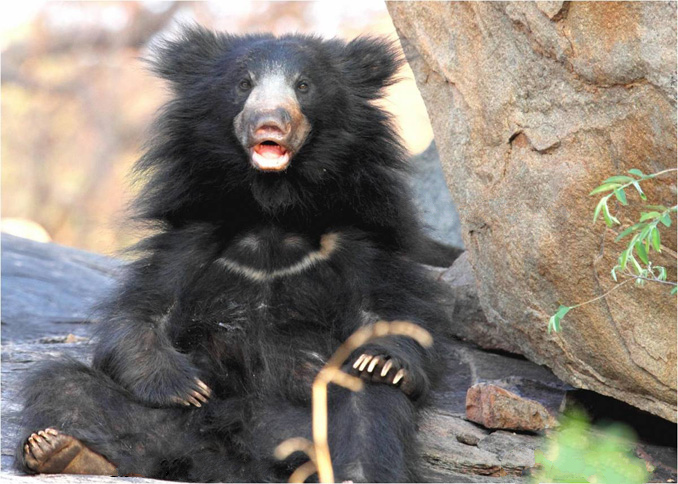
The Indian Sloth Bear (Melursus ursinus) is an endemic mammal of the Indian subcontinent, uniquely adapted to a specialized diet of social insects and wild fruits (myrmecophagy). Characterized by a shaggy, unkempt coat of coarse black hair, a distinctive V-shaped white chest blaze, a mobile snout, and long curved ivory-colored claws, the sloth bear lacks upper front incisors.
This anatomical gap allows the bear to insert its snout deep into termite mounds, blow away loose dirt, and suck out thousands of termites in seconds with acoustic force.
Despite their comical, shuffling gait, sloth bears are remarkably agile climbers capable of scaling vertical granitic cliffs and clambering into high honeycombs. While largely solitary and nocturnal, the safety of Daroji has made the local bear population comfortable foraging during late daylight hours, making it the most reliable place in the world to observe wild sloth bear behavior.
Daroji was established in 1994 as the very first sanctuary in Asia exclusively dedicated to the conservation of the Indian Sloth Bear (Melursus ursinus). In local folklore and Ramayana lore, this rugged boulder terrain corresponds to Kishkindha—the ancient bear kingdom ruled by King Jambavantha, who led his bear army to assist Lord Rama in locating Sita.
4. Coexisting Deccan Wildlife: Leopards, Hyenas & Pangolins
While the sloth bear is the undisputed flagship species, Daroji's restored thorn scrub jungle harbors a rich guild of coexisting Deccan wildlife. The rocky boulder crevices provide ideal denning sites for Indian leopards, which are frequently spotted sharing the same rocky outcrops with bears.
The sanctuary is one of the best locations in Karnataka to sight the elusive Striped Hyena (Hyaena hyaena), alongside golden jackals, Indian foxes, wild boars, and the Indian porcupine.
Herpetologists regularly record the Indian star tortoise, monitor lizards, and saw-scaled vipers among the scrub. For birdwatchers, Daroji is home to rare arid-zone specialists, including the Yellow-throated Bulbul (perched on granitic boulders), Painted Spurfowl, Sirkeer Malkoha, Chestnut-bellied Sandgrouse, and Eagle Owls.

5. Kishkindha Lore & The Granite Boulder Landscape
A visit to Daroji is deeply enriched by the mythical and geological resonance of its landscape. Geologically, these granitic boulder hills belong to the Dharwar Craton, ranking among the oldest exposed rock surfaces on earth at over 2.5 billion years old. Millennia of wind and water exfoliation have sculpted the colossal boulders into bizarre balancing rock piles, natural arches, and hollow caverns.
In Hindu mythology, this boulder realm is identified with Kishkindha, the Vanara and bear kingdom described in the Ramayana.
King Jambavantha, the immortal bear chieftain who played a pivotal role in awakening Hanuman's latent powers, is believed in sacred legend to have inhabited these very caves. Exploring Daroji just after touring the magnificent stone temples and palaces of Vijayanagara Hampi allows travelers to bridge ancient mythology with contemporary wildlife conservation.
The sanctuary is located on arid Deccan granitic rocks where afternoon temperatures routinely surpass 38°C; bear viewing takes place exclusively from the high cliff watchtower between 4:00 PM and 6:00 PM when bears emerge from caves. Visitors must maintain absolute silence on the watchtower—human whispering or sudden movements easily spook foraging bears back into the boulders.
6. Transit Logistics, Access Routes & Hampi Circuit Planning
Daroji is conveniently located 15 km from Kamalapura (Hampi), 20 km from Hosapete, and 50 km from Ballari. Hosapete Junction (HPT) is the nearest major railway hub, with direct express trains linking Bengaluru, Hyderabad, Goa, and Mumbai. Jindal Vijayanagar Airport at Toranagallu (VDY) is located 35 km away, offering scheduled domestic flights to Bengaluru and Hyderabad.
Taxis and auto-rickshaws are readily hired from Hampi or Hosapete.
The sanctuary is open to visitors daily from 2:00 PM to 6:00 PM (watchtower viewing is best between 4:00 PM and 6:00 PM). The optimal season to visit is between October and March, when winter days are dry and clear with comfortable afternoon temperatures. Daroji is a natural afternoon excursion seamlessly paired with morning exploration of the Hampi ruins.
Curated Field Dossier & Offline Google Maps Pin Pack
Bypass tourist traps with verified local logistics, exact parking coordinates, and field-tested routes.
- ✓Exact GPS Pin Pack: Unmarked parking spots, best dawn photography vantage points, and hidden trailheads.
- ✓Crowd-Avoidance Timing Matrix: Exact hour-by-hour windows to explore with zero tourist chaos.
- ✓Vetted Local Dhabas: 100% authentic, hygiene-checked regional food stops not on commercial maps.
- ✓Scam & Overcharge Shield: Verified taxi rates, auto fares, and local guide fee guidelines.
🛡️ Personally curated by PK Gupta & the Hidden Routes research desk. Delivered directly to your Email & WhatsApp within 4–8 hours.
Frequently Asked Questions
What is the best time of day to see sloth bears at Daroji?
The best time is between 4:00 PM and 6:00 PM from the Cliff Watchtower, when wild bears emerge from their boulder caves to feed on jaggery smeared on the rocks below.
How far is Daroji Sloth Bear Sanctuary from Hampi?
Daroji is located approximately 15 km (about a 25 to 30-minute drive) south of Kamalapura and Hampi, making it an easy afternoon trip from Hampi.
Are private vehicles allowed inside Daroji Sanctuary?
Visitors can drive their personal cars or taxis along the 3 km forest approach road to the watchtower parking area, after purchasing entry and vehicle permits at the sanctuary gate.
How many sloth bears live in Daroji?
The sanctuary is home to an estimated population of over 120 wild Indian sloth bears within its 82 square kilometer protected habitat.
What other animals can be spotted at Daroji?
Besides sloth bears, visitors can sight Indian leopards, striped hyenas, jackals, wild boars, porcupines, star tortoises, and rare birds like the yellow-throated bulbul.