
1. The Sahyadri Crescent & Bhadra Reservoir Basin
Bhadra Tiger Reserve (historically celebrated as the Muthodi Wildlife Sanctuary) is one of Karnataka's most scenic and ecologically successful protected areas. Nestled amidst the towering, horseshoe-shaped amphitheater of the Western Ghats across Chikkamagaluru and Shivamogga districts, the reserve encompasses nearly 500 square kilometers of pristine, unfragmented rainforest and montane woodlands.
The park is crowned by the soaring crest of Mullayanagiri and the Baba Budan range to the south, while the northern perimeter is defined by the shimmering expanse of the Bhadra River reservoir.
Originally declared a wildlife sanctuary in 1951, Bhadra was incorporated into Project Tiger in 1998 as India's 25th Tiger Reserve. What sets Bhadra apart from many other Indian reserves is its rugged, dramatic terrain: steep razor-edge ridges, deep verdant valleys, bamboo brakes, and babbling perennial streams that feed into the Bhadra River. The forest exhibits an exceptional range of vegetation types, shifting from dry deciduous woodland to dense moist semi-evergreen and high-altitude montane shola-grassland ecosystems.
2. The Historic Voluntary Village Relocation Landmark
Bhadra stands as an internationally acclaimed model in global conservation biology for its historic, entirely voluntary village resettlement program. In the late 1990s, the reserve harbored sixteen revenue villages with over 4,000 residents situated deep inside its core tiger breeding habitat, leading to severe human-wildlife conflict, cattle grazing, and forest degradation.
Through a landmark initiative spearheaded by visionary conservationists, local NGOs, and the Karnataka Forest Department, a transparent, empathetic rehabilitation package was designed.
Between 1999 and 2002, all sixteen villages voluntarily relocated outside the tiger reserve into fertile agricultural lands equipped with schools, clinics, and irrigation. Within a single decade following the departure of human settlement, the forest regenerated with miraculous speed: abandoned farmlands reverted to tall grasslands, wildlife populations surged, and Bhadra transformed into an unassailable bastion for apex predators.

3. Tigers, Leopards & The Primate Diversity of Muthodi
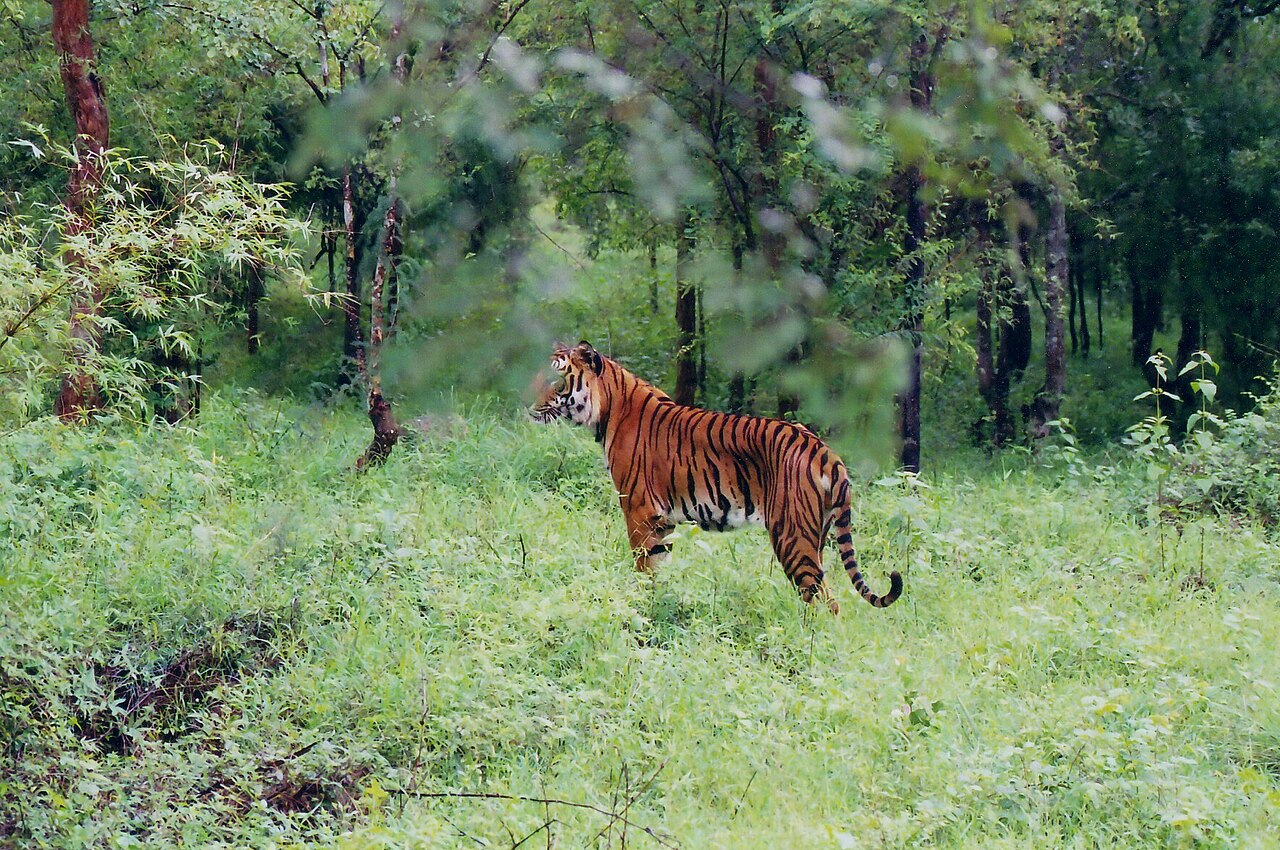
Bhadra harbors a flourishing population of over 30 Bengal tigers and an exceptionally dense population of Indian leopards. The moist understory provides abundant browse for thriving herds of gaur (Indian bison)—often seen moving in powerful herds of twenty to thirty animals—along with sambar, chital, barking deer, and the shy mouse deer (Indian chevrotain).
The canopy of Bhadra is particularly celebrated for its rich primate community.
Troops of endangered lion-tailed macaques inhabit the remote southern evergreen canopies, while common langurs, bonnet macaques, and the striking Malabar giant squirrel leap acrobatically across the towering terminalia and rosewood branches. Sloth bears are frequently encountered rummaging through termite mounds along forest fire-lines in the Muthodi range.
Every summer between March and June, the receding waters of the Bhadra reservoir expose small rocky islands near Lakkavalli. Tens of thousands of River Terns (Sterna aurantia) converge here from across peninsular India to nest and raise chicks, creating a mesmerizing spectacle of swirling wings and aerial courtship displays witnessed from safari boats.
4. Lakkavalli Reservoir Boat Safaris & River Tern Lodge
The northern sector of the reserve, centered around the town of Lakkavalli, offers a completely different wilderness experience anchored around water. Here, Jungle Lodges & Resorts operates the acclaimed River Tern Lodge, perched on a pine-clad hillock overlooking the glistening reservoir.
Boat safaris departing from Lakkavalli cruise along submerged hillocks and forested shores where wild elephants, leopards, and herds of deer come down to drink.
Between March and June, the boat safari visits the famous River Tern Island, where thousands of river terns perform dazzling aerial maneuvers and dive synchronously into the turquoise water to feed their fledglings. The reservoir also shelters massive marsh crocodiles, otters, and osprey.
5. Birdwatching: The Whistle of the Malabar Thrush
With over 250 documented bird species, Bhadra is an ornithologist's dream. The signature sound of the reserve at dawn is the melodious, flute-like song of the Malabar Whistling Thrush (fondly nicknamed the 'Whistling Schoolboy'), whose lilting notes echo across rushing forest brooks.
Walking trails around Muthodi and Lakkavalli regularly yield sightings of rare Western Ghats endemics, including the Malabar trogon, southern hill myna, ruby-throated bulbul, and the white-bellied treepie.
The reserve is also home to all four southern hornbill species, four species of kingfishers, the majestic grey-headed fish eagle, and numerous nocturnal raptors including the spot-bellied eagle-owl and Ceylon frogmouth.
During the monsoon and post-monsoon months (June to October), terrestrial safari trails at Muthodi are heavily populated by terrestrial tiger leeches; wearing leech gaiters or applying tobacco powder is advised. Safaris operate strictly under Forest Department timings (6:30–8:30 AM and 3:30–5:30 PM); unauthorized entry into core zones carries severe penalties.
6. Transit Logistics, Access Routes & Forest Excursions
Bhadra Tiger Reserve is accessed through two primary gateways. The Muthodi Wing (terrestrial jeep safari) is located 32 km northwest of Chikkamagaluru town. The Lakkavalli Wing (boat and jeep safari) is located 22 km from Tarikere and 35 km from Shivamogga.
Tarikere Junction is the closest railway station, connecting regular express trains from Bengaluru. Mangaluru International Airport (IXE) is 180 km away, and Hubballi Airport (HBX) is 170 km away.
The best season to visit Bhadra is from October to May. The post-monsoon winter months (October to February) offer breathtaking verdant landscapes, cool mountain mornings, and exceptional birdwatching. The summer months (March to May) provide the highest probability of large mammal sightings around water bodies and the peak breeding spectacle at River Tern Island.
Curated Field Dossier & Offline Google Maps Pin Pack
Bypass tourist traps with verified local logistics, exact parking coordinates, and field-tested routes.
- ✓Exact GPS Pin Pack: Unmarked parking spots, best dawn photography vantage points, and hidden trailheads.
- ✓Crowd-Avoidance Timing Matrix: Exact hour-by-hour windows to explore with zero tourist chaos.
- ✓Vetted Local Dhabas: 100% authentic, hygiene-checked regional food stops not on commercial maps.
- ✓Scam & Overcharge Shield: Verified taxi rates, auto fares, and local guide fee guidelines.
🛡️ Personally curated by PK Gupta & the Hidden Routes research desk. Delivered directly to your Email & WhatsApp within 4–8 hours.
Frequently Asked Questions
What are the two main safari entry gates for Bhadra Tiger Reserve?
The two primary gateways are Muthodi (32 km from Chikkamagaluru, famous for jeep safaris into dense shola forest) and Lakkavalli (22 km from Tarikere, famous for reservoir boat safaris and the River Tern Lodge).
Why is Bhadra famous in conservation history?
Bhadra is celebrated worldwide for the successful, completely voluntary relocation of 16 villages from its core area between 1999 and 2002, allowing the forest and tiger population to regenerate dramatically.
When can one see the River Tern nesting phenomenon?
The River Tern nesting phenomenon occurs annually between March and June, when receding reservoir waters expose nesting islands near Lakkavalli.
How far is Bhadra Tiger Reserve from Bengaluru?
Bhadra is approximately 275 km northwest of Bengaluru, taking about 5 to 5.5 hours by car via NH-75 and Chikkamagaluru (for Muthodi) or via NH-48 and Tarikere (for Lakkavalli).
Are private vehicles allowed inside the core safari zones?
No, private vehicles are strictly prohibited inside the core zones. Safaris are conducted exclusively in official Forest Department 4x4 jeeps or authorized Jungle Lodges safari boats.