Mughal Mosques on Port Hills
Andar Qila Mosque (1667) hides cross-vaulted chambers inside the old fort mound; climb nearby Batali Hill at dusk to see its dome silhouette against container-ship lights threading the Karnaphuli.
Chittagong, Bangladesh, is a working port city with 17th-century Mughal mosques. The guide covers 19 attractions. The best season to visit is October–February, with a suggested visit duration of 2–3 days. Visitors can climb Batali Hill for a 270-degree view.
The first thing that hits you in Chittagong is the smell of diesel mixing with salt—trucks idling beside the Karnaphuli River while fishermen haul silver hilsa onto a sidewalk that’s already simmering with nutmeg-colored mezban beef. Bangladesh’s second city isn’t a postcard; it’s a working port where 1,200-year-old trade routes still creak through the docks, and where a six-domed Mughal mosque can hide behind a row of LED-lit sneaker shops. If Dhaka is the country’s pulse, Chittagong is its calloused, clove-scented palm.
 Chittagong · Bangladesh
Researched from Wikidata, Wikipedia & official sources · fact-checked · Verified travel intelligence for Indian travelers
CThe first thing that hits you in Chittagong is the smell of diesel mixing with salt—trucks idling beside the Karnaphuli River while fishermen haul silver hilsa onto a sidewalk that’s already simmering with nutmeg-colored mezban beef. Bangladesh’s second city isn’t a postcard; it’s a working port where 1,200-year-old trade routes still creak through the docks, and where a six-domed Mughal mosque can hide behind a row of LED-lit sneaker shops. If Dhaka is the country’s pulse, Chittagong is its calloused, clove-scented palm.
Hills press straight against the bay here, so streets tilt like ship decks and every fourth building seems to be either a 19th-century British customs house or a concrete bunker selling dried Bombay duck. Ride the new Bangabandhu Tunnel at night and you’ll surface in Anwara to find phosphorescent plankton washing onto Guliakhali Beach, while back in town the last show at Theatre Institute Chattagram lets out onto Cheragi Pahar, where book vendors and date-sellers argue over loudspeakers until 1 a.m.
This is a city that eats beef with the lights on: mezban feasts spill onto pavements, kala bhuna blackens in woks wide as satellite dishes, and shutki—sun-dried fish so pungent it has its own market district—wafts through alleyways like a dare. Between meals, climb Batali Hill for a 270-degree view of container cranes and jungle-green ridge lines, or walk the old quarter of Anderkilla where Portuguese tilework still clings to legal chambers built in 1898. Chittagong doesn’t ask for love; it offers credit-ledgers, sea breeze, and the certain knowledge that every ship you see is carrying something someone, somewhere, can’t live without.
What makes this place worth slowing down for.
Andar Qila Mosque (1667) hides cross-vaulted chambers inside the old fort mound; climb nearby Batali Hill at dusk to see its dome silhouette against container-ship lights threading the Karnaphuli.
The scent of marigolds mixes with ink at Baatighar bookstore; evening crowds debate poetry under neon signs, a ritual since the 1950s when coffee-house intellectuals plotted literary journals.
Not a swimming strand but a front-row seat for port choreography: fishing trawlers, navy patrols, and 300-m container ships sliding past kebab stalls that fire up at sunset.
Bangladesh’s only public anatomy collection: whale vertebrae the size of truck tyres, translucent pickled sharks, and a giraffe skull that lets you eye-level with the savannah—open Sunday-Thursday, free.
Not every monument, just the ones we'd walk you past ourselves.

Ships, runways, and the Bay of Bengal collide at Patenga, Chattogram's urban beach: come for sunset, street snacks, and the city at full volume daily.
Nazir Ahmed Chowdhury Road in Chittagong, Bangladesh, is more than just a bustling thoroughfare; it is a living testament to the city's rich history, cultural…
Nestled in the vibrant heart of Chittagong’s historic Chawk Bazar, the Wali Khan Mosque stands as a resplendent symbol of Mughal architectural mastery and…
Situated along the Karnaphuli River and opening to the Bay of Bengal, the Port of Chittagong is Bangladesh’s largest and busiest maritime gateway, embodying…
Nestled in the bustling port city of Chattogram, Bangladesh, the District Stadium—also known as the Zahur Ahmed Chowdhury Stadium (ZACS)—stands as a premier…
Baitul Falah Mosque, also known as Jamiatul Falah Mosque, stands as the largest mosque in Chittagong, Bangladesh, serving as both a spiritual sanctuary and a…
Masjid-E-Siraj Ud-Daulah, also known locally as Chandanpura Masjid, is a distinguished historical and cultural landmark nestled in the heart of Chittagong,…
Where to wander, by quarter — each with its own rhythm.
The city’s mercantile spine—narrow lanes reeking of diesel and dried hilsa, where 17th-century Mughal mosques stand beside steel-shuttered hardware shops. Come for Asadganj Shutki Market, stay for the riverfront chaos of Sadarghat launch terminal at sunset.
A traffic circle turned cultural engine. Flower stalls, second-hand book carts, and the 18-year-old Baatighar bookstore anchor nightly adda (debate) sessions that spill into street-side tea. If a protest or poetry reading is happening, it starts here.
Colonial railway bungalows and banyan-shaded lanes climbing toward the 1892 Indo-Saracenic Court Building—still functioning, still the best city viewpoint. Locals jog here at dawn; couples share clandestine oranges on the stone retaining walls after dark.
Chain-café central—Segafredo, Secret Recipe, Barcode—where university students nurse TK 220 lattes and debate start-up pitches. The mirror-glass shopping arcades feel like Singapore until the power cuts and generators kick in.
Café society meets mosque acoustics. Book-exchange festivals clog the lane outside Current Book House, while inside Kadam Mubarak Mosque (1723) caretakers dust off sacred footprints between prayer times. Good spot to buy a shawarma and overhear three languages at once.
Urban beachfront grilled by port floodlights—more carnival than Caribbean. Ride the tunnel, then keep going to Guliakhali’s canal-laced sands where buffalo graze between tidal pools and the only soundtrack is clanging ship bells on the horizon.
Ramadan transforms this grid of Mughal-era lanes into a midnight kebab carnival—chicken chaap, jali kebab, rose-scented hand-churned ice cream. Off-season, it’s still the place to watch butchers rhythmically cleave beef while radios blast 90s Bollywood.
The old Portuguese-Armenian quarter now a wholesale labyrinth. Hunt for PK Sen Sattala, a 1935 reinforced-concrete palace with Hindu-Islamic-European facades, then dive into alleys selling Chinese thermos flasks next to century-old spice godowns that still smell of star anise and gunny sacks.
From Harikela coins to steel-ribbed jetties, a port that always refused to stay quiet
The first Baghdad merchants felt the tug of the Karnaphuli’s brown water and stayed. They left behind salt-glazed pottery, fragments of turquoise, and a new vocabulary—‘sultan’, ‘bazaar’, ‘adab’—that still clings to the docks like barnacles.
In Palermo’s royal scriptorium, the geographer inked ‘Samtogram’ on vellum, placing it between the Andaman Sea and the ‘Land of Elephants’. Mediterranean captains now had a name for the harbour where Bengali rice, Arakanese rubies and Chinese silk changed hands.
The Sultan of Sonargaon rode in through the Anderkilla ridge, planted his turquoise standard on the hill, and ordered a stone highway cut south to Chandpur. For the first time, Chittagong’s customs tolls flowed to a Bengali court, not an Arakanese one.
Captain João de Melo’s caravels exchanged broadsides for docking rights, turning Dianga fishing village into a red-roofed casbah. By night, the smell of bacalhau and palm-wine drifted over mudflats where Bengali, Portuguese and Arakanese mixed coins, creeds and blood.
Born in Sultanpur village, Qazi sat beneath banyan roots listening to Arakanese sailors sing of lost pearls. He rendered their tales into Bengali couplets, birthing the first literary spark in a city more used to cannon smoke than candle-lit manuscripts.
Shaista Khan’s artillery breached the riverfront fort at dawn; by sunset, green Mughal banners replaced the white Arakanese ones. The city was renamed Islamabad, and the Friday khutba echoed in Persian for the next ninety-one years.
Clive’s agents accepted the diwani keys from a Mughal envoy too tired to fight. Redcoats marched into the old stone fort, converted the Andar Qila mosque into an armoury, and painted the minaret white so ships could sight the Company’s new customs house.
At 5 a.m. the ground convulsed for four minutes; every brick wall in the fort cracked like dry mud. Over 200 people vanished into liquefied riverbanks, and the East India factory had to pitch tents on the racecourse for a year.
The Sufi who had once sold lemons in the riverside bazaar was buried on a low hillock. By dusk, thousands threw rose petals and coins, beginning a cult that still reroutes Friday traffic around his green-domed shrine.
Fifteen European merchants and two Bengali clerks signed the charter on a teak table still stained with indigo. They voted to tax every bale of jute and chest of opium to fund gas lamps that would, within a decade, turn the waterfront into a necklace of yellow flames.
At 9 a.m. the dredger ‘Platypus’ bit into the Karnaphuli bar, carving a 5.5-metre channel. Tea, jute and shellac now steamed out in steel holds, replacing the fragile wooden patas that had hugged the coast for a millennium.
Born in Raozan, the boy who would be called ‘Masterda’ first heard cannon stories from his grandfather—tales of 1857 sepoys still echoing in the hills. Those lullabies became blueprints for armoury raids that would wake an empire.
Ten teenagers in dhotis cut telegraph wires, stormed the European Club and hoisted a tricolour on the port’s tallest crane. For three days, Chittagong became a rebel republic before British Gurkhas hunted the revolutionaries through the hills of Jalalabad.
Silver Mitsubishi bombers droned in low, scattering the bazaar and leaving the airfield a lattice of craters. Overnight, the city’s skyline changed—tarpaulin hangars, searchlight batteries and Gurkha patrols replaced the lazy river cranes.
Calcutta’s loss was Chittagong’s gain: overnight the port handled 100 % of Pakistan’s eastern trade. Sirens that once saluted Armenian tea clippers now greeted rusty Liberty ships flying the new green-and-white crescent.
Chairman A.K. Khan hammered a golden bolt into berth No. 8, signalling the start of concrete silos and electric loaders. Export figures doubled in five years, and the smell of raw jute began sharing the breeze with diesel and welding sparks.
Major Ziaur Rahman’s voice crackled over captured transmitters: ‘This is Swadhin Bangla Betar…’ The port workers had already refused to unload the MV Swat’s crates of Pakistani rifles. Chittagong became the first city to declare war—and the last to see the green flag raised on 17 December.
South Korean tailors and Hong Kong zipper-makers moved into white-washed sheds where buffalo once grazed. Within a decade, ‘Made in Chittagong’ labels were showing up in Frankfurt department stores, stitched by women who rode company buses at dawn.
A 6-metre surge rode the spring tide, snapping container cranes like twigs. When the water receded, 140,000 names were missing and Patenga beach was a tangle of fishing nets and refrigerator doors. The city rebuilt on stilts—every new house a metre higher than the last.
The boy who once hawked snacks outside Chittagong Collegiate School accepted the gold medal in Oslo for turning rural women into bankers. His microphone carried the faint honk of Karnaphuli ferries—proof that a port city could export more than jute: it could ship an idea.
LED strips lit the 3.4 km tube beneath the Karnaphuli like a neon vein. For the first time in 1,400 years, you could cross the river without smelling it—an engineering whisper that the city’s next chapter might be underwater, but it will not wait for ferries.
The people who shaped the city — and were shaped by it.
He first imagined micro-credit while wandering the city’s bustling bazaars between classes; today he’d still recognise the marrow-rich mezban stalls that fueled his walks to college debates.
His maths lessons doubled as secret map-reading sessions on Batali Hill; the raid that shook the British started in a classroom that now hosts morning tuition for port workers’ children.
He practised power chords on a borrowed amp in a Patenga sea-shack; locals swear the evening wind still carries the opening riff of ‘Cholo Bodle Jai’ across the beach food carts.
She slipped into the European-only club through the Karnaphuli breeze’s cover; today the same hillside is a public park where teenagers film TikTok dances without a curfew.
Ship captains once anchored mid-river to pray at his hillside lodge; jets now roar over the tomb, yet the evening zikr circle still pauses exactly at maghrib.
Where locals actually book dinner — not the tourist menus.
Small things that change how the city treats you.
Specialist cafés serve mezbani gosht from 11 a.m.; by 2 p.m. the best pots are gone. Arrive before noon for the marrow-rich version locals queue for.
Shared auto-rickshaws run fixed routes (GEC–Agrabad, GEC–Chawkbazar) for ৳20–30—cheaper than haggling and faster than buses in the hill folds.
The beach faces west-southwest; light drops behind shipping lanes at 5:45 p.m. in winter. Bring small notes—vendors sell spiced guava for ৳10 a cup.
Outside five-star hotels, cards fail often. Withdraw in Agrabad or GEC before heading to old quarter markets—ATMs thin out past Chaktai.
Andar Qila and Kadam Mubarak mosques supply scarves, but sizes run small. Carry your own; men in shorts may be refused entry during prayer windows.
Joggers claim the 1.8 km CRB circuit from 6–7 a.m.; after 8 a.m. the same road turns into a lorry queue for the port. Go early for colonial-era shade.
The city, as it actually looks.
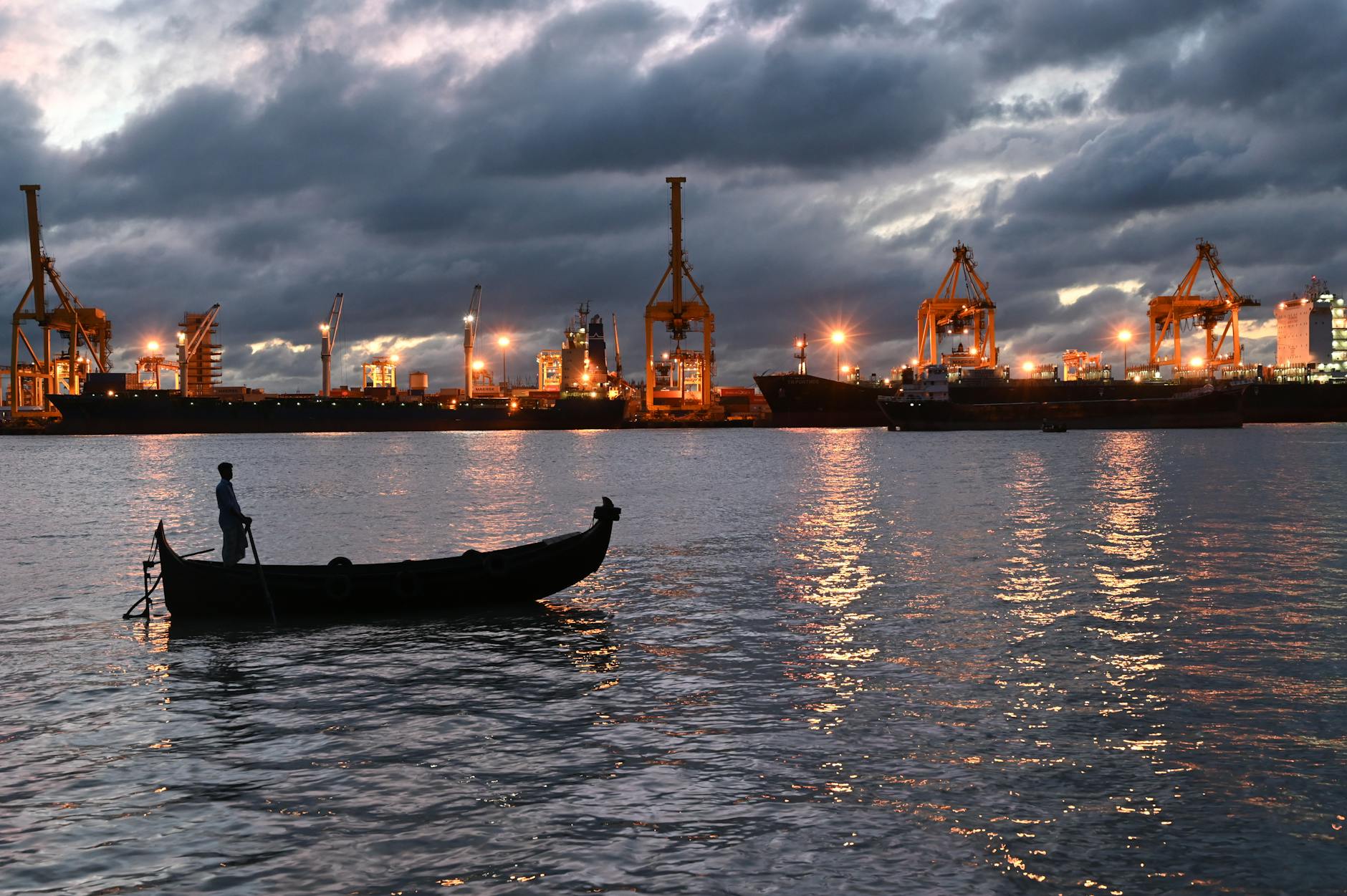
A lone boatman navigates the waters of Chittagong, Bangladesh, as the industrial port comes alive with golden lights against a moody, dramatic sunset.
Mumtahina Tanni on Pexels
Yes—its hill-backed port, 17th-century Mughal mosques, and fiery beef feasts give a completely different texture from delta-flat Dhaka or tourist-heavy Cox’s. Two days here lets you eat mezban, walk colonial railway ridges, and watch container ships slide under sunset.
Plan 2 full days for the core (old quarter mosques, CRB, Patenga sunset, mezban lunch, Ethnological Museum) and a third if you want day-trips to Sitakunda eco-park or Guliakhali beach.
Local bus 2A costs ৳25 to GEC Circle—look for the yellow sticker on the windshield. A prepaid CNG booth inside the terminal quotes ৳400 to Agrabad; bargain down to ৳250 off-peak.
Stick to stalls that cook to order and crowd between 5–8 p.m. (Jhautola, GEC). Avoid pre-peeled fruit and lukewarm bhorta; health inspectors regularly flag midday vendors near New Market.
Late October–February: humidity drops below 60 %, nights hit 18 °C, and port fog rarely delays plans. April’s pre-monsoon heat reaches 34 °C with sticky 80 % humidity—fine for food, bad for hill walks.
Only hotel-licensed bars serve foreigners legally. Radisson’s Port Bar or Hotel Tower Inn’s Night Shadow Club let non-guests in with passport; expect ৳500 cover plus 35 % tax. There is no standalone pub street.
Ready to book?
Shah Amanat International Airport (CGP) 18 km south of downtown; 30–45 min by CNG or Pathao ride. Chattogram Railway Station is the main rail terminus with daytime expresses to Dhaka (6 h) and overnight Turna Nishitha (8 h). Dhaka–Chittagong Expressway (N1) is the primary road artery; count 5–6 h by Volvo coach.
No metro or tram; city moves on CNG auto-rickshaws ( Tk 30–80 per km), ride-hailing (Pathao, Uber), and crowded buses. Amazing Chattogram open-top tourist bus runs Patenga–DC Hill–New Market at 14:45 & 15:45; day ticket Tk 250. A 2.2 km Airport Road cycling track opened 2025, but network is embryonic—stick to short hops.
Tropical monsoon: Nov–Feb dry and mild (18–26 °C), Mar–May steamy 30–34 °C, Jun–Sep monsoon deluge 300–400 mm/month. Visit Nov–Feb for clear skies and breathable hill walks; July storms can strand you in hotel cafés with sweet milky tea.
City itself is outside UK & US Hill-Tracts warning zones, but avoid political rallies and empty alleys after 22:00. Use hotel-arranged CNG for late returns; emergency dial 999. Tourist Police maintain a booth at Patenga Beach and CRB hills.
19 places to discover
Bypass tourist traps with verified local logistics, exact parking coordinates, and field-tested routes.
🛡️ Personally curated by PK Gupta & the Hidden Routes research desk. Delivered directly to your Email & WhatsApp within 4–8 hours.
Two millennia of seafaring: Arab dhows, Portuguese privateers, Mughal admirals, and the industrial lifeblood of the nation.
Chattogram’s geography has dictated regional history since antiquity. Mentioned by the Greco-Roman geographer Ptolemy in the 1st century CE as the trading port of *Pentapolis*, the natural deep-water estuary of the Karnaphuli River served as the primary gateway connecting ancient Bengal with the maritime Silk Route. By the 9th century, Arab merchants had established permanent commercial enclaves here, introducing Islam and leaving linguistic traces in the distinct local Chittagonian dialect (*Chatgaya*).
In the 16th century, Portuguese explorers and navigators arrived, designating the harbor as *Porto Grande de Bengala* (the Grand Port of Bengal), in contrast to Porto Pequeno (Satgaon on the Hooghly). For over a century, Portuguese mercenaries and Arakanese (Magh) sea-raiders controlled the delta coastline, conducting daring raids along the river channels until 1666, when the Mughal Viceroy of Bengal, Shaista Khan, dispatched a massive imperial naval flotilla that decisively captured the port, renaming it Islamabad. During the British colonial era, the Assam-Bengal Railway was constructed with its grand terminus in Chittagong, transforming the port into the premier export conduit for Assam tea and Bengal jute.
A legendary Sufi sanctuary sheltering the world's rarest freshwater reptiles.
Located six kilometers northwest of central Chittagong on a tranquil forested hillock in Nasirabad, the Shrine of Hazrat Bayazid Bostami is one of the most revered spiritual destinations in Bangladesh. Dedicated to the celebrated 9th-century Persian Sufi mystic Abu Yazid al-Bistami (who is believed by local tradition to have visited Bengal during his spiritual travels), the shrine complex centers around a tranquil, stepped masonry pond (*dighi*).
This pond is home to a world-famous biological wonder: a captive population of several hundred Black Softshell Turtles (*Nilssonia nigricans*, locally known as *Bostami Kasheem*). For decades, these gentle prehistoric reptiles—distinguished by their enormous cartilaginous shells, tube-like snouts, and docile nature—were classified by the International Union for Conservation of Nature (IUCN) as 'Extinct in the Wild', existing exclusively within the sacred pond of this Chittagong shrine. Local folklore holds that these turtles were originally evil spirits (*jinns*) who incurred the wrath of the Sufi saint and were transformed into chelonian custodians of the waters. Devotees and pilgrims flock to the water's edge to feed the turtles offerings of puffed rice (*muri*), boiled meat, and bread, watching as giant turtles over a century old surface from the green depths. Today, dedicated conservation partnerships between the shrine committee and wildlife organizations are successfully breeding these sacred reptiles and reintroducing hatchlings into protected river basins across northeastern Bangladesh.
Where oceanic sunsets meet cargo ships and the thunder of maritime trade.
Located fourteen kilometers south of the city center, Patenga Beach is Chittagong’s beloved maritime playground. Situated directly at the mouth of the Karnaphuli River as it empties into the Bay of Bengal, Patenga presents a kinetic, industrial-coastal spectacle found nowhere else in South Asia. Massive ocean-going freighters, oil tankers, and container ships ride at anchor on the horizon, waiting for tide windows to enter the river port, while naval frigates from the adjacent Bangladesh Naval Academy cruise past the shoreline.
The beach promenade is fortified with massive concrete tetrapods designed to withstand monsoonal tidal surges. At sunset, thousands of local residents gather along the sea wall to catch cool oceanic breezes and feast on iconic street delicacies: spicy, crispy fried river crab dusted with roasted cumin and chili, spicy lentil fritters (*piaju*), and fresh sugarcane juice. Nearby, the newly inaugurated Bangabandhu Sheikh Mujibur Rahman Tunnel—the first underwater road tunnel in South Asia, traversing beneath the Karnaphuli River—connects the city directly to the industrial hub of Anwara.
Preserving the vibrant heritage of the 25 distinct indigenous nationalities of Bangladesh.
Situated in the Agrabad commercial district, the Ethnological Museum of Chittagong is one of only two specialized ethnological institutions in South Asia. Established in 1974, the museum is dedicated to documenting, preserving, and celebrating the customs, lifestyle, and material culture of Bangladesh’s diverse indigenous communities, with particular emphasis on the ethnic nationalities inhabiting the adjoining Chittagong Hill Tracts.
Through meticulously curated galleries, visitors encounter authentic exhibits representing the Chakma, Marma, Tripura, Bawm, Mro, Tanchangya, Khasi, Santal, Garo, and Monipuri peoples. Displays showcase traditional bamboo stilt-house architecture (*tong ghar*), intricate backstrap handlooms used to weave colorful *pinon* and *hadi* garments, agricultural implements used for shifting hillside cultivation (*jhum*), ceremonial brass gongs, tribal hunting bows, and musical instruments like the bamboo mouth organ (*plung*). The museum provides crucial cultural context before travelers embark on journeys into the hill districts of Bandarban, Rangamati, and Khagrachhari.
From communal copper-cauldron feasts to pure vegetarian Hindu dining traditions.
The undisputed crown jewel of Chittagonian cuisine is Mezban—a centuries-old communal feast tradition organized to celebrate births, weddings, harvest milestones, and memorials. The centerpiece is *Mezbani Gosht*, where massive portions of beef or mutton are slow-cooked over firewood in enormous copper pots (*degs*). The meat is marinated in cold-pressed mustard oil, freshly ground coriander, cumin, ginger, garlic, white sesame seeds, fenugreek, and a secret blend of roasted spices that gives the curry an intense, dark mahogany hue and complex, aromatic heat. It is served atop steaming hills of parboiled white rice, accompanied by *Chonar Dal* (split Bengal gram lentils stewed with beef bones and whole spices) and *Kala Bhuna* (beef chunks braised until nearly black and intensely caramelized). Top places to sample authentic Mezbani cooking in the city include *Mezzan Haile Aaiun* and *GEC Circle Mezbani Kitchen*.
Vegetarian travelers are exceptionally well catered for in Chittagong, which is home to a prosperous and historic Bengali Hindu community centered in the commercial quarters of Teribazar, Firingi Bazar, and Sadarghat.