
Sacred Geography: The Foothill Sanctuary of Kavlem
Cradled within an emerald amphitheater of lush, forested laterite hills in Ponda taluka, Shree Shantadurga Temple occupies one of the most serene valley locations in central Goa. The village of Kavlem (Queula) sits approximately four kilometers southwest of Ponda town, sheltered from coastal sea winds by dense canopies of betel nut palms, coconut groves, and wild mango orchards.
The temple compound is centered around a sprawling stone courtyard, bordered on the southern side by an ancient rectangular sacred tank (*tirtha* or *talab*) fed by natural mountain spring waters flowing down from the surrounding hills. Slender stone steps descend into the mirror-calm water, where blooming pink lotus flowers float and fish swim undisturbed.
Surrounding the sanctum are traditional multi-story pilgrim rest houses (*agrashalas*), administrative halls, and residential quarters for temple priests, all built with classical terracotta tile roofs and arched laterite verandas that harmonize with the verdant jungle landscape.
The Goddess Who Reconciled Vishnu and Shiva
According to ancient regional scripture, Goddess Shantadurga (the peaceful form of Durga) manifested during a cosmic battle between Lord Vishnu and Lord Shiva. Appearing between the two warring deities, she placed one hand on Vishnu and the other on Shiva, calming their cosmic fury and restoring cosmic equilibrium—giving her the revered epithet *Shanta-Durga* ('Durga the Peacemaker').
Historical Odyssey: The 1566 Exodus from Keloshi to Ponda
The temple possesses a dramatic history of resilience. Originally, the sacred deity of Goddess Shantadurga was venerated in an ancient temple in the coastal village of Keloshi (Quelossim) in Salcete taluka. In 1566, facing imminent destruction during early Portuguese colonial religious campaigns, devoted Saraswat Brahmin priests smuggled the sacred idol under the cover of night across the Zuari River into the territory of the Hindu Rajas of Soonda.
The deity was initially sheltered in a modest mud-and-thatch shrine in the jungle valley of Kavlem. In 1738, during the reign of the Maratha ruler Chhatrapati Shahu Maharaj of Satara, the current monumental temple complex was constructed through the generous patronage and funding of his prime minister, Naroram Shenvi Rege, an illustrious native Goan Saraswat statesman.
The temple construction represented a glorious golden age of Hindu architectural revival in the safe haven of Ponda, establishing Kavlem as the supreme spiritual seat of the Goud Saraswat Brahmin community.
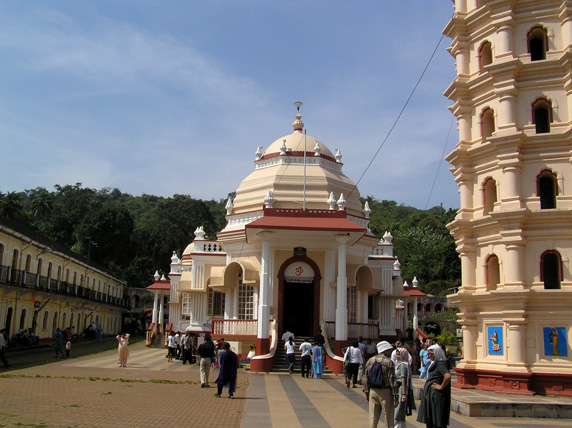
Architectural Synthesis: Indo-Portuguese Pagoda Style and Deepstambha
The architecture of Shree Shantadurga Temple is a world-famous example of the unique Goan Indo-Portuguese temple style. Unlike the stone-carved gopurams of southern India, the temple features a distinctive central pyramidal dome and octagonal shikhara reminiscent of European baroque churches, fused with multi-tiered sloping red tile roofs inspired by Nepalese and East Asian pagodas.
The facade is adorned with classical arched windows fitted with mother-of-pearl oyster shell panes (*carepas*), white fluted pilasters, and decorative balustrades. Inside, the spacious assembly hall (*sabhamandapa*) is supported by massive teakwood pillars and illuminated by antique Italian crystal chandeliers suspended from the high ceiling.
Standing majestically in the central courtyard is the temple's iconic *Deepstambha* (lamp tower)—a towering, multi-tiered white octagonal stone structure. On festive nights, hundreds of oil lamps (*diyas*) are placed in its carved wall niches, transforming the tower into a dazzling pillar of golden flame.
Temple Dress Code & Sacred Photography Restrictions
Modest, traditional attire covering shoulders and knees is strictly mandatory; sleeveless tops, shorts, and mini-skirts are prohibited. Photography and videography are strictly forbidden inside the inner sanctum (*garbhagriha*); respect the tranquility of active worshippers and temple rituals.
Sacred Sanctum: The Golden Idol of the Peacemaker Goddess
At the heart of the complex lies the sacred inner sanctum (*garbhagriha*), accessed through an ornate silver-plated doorway embossed with scenes from Hindu epics. Within sits the four-armed deity of Goddess Shantadurga, cast in a sacred alloy of five metals (*panchadhatu*).
The divine idol is depicted in a peaceful seated posture, holding two serpents (representing Vishnu and Shiva) in her hands, flanked by small representations of the two great gods on either side. Devotees offer garlands of fresh fragrant jasmine (*mogra*), red hibiscus, and coconuts while temple priests chant ancient Vedic mantras.
Adjoining the main sanctum are dedicated subsidiary shrines honoring Lord Mangesh, Lord Ganesha, and Bhagwati, forming an integrated pantheon that reflects the syncretic spiritual harmony of Goan Hindu traditions.

Transit Log, Festive Calendar and Travel Guidelines
Shree Shantadurga Temple is located 4 kilometers from Ponda town, 18 kilometers northeast of Margao (Madgaon) Railway Station, and 28 kilometers southeast of Panaji. Dabolim International Airport is 33 kilometers away via the Borim Bridge. Regular buses and taxis connect Ponda to Margao and Panaji.
The temple is open daily to devotees and respectful visitors from 5:00 AM to 10:00 PM, with afternoon aarti performed at 12:30 PM and evening aarti at 8:00 PM. Ample parking, traditional vegetarian eateries, and flower stalls are located at the entrance plaza.
The most auspicious time to visit is during the grand annual Jatra festival held in the Hindu month of Magha (January or February). During the week-long festival, the deity is taken out in a magnificent gilded wooden chariot (*ratha*) in a nighttime procession witnessed by tens of thousands of pilgrims, illuminated by firecrackers and brass ensembles.
Curated Field Dossier & Offline Google Maps Pin Pack
Bypass tourist traps with verified local logistics, exact parking coordinates, and field-tested routes.
- ✓Exact GPS Pin Pack: Unmarked parking spots, best dawn photography vantage points, and hidden trailheads.
- ✓Crowd-Avoidance Timing Matrix: Exact hour-by-hour windows to explore with zero tourist chaos.
- ✓Vetted Local Dhabas: 100% authentic, hygiene-checked regional food stops not on commercial maps.
- ✓Scam & Overcharge Shield: Verified taxi rates, auto fares, and local guide fee guidelines.
🛡️ Personally curated by PK Gupta & the Hidden Routes research desk. Delivered directly to your Email & WhatsApp within 4–8 hours.