Historical Zenith: A 3rd-Century BCE International Buddhist University
Perched serenely atop a flat, breezy hillock 130 meters above sea level overlooking the azure expanse of the Bay of Bengal, 16 kilometers north of central Visakhapatnam, Bavikonda (literally 'Hill of Wells') is one of the most intellectually and spiritually profound archaeological complexes in South Asia. Flourishing from the 3rd century BCE through the 3rd century CE under the royal patronage of the Mauryan and Satavahana empires, Bavikonda served as a premier international residential monastic university of the Theravada (Hinayana) Buddhist tradition.
Archaeological and inscriptional evidence confirms that Bavikonda was a thriving spiritual epicenter along the ancient maritime trade routes connecting the fertile Krishna-Godavari deltas with Kalinga, Sri Lanka, and Southeast Asia. Hundreds of ordained monks, novice bhikkus, and foreign scholars resided in the sprawling monastery, studying Buddhist philosophy, Abhidharma, logic, and meditation.
The quietude of the coastal hilltop provided an ideal hermitage for contemplative practice, with monk cells oriented toward the rising sun and the rhythmic sound of ocean waves drifting up the valley slopes.
The Mahastupa: Architecture and the Corporeal Relic Discovery
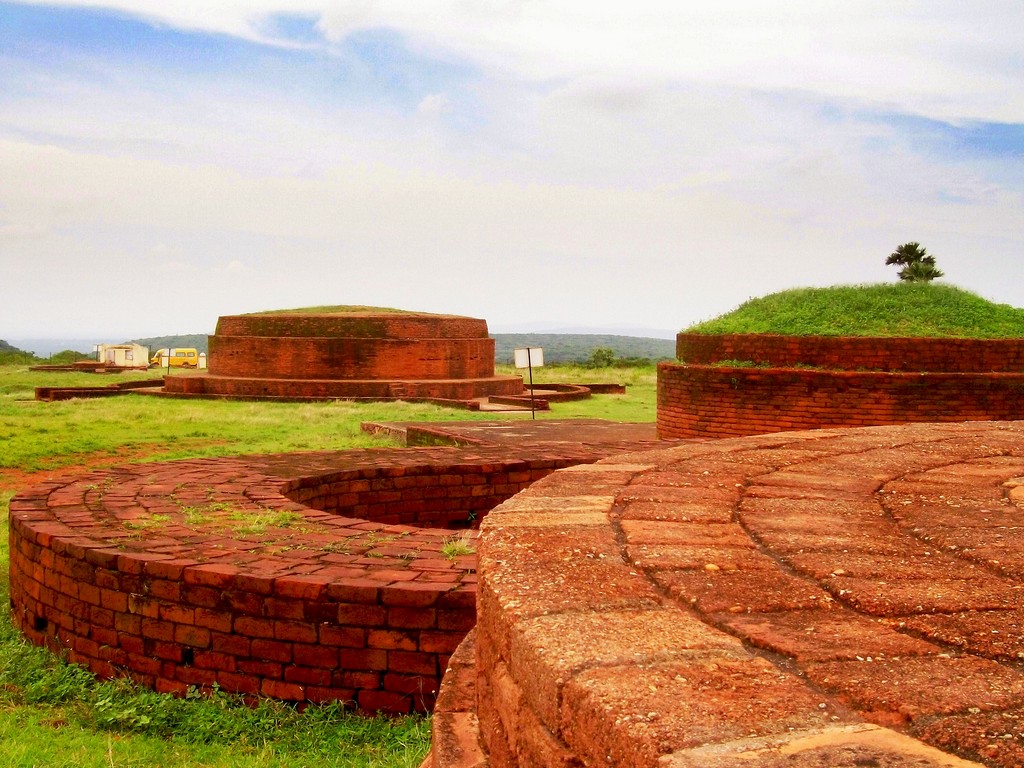
The architectural and spiritual center of Bavikonda is the monumental Mahastupa, positioned proudly at the highest elevation of the hill plateau. Built with large, ancient burnt bricks laid in concentric tiers, the stupa measures approximately 25 meters in diameter, featuring an expansive circumambulatory path (pradakshina patha) and projecting rectangular platforms (Ayaka platforms) oriented to the four cardinal directions.
In 1993, archaeologists unsealed the southern Ayaka platform, revealing a discovery that made global headlines: five concentric relic caskets placed one inside another (earthenware, red clay, steatite, silver, and gold). Inside the innermost gold casket lay sacred calcined bone fragments, believed to be the holy corporeal relics of the Buddha, accompanied by twenty-four seed pearls, carnelian beads, and gold flowers.
Surrounding the Mahastupa are numerous smaller votive stupas erected by visiting royal patrons and merchants to honor enlightened masters, creating a sacred stone landscape of extraordinary spiritual gravity.

Complex Anatomy: Chaityas, Viharas, and the Ancient Dining Hall
The 40-acre archaeological site reveals a remarkably sophisticated urban layout that reflects the organized daily communal life of ancient Buddhist monasticism. The complex comprises three distinct functional zones: the sacred stupa and chaitya zone, the residential monastic quarters, and the secular utility areas.
Pilgrims can explore two large apsidal Chaitya Grihas (prayer halls) that once housed cylindrical stone stupas, featuring stone drainage channels and pillared porticos. Directly adjacent are multi-roomed Viharas (monasteries) arranged around central open courtyards, where monks lived in simple rectangular stone cells equipped with raised sleeping platforms.
A massive rectangular stone structure measuring over 30 meters in length has been identified by archaeologists as the monastic refectory (Bhojana Shala) and community kitchen, complete with stone hearths, food-grinding troughs, and a sophisticated drainage network that carried away kitchen wastewater.
During systematic archaeological excavations conducted by the Andhra Pradesh State Department of Archaeology in 1993, a momentous discovery was made inside the southern Ayaka platform of the Mahastupa: five nested relic caskets crafted from earthenware, steatite, red pottery, silver, and gold, containing sacred calcined bone fragments, pearls, and precious gems, believed by scholars to be the authentic corporeal relics (Dhatu) of the Buddha.
Hydrological Wonder: The 'Bavulu' (Wells) of Bavikonda
Bavikonda derives its evocative Telugu name from the twenty-six large, circular wells (Bavulu) cut directly into the solid khondalite bedrock across the hill plateau. Because the high hilltop had no natural springs, ancient monastic engineers devised an ingenious rainwater harvesting system that sustained over 300 resident monks through long dry seasons.
The flat rocky surface of the hill was graded and chiseled with stone-lined drainage conduits that captured seasonal monsoon rainwater, channeling it through natural gravel and charcoal filtration beds into the deep rock-cut cisterns.
These circular wells, measuring up to 3 meters in diameter and 4 to 6 meters in depth, held tens of thousands of gallons of pure, cool water, allowing the monastic community to remain entirely self-sufficient on their coastal mountain perch.
Transit Gateways, Road Logistics, and The Marine Drive
Bavikonda is located 16 km north of central Visakhapatnam along the picturesque Visakhapatnam-Bheemunipatnam Beach Road. Visakhapatnam Junction (16 km) is the primary rail gateway, while Visakhapatnam International Airport (VTZ) lies 26 km to the southwest.
The site is accessed via a short, paved 2-kilometer hill road branching off the coastal highway just past Rushikonda Beach and Mangamaripeta village. The hill road is asphalted and easily navigable by cars, tour coaches, and auto-rickshaws, with ample parking at the summit visitor center.
APSRTC city buses (Route 900 series) ply between Visakhapatnam and Bheemili, stopping at the Bavikonda highway junction. Taxis and auto-rickshaws can be easily hired in Vizag for half-day heritage circuits combining Bavikonda, Thotlakonda, and Rushikonda Beach.
Bavikonda is situated on an open, flat, completely unshaded hilltop plateau. The midday sun can be scorching between 11:30 AM and 3:30 PM. Wear sun protection, wide-brimmed hats, and carry drinking water. Visitors are strictly prohibited from climbing onto fragile 2,000-year-old brick stupa bases or sitting on ancient monastic walls.
Archaeological Conservation and Pilgrim Etiquette
Bavikonda is a protected monument of supreme historical importance managed by the Andhra Pradesh State Department of Archaeology and Museums. The department maintains an on-site interpretation center displaying excavated pottery, lead coins of the Satavahana kings, and photographic documentation of the relic casket excavations.
The complex is open daily from 9:00 AM to 5:30 PM for a nominal entry fee. Visitors must strictly respect archaeological conservation protocols: walking over ancient brick stupas, removing loose pottery shards, or defacing 2,000-year-old stone walls is strictly prohibited by law.
Visitors are encouraged to walk peacefully around the Mahastupa circumambulatory path in a clockwise direction, enjoying the profound meditative silence, panoramic ocean winds, and timeless spiritual atmosphere of this ancient Buddhist sanctuary.
Curated Field Dossier & Offline Google Maps Pin Pack
Bypass tourist traps with verified local logistics, exact parking coordinates, and field-tested routes.
- ✓Exact GPS Pin Pack: Unmarked parking spots, best dawn photography vantage points, and hidden trailheads.
- ✓Crowd-Avoidance Timing Matrix: Exact hour-by-hour windows to explore with zero tourist chaos.
- ✓Vetted Local Dhabas: 100% authentic, hygiene-checked regional food stops not on commercial maps.
- ✓Scam & Overcharge Shield: Verified taxi rates, auto fares, and local guide fee guidelines.
🛡️ Personally curated by PK Gupta & the Hidden Routes research desk. Delivered directly to your Email & WhatsApp within 4–8 hours.
Frequently Asked Questions
Field-verified practical and cultural answers for planning your expedition to Bavikonda Ancient Buddhist Monastery:
Connecting Andhra Routes
Continue your journey across the Eastern Ghats, Godavari river deltas, Bay of Bengal coastline, and sacred pilgrimage shrines: