
Origins & Coastal Geography: The Rugged Face of the Arabian Sea
Located approximately 16 kilometres southwest of Nagercoil and 32 kilometres northwest of Kanyakumari, the seaside village of Muttom occupies one of the most visually dramatic coastal headlands on the Indian peninsula. While most beaches along the Tamil Nadu coastline are flat, sandy littoral strips, Muttom is renowned for its formidable natural topography: towering volcanic-like cliffs of dark crystalline rock and high sand dunes that plunge directly into the churning, foam-crested breakers of the Arabian Sea.
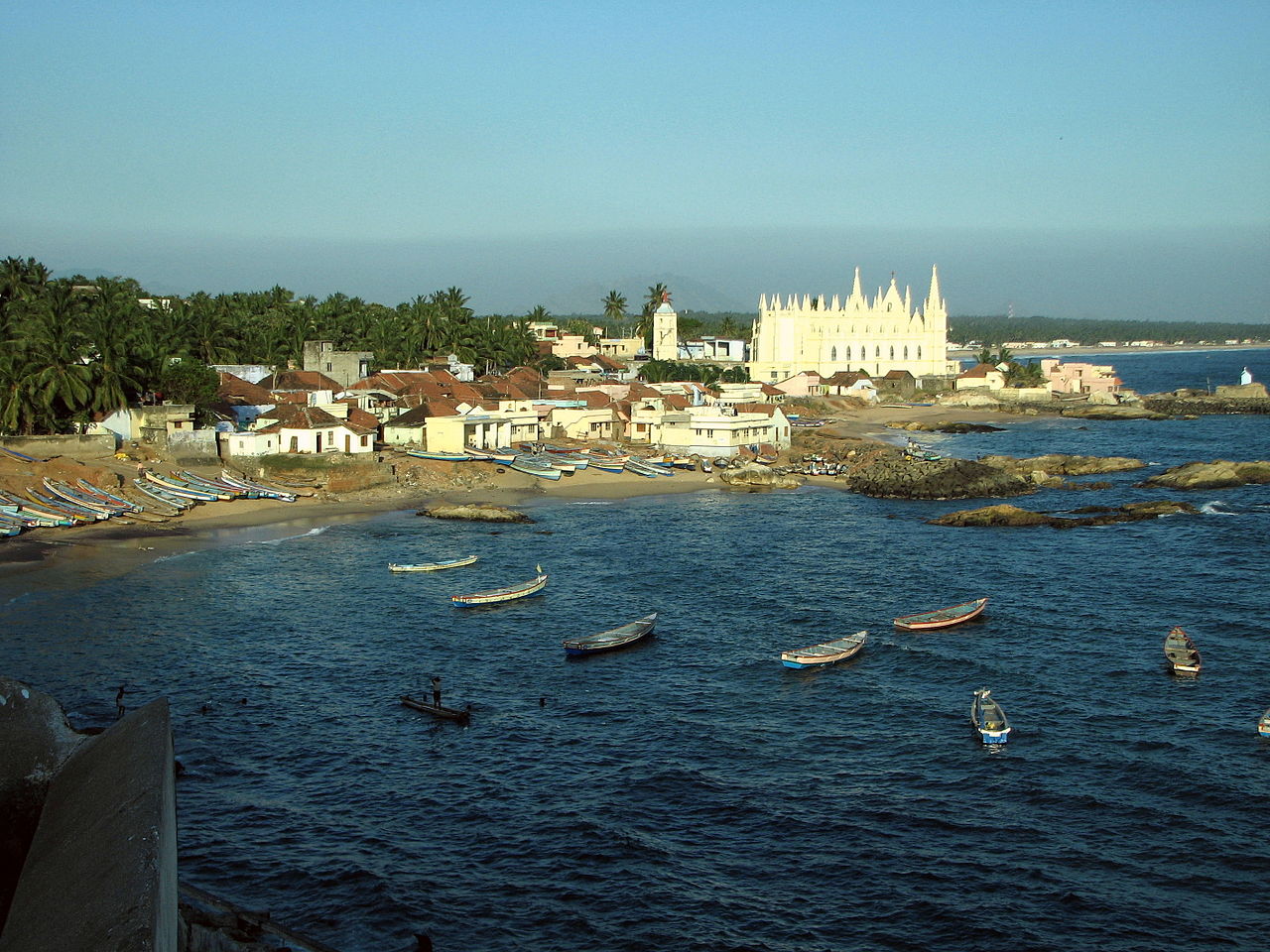
The village itself is an ancient, close-knit Christian fishing community whose roots trace back to the evangelistic mission of Saint Francis Xavier in the sixteenth century. The imposing white twin towers of the historic *All Saints Church*, built in Portuguese-Gothic style, rise gracefully above the fishing harbour, with hundreds of colorful wooden boats and catamarans anchored in the sheltered cove below.
The dramatic contrast between the weathered red sandstone cliffs, the dark granite boulders battered by crashing turquoise waves, and the sweeping golden dunes has made Muttom an irresistible cinematic destination. It has served as the iconic backdrop for dozens of classic South Indian movies, most notably director Bharathiraja’s immortal romantic masterpiece *Alaigal Oivathillai* (1981).
The 1875 Colonial Lighthouse: Beacon of the Arabian Sea
Perched on the highest rocky promontory overlooking the ocean stands the *Muttom Lighthouse*, an imposing 110-foot-tall masonry tower constructed in 1875 during the British colonial era. Commissioned by the British Board of Trade to guide international merchant steamships navigating between the Suez Canal, Colombo, and the Malabar coast, the lighthouse is one of the oldest navigational light stations in southern India.
The lighthouse features a classic cylindrical stone masonry tower painted in alternating horizontal bands of bright red and white, crowned by a cast-iron lantern house fabricated in Birmingham. Inside, a spiraling cast-iron staircase of 150 steps winds upward through the heart of the tower to the service platform.
Ascending to the open-air lantern balcony provides a dizzying, breathtaking panoramic perspective: beneath the tower, massive oceanic swells crash against the jagged black cliffs in towering geysers of white sea foam, while the coastline curves away toward the distant fishing harbours of Colachel and Manakudy.

The Clifftop Promenade & Dramatic Rock Formations
The Department of Tourism has developed a scenic clifftop promenade and coastal park along the rocky bluffs of Muttom. Paved pathways, shaded gazebos, and stainless-steel safety railings allow travelers to wander safely along the cliff edge, enjoying the invigorating, salt-scented ocean gales.
Below the promenade, nature has carved an extraordinary gallery of geological sculptures. Centuries of relentless hydraulic action by Arabian Sea waves have hollowed out natural sea arches, deep blowholes where trapped air and spray explode through rock crevices, and smooth natural stone basins where marine crabs and anemones dwell in tidal pools.
A specialized children’s play area and open-air seating pavilions make the clifftop an idyllic gathering place for families in the late afternoon. Visitors can watch local fishermen skillfully maneuver their lightweight fiberglass boats through the dangerous rock channels into the open sea.
The historic Muttom Lighthouse, maintained by the Directorate General of Lighthouses and Lightships (DGLL), is open to visitors Tuesday through Sunday from 15:00 to 17:30 (Mondays closed; entry ticket ₹10 for adults, ₹5 for children; camera ₹25). The viewing gallery atop the tower offers an extraordinary panoramic perspective of the rocky cliffs battered by crashing Arabian Sea waves. Arriving around 16:30 allows visitors to tour the lighthouse before settling on the rocky headland for sunset.
Sunset Splendour: The Golden Hour Over the Western Sea
Muttom is celebrated among photographers and film directors as the premier sunset viewpoint in Kanyakumari district. Because the rocky headland faces directly westward into the open Arabian Sea, sunsets here are uncommonly dramatic and intensely atmospheric.
As evening approaches, the fierce tropical sun descends toward the ocean horizon, illuminating the dark volcanic cliffs in radiant shades of amber, bronze, and burnt orange. The roaring waves reflect the fiery crimson hues of the twilight sky, while the white lighthouse beam begins its silent, rhythmic sweep across the darkening waters.
Visitors often sit on the high rock benches until dusk, listening to the thunderous acoustic rhythm of crashing breakers that echoes through the rock amphitheaters—a sensory encounter that explains why filmmakers have repeatedly chosen this coastline to symbolize passion, nature’s power, and eternal longing.
Living Maritime Culture: Catamarans & The Coastal Economy
Beyond tourism, Muttom is a vibrant, hard-working traditional maritime hub. In the sheltered cove beneath the lighthouse lies the active Muttom Fishing Harbour. At dawn, fleets of traditional wooden catamarans and motorized outboard country craft return from overnight fishing expeditions in the deep waters of the Wadge Bank—one of the richest fishing grounds on the Indian continental shelf.
The beach landing center erupts in vibrant activity as catches of seer fish (*Vanjaram*), king mackerel, yellowfin tuna, barracuda, squids, and lobsters are unloaded into woven baskets and auctioned to coastal merchants. Travelers can witness traditional shore-seine netting (*Karamadi*), an ancient communal fishing technique where dozens of fishermen haul monumental hand-woven nets onto the sand in synchronized unison.
Small seafood shacks near the harbour serve exceptionally fresh, simply prepared coastal delicacies: spicy fish fry, fiery crab curry, and fried squid seasoned with local black pepper and coconut oil, offering an authentic taste of coastal Kanyakumari culinary traditions.
The coastal rocks of Muttom are notoriously slippery, steep, and completely unfenced. Rogue oceanic swells frequently surge over low-lying rock shelves without warning. Walking onto wet black rocks or attempting to swim in the turbulent sea is extremely hazardous and strictly prohibited; visitors must remain on the paved clifftop promenade and behind marked safety borders.
Transit Gateways, Coastal Circuits & Practical Travel Advice
Muttom is easily accessible via scenic coastal roads. The village is located 16 kilometres southwest of Nagercoil via State Highway 45, and 32 kilometres northwest of Kanyakumari via the coastal road passing through Rajakkamangalam. Nagercoil Junction (NCJ, 16 km) is the primary railway station with direct superfast trains across India.
Thiruvananthapuram International Airport (TRV, 75 km northwest) provides the nearest flight connections, reachable in approximately 2 hours by road via Marthandam. Regular state transport buses connect Nagercoil, Thuckalay, and Kanyakumari directly to Muttom bus stand.
Muttom is an ideal afternoon destination on a southern heritage circuit: spend the morning exploring the wooden architecture of *Padmanabhapuram Palace* (20 km northeast) and the Trimurti temple at *Suchindram* (22 km east), before arriving at Muttom around 15:30 to tour the lighthouse, explore the rocky cliffs, and watch the sunset over the sea. Clean accommodations are available in Nagercoil and Kanyakumari.
Curated Field Dossier & Offline Google Maps Pin Pack
Bypass tourist traps with verified local logistics, exact parking coordinates, and field-tested routes.
- ✓Exact GPS Pin Pack: Unmarked parking spots, best dawn photography vantage points, and hidden trailheads.
- ✓Crowd-Avoidance Timing Matrix: Exact hour-by-hour windows to explore with zero tourist chaos.
- ✓Vetted Local Dhabas: 100% authentic, hygiene-checked regional food stops not on commercial maps.
- ✓Scam & Overcharge Shield: Verified taxi rates, auto fares, and local guide fee guidelines.
🛡️ Personally curated by PK Gupta & the Hidden Routes research desk. Delivered directly to your Email & WhatsApp within 4–8 hours.
Frequently Asked Questions
What are the visiting hours for the Muttom Lighthouse?
The Muttom Lighthouse is open to public visitors Tuesday through Sunday from 15:00 to 17:30 (closed on Mondays). The entry fee is ₹10 for adults, ₹5 for children, and ₹25 for cameras.
Why is Muttom Beach famous in Tamil cinema?
Muttom Beach is famous for its dramatic rocky cliffs, crashing waves, and 1875 lighthouse, which served as the iconic filming location for Bharathiraja’s classic 1981 movie Alaigal Oivathillai and dozens of subsequent Tamil and Malayalam films.
Is swimming permitted at Muttom Beach?
No, swimming is strictly prohibited and dangerous due to steep rocky cliffs, sudden rogue ocean waves, and powerful undertows. Visitors should remain safely on the paved clifftop promenade and viewing decks.
How far is Muttom Beach from Kanyakumari and Nagercoil?
Muttom is located 16 km southwest of Nagercoil (about 25 minutes by road) and 32 km northwest of Kanyakumari (about 45 minutes along the coastal route).
What are the main sights to see in Muttom village?
Key sights include the 1875 colonial lighthouse, the rocky clifftop promenade, the historic All Saints Church with its Gothic towers, the active traditional fishing harbour, and sunset viewpoints.