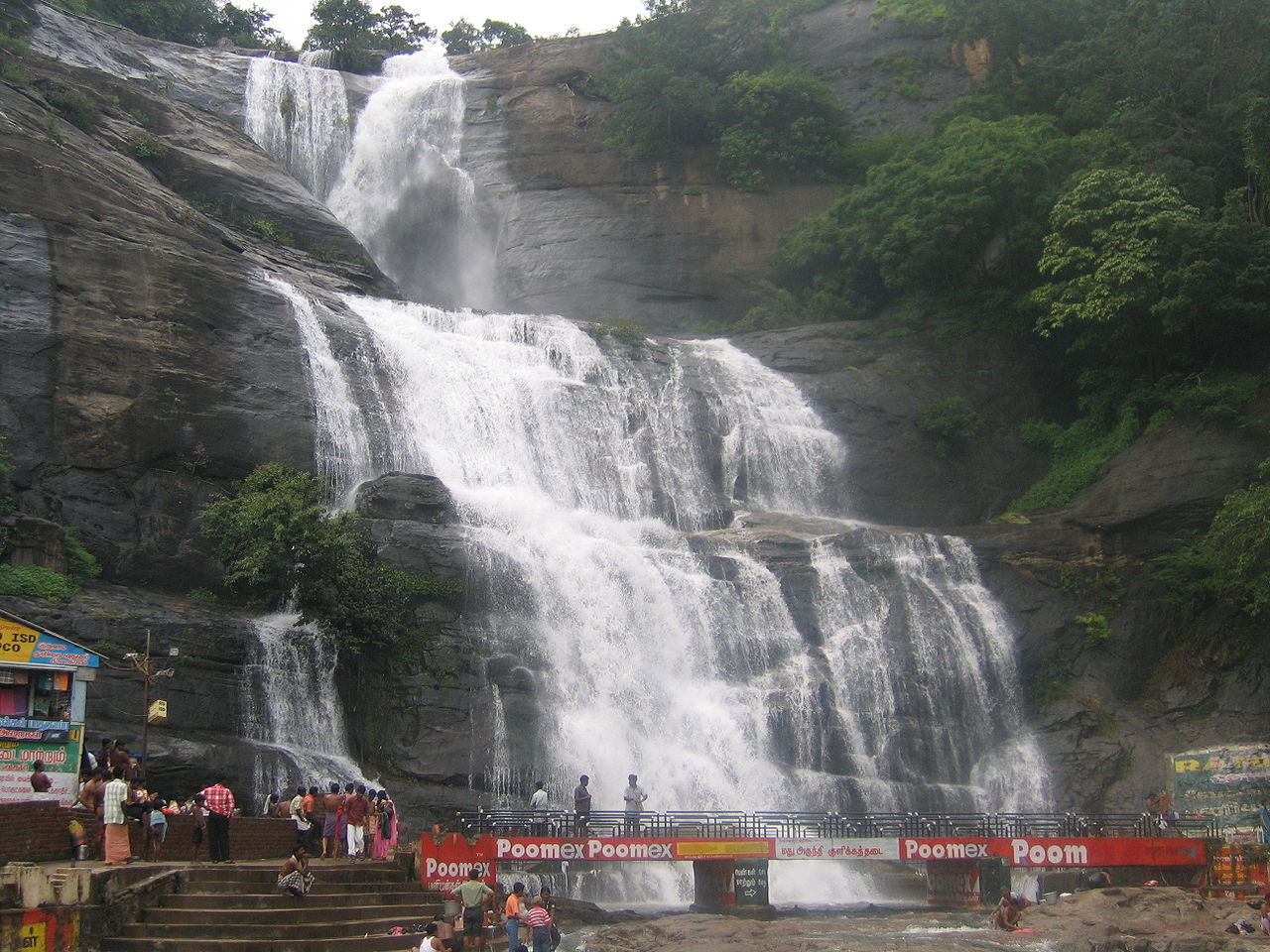
The Spa of South India: The Magic of the Courtallam Saaral
High along the verdant slopes of the Agasthyamalai Biosphere Reserve in Tenkasi district, the Western Ghats produce one of the most celebrated natural phenomena in peninsular India: the magical monsoon season of Kutralam (Courtallam). Known affectionately throughout Tamil culture as the "Spa of South India", Courtallam is an enchanted landscape where nine distinct waterfalls tumble down granite cliffs, enveloped by perpetual cool drizzles, swirling mountain mists, and the gentle monsoon breeze known locally as the *Saaral*. When the southwest monsoon breaks across the mountains between June and September, the parched plains of southern Tamil Nadu are transformed into a verdant paradise of tumbling waters and rejuvenating cool air.
The history of Courtallam as a therapeutic sanctuary extends into the deep mists of antiquity. The region is immortalized in classical Tamil literature, particularly in the 18th-century courtly poetic masterpiece *Kutrala Kuravanji*, penned by the court poet Tirukuda Rasappa Kavirayar, which extols the divine beauty of the hills, the majesty of the cascades, and the romantic mystique of the Kuravar tribal dwellers. Ancient sages, Ayurvedic physicians, and travelers have recognized for over a millennium that the waters cascading through these valleys are endowed with profound healing and restorative properties, making an annual pilgrimage to Courtallam a cherished ritual for millions across South India.
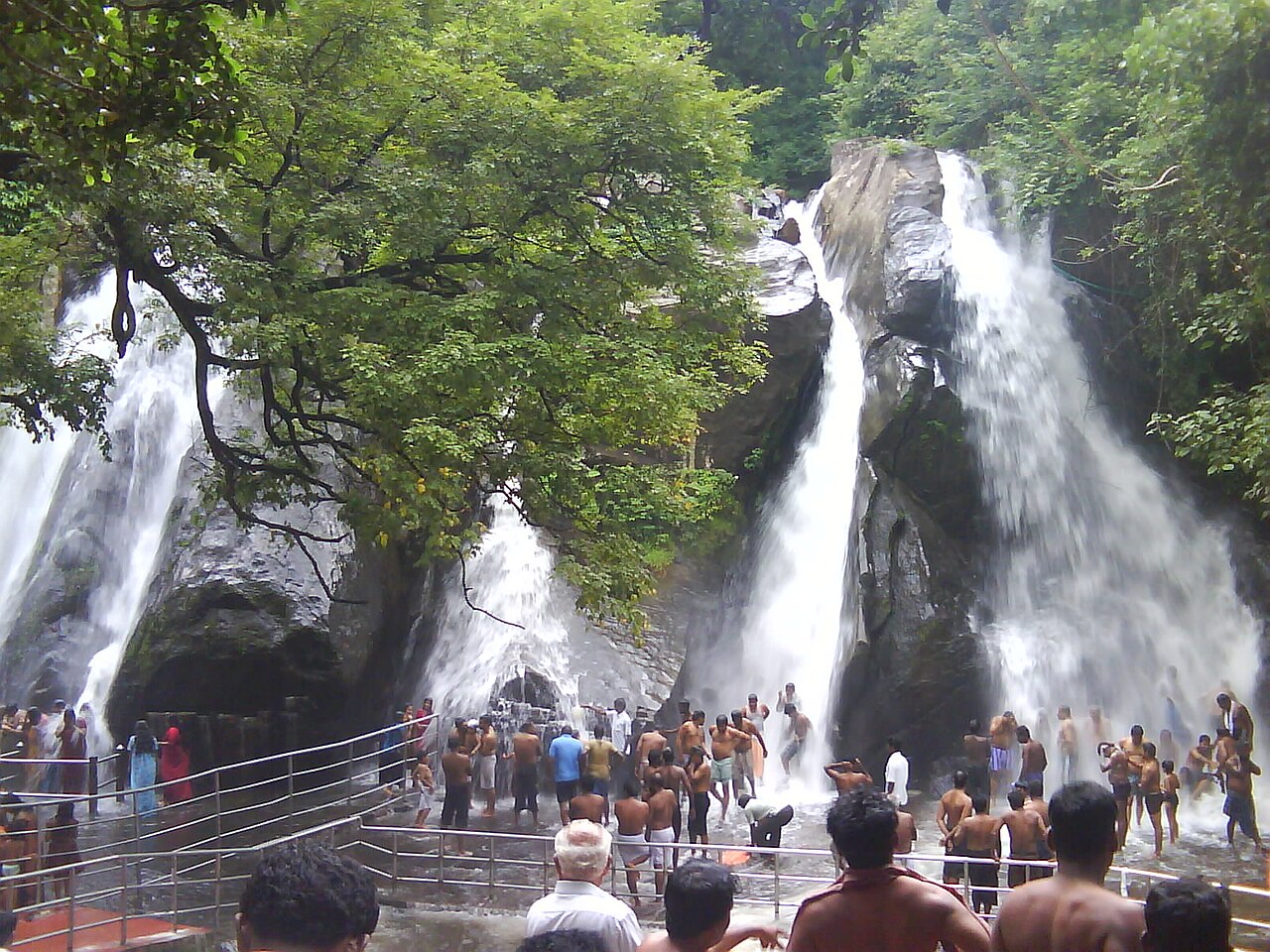
Unlike typical mountain resorts that cater primarily to passive sightseeing, Courtallam is an active, immersive hydrotherapy landscape. From early morning until late into the night, pilgrims, wellness seekers, and vacationing families immerse themselves in the rushing cascades, allowing the pressurized mountain currents to wash away physical tension, fatigue, and nervous exhaustion under the watchful gaze of ancient temples and canopy trees.
The Nine Cascades: Exploring Courtallam’s Water Network
Courtallam’s fame rests on its remarkable concentration of nine distinct waterfalls, each possessing its own unique geological setting, water volume, and therapeutic atmosphere. The centerpiece of the town is the **Peraruvi (Main Falls)**, where the Chittar River drops approximately 60 meters (197 feet) over a smooth vertical granite rock face into a natural stone pond called the Pongumakadal. Before plunging, the water flows through an enormous natural rock depression that cushions the torrent’s velocity, allowing bathers to stand safely under designated segments of the pounding torrent under the shadow of the historic Kutralanathar Temple.
Approximately 4 km from the town center lies the extraordinarily scenic **Aintharuvi (Five Falls)**, arguably the most picturesque of the cluster. Here, the mountain river divides naturally across five separate channels, tumbling like the five hoods of a celestial serpent over smooth boulders. Divided into demarcated bathing zones for men and women, Five Falls is flanked by dense teak and clove plantations, providing an intensely atmospheric forest bathing setting. Nearby, the **Pazhaya Kutralam (Old Courtallam Falls)** drops through a tranquil rock canyon, offering a gentler, expansive cascade favored by those seeking a less crowded, serene experience.
Further up the slopes and deeper within the forest ranges lie the more secluded cascades. The **Shenbaga Devi Falls** cascades past wild champak (Shenbagam) groves, adjacent to an ancient shrine dedicated to Goddess Shenbagadevi. Further still along the higher trekking trail is **Thenaruvi (Honey Falls)**, a majestic 200-foot drop wedged between sheer canyon walls where wild rock bees build massive honeycombs on the overhangs. Other notable cascades include the **Chittaruvi (Small Falls)**, the **Tiger Falls (Puli Aruvi)** with its gentle shallow stream ideal for children and elders, and the secluded **Pazhathotta Aruvi (Fruit Garden Falls)** tucked within government agricultural research orchards.
The Science of Herbal Water: Ayurvedic Ecology of Agasthyamalai
What sets Courtallam apart from virtually every other waterfall system in the world is the verified chemical and botanical composition of its water. The river streams feeding Courtallam originate in the pristine, uninhabited core zones of the Agasthyamalai Biosphere Reserve—one of the world’s hottest biodiversity hotspots, harboring over 2,000 species of medicinal plants, including rare endemic species of herbs, wild spices, ferns, and aromatic flora. As rainfall filters through the deep forest humus and flows over beds of wild lemongrass, vetiver, sarsaparilla, turmeric, and wild cinnamon, the water naturally dissolves essential botanical oils and organic compounds.
Traditional Siddha and Ayurvedic texts describe the waters of Courtallam as naturally mineral-rich and therapeutic, acting as an effective natural remedy for skin disorders, chronic joint pains, digestive ailments, and insomnia. Modern hydrological analyses have confirmed that the water carries significant trace minerals and a remarkably low turbidity combined with high dissolved oxygen levels generated by the violent atomization of water as it strikes the rock face. The resulting ambient air at Courtallam is saturated with negative ions and micro-droplets of aromatic oils, which stimulates blood circulation, eases respiratory passages, and produces a noticeable calming effect on the nervous system.
Complementing the natural baths is the widespread culture of traditional oil massages. Along every lane leading to the falls, traditional massage practitioners offer herbal oil rubs using authentic Thailams (medicated oils) prepared with country herbs. An hour of deep rhythmic massage followed by a prolonged plunge beneath the cool, herbal torrent creates a comprehensive hydrotherapy routine that leaves visitors physically rejuvenated and mentally restored.
Courtallam’s waters flow into vital agricultural irrigation systems in the Thamirabarani and Chittar basins. The use of chemical detergents, shampoos, and soaps is strictly banned under district administration environmental bylaws. Please honor these ancient waters by using only natural bath powders (shikakai) or pure water bathing.
The Divine Abode: Sri Kutralanathar Temple & Sage Agastya
Intimately entwined with the waterfalls is the ancient **Sri Kutralanathar Temple**, situated immediately adjacent to the Main Falls. Dedicated to Lord Shiva as Kutralanathar (the Lord of the Kuruntha Forest), this historic shrine is one of the revered Paadal Petra Sthalams celebrated in the Tevaram hymns of the 7th-century Nayanmar saints Appar and Sambandar. Architecturally, the temple is remarkable for its Conch-shaped (Shankha) sanctum plan, a sacred layout unique in Dravidian temple architecture.
According to venerable Sthala Purana mythology, during the celestial wedding of Lord Shiva and Parvati in Mount Kailash, the divine assembly gathered in such overwhelming numbers in the north that the Earth tilted dangerously out of equilibrium. Shiva commissioned the diminutive sage Agastya to travel south to the Podhigai Hills to restore cosmic balance. Arriving at Courtallam, Agastya found a Vaishnavite temple dedicated to Vishnu; through his spiritual yogic powers, he transformed the deity into a Shiva Lingam, shaping it with his hands. To this day, the Lingam bears the thumb and finger impressions of Sage Agastya, symbolizing the synthesis of Shaivite and Vaishnavite spiritual traditions.
Within the temple complex lies the sacred **Chitra Sabha (Hall of Pictures)**, one of the five cosmic dance halls (Pancha Sabhai) of Lord Shiva, representing the cosmic dance performed on canvas. The Chitra Sabha is adorned with centuries-old mural paintings depicting puranic episodes, celestial dancers, and botanical motifs executed using indigenous vegetable dyes, presenting an irreplaceable treasure of southern Indian artistic heritage.

The Saaral Season, Microclimate & Cultural Life
The rhythm of life in Courtallam is entirely dictated by the *Saaral* season, which commences when the clouds of the southwest monsoon breach the mountain passes of Aryankavu and Shencottah between early June and mid-September. Unlike the torrential downpours that characterize the coastal Malabar, Courtallam experiences intermittent sunlit drizzles, where sunbeams pierce through gentle showers while the temperature hovers around a delightful 22°C to 26°C. The air smells intensely of wet granite, eucalyptus, and wild forest blossom.
During the Saaral festival (Saaral Thiruvizha), organized annually by the Department of Tourism in July or August, the town erupts in festive vibrancy. Classical music concerts, traditional folk dance performances (such as Karakattam and Villupattu), flower shows, boat races, and culinary fairs celebrate the blessing of the waters. The bazaar streets around the falls stay open round the clock, bustling with stalls selling hot crispy pepper *bajis*, steamed *kozhukattai*, fresh seasonal jackfruits, wild forest honey, handloom textiles, and aromatic hill spices.
Outside the monsoon season, from November to January, the northeast monsoon brings a second phase of moderate flow accompanied by crisp, pleasant winter weather. During the peak summer months of March through May, the waterfalls recede to thin trickles, and the town reverts to a peaceful, sleepy hill settlement.
During intense cloudbursts in the Agasthyamalai upper catchment, water levels at Main Falls and Five Falls can rise dramatically within minutes. Always obey the whistle signals and sirens operated by the fire and rescue department; evacuate the bathing areas immediately when instructed.
How to Reach, Accommodation & Practical Tips
Courtallam is situated in the newly formed Tenkasi district of southern Tamil Nadu, nestled right up against the border with Kerala. Its proximity to major transit junctions makes it effortlessly accessible from all parts of South India.
**By Rail:** The nearest railway station is **Tenkasi Junction (TSI)**, located just 6 km away. Tenkasi is well connected by daily express trains to Chennai (via the Podhigai Express and Silambu Express), Madurai, Tirunelveli, and Kollam. Tirunelveli Junction (55 km) serves as a mega-rail hub connecting to Mumbai, Delhi, Bengaluru, and Hyderabad, with regular round-the-clock buses linking Tirunelveli to Courtallam.
**By Road:** Excellent national and state highways link Courtallam to Tirunelveli (55 km), Madurai (160 km), Kanniyakumari (135 km), and Thiruvananthapuram (110 km via Shencottah-Tenmala). State transport buses (TNSTC and KSRTC) operate continuous shuttle services between Tenkasi town and Courtallam Main Falls.
**By Air:** The closest operational airport is **Tuticorin Airport (TCR)** at 90 km, offering daily flights to Chennai and Bengaluru. For wider domestic and international connectivity, **Thiruvananthapuram International Airport (TRV)** is 115 km away across the scenic mountain ghat, while **Madurai International Airport (IXM)** is 155 km to the northeast.
**Visitor Tips:** Bathing areas at Main Falls and Five Falls feature separate barricaded enclosures for men and women monitored by police personnel. Visitors are strongly advised not to use synthetic shampoos, chemical detergents, or non-biodegradable soaps while bathing in the falls to preserve the fragile river ecology. Keep personal belongings in locker facilities or with companions, as playful wild macaques inhabit the surrounding canopy.
Curated Field Dossier & Offline Google Maps Pin Pack
Bypass tourist traps with verified local logistics, exact parking coordinates, and field-tested routes.
- ✓Exact GPS Pin Pack: Unmarked parking spots, best dawn photography vantage points, and hidden trailheads.
- ✓Crowd-Avoidance Timing Matrix: Exact hour-by-hour windows to explore with zero tourist chaos.
- ✓Vetted Local Dhabas: 100% authentic, hygiene-checked regional food stops not on commercial maps.
- ✓Scam & Overcharge Shield: Verified taxi rates, auto fares, and local guide fee guidelines.
🛡️ Personally curated by PK Gupta & the Hidden Routes research desk. Delivered directly to your Email & WhatsApp within 4–8 hours.
Frequently Asked Questions
What is the best time to experience Courtallam waterfalls?
The peak season is the Saaral season from June to September during the southwest monsoon, when all nine waterfalls roar with full volume and cool mountain drizzles envelop the town. A secondary season occurs from November to January during the northeast monsoon.
Why are Courtallam waterfalls considered medicinal?
The streams originate in the Agasthyamalai Biosphere Reserve, flowing over thousands of indigenous medicinal plants, wild herbs, and forest roots. The water absorbs botanical extracts, and when combined with the forceful hydro-massage on the body, it helps relieve stress, skin conditions, and joint aches.
Which are the most popular waterfalls to visit in Courtallam?
The most famous are Main Falls (Peraruvi) next to the Kutralanathar Temple, Five Falls (Aintharuvi) where the river splits into five cascades, Old Courtallam Falls (Pazhaya Kutralam), and Tiger Falls (Puli Aruvi), which is ideal for children.
How far is Courtallam from Tenkasi and Tirunelveli?
Courtallam is just 6 km from Tenkasi town (approx. 15 minutes by auto or bus) and 55 km from Tirunelveli (approx. 1 hour 15 minutes by road via NH-744).
Are there separate bathing areas for men and women at Courtallam?
Yes. At all major waterfalls including Main Falls, Five Falls, and Old Courtallam, the district administration provides clearly demarcated, barricaded bathing zones for men and women, monitored continuously by police and lifeguards for safety.