
Imperial Origins: Rajaraja Chola II & The Sculptural Masterpiece
Situated on the southwestern outskirts of Kumbakonam, merely four kilometres from the town center, the Airavatesvara Temple at Darasuram represents the third and final jewel in the UNESCO World Heritage triumvirate of the *Great Living Chola Temples*. Built during the twelfth century by Emperor Rajaraja Chola II (reigned 1146–1173 CE), this exquisite complex marks the transition of Chola architecture from the colossal, monumental scale of Thanjavur and Gangaikonda Cholapuram into a period of breathtaking sculptural refinement, delicate ornamentation, and jewel-like perfection.
According to sacred Puranic lore, the temple is named after *Airavata*, the celestial white elephant of King Indra. Stricken with a curse by Sage Durvasa that caused his gleaming white skin to turn discolored and mottled, the divine elephant wandered the earth in despair until he arrived at the sacred spring at Darasuram. Bathing in the holy tank (*Yama Theertham*) and offering worship to the Shivalingam, Airavata was miraculously restored to his pure white radiance. In gratitude, the divine elephant consecrated the shrine as *Airavatesvara* ("the Lord of Airavata").
Another celebrated legend states that Yama, the Lord of Death, who suffered from a burning bodily affliction inflicted by a sage’s curse, was similarly cured by bathing in the temple tank, which has since been venerated as *Yama Theertham*. Historical epigraphs confirm that the surrounding settlement was anciently known as *Rajarajapuram*, serving as a royal residential suburb for the Later Chola court.
The Celestial Stone Chariot: Dynamic Motion Frozen in Granite
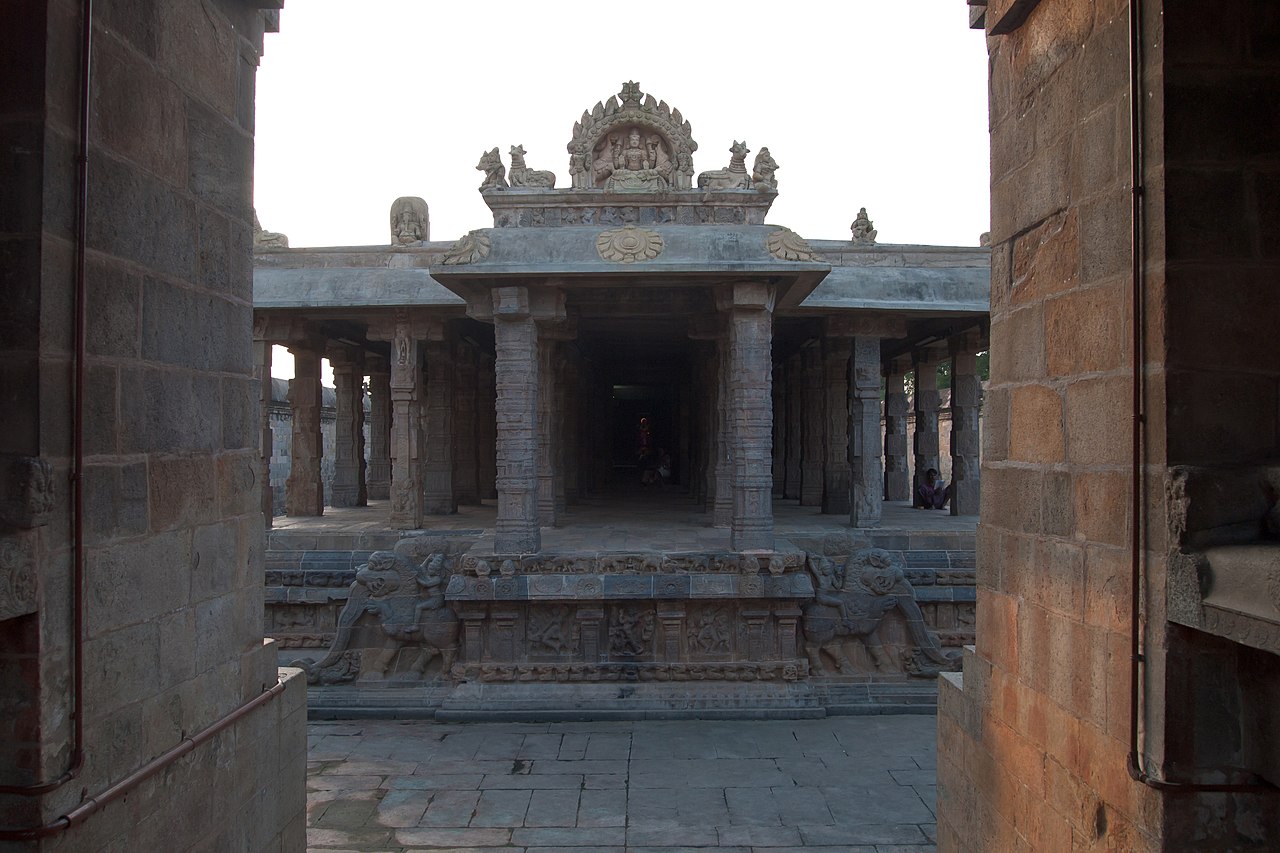
The architectural centerpiece of Darasuram is the breathtaking *Agra Mandapa* (the frontal royal porch), ingeniously conceived and sculpted in the form of a celestial stone chariot (*Ratha*). Resting upon a raised basement adorned with intricate friezes of galloping horses and charging war-elephants, the chariot is flanked by two monumental stone wheels measuring over six feet in diameter, complete with delicately carved hubs, spokes, and ornamental rims.
The chariot is depicted as being pulled forward by a pair of life-sized rearing stone horses and caparisoned elephants carved in high relief. The dynamic tension, flared nostrils, and realistic muscle definition of the galloping animals create an astonishing illusion of kinetic momentum frozen forever in crystalline granite. This pioneering stone-chariot design at Darasuram served as the direct architectural inspiration for subsequent masterpieces across peninsular India, including the celebrated Sun Temple at Konark and the stone chariot of Vijayanagara at Hampi.
Ascending into the mandapa, visitors are greeted by a forest of exquisitely sculpted pillars. The ceiling is supported by carved stone beams adorned with miniature lotus rosettes, while the pillar brackets feature rearing *Yalis* (mythical lion-beasts) with rolling stone balls miraculously trapped inside their open mouths, which can be rotated by finger yet cannot be removed.

The Singing Steps: Acoustic Marvels of the Balustrade
Directly fronting the southern entrance of the chariot mandapa stands the celebrated *Bali Peetha* (altar platform), accessed via a small flight of seven carved granite steps. What distinguishes these stones from any ordinary flight of stairs is their miraculous acoustic property: when tapped or struck with precise frequency, each of the seven steps resonates with a distinct, clear musical tone corresponding to the seven classical notes (*Sapta Swaras*: Sa, Re, Ga, Ma, Pa, Dha, Ni) of Indian Carnatic music.
Known popularly as the *Singing Steps*, this acoustic staircase demonstrates the extraordinary metallurgical and mineralogical mastery possessed by twelfth-century Chola masons. The sthapatis carefully selected granite blocks with varying crystalline densities and internal mineral compositions, chiseling each step to precise hollow specifications so that its natural harmonic frequency produces an exact musical pitch.
For centuries, temple dancers would ascend these steps during ceremonial processions, their rhythmic footfalls striking the stones to create a natural musical accompaniment. To protect these irreplaceable acoustic treasures from physical degradation caused by millions of tourists, the Archaeological Survey of India has permanently enclosed the steps within an ornamental iron security barrier, allowing visitors to admire their sculptural beauty while preserving their structural integrity.
The Airavatesvara Temple complex is protected by the ASI and is open daily from 06:00 to 20:30. Entry is completely free for all Indian and foreign travelers. The inner sanctum sanctorum opens for morning darshan from 06:00 to 12:30 and evening darshan from 16:00 to 20:30. Free footwear storage is provided at the entrance gate.
The 63 Nayanmars: A Stone Encyclopedia of Shaivite Hagiography
Where Thanjavur overwhelms with monumental size, Darasuram captivates with the unparalleled microscopic precision of its stone reliefs. Encircling the entire base of the central sanctum is a continuous horizontal frieze of miniature stone relief panels, each measuring just one to two feet in height. These panels constitute an exhaustive stone-carved encyclopedia documenting the lives, miracles, and martyrdoms of all sixty-three *Nayanmars* (the revered Tamil Shaivite poet-saints celebrated in Sekkizhar’s twelfth-century epic, the *Periya Puranam*).
Each miniature panel is accompanied by an explanatory Tamil inscription in twelfth-century Chola Grantha script, identifying the saint and the specific miracle depicted. Scenes include Saint Kannappa Nayanar offering his own eyes to the bleeding Shivalinga, Saint Siruthondar preparing the ultimate test of devotion, Saint Karaikkal Ammaiyar walking on her hands up Mount Kailash, and Saint Sambandar receiving the cup of divine milk from Goddess Parvathi.
The technical virtuosity of these miniature carvings is staggering: within a stone surface no larger than a postcard, master sculptors captured nuanced facial expressions, anatomical gestures, folding drapery, and emotional intensity with a fluidity that resembles soft ivory carving rather than hard crystalline granite.
The Periya Nayaki Shrine & Serene Courtyard Gardens
Just outside the main enclosure wall, situated within an adjoining independent courtyard, stands the dedicated temple of Goddess *Periya Nayaki Amman* (the divine consort of Airavatesvara). Built during the reign of Kulothunga Chola III in the late twelfth century, this temple features its own independent gopuram, pillared mandapas, and sanctum, reflecting the evolving theological prominence of the independent Mother Goddess shrine (*Amman Sannidhi*) during the Later Chola period.
The outer perimeter of the Airavatesvara complex was once fortified with three concentric enclosure walls and defensive moats, much of which was dismantled during the chaotic wars of the sixteenth and seventeenth centuries. However, the inner enclosure remains remarkably intact, surrounded by a cloister gallery (*Thiruchutrumaligai*) housing hundreds of carved stone lingams and sculptures of the river goddesses Ganga and Yamuna.
The Archaeological Survey of India has surrounded the entire complex with lush green lawns, flowering bougainvillea hedges, and stone walkways. The tranquil rural setting, accompanied by the gentle rustle of coconut palms, allows visitors to study the miniature carvings in complete peace, far from commercial interruptions.
To prevent irreversible physical erosion caused by centuries of pilgrim footsteps, the famous seven singing musical steps at the entrance balustrade are now protected behind an ornamental iron security grill. Visitors can view and photograph the steps closely, but walking or striking the stones is strictly prohibited by ASI regulations.
Transit Connections, Local Silk Weaving & Travel Logistics
Darasuram is exceptionally accessible, located just 4 kilometres southwest of Kumbakonam along the main Thanjavur-Kumbakonam road (SH-22). Local auto-rickshaws and town buses from Kumbakonam reach the temple gates in less than ten minutes. The nearest railway station is Darasuram railway station (1 km), while major express trains stop at Kumbakonam Railway Station (KMU, 4 km). Tiruchirappalli International Airport (TRZ, 88 km west) provides the nearest flight gateway.
Beyond its architectural glory, the village of Darasuram is an ancient, renowned center of traditional *Kumbakonam Silk Weaving*. The streets immediately surrounding the temple house hundreds of traditional handloom weaver families who craft exquisite pure silk sarees (*Darasuram Pattu*) woven with pure silver and gold zari threads, featuring traditional temple border motifs (*Korvai*) that reflect the stone friezes of the Airavatesvara temple.
A visit to Darasuram typically requires 1.5 to 2 hours and is an indispensable component of any Kaveri delta journey. Combine Darasuram with morning temple visits in *Kumbakonam* (4 km), the bronze casting foundries of *Swamimalai* (5 km west), and the imperial capital temple at *Gangaikonda Cholapuram* (35 km northeast). High-quality heritage hotels and traditional vegetarian restaurants are available in nearby Kumbakonam.
Curated Field Dossier & Offline Google Maps Pin Pack
Bypass tourist traps with verified local logistics, exact parking coordinates, and field-tested routes.
- ✓Exact GPS Pin Pack: Unmarked parking spots, best dawn photography vantage points, and hidden trailheads.
- ✓Crowd-Avoidance Timing Matrix: Exact hour-by-hour windows to explore with zero tourist chaos.
- ✓Vetted Local Dhabas: 100% authentic, hygiene-checked regional food stops not on commercial maps.
- ✓Scam & Overcharge Shield: Verified taxi rates, auto fares, and local guide fee guidelines.
🛡️ Personally curated by PK Gupta & the Hidden Routes research desk. Delivered directly to your Email & WhatsApp within 4–8 hours.
Frequently Asked Questions
Why is the temple at Darasuram called Airavatesvara?
The temple is named after Airavata, the sacred white elephant of King Indra. According to legend, Airavata was cursed with discolored skin by Sage Durvasa and was restored to his pure white radiance after bathing in the temple tank and worshipping the Shivalingam here.
What are the singing steps at Darasuram and can visitors touch them?
The singing steps are a flight of seven carved granite steps at the Bali Peetha entrance that produce the seven classical musical notes (Sapta Swaras) when tapped. To preserve them from physical wear, the Archaeological Survey of India has permanently enclosed them behind an ornamental iron grill; visitors can view them closely, but walking on them is prohibited.
How does Darasuram compare to the temples at Thanjavur and Gangaikonda Cholapuram?
While Thanjavur and Gangaikonda Cholapuram are celebrated for their monumental scale and towering vimanas, Darasuram is celebrated for its exquisite sculptural refinement, its dynamic stone-chariot architecture, and its intricate miniature carvings depicting the 63 Nayanmar saints.
What are the visiting hours and entry fees for Airavatesvara Temple?
The monument complex is open daily from 06:00 to 20:30. The inner sanctum is open for darshan from 06:00 to 12:30 and 16:00 to 20:30. Entry is completely free for all Indian and international visitors.
How far is Darasuram from Kumbakonam town center?
Darasuram is located just 4 km southwest of Kumbakonam town center. It takes less than 10 minutes by auto-rickshaw, taxi, or local town bus to reach the temple gates from Kumbakonam railway station.