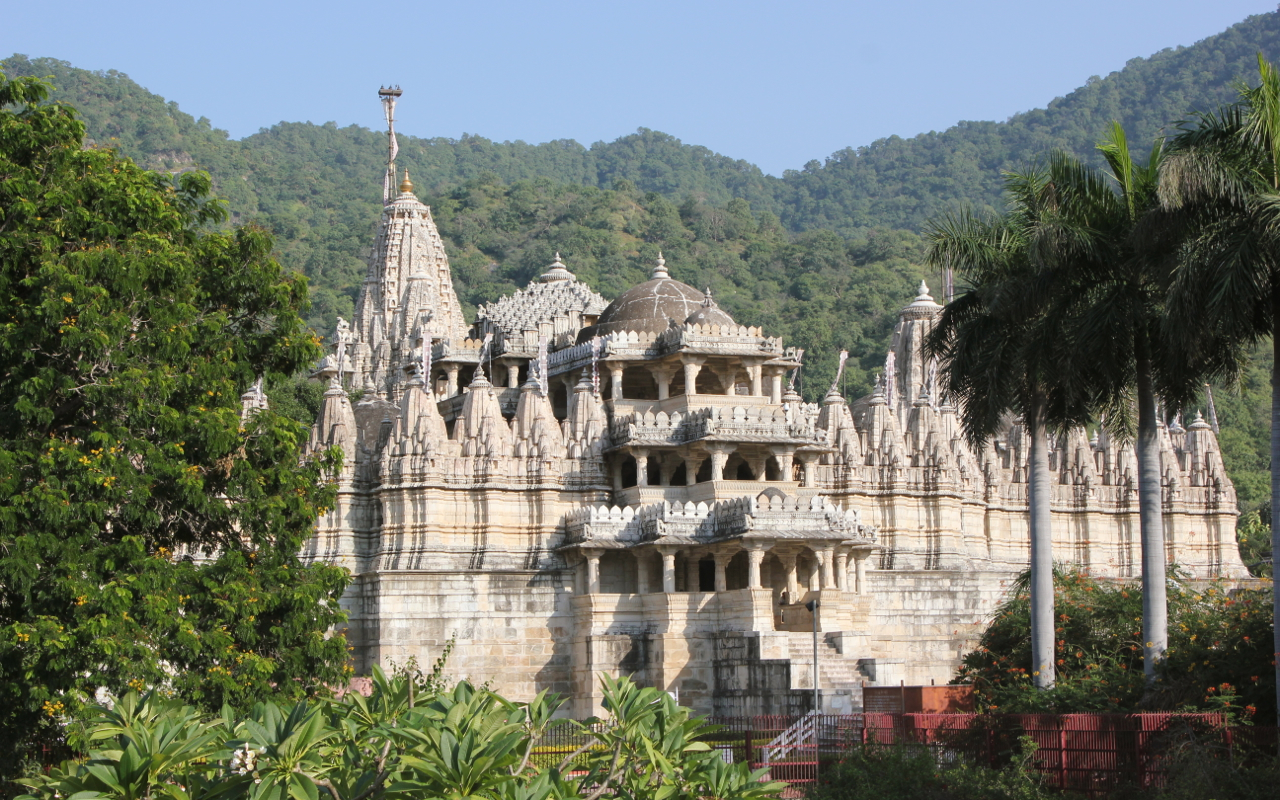
Dharna Shah, Maharana Kumbha & The Celestial Vimana Vision
Cradled within a tranquil, secluded valley on the western slopes of the Aravali Range in Pali district, approximately 95 km north of Udaipur, the Ranakpur Jain Temple complex represents the absolute zenith of medieval Indian marble architecture. Commissioned in 1389 CE by Dharna Shah, an enterprising Porwad Jain merchant and minister to the Mewar court, the temple took over fifty years to complete, with consecration rituals performed in 1439 CE (with expansions continuing until 1458).
According to historical Jain epigraphs, Dharna Shah was inspired by a divine dream of Nalinigulma Vimana—the celestial flying aerial chariot of the gods. Vowing to manifest this heavenly vision in stone on earth, he invited master architects across India. The commission was awarded to Depa (Depaka), an eccentric master builder whose spiritual humility and artistic genius brought the merchant's vision into physical reality.
Maharana Kumbha of Mewar granted extensive lands in the lush Magai river valley, as well as royal security and architectural patronage, requesting only that the holy town be named 'Ranakpur' in honor of the royal title Rana. Constructed entirely from light-amber and crystalline white marble quarried from nearby Sonana, the temple stands as an unblemished jewel of Svetambara Jain devotion.
- Historical Origin: Commissioned by Porwad Jain merchant Dharna Shah and designed by architect Depa.
- Royal Patronage: Land and patronage gifted by Maharana Kumbha of Mewar in the 15th century.
- Celestial Blueprint: Modelled after the divine heavenly flying chariot, Nalinigulma Vimana.
- Chaumukha Design: Four-faced sanctum symbolizing Tirthankara Adinatha preaching to the four corners.
The central Chaumukha temple is supported by exactly 1,444 light amber-tinted white marble pillars, each carved with entirely distinct floral arabesques, dancing celestial apsaras, and geometric bands. No two pillars are identical. The pillars are engineered with subtle shifts in alignment so that unobstructed sightlines to the four-faced central sanctum are maintained from every vantage point.
Chaumukha Mandir: The 1,444 Pillars & Intricate Ceilings
The primary shrine of the complex is the Chaumukha Temple (Dharana Vihara), dedicated to Bhagwan Adinatha (Rishabhanatha), the first Jain Tirthankara. Elevated on an expansive stone plinth measuring 48,000 square feet, the three-story temple features twenty-nine halls (mandapas), eighty-four subterranean chambers, and eighty-six shikharas and domes rising gracefully against the wooded Aravali mountain slopes.
At the core of the sanctuary stands the four-faced (chaumukha) idol of Adinatha, sculpted from a single colossal block of white marble. The four identical idols face the four cardinal directions, symbolizing the omniscient Tirthankara's universal presence and the propagation of Jain principles—non-violence (Ahimsa), truth (Satya), and non-possessiveness (Aparigraha)—across the cosmos.
The temple is supported by exactly 1,444 marble pillars, renowned worldwide because no two pillars share the same design. Master sculptors carved intricate foliage, dancing apsaras playing celestial flutes, lotus rosettes, and depictions of the Kalpavriksha (wish-fulfilling tree). Above, twenty-four ribbed domes feature concentric corbelled ceiling rings with hanging marble pendants that resemble delicate lace carved from stone.

Parshvanatha Sanctum, Surya Mandir & Rayan Tree
Within the same peaceful courtyard enclosure stands the Parshvanatha Temple, dating from the mid-15th century. This shrine is celebrated for its extraordinary sculpture of Tirthankara Parshvanatha sheltered beneath the thousand hoods of the cosmic serpent Dharanendra. Carved from a single marble block, the intertwined coils of the serpent are rendered with astonishing fluidity and realism.
Nearby stands the ancient Surya Mandir (Sun Temple), dating to the 13th century. This polygonal shrine features magnificent relief carvings of the Sun God driving his celestial chariot harnessed to seven galloping horses, surrounded by warrior attendants and celestial nymphs.
In the central courtyard grows the sacred Rayan Tree (Manilkara hexandra), an ancient specimen dating back over five centuries. Under its protective shade are carved marble footprints (charan padukas) of Lord Adinatha, commemorating the tree beneath which the first Tirthankara attained omniscience (Kevala Jnana). Devout pilgrims circumambulate the tree while chanting the Navkar Mantra.
Ranakpur is a deeply venerated living Digambara and Svetambara Jain pilgrimage shrine. Footwear, leather accessories (belts, wallets, watchstraps), and outside food are strictly prohibited inside. Visitors must dress modestly, ensuring shoulders and knees are completely covered. Menstrual restriction notices are posted by the temple trust at the entry gate.
Transit Infrastructure, Basecamp Hubs & Road Access
Ranakpur is situated in the Godwar region of Pali district, approximately 95 km north of Udaipur, 160 km south of Jodhpur, and 50 km west of Kumbhalgarh Fort. The drive from Udaipur takes roughly 2 hours via NH 76 branching at Iswal toward the winding, scenic mountain pass of Ranakpur Ghat. The road descent through the Aravali foothills offers panoramic views of wooded gorges frequented by wild grey langurs and peacocks.
For rail commuters, the nearest broad-gauge railway station is Falna (station code: FA), located just 35 km northwest. Falna is a major railway junction with direct superfast express trains to Delhi, Mumbai, Ahmedabad, and Jaipur. Taxis and local state buses operate regularly from Falna station to Ranakpur.
Accommodations in Ranakpur range from serene temple dharamshalas (which offer pure vegetarian dining (bhojanalaya) following strict Jain dietary rules) to boutique luxury jungle lodges and eco-resorts nestled among mango orchards along the Magai River, making it an idyllic wellness retreat.

- Road Route: 95 km north of Udaipur (2 hours) and 160 km south of Jodhpur (3 hours).
- Nearest Railhead: Falna Railway Station (35 km, 45 minutes by taxi).
- Nearest Airport: Maharana Pratap Airport, Udaipur (UDR, 105 km).
- Circuit Synergy: Ideally combined with Kumbhalgarh Fort (50 km away) via a scenic mountain road.
Visiting Seasons, Audio Guides & Photography Regulations
The ideal season to visit Ranakpur is from October to March, when the Godwar valley experiences crisp, pleasant daytime temperatures between 19°C and 26°C. The temple opens for tourist visits from 12:00 PM to 5:00 PM daily (morning hours until noon are strictly reserved for private devotional worship and puja by Jain pilgrims).
An official international-standard audio guide tour is available at the main counter in multiple languages (including English, French, German, Spanish, and Hindi). The narrated tour takes visitors through the temple's architectural secrets, explaining the mathematical acoustics and pointing out the lone tilted pillar deliberately left imperfect by the architects to avert the evil eye.
Photography with mobile phones and DSLR cameras is permitted with a modest token fee purchased at the ticket desk; however, tripods and commercial filming gear are strictly prohibited. The soft afternoon light filtering through the marble colonnades creates mesmerizing shadow patterns, making it a dream destination for architectural photographers.
Curated Field Dossier & Offline Google Maps Pin Pack
Bypass tourist traps with verified local logistics, exact parking coordinates, and field-tested routes.
- ✓Exact GPS Pin Pack: Unmarked parking spots, best dawn photography vantage points, and hidden trailheads.
- ✓Crowd-Avoidance Timing Matrix: Exact hour-by-hour windows to explore with zero tourist chaos.
- ✓Vetted Local Dhabas: 100% authentic, hygiene-checked regional food stops not on commercial maps.
- ✓Scam & Overcharge Shield: Verified taxi rates, auto fares, and local guide fee guidelines.
🛡️ Personally curated by PK Gupta & the Hidden Routes research desk. Delivered directly to your Email & WhatsApp within 4–8 hours.
Frequently Asked Questions
How many pillars are there in Ranakpur Jain Temple?
Ranakpur Jain Temple contains exactly 1,444 intricately carved marble pillars, and remarkably, no two pillars share the same design or ornamentation.
Who built Ranakpur Jain Temple and when was it completed?
The temple was commissioned in 1389 CE by Porwad Jain merchant Dharna Shah under the royal patronage of Maharana Kumbha, and designed by master architect Depa, completing in the 1450s.
What are the visiting hours for tourists at Ranakpur Jain Temple?
Tourists can explore the temple between 12:00 PM and 5:00 PM daily. Morning hours before noon are reserved exclusively for religious prayers and rituals by Jain devotees.
What dress code is enforced at Ranakpur Jain Temple?
Visitors must dress modestly with shoulders and knees covered. All footwear, leather items (belts, wallets, watchstraps), cigarettes, and outside food must be deposited at the cloakroom before entry.
How can one travel to Ranakpur from Udaipur or Jodhpur?
Ranakpur is located 95 km north of Udaipur (approx. 2 hours by car) and 160 km south of Jodhpur (approx. 3 hours). The closest major railway junction is Falna, located 35 km away.