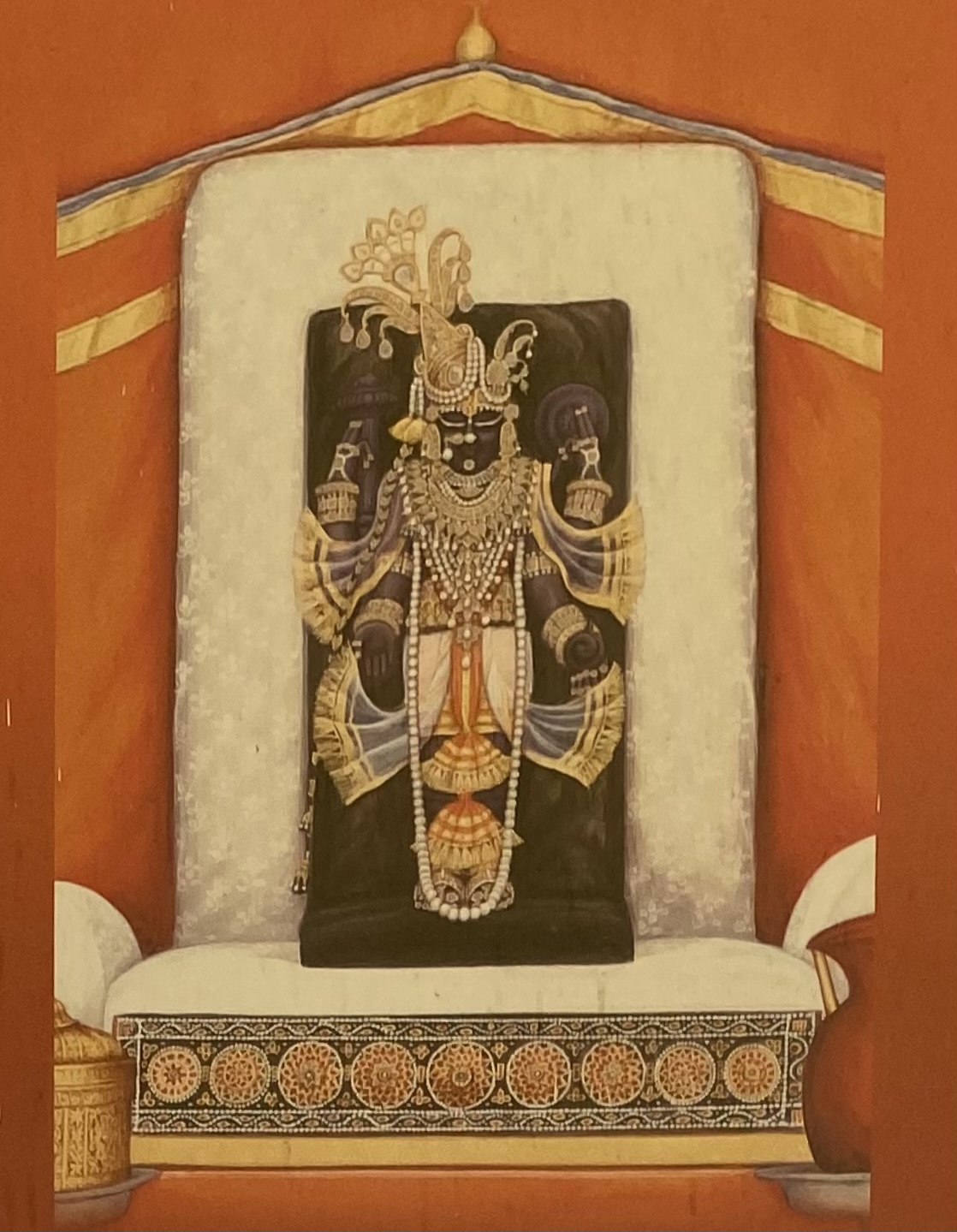
The Mathura Migration, Maharana Raj Singh & The Lakeside Haveli
Perched majestically upon an elevated promontory overlooking the shimmering waters of Rajsamand Lake in Kankroli, the Dwarkadhish Temple is one of the most revered and serene pilgrimage centers in western India. Dedicated to Lord Krishna as Dwarkadhish ('Lord of Dwarka') or Dwarkanathji, the temple is recognized as the Third Peeth (Tritiya Peeth) of the Pushtimarg Vaishnavite tradition, holding profound spiritual authority alongside its sister sanctuary at Nathdwara.
The sacred dark-stone idol of Lord Dwarkadhish was originally worshipped in Gokul and Mathura. During the late 17th century, to safeguard the sacred image from imperial destruction during the reign of Mughal Emperor Aurangzeb, the Goswami priests transported the deity into the sovereign territory of Mewar. Maharana Raj Singh I of Mewar welcomed the deity with royal reverence, offering land and permanent royal security.
In 1671 CE, the idol was initially consecrated in Asotiya before being permanently installed in 1676 CE in this magnificent palatial haveli built directly upon the newly constructed banks of Rajsamand Lake. The harmonious synthesis of royal palace architecture, lush gardens, and sweeping lake views makes Kankroli a haven of sublime devotional peace.
- Third Peeth of Pushtimarg: One of the supreme seven seats of the Vallabhacharya Vaishnavite lineage.
- Lord of Dwarka: Enshrines the sacred dark-stone four-armed idol of Lord Krishna as Dwarkadhish.
- Royal Mewar Patronage: Protected and endowed by Maharana Raj Singh in 1671 CE.
- Lakeside Splendor: Overlooks the vast freshwater expanse and marble ghats of Rajsamand Lake.
Kankroli holds immense theological significance as the official Third Peeth (Tritiya Peeth) among the seven primary seats of the Pushtimarg tradition established by Mahaprabhu Vallabhacharya. The spiritual lineage is presided over by the descendants of Shri Balkrishnaji, the third son of Gusainji Shri Vitthalnathji, maintaining unbroken ritual traditions for over 350 years.
Haveli Architecture, The Four-Armed Deity & Ritual Splendor
Constructed in the traditional Rajput-Pushtimarg haveli style, the Kankroli temple is designed not as a monumental stone pyramid, but as an open, welcoming royal mansion. Approached through stone gateway arches, the complex opens into expansive polished stone courtyards, pillared verandas (tibaris), and cool open terraces that capture refreshing breezes sweeping off the lake.
The inner sanctum enshrines the revered four-armed idol of Lord Dwarkanathji, sculpted from a single piece of dense black stone. The deity holds the divine conch (Panchajanya), the cosmic discus (Sudarshana Chakra), the mace (Kaumodaki), and the lotus flower (Padma), embodying the supreme majesty of Lord Krishna as the sovereign ruler of Dwarka.
The daily seva rituals mirror those of Nathdwara, structured around the loving care of the deity across eight distinct jhankis. Devotional poets and temple singers perform Haveli Sangeet using traditional acoustic instruments, while master cooks prepare sanctified vegetarian feasts (Mahaprasad) featuring pure ghee sweets, dry fruits, and seasonal savories.

The Historic Kankroli Vidya Vibhag Library & Rare Manuscripts
Beyond its devotional sanctity, Kankroli has long flourished as a preeminent center for traditional Indian scholarship, Sanskrit literature, and Pushtimarg theology. Within the temple precinct lies the historic 'Vidya Vibhag' (Department of Knowledge), established by the scholarly Goswami pontiffs to preserve and propagate ancient learning.
The temple library houses one of the finest private archives of medieval manuscripts in northern India, preserving thousands of rare hand-written palm-leaf and handmade paper manuscripts in Sanskrit, Braj Bhasha, and Gujarati. The collection includes rare treatises on Advaita and Shuddhadvaita Vedanta, astronomical calculations, ancient musicological texts, and illuminated miniature paintings from the Mewar and Kishangarh schools.
For centuries, scholars, poets, and philosophers traveled from across India to study at Kankroli, contributing to an intellectual environment that balanced intense devotional love with rigorous philosophical debate.
Like Nathdwara, darshan at Kankroli Dwarkadhish operates on specific, brief jhankis throughout the day. Photography is strictly prohibited within the temple complex. Cellphones, cameras, and leather items must be deposited in lockers. Maintain silence during aarti ceremonies.
Transit Infrastructure, Rail Hubs & Road Access
Kankroli is situated in Rajsamand district, approximately 65 km north of Udaipur, 18 km north of Nathdwara, and 330 km southwest of Jaipur. The town is situated directly along National Highway 8 (NH 8 / NH 58), the primary four-lane national expressway connecting Jaipur to Udaipur. Driving time from Udaipur is roughly 1 hour, while Nathdwara is reachable in just 20 minutes.
The Kankroli Railway Station (station code: KDL) is located just 2 km from the temple. It is a broad-gauge station on the Marwar-Udaipur line, served by regional passenger and express trains. For broader nationwide express train connectivity, Udaipur City Railway Station (65 km south) and Mavli Junction (35 km southeast) provide daily connections to Delhi, Mumbai, Jaipur, and Ahmedabad.
The nearest airport is Maharana Pratap Airport in Udaipur (UDR, 75 km south, approx. 1.25 hours driving time). Taxis, autorickshaws, and frequent state buses connect Kankroli with Udaipur, Nathdwara, and Rajsamand, making travel effortless.

- Highway Location: 65 km north of Udaipur (1 hour) via NH 8; 18 km north of Nathdwara (20 minutes).
- Nearest Railhead: Kankroli Station (2 km) and Mavli Junction (35 km).
- Nearest Airport: Maharana Pratap Airport, Udaipur (UDR, 75 km).
- Twin Pilgrimage: Almost universally paired with Nathdwara as part of the sacred Pushtimarg yatra.
Festivals, Annakoot & Visiting Guidelines
The temple celebrates traditional Vaishnavite festivals with extraordinary grandeur. During Janmashtami (August) and the grand Annakoot festival (October-November), the entire lakeside town of Kankroli is illuminated, and thousands of devotees gather to witness the deity dressed in radiant gold robes and to receive consecrated sweets.
The ideal visiting window spans from October through March, when daytime temperatures are mild (19°C to 26°C) and cool lake breezes make exploring the temple courtyards and adjacent lake embankments delightful. Visiting during the morning Rajbhog darshan (around 11:00 AM) or evening Sandhya Aarti (around 6:30 PM) offers the most vibrant spiritual atmosphere.
Visitors should dress modestly in Indian attire and allow time after darshan to walk down to the adjacent Nau Chauki Ghat to view the famous Rajprasasti black marble inscriptions and enjoy the sunset over Rajsamand Lake.
Curated Field Dossier & Offline Google Maps Pin Pack
Bypass tourist traps with verified local logistics, exact parking coordinates, and field-tested routes.
- ✓Exact GPS Pin Pack: Unmarked parking spots, best dawn photography vantage points, and hidden trailheads.
- ✓Crowd-Avoidance Timing Matrix: Exact hour-by-hour windows to explore with zero tourist chaos.
- ✓Vetted Local Dhabas: 100% authentic, hygiene-checked regional food stops not on commercial maps.
- ✓Scam & Overcharge Shield: Verified taxi rates, auto fares, and local guide fee guidelines.
🛡️ Personally curated by PK Gupta & the Hidden Routes research desk. Delivered directly to your Email & WhatsApp within 4–8 hours.
Frequently Asked Questions
What is the theological status of Kankroli Dwarkadhish Temple?
Kankroli Dwarkadhish is the official Third Peeth (Tritiya Peeth) of the Pushtimarg tradition founded by Mahaprabhu Vallabhacharya, presided over by the descendants of Shri Balkrishnaji.
Where was the idol of Dwarkadhish originally worshipped?
The four-armed dark-stone idol of Dwarkanathji was originally worshipped in Gokul and Mathura, before being brought to Mewar in 1671 CE to protect it from Mughal iconoclasm.
What lake is Kankroli Dwarkadhish Temple situated beside?
The temple is perched on the eastern banks of the massive 17th-century Rajsamand Lake, directly adjacent to the historic Nau Chauki marble embankment.
How far is Kankroli from Nathdwara and Udaipur?
Kankroli is located just 18 km north of Nathdwara (about 20 minutes by road) and 65 km north of Udaipur (about 1 hour via NH 8).
What rare academic resource is housed in Kankroli temple?
The temple houses the historic Vidya Vibhag library, containing thousands of rare medieval manuscripts in Sanskrit and Braj Bhasha on philosophy, music, and Vedanta.