1. Overview & Archaeological Significance
The Tomb of Itmad-ud-Daulah, affectionately known as the 'Baby Taj' or the 'Jewel Box' of Agra, stands serenely on the eastern bank of the Yamuna River in Uttar Pradesh. Constructed between 1622 and 1628 CE, this breathtaking mausoleum was commissioned by the powerful Mughal Empress Nur Jahan (born Mehr-un-Nissa) as a loving tribute to her father, Mirza Ghiyas Beg, a Persian nobleman who rose to become the chief imperial prime minister and was bestowed the exalted title *Itmad-ud-Daulah* ('Pillar of the State') by Emperor Jahangir.
Located in the Agra district of Uttar Pradesh, Tomb of Itmad-ud-Daulah is centrally protected by the Archaeological Survey of India (ASI) as an irreplaceable landmark of South Asian civilization. Recognized for its pietra dura inlaid white marble, persian charbagh & delicate jali screen architecture, the site provides profound insights into the technological prowess, cosmological beliefs, and cultural aesthetics of its ancient builders.
2. Dynastic Origins, Royal Patrons & Chronology
Mirza Ghiyas Beg was also the grandfather of Arjumand Banu Begum (better known as Mumtaz Mahal, for whom the Taj Mahal was built), making this monument intimately woven into the romantic and dynastic fabric of the Mughal Empire. Constructed over six years at immense royal expense, the tomb represents the critical stylistic turning point in Mughal architecture—transitioning from the robust red sandstone constructions of Akbar and Jahangir to the delicate, ethereal white marble and semi-precious stone embellishments perfected under Shah Jahan.
Centrally protected by the Archaeological Survey of India (ASI), Itmad-ud-Daulah is celebrated by art historians worldwide for introducing the Italian Renaissance art of *pietra dura* (known in India as *parchin kari*) into Mughal imperial architecture on a monumental scale. Unlike the massive monuments of Delhi and Agra, Itmad-ud-Daulah retains an intimate, feminine jewel-like delicacy that makes it one of the most beloved historical destinations in northern India.
3. Structural Engineering & Architectural Design
The tomb is set within an intimate walled Charbagh garden covering approximately 50 metres square, intersected by paved walkways, geometric water channels, and sunken fountain basins fed from the Yamuna. The mausoleum itself is built entirely of white crystalline Makrana marble quarried from Rajasthan, resting on a raised red sandstone terrace measuring 45 metres on each side.

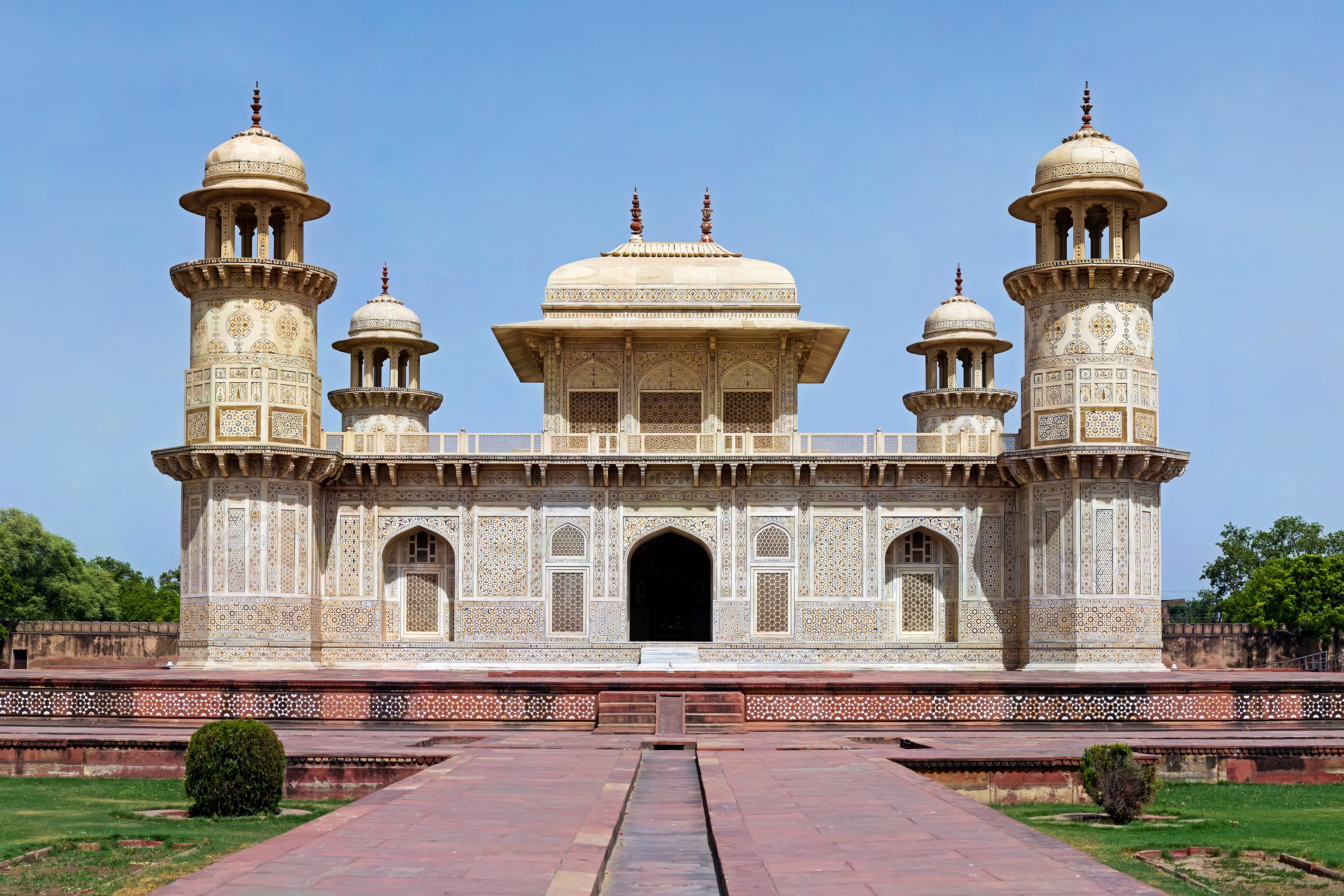
The architectural plan is a square measuring 23 metres (75 feet) on each side, anchored at the four corners by four hexagonal, three-tiered minarets rising 13 metres high, capped by domed marble pavilions. Crowning the center of the rooftop terrace is a delicate square canopy-like pavilion (*baradari*) with curved eaves (*bangladar* roof), illuminated by intricate marble jali screens.
What distinguishes Itmad-ud-Daulah above all other Mughal monuments is its astonishing surface ornamentation. Every square foot of interior and exterior marble is encrusted with semi-precious stone inlays—including carnelian, jasper, lapis lazuli, onyx, topaz, and malachite. The designs depict Persian motifs: slender cypress trees intertwined with blossoming almond trees, wine carafes, fruit bowls, bouquets of roses, and geometric tessellations. The interior cenotaph chamber features perforated marble screens through which river light filters with kaleidoscopic softness.
4. Archaeological Excavations, Epigraphy & Conservation
The ASI Science Branch carried out clay poultice (Fuller's earth) treatments on the white marble walls to absorb airborne carbon particulates and restore original stone luminescence.
Pietra dura specialists restored missing semi-precious stone tesserae on the riverfront facade using traditional natural resin adhesives.
The riverfront red sandstone redoubt and ghat walls were stabilized against seasonal Yamuna monsoon floodwaters in 2021.
Itmad-ud-Daulah is an ASI centrally protected monument. Online tickets cost ₹30 for Indian, SAARC, and BIMSTEC visitors (₹35 at counter), and ₹310 for foreign tourists (₹350 at counter). Free entry for children under 15.
5. Master Highlights & Archaeological Marvels
The extraordinary polychrome pietra dura inlay depicting wine ewers, chalices, and cypress trees—the finest inlaid stonework in India outside the Taj Mahal.

The delicate marble jali screens that filter the morning sun into intricate geometric shadow patterns across the yellow marble cenotaphs.
The tranquil river terrace overlooking the Yamuna River, offering distant vistas toward the Agra Fort and Mehtab Bagh.
6. Visiting Hours, Entry Permits & Visitor Guidelines
The Tomb of Itmad-ud-Daulah is open daily from 6:00 AM to 6:00 PM throughout the year. Accessible on all days.
Online ticket costs are ₹30 for Indian and SAARC visitors, and ₹310 for foreign tourists. Children under 15 enter free.
Footwear must be removed or shoe covers worn before ascending the red sandstone plinth to the white marble mausoleum.
Touching or scratching the delicate semi-precious stone inlays is strictly prohibited. Personal photography without tripods is allowed.
Itmad-ud-Daulah is a Centrally Protected Monument of world significance. Defacing or attempting to dislodge semi-precious stones will attract immediate police arrest and severe penalties under the AMASR Act 1958.
7. Site Museum & Interpretation Centers
The Taj Museum inside the Taj Mahal complex (3 km downstream) displays 17th-century Mughal jade artifacts, manuscripts, and original construction plans.
ASI interpretive signboards at the entrance gateway chronicle the remarkable life of Empress Nur Jahan and her Persian family.
8. Climate, Best Seasons & Ideal Visiting Hours
The best time to visit Itmad-ud-Daulah is from October to March, with pleasant winter weather and temperatures between 12°C and 25°C.
Late afternoons (4:00 PM to 5:45 PM) offer warm golden sunlight reflecting off the white marble and river water, creating exceptional photography conditions.
9. Transit Logistics, Rail, Air & Road Access
The tomb is located on the eastern bank of the Yamuna River in Moti Bagh, Agra, 4 km from Agra Fort and 6 km from Agra Cantt Railway Station.
Easily reached via the Strachey Bridge or Ambedkar Bridge by auto-rickshaw or taxi. Agra Airport (AGR) is 10 km southwest.
10. Regional Heritage Circuits & Sibling Monuments
Itmad-ud-Daulah is an essential gem on the Agra Yamuna Riverfront Heritage Trail:
Sacred Architecture & Darshan Protocol Guide
Maximize your spiritual journey: VIP vs Sugam Darshan line reality, locker rules, and historical truth.
- ✓Sugam Darshan & Token Blueprint: Accurate online booking rules, pre-dawn passes, and entry lane realities.
- ✓Zero Commercialization Guard: Avoid bogus intermediaries, fake priest fees, and paid blessing scams.
- ✓Locker, Footwear & Mobile Safety: Verified cloakroom locations, authorized phone lockers, and security rules.
- ✓Hidden Architectural Marvels: Inscriptions, subterranean sanctums, and forgotten stone carvings.
🛡️ Personally curated by PK Gupta & the Hidden Routes research desk. Delivered directly to your Email & WhatsApp within 4–8 hours.
11. Frequently Asked Questions
Why is the Tomb of Itmad-ud-Daulah called the 'Baby Taj'?
It is called the 'Baby Taj' because it served as the direct stylistic blueprint for the Taj Mahal, pioneering the complete use of white Makrana marble, four corner minarets, and intricate semi-precious stone pietra dura inlays.
Who was Itmad-ud-Daulah?
Itmad-ud-Daulah ('Pillar of the State') was the royal title of Mirza Ghiyas Beg, a Persian nobleman who became Prime Minister under Emperor Jahangir. He was the father of Empress Nur Jahan and the grandfather of Mumtaz Mahal.
Who commissioned this tomb and when was it built?
It was commissioned and overseen by Empress Nur Jahan between 1622 and 1628 CE following the death of her father.
What makes the pietra dura work at Itmad-ud-Daulah unique?
It represents the first extensive use of pietra dura (parchin kari) in India, featuring Persian motifs of cypress trees, wine flasks, and floral bouquets inlaid with lapis lazuli, jasper, carnelian, and onyx.
What are the visiting hours and ticket prices for Itmad-ud-Daulah?
Open daily from 6:00 AM to 6:00 PM. Online ASI tickets cost ₹30 for Indian, SAARC, and BIMSTEC visitors, and ₹310 for foreign tourists. Children under 15 enter free.