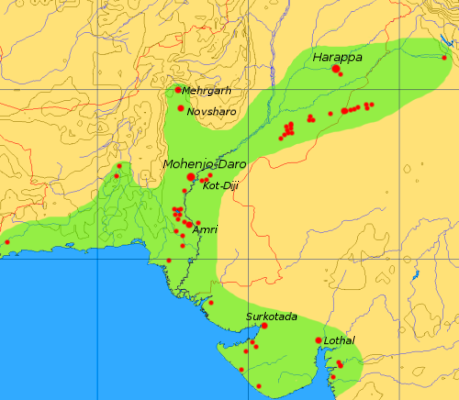
1. Overview & Archaeological Significance
Surkotada is a fortified archaeological site of the Indus Valley Civilization located in Rapar taluka of Kutch district, Gujarat. Occupying a strategic low sandstone hillock surrounded by an undulating landscape of thorn scrub, the site encompasses a compact area of roughly 3.5 acres (1.4 hectares). Excavations revealed three distinct cultural sub-periods spanning from circa 2300 BCE to 1700 BCE (Period IA, IB, and IC), illustrating the expansion of Mature Harappan culture into the Kutch peninsula and its interaction with indigenous non-Harappan communities.
Located in the Kutch district of Gujarat, Surkotada Harappan Site is centrally protected by the Archaeological Survey of India (ASI) as an irreplaceable landmark of South Asian civilization. Recognized for its rubble stone masonry, ramp gateway with guardrooms & megalithic pot-burials, the site provides profound insights into the technological prowess, cosmological beliefs, and cultural aesthetics of its ancient builders.
2. Dynastic Origins, Royal Patrons & Chronology
The site was discovered and excavated between 1970 and 1972 by Jagat Pati Joshi of the Archaeological Survey of India. Unlike the vast metropolises of Dholavira or Rakhigarhi, Surkotada was designed as a heavily fortified military outpost and administrative trading garrison commanding the overland transit routes connecting the Great Rann of Kutch with mainland Saurashtra and the Gulf of Khambhat.
Surkotada achieved international scientific prominence due to the controversial discovery of alleged horse skeletal remains in Periods IA, IB, and IC. Hungarian archaeozoologist Sándor Bökönyi examined the bone fragments and molar teeth, concluding they belonged to true domesticated horses. While several scholars contested this identification, suggesting they represented the wild ass, the finds sparked decades of debate regarding prehistoric animal domestication and trans-Eurasian contacts.
3. Structural Engineering & Architectural Design
Surkotada's architectural design features an integrated dual-enclosure system consisting of a fortified Citadel to the west and an adjoining fortified Residential Annexe to the east, separated by a massive dividing wall. Both enclosures were built using rubble stone masonry bonded with sticky mud-brick mortar, faced with fine clay plaster. The Citadel perimeter wall was built on an imposing scale, measuring up to 7 metres thick at the base with square corner bastions.

The main entrance to the Citadel was an architectural marvel: an imposing ramped gateway on the southern face. Flanked by massive stone-built guardrooms, the gateway featured a wide stone staircase and ramp leading up to a recessed timber gate. Stone lintel sockets and pivot stones recovered in situ indicate heavy double-leaf wooden doors that could be securely barred during military sieges.
The interior of the Citadel contained large, well-planned residential quarters for the garrison commander and civic officials, featuring stone-paved courtyards, drain channels, and storage rooms. The Residential Annexe housed craftsmen, traders, and soldiers, with houses arranged around a central open street.
4. Archaeological Excavations, Epigraphy & Conservation
J.P. Joshi's excavations yielded groundbreaking insights into Harappan mortuary practices. Surkotada revealed a unique cemetery featuring four megalithic-style pot-burials (cairn circles). The burials consisted of large oval pits containing deep terracotta urns filled with human bone fragments and grave pottery, sealed by colossal flat sandstone capstones surrounded by a circle of undressed boulders—a mortuary style anticipating South Indian Megalithic traditions.
Artifacts salvaged from the site include steatite beads, shell bangles, copper blades, terracotta bull figurines, chert blades, and typical Harappan black-on-red painted ceramics alongside distinct White-Painted Black-and-Red Ware reflecting indigenous Kutch ceramic traditions.
Stratigraphic samples analyzed for botanical remains revealed that the garrison relied on cultivated barley, wheat, and finger millet, supplemented by domesticated cattle, sheep, goats, and camel bones.
Surkotada is a Centrally Protected Monument under the Archaeological Survey of India (Vadodara Circle). Entry to the archaeological site is free for all visitors. Visitors register at the entry kiosk.
5. Master Highlights & Archaeological Marvels
Visitors can inspect the preserved rubble-stone ramparts of the Citadel, the massive corner bastions, and the connecting wall dividing the Citadel from the Residential Annexe.

The southern ramped gateway with its intact guardrooms and stone flight of stairs is the architectural centerpiece of the ruins, providing a vivid picture of Harappan military engineering.
In the nearby cemetery area, the circular boulder alignments of the pot-burial cairns offer a rare glimpse into Bronze Age funerary customs.
6. Visiting Hours, Entry Permits & Visitor Guidelines
Surkotada is open daily from sunrise to sunset (6:00 AM to 6:00 PM). There are no weekly closure days.
Entry is free for all visitors. Free parking is available outside the ASI perimeter gate.
Climbing on the dry rubble-stone walls or dislodging stones from the gateway is strictly prohibited under the AMASR Act.
Personal photography is allowed; commercial filming and drones require prior ASI permission. Bring drinking water and sun protection.
Surkotada is a Centrally Protected archaeological monument. Removing artifacts, stones, or pottery shards is punishable under the AMASR Act with imprisonment up to 2 years.
7. Site Museum & Interpretation Centers
Excavated artifacts from Surkotada are housed in the ASI Central Antiquity Collection and the Kutch Museum in Bhuj.
An on-site interpretive pavilion provides structural layout maps and historical summaries of the three cultural periods.
8. Climate, Best Seasons & Ideal Visiting Hours
The best time to visit Surkotada is during winter from October to March, with temperatures between 15°C and 28°C.
Summers (April to June) are arid and scorchingly hot (over 42°C). Monsoons (July to September) bring seasonal green scrub.
9. Transit Logistics, Rail, Air & Road Access
Surkotada is located near Sanva village in Rapar taluka of Kutch district, approximately 160 kilometres northeast of Bhuj, 100 kilometres northeast of Gandhidham, and 30 kilometres from Adesar.
The nearest railway station is Adesar (30 km) or Samakhiali Junction (60 km). Bhuj Airport (165 km) and Ahmedabad Airport (280 km) provide flight access.
10. Regional Heritage Circuits & Sibling Monuments
Surkotada connects naturally with the major Harappan circuit in Kutch:
Sacred Architecture & Darshan Protocol Guide
Maximize your spiritual journey: VIP vs Sugam Darshan line reality, locker rules, and historical truth.
- ✓Sugam Darshan & Token Blueprint: Accurate online booking rules, pre-dawn passes, and entry lane realities.
- ✓Zero Commercialization Guard: Avoid bogus intermediaries, fake priest fees, and paid blessing scams.
- ✓Locker, Footwear & Mobile Safety: Verified cloakroom locations, authorized phone lockers, and security rules.
- ✓Hidden Architectural Marvels: Inscriptions, subterranean sanctums, and forgotten stone carvings.
🛡️ Personally curated by PK Gupta & the Hidden Routes research desk. Delivered directly to your Email & WhatsApp within 4–8 hours.
11. Frequently Asked Questions
Why is Surkotada famous in Indian archaeology?
Surkotada is famous for its heavily fortified stone citadel with an intact ramped gateway, megalithic pot-burial cairns, and the controversial discovery of alleged horse skeletal remains dated to 2000 BCE.
What kind of architecture does Surkotada exhibit?
Unlike the brick cities of mainland Gujarat, Surkotada was built of undressed rubble stone masonry bonded with mud mortar, featuring a fortified Citadel, an adjoining Residential Annexe, and a monumental gateway flanked by guardrooms.
What are the visiting hours and ticket costs for Surkotada?
Surkotada is open daily from sunrise to sunset with free entry for all domestic and foreign visitors.
How far is Surkotada from Bhuj or Dholavira?
Surkotada is approximately 160 km from Bhuj and about 120 km from Dholavira via Rapar, making it an ideal midpoint stop on a Kutch archaeological tour.
Who excavated Surkotada?
Surkotada was discovered and excavated between 1970 and 1972 by Jagat Pati Joshi of the Archaeological Survey of India.