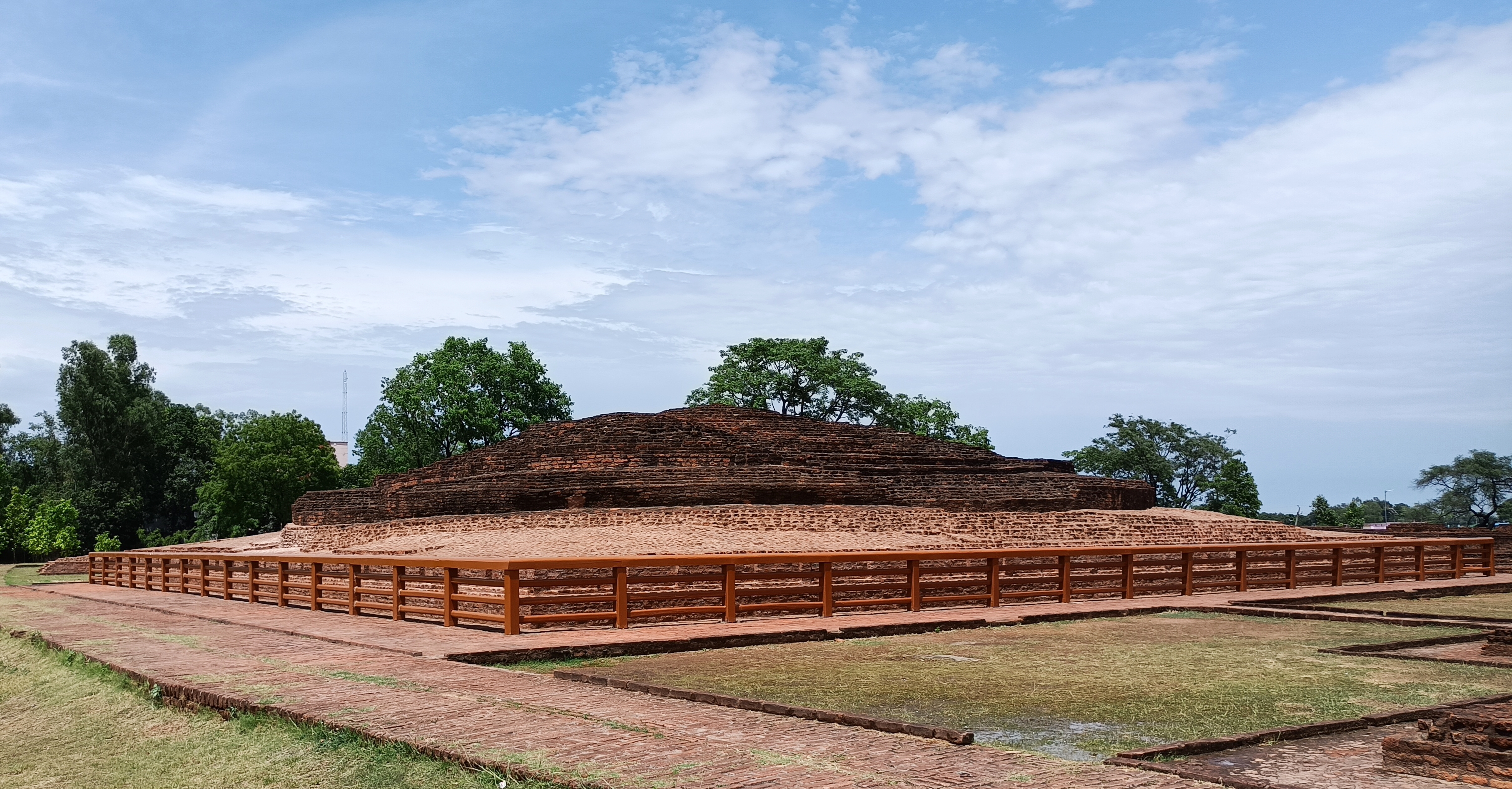
1. Overview & Archaeological Significance
Piprahwa Stupa, located in the Siddharthnagar district of eastern Uttar Pradesh near the Indo-Nepal border, is one of the most historically momentous and sacred Buddhist archaeological monuments on Earth. It was here, in the ancient kingdom of the Sakya clan, that the mortal remains (bone relics) of Gautama Buddha were deposited after his cremation at Kushinagar in 483 BCE. When the relics were divided into eight portions among contemporary kingdoms, the Sakyas of Kapilavastu—Buddha's own kinsmen—built a monumental brick stupa over their one-eighth share.
Located in the Siddharthnagar district of Uttar Pradesh, Piprahwa Stupa Kapilavastu is centrally protected by the Archaeological Survey of India (ASI) as an irreplaceable landmark of South Asian civilization. Recognized for its multi-tiered circular brick stupa, terracotta relic vault & quadrangular monasteries, the site provides profound insights into the technological prowess, cosmological beliefs, and cultural aesthetics of its ancient builders.
2. Dynastic Origins, Royal Patrons & Chronology
In 1898, British landowner William Claxton Peppe excavated the stupa mound, discovering a massive sandstone coffer at a depth of 5.5 metres. Inside were five exquisite relic vessels made of steatite (soapstone) and crystal, filled with gold flowers, pearls, gemstones, and charred human bone fragments. One of the soapstone caskets bore a celebrated 5th-century BCE inscription in archaic Brahmi script: *Iyam salila nidhane Budhasa bhagavate Sakiyanam sukiti-bhatinam sabhaginikanam saputa-dalanam* ('This relic shrine of the divine Buddha is the pious donation of the Sakya brethren, with their sisters, sons, and wives').
To resolve academic debates over the true location of Kapilavastu, K.M. Srivastava of the Archaeological Survey of India conducted deep excavations between 1971 and 1977. Sinking trenches below Peppe's level, Srivastava discovered two earlier pre-Mauryan brick chambers containing soapstone and terracotta caskets with sacred bone relics, along with over 40 terracotta sealings inscribed with *Om Devaputra Vihare Kapilavastu Bhikshu Sanghasya* ('Of the community of Buddhist monks of Kapilavastu residing in Devaputra Monastery'), conclusively proving that Piprahwa is indeed ancient Kapilavastu.
3. Structural Engineering & Architectural Design
The architectural history of Piprahwa Stupa reveals three distinct structural construction phases spanning eight centuries. The earliest Phase I stupa was built in the 5th century BCE by the Sakyas: an austere, solid hemispherical mound constructed of large kiln-burnt mud-mortared bricks measuring 40 x 27 x 7 centimetres, resting on a circular base diameter of 19 metres.

In Phase II, Emperor Ashoka enlarged the stupa, encasing the original mound in high-fired bricks and constructing a central square relic chamber lined with heavy sandstone slabs. In Phase III (Kushana period, 1st–2nd century CE), the stupa was elevated onto a stepped square plinth and surrounded by a paved pradakshina path.
Adjacent to the stupa lies an expansive monastic town complex. To the east stands Monastery 1, an immense brick-built vihara quadrangle comprising 30 residential cells arranged around a central open courtyard, complete with a dining hall, well, and drainage sluices. To the south lies a second monastic complex, and 1.5 km west at Ganwaria stand the excavated palatial residential quarters of ancient Kapilavastu.
4. Archaeological Excavations, Epigraphy & Conservation
K.M. Srivastava's landmark excavations between 1971 and 1977 yielded some of the most sensational finds in South Asian archaeology. In 1972, beneath the base of Peppe's coffer, Srivastava uncovered two separate brick-built chambers. The northern chamber contained a cylindrical red earthenware casket; the southern chamber held another soapstone casket and a terracotta vessel containing sacred bone fragments.
The decisive evidence identifying Piprahwa as Kapilavastu came from the discovery of 44 terracotta sealings recovered from the rooms of Monastery 1, which bore inscriptions in 1st-century CE Kushana Brahmi explicitly mentioning 'Kapilavastu Bhikshu Sangha'.
At neighboring Ganwaria, excavations uncovered fortified brick mansions with double-storey walls, copper cooking vessels, terracotta figurines, and coins of the Mitra and Kushana dynasties.
Piprahwa Stupa and the Ganwaria palace ruins are Centrally Protected Monuments under the Archaeological Survey of India (Patna Circle). Admission is free for all visitors.
5. Master Highlights & Archaeological Marvels
Visitors can inspect the multi-tiered circular brick stupa, viewing the central excavation shaft that revealed the original Sakya-era relic chambers.

Monastery 1 is exceptionally well preserved, allowing visitors to walk through ancient corridors, residential monk dormitories, and central gathering halls.
The adjoining palatial complex of Ganwaria (1.5 km west) features massive brick courtyards identified as the royal residential complex of King Suddhodana (Buddha's father).
6. Visiting Hours, Entry Permits & Visitor Guidelines
The monument is open daily from sunrise to sunset (6:00 AM to 6:00 PM). Accessible all days of the year.
Admission is completely free for all Indian and international visitors. Free parking is available near the entrance garden.
Visitors must not walk on or dislodge ancient bricks from the stupa or monastery walls. Maintaining quiet respect within this holy relic sanctuary is requested.
Personal photography is permitted without tripods; commercial filming and drones require prior written ASI authorization.
Piprahwa is the sacred discovery site of the mortal bone relics of Gautama Buddha. Any vandalism, defacement, or unauthorized digging will result in strict criminal prosecution under the AMASR Act.
7. Site Museum & Interpretation Centers
The Kapilavastu Archaeological Museum on site displays excavated terracotta seals, pottery vessels, coins, and photographs of the landmark 1972 relic discovery.
The original bone relics discovered by K.M. Srivastava in 1972 are enshrined in the National Museum in New Delhi and periodically travel for international state expositions.
8. Climate, Best Seasons & Ideal Visiting Hours
The best time to visit Piprahwa is from October to March, when winter weather is pleasantly cool, with temperatures between 12°C and 25°C.
Summer (April to June) brings intense dry heat (over 42°C). The monsoon (July to September) makes the Terai plains lush and green.
9. Transit Logistics, Rail, Air & Road Access
Piprahwa is situated in Siddharthnagar district of Uttar Pradesh, 22 kilometres north of Siddharthnagar (Naugarh) railway station and 95 kilometres north of Gorakhpur.
The nearest railway junction is Siddharthnagar (22 km) or Gorakhpur Junction (95 km). Gorakhpur Airport (GOP, 105 km) offers daily flights to Delhi, Mumbai, and Kolkata.
10. Regional Heritage Circuits & Sibling Monuments
Piprahwa is the historic heart of the Kapilavastu & Buddhist Terai Pilgrimage Corridor:
Sacred Architecture & Darshan Protocol Guide
Maximize your spiritual journey: VIP vs Sugam Darshan line reality, locker rules, and historical truth.
- ✓Sugam Darshan & Token Blueprint: Accurate online booking rules, pre-dawn passes, and entry lane realities.
- ✓Zero Commercialization Guard: Avoid bogus intermediaries, fake priest fees, and paid blessing scams.
- ✓Locker, Footwear & Mobile Safety: Verified cloakroom locations, authorized phone lockers, and security rules.
- ✓Hidden Architectural Marvels: Inscriptions, subterranean sanctums, and forgotten stone carvings.
🛡️ Personally curated by PK Gupta & the Hidden Routes research desk. Delivered directly to your Email & WhatsApp within 4–8 hours.
11. Frequently Asked Questions
What is the historical connection between Piprahwa and ancient Kapilavastu?
Kapilavastu was the capital of the Sakya kingdom where Prince Siddhartha (Gautama Buddha) grew up. Excavations at Piprahwa by K.M. Srivastava in the 1970s discovered terracotta sealings reading 'Kapilavastu Bhikshu Sangha', proving that Piprahwa is the true site of ancient Kapilavastu.
What was discovered inside Piprahwa Stupa in 1898 and 1972?
In 1898, W.C. Peppe discovered inscribed soapstone caskets containing bone relics of the Buddha deposited by the Sakya clan. In 1972, the ASI excavated even deeper pre-Mauryan chambers containing additional original bone relics in terracotta and soapstone caskets.
Where are the sacred Piprahwa bone relics kept today?
The relics excavated in 1972 are enshrined in a special golden sanctum in the National Museum in New Delhi, while portions of Peppe's 1898 finds were gifted to the King of Siam (Thailand) and the Indian Museum in Kolkata.
What are the visiting hours and entry fees for Piprahwa Stupa?
The archaeological site is open daily from sunrise to sunset with free admission for all visitors.
How can I travel to Piprahwa from Gorakhpur or Lucknow?
From Gorakhpur, drive north via Bansi and Naugarh to Piprahwa (95 km, roughly 2.5 hours by taxi). From Lucknow, travel east via Ayodhya and Basti (roughly 260 km, 5.5 hours).