1. Overview & Archaeological Significance
The Pancha Rathas (literally the 'Five Chariots'), standing serenely in a sandy precinct at the southern edge of Mamallapuram in Chengalpattu district, Tamil Nadu, represent one of the most astonishing, pioneering, and influential experiments in the history of world rock-cut architecture. Commissioned in the mid-7th century CE (c. 630–668 CE) during the reign of King Narasimhavarman I (popularly known as *Mamalla*, 'The Great Wrestler', from whom Mamallapuram derives its name) of the Pallava dynasty, the monuments remained unfinished following the king's death in 668 CE.
Located in the Chengalpattu district of Tamil Nadu, Pancha Rathas Mamallapuram is centrally protected by the Archaeological Survey of India (ASI) as an irreplaceable landmark of South Asian civilization. Recognized for its monolithic rock-cut architecture, carved from single granite boulders, dravidian prototype models, the site provides profound insights into the technological prowess, cosmological beliefs, and cultural aesthetics of its ancient builders.
2. Dynastic Origins, Royal Patrons & Chronology
Although named by local villagers after the five Pandava brothers of the *Mahabharata* (Dharmaraja, Bhima, Arjuna, Nakula, and Sahadeva) and their common consort Draupadi, these monolithic structures have no historical connection to the epic. Instead, modern art historians recognize them as full-scale architectural prototypes created by Pallava royal architects to experiment with and codify different styles of Hindu temple vimanas in solid granite before constructing freestanding structural temples across South India.
Inscribed on the UNESCO World Heritage list in 1984 under the 'Group of Monuments at Mahabalipuram', the Pancha Rathas are protected as an ancient monument of national importance by the Archaeological Survey of India (ASI). Buried under shifting coastal sands for centuries until excavated by British antiquarians in the early 19th century, the complex preserves pristine chisel marks that illuminate the transition of Indian temple building from timber to eternal granite.
3. Structural Engineering & Architectural Design
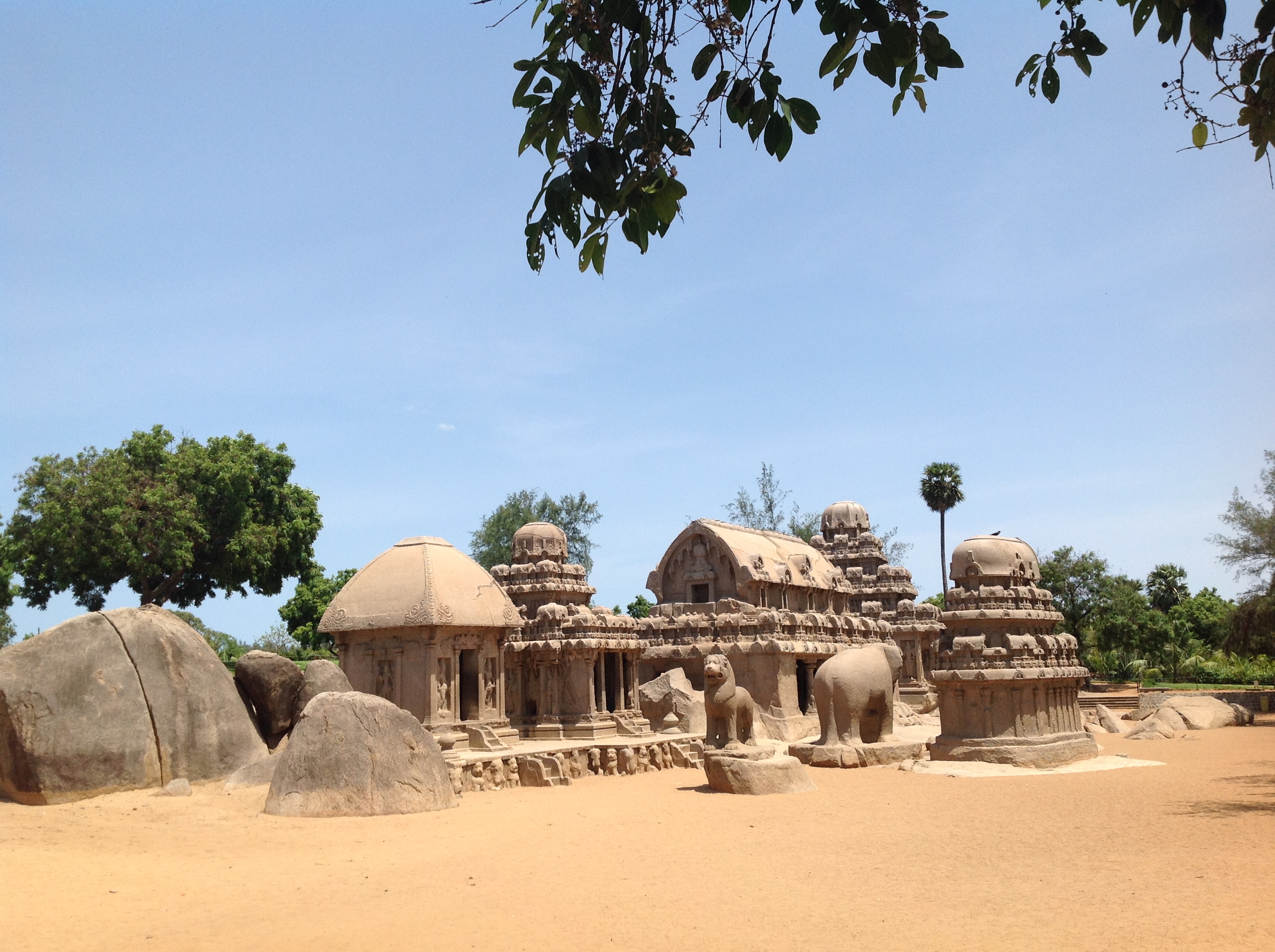
What makes the Pancha Rathas an engineering marvel is that all five distinct shrines, along with three massive life-sized animal sculptures (an elephant, a lion, and a Nandi bull), were carved out of a single, continuous, sloping outcrop of pinkish-grey crystalline granite bedrock without any structural joints.

The five shrines exhibit completely distinct architectural roof forms: *Draupadi Ratha* resembles a simple rural thatched mud hut of Bengal (*kutir*) with curved eaves; *Arjuna Ratha* is a two-tiered stepped pyramidal Dravidian shrine with sculpted guardian dvarapalas; *Bhima Ratha* features an elongated wagon-vaulted barrel roof (*valabhi*) with haram colonnades; *Dharmaraja Ratha* is the largest and most complex, rising across three storeys with an octagonal shikhara and inscriptions bearing royal Pallava titles; and *Nakula-Sahadeva Ratha* exhibits an apsidal (*gajaprishta* or elephant-back) horseshoe design.
Standing beside the shrines are three astonishing monolithic animal sculptures carved from adjacent boulders: a colossal life-sized monolithic *Elephant* (standing 12 feet high with detailed skin folds), a roaring royal *Lion* representing Goddess Durga, and a serene *Nandi Bull* resting behind Arjuna Ratha, demonstrating the extraordinary naturalistic mastery of 7th-century Pallava sculptors.
4. Archaeological Excavations, Epigraphy & Conservation
Archaeological clearance by the ASI Chennai Circle in the 19th and 20th centuries excavated several feet of accumulated beach sand that had partially buried the monolithic plinths.
Laser-guided scanning documented the uncarved lower plinths, revealing the exact top-down vertical chiseling techniques employed by Pallava stonemasons.
Chemical consolidation desalted the granite surfaces, removing microscopic sea-salt crystals carried by coastal winds from the nearby Bay of Bengal.
A combined ASI UNESCO World Heritage ticket covers Pancha Rathas, the Shore Temple, and Descent of the Ganges. Online tickets cost ₹40 for Indian, SAARC, and BIMSTEC visitors (₹45 at counter), and ₹600 for foreign tourists (₹650 at counter). Free entry for children under 15.
5. Master Highlights & Archaeological Marvels
Standing beside the colossal monolithic granite elephant, admiring the astonishing lifelike detail of its trunk and ears carved from a single boulder.

Observing how five completely distinct styles of Indian temple architecture were created side by side out of a single rock outcrop.
Reading the 7th-century Grantha script inscriptions on the Dharmaraja Ratha recording the royal titles of King Narasimhavarman Mamalla.
6. Visiting Hours, Entry Permits & Visitor Guidelines
Pancha Rathas is open daily from 6:00 AM to 6:00 PM throughout the year. Accessible on all days.
Online ticket costs are ₹40 for Indian visitors, and ₹600 for foreign tourists. Children under 15 enter free.
Do not climb onto the monolithic elephant, lion, or chariot plinths (protective boundaries installed).
Personal photography without tripods is allowed; drones are strictly prohibited without prior written authorizations.
Pancha Rathas is a protected UNESCO World Heritage Site. Defacing ancient granite sculptures or climbing onto monoliths will attract heavy penalties under the AMASR Act 1958.
7. Site Museum & Interpretation Centers
The nearby Mamallapuram Sculpture Museum displays over 3,000 historic and modern stone and bronze sculptures, demonstrating living local stonecraft.
ASI interpretive signboards explain the architectural classification of each ratha and its influence on subsequent Chola and Southeast Asian temples.
8. Climate, Best Seasons & Ideal Visiting Hours
The best time to visit Pancha Rathas is from October to March, with pleasant coastal weather and temperatures between 22°C and 30°C.
Early mornings (6:30 AM to 9:00 AM) offer soft golden light on the pink granite surfaces and quiet uncrowded photography.
9. Transit Logistics, Rail, Air & Road Access
Pancha Rathas is located in Mamallapuram, 1.5 km south of the town bus stand and 55 km south of Chennai.
Easily reached via taxi, auto-rickshaw, or state TNSTC bus from Chennai along the East Coast Road (ECR) in 1 hour.
10. Regional Heritage Circuits & Sibling Monuments
Pancha Rathas is an indispensable highlight of the Mamallapuram UNESCO Monolithic Heritage Trail:
Sacred Architecture & Darshan Protocol Guide
Maximize your spiritual journey: VIP vs Sugam Darshan line reality, locker rules, and historical truth.
- ✓Sugam Darshan & Token Blueprint: Accurate online booking rules, pre-dawn passes, and entry lane realities.
- ✓Zero Commercialization Guard: Avoid bogus intermediaries, fake priest fees, and paid blessing scams.
- ✓Locker, Footwear & Mobile Safety: Verified cloakroom locations, authorized phone lockers, and security rules.
- ✓Hidden Architectural Marvels: Inscriptions, subterranean sanctums, and forgotten stone carvings.
🛡️ Personally curated by PK Gupta & the Hidden Routes research desk. Delivered directly to your Email & WhatsApp within 4–8 hours.
11. Frequently Asked Questions
What are the Pancha Rathas in Mamallapuram?
They are five monolithic rock-cut shrines carved out of a single granite outcrop in the 7th century CE by Pallava King Narasimhavarman I, serving as experimental prototypes for Dravidian temple architecture.
Are the Pancha Rathas actually connected to the Mahabharata Pandavas?
No, their names (Dharmaraja, Bhima, Arjuna, Nakula-Sahadeva, Draupadi) were assigned by local villagers centuries later. They were created as architectural models of Hindu temples and were never consecrated for worship.
What monolithic animals are carved at the Pancha Rathas?
Beside the chariots stand three life-sized monolithic animal sculptures carved from single granite boulders: a magnificent 12-foot elephant, a royal lion, and a sacred Nandi bull.
What are the visiting hours and entry fees?
Open daily from 6:00 AM to 6:00 PM. A combined ASI ticket covering Pancha Rathas, Shore Temple, and Descent of the Ganges costs ₹40 for Indians and ₹600 for foreign tourists.
Which of the five rathas is the largest and most complex?
The Dharmaraja Ratha is the largest and most complex, rising across three storeys with an octagonal dome and bearing royal Pallava inscriptions in the Grantha script.