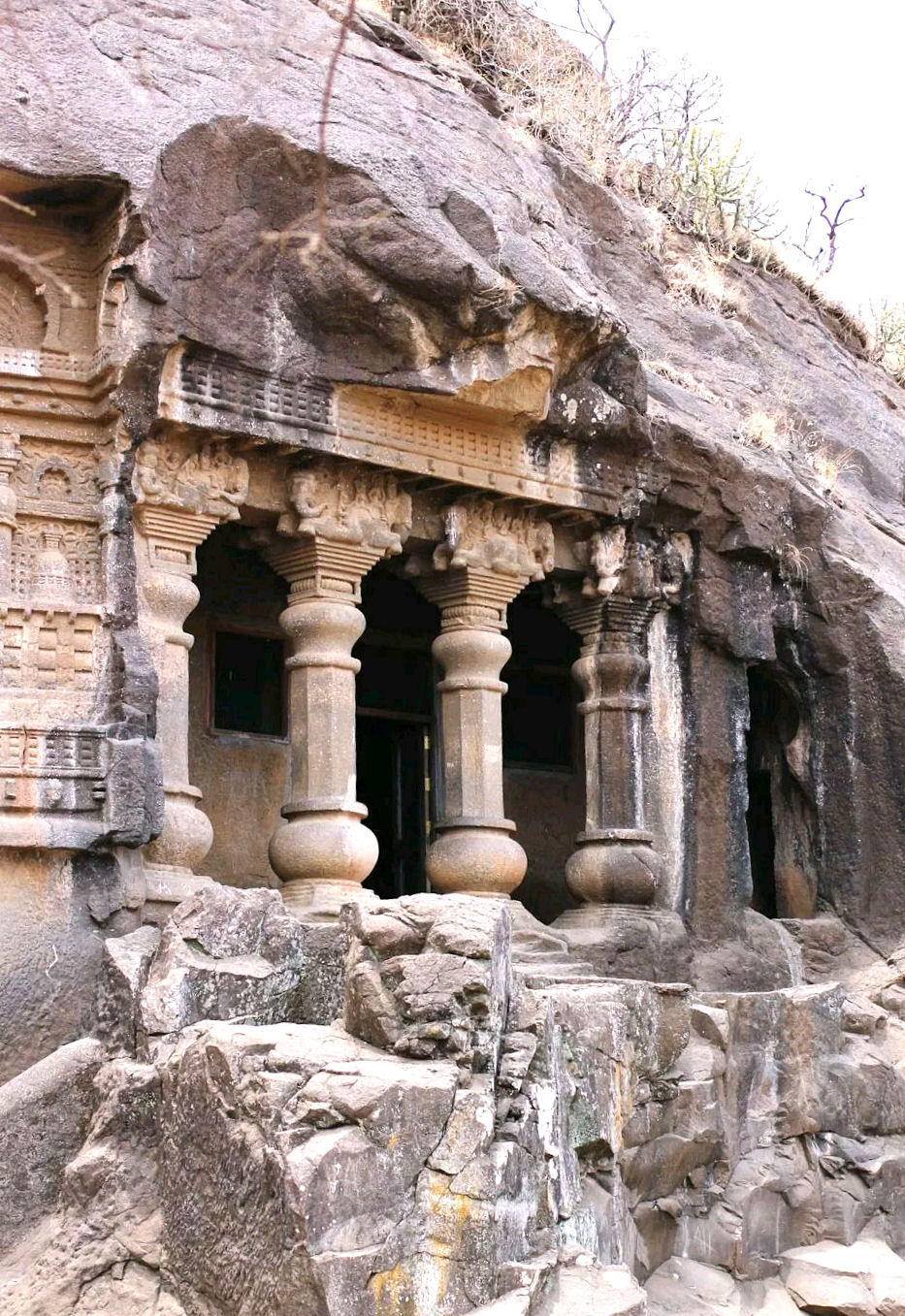
1. Overview & Archaeological Significance
The Pandavleni Caves (historically known as the Trirashmi Buddhist Caves) form a celebrated complex of twenty-four rock-cut caves carved into the northern flank of Trirashmi Hill, approximately 8 kilometres southwest of Nashik in Maharashtra. Originating between the 2nd century BCE and the 6th century CE, the complex spans the Hinayana, Mahayana, and early Vajrayana phases of Buddhism. Positioned at the crossroads of ancient trans-peninsular caravan highways linking the Arabian Sea ports of Sopara and Bharuch with inland emporia such as Tagara and Paithan, Trirashmi was a renowned spiritual haven patronized by royalty, merchants, and guild fraternities.
Located in the Nashik district of Maharashtra, Pandavleni Caves Trirashmi Buddhist Complex is centrally protected by the Archaeological Survey of India (ASI) as an irreplaceable landmark of South Asian civilization. Recognized for its rock-cut buddhist chaitya & vihara architecture, fluted animal capitals, intricate façade reliefs & rock-cut water cisterns, the site provides profound insights into the technological prowess, cosmological beliefs, and cultural aesthetics of its ancient builders.
2. Dynastic Origins, Royal Patrons & Chronology
What elevates Pandavleni into a monument of supreme epigraphical significance is its extraordinary wealth of royal inscriptions. Cave 3 contains the legendary 2nd-century CE Nashik prashasti of Queen Gautami Balashri, eulogizing her son, the great Satavahana Emperor Gautamiputra Satakarni, as the 'destroyer of the pride of the Kshatriyas' and 'lord of the three oceans'. Cave 10 preserves extensive Prakrit inscriptions detailing endowments of land, coconut plantations, and gold coins by Ushavadata, the son-in-law of Western Kshatrapa ruler Nahapana. These dual epigraphic records provide unmatched chronological anchors for reconstructing ancient Indian dynastic history.
Maintained by the Archaeological Survey of India (ASI) Mumbai Circle, the caves represent an indispensable pilgrimage for scholars of ancient epigraphy, Buddhist monastic life, and rock-cut structural development across eight continuous centuries.
3. Structural Engineering & Architectural Design
The twenty-four excavations at Pandavleni present a rich evolution of rock architecture. Cave 18 is the primary Chaitya Griha, dating to the 1st century BCE. Its majestic horse-shoe shaped chaitya window features intricate stepped crenellations, lattice screens, and flanking guardian figures. Inside, an apsidal nave surrounded by octagonal columns terminates at a plain monolithic stupa crowned by a stone harmika and umbrella shaft.

Cave 3 (the Gautamiputra Vihara) is an expansive residential monastery entered via an ornate verandah supported by six octagonal pillars resting on inverted water pots (*ghata-pallava*) and crowned by kneeling animal capitals. Its central hall opens into eighteen residential cells. The doorway is flanked by massive Dvarapalas in early Satavahana courtly attire, while the interior walls preserve finely chiseled donor records.
Cave 10 (Nahapana Vihara) is equally monumental, featuring sixteen individual cells and a central assembly space measuring nearly forty feet square. Each cave is integrated with a sophisticated water-management system consisting of rock-cut perennial cisterns (*podhis*) excavated beneath verandah floors to harvest rain runoff filtering through the porous volcanic basalt layer.
4. Archaeological Excavations, Epigraphy & Conservation
ASI epigraphical teams documented, translated, and digitally archived over thirty Prakrit and Sanskrit rock inscriptions across the complex.
Structural interventions repaired weathering basalt stone steps and installed stainless-steel safety railings along precipitous cliff ledges.
Chemical poultice cleaning removed centuries of soot, guano encrustations, and waterborne algae from the delicate decorative friezes.
ASI entry ticket is ₹25 for Indian, SAARC, and BIMSTEC visitors, and ₹300 for foreign travelers. Entry is free for children under 15.
5. Master Highlights & Archaeological Marvels
Gautami Balashri Inscription: Cave 3's historic 2nd-century royal prashasti describing Gautamiputra Satakarni's territorial conquests.

Cave 18 Chaitya Hall: An archaic 1st-century BCE apsidal sanctuary with an intact stupa and timber-mimicking stone screen.
Cave 10 Nahapana Vihara: An expansive hypostyle monastery featuring ornate fluted columns and animal capitals.
6. Visiting Hours, Entry Permits & Visitor Guidelines
Open daily from 8:00 AM to 6:00 PM. Expect to climb approximately 300 well-constructed stone steps up Trirashmi Hill.
Early morning visits (8:00 AM to 10:00 AM) are recommended to enjoy pleasant temperatures and golden morning sunlight on the facades.
Do not touch, scratch, or write on ancient rock inscriptions; these are irreplaceable national historical archives.
Photography is permitted; tripods and commercial filming require prior written authorization from the ASI.
The stone stairway can become hot by midday. Carry adequate drinking water and wear sun hats during summer months.
7. Site Museum & Interpretation Centers
The Dadasaheb Phalke Smarak cultural complex and botanical gardens are located adjacent to the base of Trirashmi Hill.
The coin museum of the Indian Institute of Research in Numismatic Studies (IIRNS) at Anjaneri (20 km west) displays rare Satavahana and Kshatrapa coins.
8. Climate, Best Seasons & Ideal Visiting Hours
October through March is the peak travel season, offering cool breezes, clear skies, and daytime temperatures around 22°C to 28°C.
Monsoon months (July to September) blanket Trirashmi Hill in verdant greenery with refreshing hill breezes and seasonal waterfalls.
9. Transit Logistics, Rail, Air & Road Access
Situated on National Highway 848 (Nashik-Mumbai Highway), 8 km from Nashik Central Bus Station and 11 km from Nashik Road railway station.
Nashik Airport (Ozar, ISK) is 30 km northeast, while Mumbai CSMIA (BOM) is approximately 165 km southwest.
10. Regional Heritage Circuits & Sibling Monuments
Pandavleni is a prime anchor of the Northern Maharashtra Rock-Cut Buddhist Corridor:
Sacred Architecture & Darshan Protocol Guide
Maximize your spiritual journey: VIP vs Sugam Darshan line reality, locker rules, and historical truth.
- ✓Sugam Darshan & Token Blueprint: Accurate online booking rules, pre-dawn passes, and entry lane realities.
- ✓Zero Commercialization Guard: Avoid bogus intermediaries, fake priest fees, and paid blessing scams.
- ✓Locker, Footwear & Mobile Safety: Verified cloakroom locations, authorized phone lockers, and security rules.
- ✓Hidden Architectural Marvels: Inscriptions, subterranean sanctums, and forgotten stone carvings.
🛡️ Personally curated by PK Gupta & the Hidden Routes research desk. Delivered directly to your Email & WhatsApp within 4–8 hours.
11. Frequently Asked Questions
Why are the caves called Pandavleni?
Although locally called Pandavleni in folklore after the mythological Pandavas, the caves are exclusively Buddhist monastic sanctuaries dating from the 2nd century BCE to the 6th century CE.
What is the historical significance of the inscriptions at Pandavleni?
The caves house over 30 critical Prakrit inscriptions, including Queen Balashri's eulogy of Gautamiputra Satakarni and Ushavadata's donations under Western Kshatrapa ruler Nahapana, key to dating ancient Indian history.
How many steps lead to the caves?
Visitors must climb approximately 300 broad, well-maintained stone steps up the northern slope of Trirashmi Hill to reach the cave terraces.
What architectural styles can be observed at Pandavleni?
The complex reflects both early Hinayana aniconic architecture (Cave 18 Chaitya) and later Mahayana sculptural traditions featuring Buddha statues, Bodhisattvas, and animal capitals.
What are the visiting hours and entry fees?
Pandavleni Caves is open daily from 8:00 AM to 6:00 PM. ASI entry tickets are ₹25 for Indian citizens and ₹300 for foreign visitors.