1. Overview & Archaeological Significance
The Great Chaitya of Karla (Cave 8), situated on a high spur of the Sahyadri mountains near Lonavala in the Pune district of Maharashtra, is universally celebrated as the largest, most complete, and most architecturally majestic rock-cut Buddhist chaitya hall in India. Excavated between the 1st century BCE and the 2nd century CE under the joint patronage of the Western Kshatrapa ruler Nahapana and the Satavahana Emperor Gautamiputra Satakarni, the monument was financed by an extraordinary consortium of merchant guilds, perfumers, nun communities, and Greek-Indian (*Yavana*) converts from Dhenukakata.
Located in the Pune district of Maharashtra, Karla Caves Great Chaitya is centrally protected by the Archaeological Survey of India (ASI) as an irreplaceable landmark of South Asian civilization. Recognized for its monumental monolithic rock-cut chaitya hall, persepolitan lion pillar & curved teak rafters, the site provides profound insights into the technological prowess, cosmological beliefs, and cultural aesthetics of its ancient builders.
2. Dynastic Origins, Royal Patrons & Chronology
An intact Brahmi donor inscription on the interior portal declares with proud justification: *Jambudvipamhi utamam selagharham* ('This rock mansion is the most excellent in all of Jambudvipa [India]'), commissioned by the merchant Bhutapala of Dhenukakata. Carved into the dense Deccan trap basalt, the Great Chaitya measures 37.8 metres (124 feet) in length, 14 metres in width, and rises to a breathtaking ceiling height of 14 metres (46 feet).
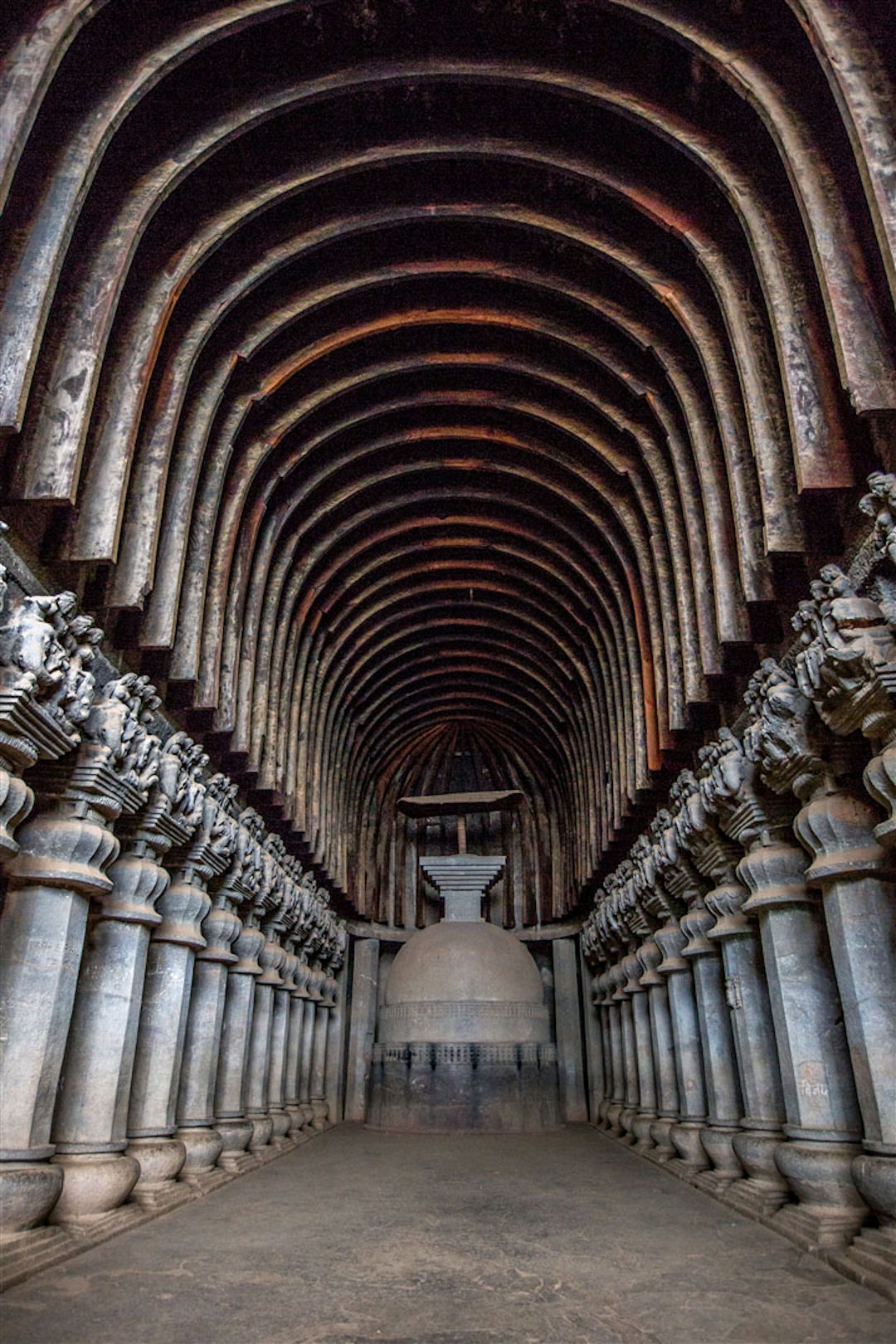
Standing proudly before the entrance is a colossal 15-metre-high monolithic freestanding pillar (*Simha-stambha*) crowned by four addorsed Asiatic lions, echoing the Mauryan pillar of Ashoka at Sarnath. Inside, the soaring barrel-vaulted ceiling still preserves its original 2,000-year-old curved teak wood ribs mortised into the basalt rock, surviving through two millennia to demonstrate the pinnacle of ancient Indian architectural joinery.
3. Structural Engineering & Architectural Design
The interior of the Great Chaitya is a breathtaking hypostyle basilica consisting of a soaring central nave separated from two narrow circumambulatory side aisles by a grand colonnade of 37 monumental pillars. The 30 pillars lining the nave are architectural masterpieces: each column rests on a carved pot base (*ghata*), rising through an octagonal shaft to an ornate bell-shaped Persepolitan capital.

Surmounting each capital is a magnificent high-relief sculpture depicting two kneeling elephants with curled trunks, carrying royal couples (a king and queen, or warriors with spears and bows) adorned with elaborate turbans, heavy torque necklaces, and beaded jewelry. At the apsidal rear stands a colossal monolithic stone stupa crowned by its original carved wooden umbrella (*chhatra*), its shaft embedded into a stone harmika.
The outer verandah is a gallery of classical early Indian sculpture. The side walls are carved with colossal multi-tiered reliefs of three life-sized elephants with curled trunks that appear to support the entire weight of the mountain. Flanking the three entrance doorways are celebrated *mithuna* panels—sensual, joyful couples sculpted in high relief, embodying vitality, marital harmony, and auspicious fertility (*mangala*).
4. Archaeological Excavations, Epigraphy & Conservation
James Fergusson and James Burgess conducted detailed photogrammetric and architectural measurements in the late 19th century, documenting the 30 Brahmi donor inscriptions.
The inscriptions record donations by Greek merchants (*Yavanas*), such as 'Dhammayavana of Dhenukakata', providing fascinating historical proof of Hellenistic merchants actively participating in Buddhist sacred art in the Deccan.
Structural laser scanning completed by the ASI in 2021 has mapped the micro-fractures in the basalt arch and verified the structural integrity of the ancient timber rafters.
Karla Caves is a Centrally Protected Monument under the Archaeological Survey of India (Mumbai Circle). Online tickets cost ₹20 for Indian, SAARC, and BIMSTEC visitors (₹25 at counter), and ₹250 for foreign tourists (₹300 at counter). Free entry for children under 15.
5. Master Highlights & Archaeological Marvels
The soaring nave of the Great Chaitya with its 37 elephant-crowned pillars and monolithic stupa creates an overwhelming sense of ancient spatial majesty.

The mithuna couples and life-sized guardian elephants on the outer verandah represent the absolute summit of early Indian figurative sculpture.
The 15-metre monolithic lion pillar standing outside the entrance is one of the grandest freestanding columns in ancient Asia.
6. Visiting Hours, Entry Permits & Visitor Guidelines
Karla Caves are open daily from 6:00 AM to 6:00 PM throughout the year. Accessible on all days.
Online ticket costs are ₹20 for Indian and SAARC visitors, and ₹250 for foreign tourists. Children under 15 enter free.
Visitors must not touch the carved elephant capitals, wooden rafters, or ancient inscriptions.
Personal photography without tripods is permitted; drones require prior written ASI authorization. Wear comfortable shoes for the 20-minute stone staircase climb.
The Great Chaitya of Karla is the largest rock-cut Buddhist hall in India. Any vandalism, defacing of sculptures, or damage to ancient timber rafters will attract severe penalties under the AMASR Act 1958.
7. Site Museum & Interpretation Centers
Casts and photographic studies of the Karla mithuna panels are displayed in the National Museum in New Delhi and the CSMVS in Mumbai.
On-site ASI signboards provide transliterations of the famous 'Jambudvipa' inscription and diagrams of the cave's architectural geometry.
8. Climate, Best Seasons & Ideal Visiting Hours
The best time to visit Karla Caves is from October to March, with pleasant winter weather and temperatures between 15°C and 28°C.
Monsoon season (July to September) brings dramatic mist, roaring waterfalls along the hillside stairs, and emerald-green valley views, though steps can be wet.
9. Transit Logistics, Rail, Air & Road Access
Karla Caves are located in Pune district of Maharashtra, 5 kilometres from Malavali railway station, 11 kilometres east of Lonavala, and 60 kilometres northwest of Pune.
Easily reached via the Mumbai–Pune Expressway or old NH 48. Taxis and auto-rickshaws operate from Lonavala and Malavali stations. Pune Airport (65 km) and Mumbai Airport (95 km) provide flight access.
10. Regional Heritage Circuits & Sibling Monuments
Karla Caves is the centerpiece of the Western Maharashtra Buddhist Rock Architecture Trail:
Sacred Architecture & Darshan Protocol Guide
Maximize your spiritual journey: VIP vs Sugam Darshan line reality, locker rules, and historical truth.
- ✓Sugam Darshan & Token Blueprint: Accurate online booking rules, pre-dawn passes, and entry lane realities.
- ✓Zero Commercialization Guard: Avoid bogus intermediaries, fake priest fees, and paid blessing scams.
- ✓Locker, Footwear & Mobile Safety: Verified cloakroom locations, authorized phone lockers, and security rules.
- ✓Hidden Architectural Marvels: Inscriptions, subterranean sanctums, and forgotten stone carvings.
🛡️ Personally curated by PK Gupta & the Hidden Routes research desk. Delivered directly to your Email & WhatsApp within 4–8 hours.
11. Frequently Asked Questions
Why is the Great Chaitya of Karla considered the finest in India?
It is the largest rock-cut Buddhist chaitya hall in India (37.8m long by 14m high), famous for its 37 grand pillars topped by royal elephant capitals, sensual mithuna sculptures, and 2,000-year-old teak wood ceiling ribs.
What does the ancient Brahmi inscription at Karla claim about the cave?
An inscription by merchant Bhutapala proudly declares that this rock-cut temple is 'the most excellent stone mansion in all of Jambudvipa (India)'.
What is the pillar standing outside the entrance of Karla Caves?
It is a 15-metre-high monolithic freestanding pillar (Simha-stambha) crowned by four addorsed lions, similar to the Ashokan pillars of the Mauryan Empire.
What are the visiting hours and entry ticket costs for Karla Caves?
The monument is open daily from 6:00 AM to 6:00 PM. Online ASI tickets cost ₹20 for Indian, SAARC, and BIMSTEC visitors, and ₹250 for foreign tourists. Children under 15 enter free.
How can I travel to Karla Caves from Mumbai or Pune?
Take an express train or drive along the Mumbai–Pune Expressway to Lonavala (about 2 hours from Mumbai, 1 hour from Pune). From Lonavala, Karla Caves is an 11 km drive east to the base parking lot.