1. Overview & Archaeological Significance
Jantar Mantar in Varanasi, Uttar Pradesh, is the most poetically and scenically situated historic astronomical observatory in India. Perched high upon the sprawling open-air rooftop terrace of the majestic 16th-century Man Mahal Palace (built around 1600 CE by Raja Man Singh of Amber, a celebrated general of Mughal Emperor Akbar), the observatory directly overlooks the sacred crescent sweep of the River Ganga immediately adjacent to Dashashwamedh Ghat. Constructed in 1737 CE by Maharaja Sawai Jai Singh II, it was the fifth and final stone observatory erected by the astronomer-king.
Located in the Varanasi district of Uttar Pradesh, Jantar Mantar Varanasi is centrally protected by the Archaeological Survey of India (ASI) as an irreplaceable landmark of South Asian civilization. Recognized for its rooftop masonry astronomical instruments atop a 16th-century rajput palace, the site provides profound insights into the technological prowess, cosmological beliefs, and cultural aesthetics of its ancient builders.
2. Dynastic Origins, Royal Patrons & Chronology
Sawai Jai Singh selected the roof of his ancestral family palace in Kashi (Varanasi)—the intellectual and spiritual capital of traditional India—so that scholars, astrologers, and pundits of the holy city could directly verify and calibrate their celestial computations. By elevating the instruments high above the dense riverfront urban fabric, Jai Singh ensured an unobstructed 360-degree horizon over the Ganga, free from dust, river fog, and building obstructions.
In the mid-19th century, the observatory was documented by British scholars and later underwent careful restoration by the Archaeological Survey of India. In 2019, the Ministry of Culture and the ASI established the state-of-the-art National Virtual Experiential Museum (Man Mahal Interpretation Centre) inside the lower floors of the palace, combining historic 18th-century rooftop astronomy with cutting-edge 3D virtual reality showcases of Varanasi's intangible cultural heritage.
3. Structural Engineering & Architectural Design
The observatory represents an extraordinary architectural marriage between 16th-century Rajput palace architecture below and 18th-century scientific masonry astronomy above. The lower palace features exquisitely carved stone brackets, corbelled balconies (*jharokhas*), and arcaded courtyards built of Chunar sandstone. The open rooftop terrace houses eight primary masonry and stone astronomical instruments.

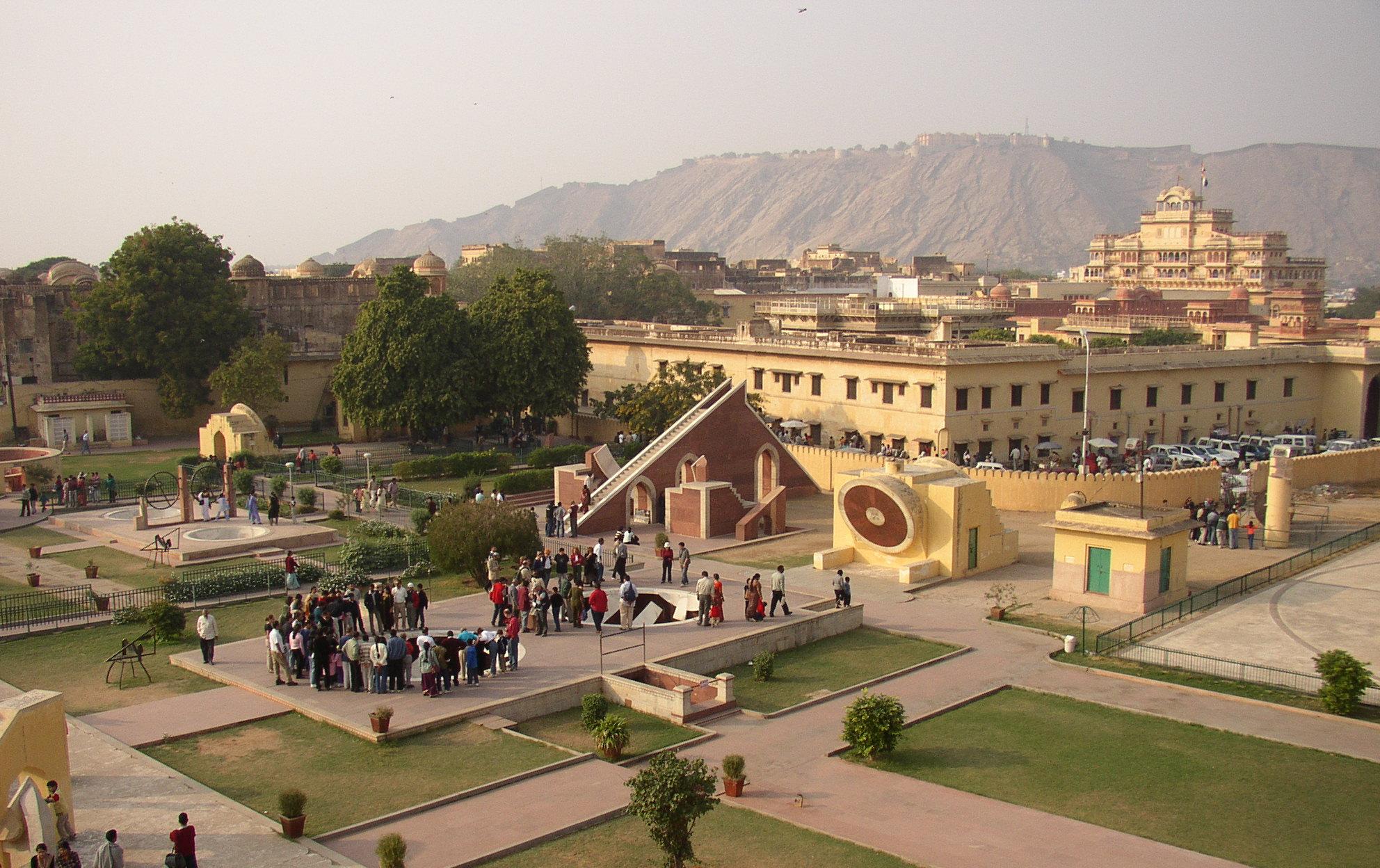
The central instrument is the *Samrat Yantra* (Small and Large), an equinoctial sundial with an inclined gnomon rising at an angle of 25°18' (the latitude of Varanasi), flanked by two curved quadrants divided into hours, minutes, and fractions of seconds. Nearby stands the *Nadivalaya Yantra*, consisting of two circular dials facing north and south to determine the sun's hemispheric passage.
Other instruments include the *Chakra Yantra*—a circular bronze and stone ring rotating on an axis parallel to the Earth's axis, utilized to measure the declination and right ascension of stars; the *Digamsa Yantra*—concentric circular walls for horizontal azimuth observation; and the *Dakshinobhitti Yantra*—a meridian wall used for measuring the zenith distance and altitude of celestial bodies at the moment of meridian transit.
4. Archaeological Excavations, Epigraphy & Conservation
The observatory was documented by Sir Robert Barker in 1772 in the *Philosophical Transactions of the Royal Society of London*, bringing Jai Singh's astronomical architecture to the attention of European scientists.
In 1912, the ASI repaired the rooftop stone dials, recut the faded graduation lines on the marble scales, and restored the parapet walls.
In 2018–2019, the National Council of Science Museums (NCSM) and the ASI completed comprehensive structural retrofitting of Man Mahal Palace, transforming the interior into an interactive cultural museum without compromising the historic rooftop instruments.
A combined ASI entry ticket covers the Jantar Mantar rooftop observatory and the high-tech National Virtual Experiential Museum inside Man Mahal. Online tickets cost ₹20 for Indian, SAARC, and BIMSTEC visitors (₹25 at counter), and ₹250 for foreign tourists (₹300 at counter). Free entry for children under 15.
5. Master Highlights & Archaeological Marvels
The rooftop instruments against the backdrop of the Ganga river and the distant eastern horizon offer an unmatched visual and photographic spectacle.

The Samrat Yantra and Chakra Yantra provide hands-on demonstration of classical shadow-based solar timekeeping.
The National Virtual Experiential Museum on the ground and first floors features virtual reality walkthroughs of Varanasi's ghats, classical music, and Vedic traditions.
6. Visiting Hours, Entry Permits & Visitor Guidelines
Jantar Mantar and Man Mahal are open daily from sunrise to sunset (approximately 6:00 AM to 6:00 PM). Accessible all 365 days a year.
Online ticket costs are ₹20 for Indian and SAARC visitors, and ₹250 for foreign tourists. Children under 15 enter free.
Visitors must not lean over the rooftop terrace railings or climb onto the historic stone dials.
Personal photography without tripods is allowed; drones are strictly prohibited over the Varanasi riverfront.
Jantar Mantar Varanasi is a Centrally Protected Monument of exceptional value. Defacing instruments or climbing structural masonry will attract severe penalties under the AMASR Act 1958.
7. Site Museum & Interpretation Centers
The National Virtual Experiential Museum inside Man Mahal Palace features interactive 3D digital installations, holographic projections, and historical artifacts.
Interpretive boards on the rooftop explain the specific calculations and coordinate systems used by each instrument.
8. Climate, Best Seasons & Ideal Visiting Hours
The best time to visit is from October to March, when winter weather is pleasant and morning river breezes are refreshing, with temperatures between 15°C and 28°C.
Early mornings during sunrise offer spectacular photography, as the rising sun casts crisp, long shadows across the rooftop gnomons while the Ganga ghats awaken below.
9. Transit Logistics, Rail, Air & Road Access
Jantar Mantar is located at Man Mahal Ghat, just 200 metres south of Dashashwamedh Ghat in Varanasi, Uttar Pradesh.
Varanasi Junction (Cantt) railway station is 5 kilometres northwest. Lal Bahadur Shastri International Airport at Babatpur (VNS, 25 km) connects all major domestic and international cities.
10. Regional Heritage Circuits & Sibling Monuments
Jantar Mantar is an integral highlight of the Varanasi Sacred Riverfront Heritage Walk:
Sacred Architecture & Darshan Protocol Guide
Maximize your spiritual journey: VIP vs Sugam Darshan line reality, locker rules, and historical truth.
- ✓Sugam Darshan & Token Blueprint: Accurate online booking rules, pre-dawn passes, and entry lane realities.
- ✓Zero Commercialization Guard: Avoid bogus intermediaries, fake priest fees, and paid blessing scams.
- ✓Locker, Footwear & Mobile Safety: Verified cloakroom locations, authorized phone lockers, and security rules.
- ✓Hidden Architectural Marvels: Inscriptions, subterranean sanctums, and forgotten stone carvings.
🛡️ Personally curated by PK Gupta & the Hidden Routes research desk. Delivered directly to your Email & WhatsApp within 4–8 hours.
11. Frequently Asked Questions
Where is Jantar Mantar located in Varanasi?
It is uniquely located on the rooftop terrace of the historic 16th-century Man Mahal Palace at Man Mahal Ghat, immediately beside Dashashwamedh Ghat overlooking the sacred River Ganga.
Who built Jantar Mantar in Varanasi and when?
It was built in 1737 CE by Maharaja Sawai Jai Singh II of Jaipur as the fifth and final stone astronomical observatory of his grand scientific enterprise.
Why was the observatory built on the rooftop of a palace?
Jai Singh built it atop his ancestral palace to provide scholars and astrologers with an elevated, unobstructed 360-degree view of the celestial horizon over the Ganga, completely free from riverbank dust and building obstruction.
What is the Virtual Museum inside Man Mahal?
The National Virtual Experiential Museum, opened in 2019 by the ASI inside Man Mahal Palace, uses cutting-edge 3D virtual reality and holographic projections to showcase Varanasi's classical music, ghats, and heritage.
What are the visiting hours and entry fees for Jantar Mantar Varanasi?
The monument is open daily from sunrise to sunset. Online ASI tickets cost ₹20 for Indian and SAARC visitors, and ₹250 for foreign tourists. Children under 15 enter free.