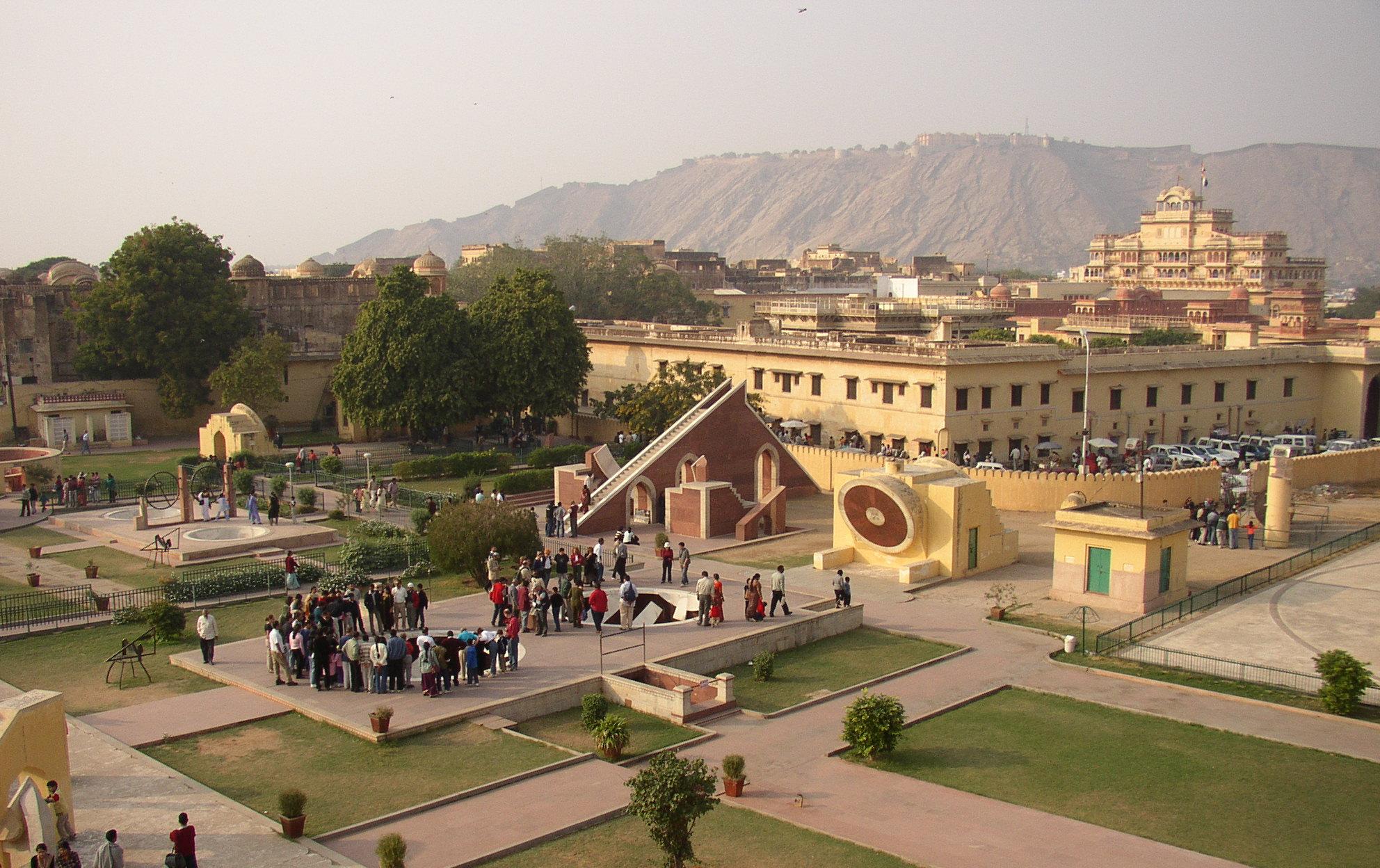
1. Overview & Archaeological Significance
Jantar Mantar in Jaipur, Rajasthan, is the largest, best preserved, and most magnificent historic astronomical observatory in the pre-modern world. Conceived, engineered, and constructed between 1728 and 1734 CE by Maharaja Sawai Jai Singh II—the visionary astronomer-king, mathematician, and founder of the planned city of Jaipur—the observatory stands as an extraordinary monument to the intersection of architectural grandeur, scientific enlightenment, and cosmological inquiry. Inscribed as a UNESCO World Heritage Site in 2010, it represents the absolute apex of medieval Indian architectural astronomy.
Located in the Jaipur district of Rajasthan, Jantar Mantar Jaipur is centrally protected by the Archaeological Survey of India (ASI) as an irreplaceable landmark of South Asian civilization. Recognized for its monumental architectural astronomy, local sandstone, white marble & brass scales, the site provides profound insights into the technological prowess, cosmological beliefs, and cultural aesthetics of its ancient builders.
2. Dynastic Origins, Royal Patrons & Chronology
Sawai Jai Singh II was a brilliant polymath who studied classical Sanskrit texts (such as the *Surya Siddhanta*), Islamic astronomical treatises (the *Zij-i Sultani* of Ulugh Beg), and European Copernican treatises brought to his court by Jesuit scholars from Portugal and France. Finding that small brass astrolabes suffered from mechanical wear, optical parallax, and thermal expansion errors, Jai Singh made the radical decision to construct monumental stationary architectural instruments out of local yellow sandstone, lime plaster, and high-purity white marble, achieving a scale that minimized human observation error.
The name 'Jantar Mantar' derives from the Sanskrit *Yantra Mantra*, meaning 'instruments and calculation'. The Jaipur observatory was the largest of five monumental observatories constructed by Jai Singh across northern India (Delhi, Ujjain, Varanasi, and Mathura). Its primary objective was to compile accurate astronomical tables (*Zij-i Muhammad Shahi*) to predict solar and lunar eclipses, determine the exact moment of solstices and equinoxes, and calibrate the civil and religious ephemeris (*Panchanga*) with unprecedented precision.
3. Structural Engineering & Architectural Design
The observatory houses nineteen monumental stone and brass instruments laid out on a spacious courtyard covering 18,700 square metres beside the City Palace. The architectural crown jewel is the *Vrihat Samrat Yantra* ('Supreme Instrument')—the world's largest stone sundial. Its massive triangular gnomon rises to a dizzying height of 27 metres (90 feet), with its hypotenuse inclined at an exact angle of 26°55' (the geographic latitude of Jaipur), pointing directly toward the Celestial North Pole.

Flanking the Samrat Yantra gnomon are two massive sweeping quadrant quadrants built of polished Makrana marble, measuring 15 metres in radius. The shadow cast by the gnomon moves visibly across these curved marble scales at a speed of 4 millimetres per minute, allowing local solar time to be read directly to an astonishing accuracy of two seconds. The instrument also accurately measures the declination of the sun and the moment of solar noon.
Other architectural masterworks include the *Jai Prakash Yantra*—two sunken hemispherical marble bowls aligned to the celestial sphere, cross-wired at the center with a taut metal ring whose shadow traces the sun's passage through the zodiac; the *Rama Yantra*—two complementary cylindrical open-topped stone structures with radial stone sectors for measuring altitude and azimuth; and the *Rashivalaya*—a collection of twelve distinct instruments, each calibrated to measure the celestial coordinates of one of the twelve constellations of the zodiac.
4. Archaeological Excavations, Epigraphy & Conservation
Following decades of neglect in the late 19th century, the observatory underwent comprehensive restoration in 1901–1902 under the direction of Major Arthur Garrett, an engineer and amateur astronomer, assisted by the court astronomer Pundit Kedarnath, who meticulously recalibrated the faded marble scales.
In 2006–2008, prior to UNESCO World Heritage inscription, the Government of Rajasthan and the Archaeological Survey of India undertook complete photogrammetric documentation and stone conservation, treating the masonry against weathering.
Contemporary astrophysicists have verified that the instruments remain functional: when corrected for standard time meridian offset (IST vs. Jaipur local solar time), the Samrat Yantra continues to indicate accurate solar time to within seconds.
Jantar Mantar Jaipur is managed by the Department of Archaeology and Museums, Government of Rajasthan. Entry tickets can be booked online via the Rajasthan Tourism / ASI portal or purchased at the automated entry gates. Tickets cost ₹50 for Indian nationals (₹25 for students) and ₹200 for foreign visitors (₹100 for foreign students).
5. Master Highlights & Archaeological Marvels
The Vrihat Samrat Yantra is the undeniable visual and scientific centerpiece, mesmerizing visitors by the steady, visible glide of the shadow across the marble scale.

The Jai Prakash Yantra allows visitors to peer down into the sunken marble bowls, viewing the inverted projection of the sky mapped onto the stone.
The Misra Yantra and Chakra Yantra provide intriguing insights into ancient methods for measuring the meridian transit of celestial bodies.
6. Visiting Hours, Entry Permits & Visitor Guidelines
Jantar Mantar Jaipur is open daily from 9:00 AM to 5:00 PM throughout the year. Accessible on all national holidays.
Entry ticket fees are ₹50 for Indian citizens and ₹200 for foreign tourists. Audio guides and authorized certified guides are available at the entrance pavilion. An evening sound and light show is conducted on site.
Visitors must not touch, scratch, or lean on the graduated marble scales or enter restricted instrument pits.
Tripods, drones, and commercial video equipment require prior written permission from the Department of Archaeology and Museums, Jaipur.
Jantar Mantar is a UNESCO World Heritage Site and an operational historic astronomical observatory. Damaging calibrated scales or climbing upon instruments is strictly punishable under the Rajasthan Monuments Act.
7. Site Museum & Interpretation Centers
An interpretation center on the grounds displays early brass astrolabes, armillary spheres, Jai Singh's astronomical notebooks, and interactive digital models explaining celestial coordinate systems.
Information panels in Hindi and English accompany every instrument, explaining the mathematical principles and observation procedures.
8. Climate, Best Seasons & Ideal Visiting Hours
The best time to visit is from October to March, when Jaipur enjoys pleasant winter days with temperatures between 15°C and 28°C.
Visiting between 11:30 AM and 1:30 PM offers optimal sunlight directly overhead, providing clear shadows across the sundials and equinoctial scales.
9. Transit Logistics, Rail, Air & Road Access
Jantar Mantar is located in the heart of the walled Pink City of Jaipur, directly adjacent to the City Palace and 300 metres from Hawa Mahal.
Jaipur Junction railway station (5 km) is a major hub connected by express trains across India. Jaipur International Airport (JAI, 12 km) at Sanganer connects all major domestic and international hubs. The Badi Chaupar Metro Station is within walking distance.
10. Regional Heritage Circuits & Sibling Monuments
Jantar Mantar is an anchor of the UNESCO World Heritage Walled City of Jaipur Circuit:
Sacred Architecture & Darshan Protocol Guide
Maximize your spiritual journey: VIP vs Sugam Darshan line reality, locker rules, and historical truth.
- ✓Sugam Darshan & Token Blueprint: Accurate online booking rules, pre-dawn passes, and entry lane realities.
- ✓Zero Commercialization Guard: Avoid bogus intermediaries, fake priest fees, and paid blessing scams.
- ✓Locker, Footwear & Mobile Safety: Verified cloakroom locations, authorized phone lockers, and security rules.
- ✓Hidden Architectural Marvels: Inscriptions, subterranean sanctums, and forgotten stone carvings.
🛡️ Personally curated by PK Gupta & the Hidden Routes research desk. Delivered directly to your Email & WhatsApp within 4–8 hours.
11. Frequently Asked Questions
Who built Jantar Mantar in Jaipur and why?
Maharaja Sawai Jai Singh II built it between 1728 and 1734 CE to create a permanent, large-scale astronomical observatory with stationary stone instruments that minimized observation errors in tracking the sun, moon, planets, and stars.
What is the Vrihat Samrat Yantra and how accurate is it?
The Vrihat Samrat Yantra is the world's largest stone sundial, rising 27 metres (90 feet) high. Its shadow moves at 4 mm per minute across its curved marble scale, measuring local solar time to an accuracy of two seconds.
Why was Jantar Mantar declared a UNESCO World Heritage Site?
It was inscribed in 2010 as a masterpiece of human creative genius, representing the most complete and best preserved historic astronomical observatory in the world, blending Ptolemaic, Islamic, and Vedic astronomy.
What are the visiting hours and ticket prices for Jantar Mantar Jaipur?
It is open daily from 9:00 AM to 5:00 PM. Tickets are ₹50 for Indian nationals (₹25 for students) and ₹200 for foreign visitors (₹100 for students). Audio guides are available.
What is the best time of day to visit Jantar Mantar?
The best time of day is around solar noon (between 11:30 AM and 1:30 PM), when the sun is at its highest point, casting crisp, dramatic shadows across the central gnomons and equinoctial quadrants.