1. Overview & Archaeological Significance
Bojjannakonda (originally Buddhanakonda, meaning 'Hill of the Buddha'), together with its companion twin hill Lingalakonda, constitutes one of the most remarkable and visually captivating Buddhist archaeological sites in South India. Situated near Sankaram village in Anakapalli district (formerly Visakhapatnam district), Andhra Pradesh, this ancient monastic sanctuary flourished continuously from the 4th to the 9th century CE, uniquely encompassing all three evolutionary phases of Buddhism: Theravada (Hinayana), Mahayana, and esoteric Vajrayana (Tantric Buddhism).
Located in the Anakapalli district of Andhra Pradesh, Bojjannakonda Buddhist Site is centrally protected by the Archaeological Survey of India (ASI) as an irreplaceable landmark of South Asian civilization. Recognized for its monolithic rock-cut stupas, rock-cut chaitya caves & terraced brick viharas, the site provides profound insights into the technological prowess, cosmological beliefs, and cultural aesthetics of its ancient builders.
2. Dynastic Origins, Royal Patrons & Chronology
The site was explored in 1906–1907 by the British archaeologist Alexander Rea, the Archaeological Superintendent of Southern Circle. Rea was astounded to discover that ancient Buddhist stonecarvers had chiseled the natural khondalite rocky hillock into a dense architectural amphitheatre of monolithic rock-cut stupas, cave shrines, viharas, and stepped brick terraces rising up the hillside like a stepped Buddhist acropolis.
On the adjacent hill of Lingalakonda, Rea documented hundreds of rock-cut monolithic stupas carved in geometric rows across the rocky ridges. The name Sankaram is an ancient corruption of *Sangharama*, the classical Sanskrit term for a Buddhist monastic university establishment.
3. Structural Engineering & Architectural Design
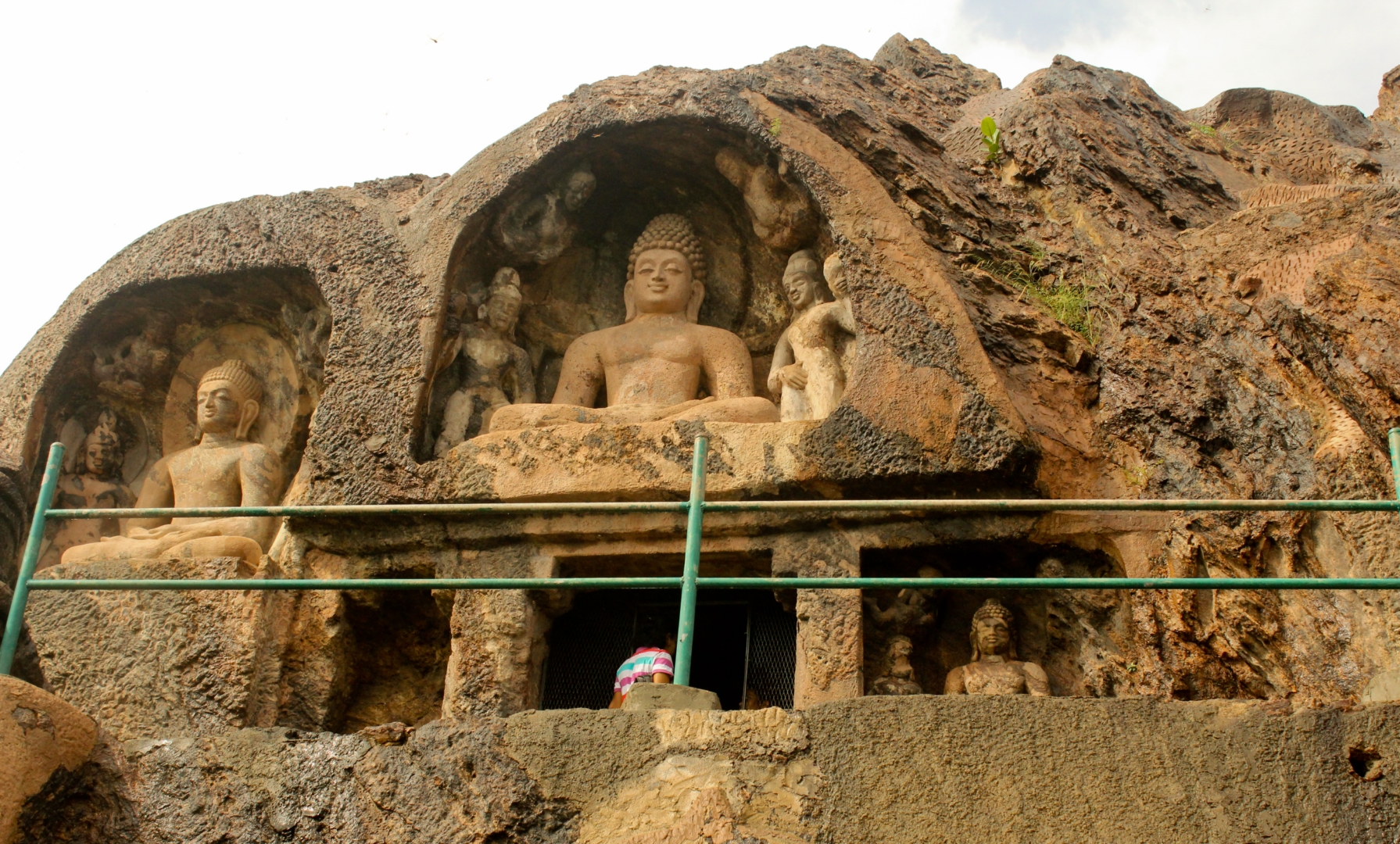
The architectural composition of Bojjannakonda exhibits a seamless integration of rock-cut and structural brick construction across three distinct terraced levels. At the lower level, rock-cut cave sanctuaries are hollowed out of the living stone, supported by square pillars and featuring large relief figures of the Buddha seated in meditative padmasana.

The middle terrace features the Upper Cave (Cave 2), which contains a massive monolithic rock-cut stupa rising 4 metres high in the center of the hall, functioning as a circumambulatory chaitya. The walls of this cave are decorated with life-sized reliefs of Dhyani Buddhas, Bodhisattvas, attendants bearing chamaras (fly-whisks), and rare Vajrayana deities such as Kalachakra and Hariti with Panchika (the Buddhist goddess of fertility and child protection).
At the summit rises the monumental Maha Stupa, built of kiln-fired bricks on a square stone platform, surrounded by dozens of monolithic rock-cut votive stupas chiseled out of living boulders. Across the valley at Lingalakonda, the entire ridge is covered with a spectacular sea of rock-cut stupas, representing centuries of devotional offerings by visiting pilgrims and monks.
4. Archaeological Excavations, Epigraphy & Conservation
Alexander Rea's 1906 excavations yielded exceptional historical treasures, including a gold coin of the Gupta Emperor Samudragupta (ruled c. 335–375 CE), copper coins of the Eastern Chalukya King Kubja Vishnuvardhana (c. 630 CE), and lead coins of the Andhra Satavahanas.
Excavators also recovered terracotta sealings with Buddhist suttas, molded clay votive plaques depicting standing Buddhas, copper bells, and iron chisels utilized in cutting the rock-cut caves.
Stratigraphic and epigraphical analysis confirms that the monastery transitioned from early Theravada aniconic veneration to Mahayana devotionalism and finally Vajrayana esoteric rituals before regional decline in the 10th century CE.
Bojjannakonda is a Centrally Protected Monument under the Archaeological Survey of India (Hyderabad Circle). Entry tickets booked online cost ₹20 for Indian, SAARC, and BIMSTEC visitors (₹25 at counter), and ₹250 for foreign tourists (₹300 at counter).
5. Master Highlights & Archaeological Marvels
Visitors can climb the ancient stone steps ascending Bojjannakonda, exploring the rock-cut chaitya caves with their colossal carved seated Buddha figures.

The central monolithic stupa inside the upper cave is an extraordinary engineering feat of subtractive rock carving.
The panoramic view across the green valley toward Lingalakonda with its hundreds of stepped rock-cut stupas provides an unforgettable visual spectacle.
6. Visiting Hours, Entry Permits & Visitor Guidelines
Bojjannakonda is open daily from 6:00 AM to 6:00 PM throughout the year.
Online ticket costs are ₹20 for Indian and SAARC visitors, and ₹250 for foreign tourists. Children under 15 enter free.
Visitors must not touch, scratch, or climb upon the rock-cut stupas or carved Buddha figures.
Personal photography without tripods is allowed; drones require prior written ASI authorization. Wear sturdy shoes for the hill climb.
Bojjannakonda is a Centrally Protected ancient Buddhist sanctuary. Vandalism, defacement of sculptures, or littering will attract severe prosecution under the AMASR Act 1958.
7. Site Museum & Interpretation Centers
Artifacts excavated from Bojjannakonda, including the gold coin of Samudragupta and terracotta seals, are preserved in the Government Museum in Chennai and the ASI collection.
Informational signboards on site provide historical maps, architectural diagrams, and transliterations of excavated seals.
8. Climate, Best Seasons & Ideal Visiting Hours
The best time to visit Bojjannakonda is from October to March, with pleasant winter weather and temperatures between 18°C and 28°C.
Summers (April to June) are hot and humid. Early mornings provide serene, mist-shrouded views across the paddy fields.
9. Transit Logistics, Rail, Air & Road Access
Bojjannakonda is located near Sankaram village, 3 kilometres north of Anakapalle town and 40 kilometres southwest of Visakhapatnam in Andhra Pradesh.
Anakapalle railway station (3 km) is well connected on the Howrah–Chennai mainline. Visakhapatnam International Airport (VTZ, 35 km) offers extensive domestic flight connectivity.
10. Regional Heritage Circuits & Sibling Monuments
Bojjannakonda is the crown jewel of the North Coastal Andhra Buddhist Trail:
Sacred Architecture & Darshan Protocol Guide
Maximize your spiritual journey: VIP vs Sugam Darshan line reality, locker rules, and historical truth.
- ✓Sugam Darshan & Token Blueprint: Accurate online booking rules, pre-dawn passes, and entry lane realities.
- ✓Zero Commercialization Guard: Avoid bogus intermediaries, fake priest fees, and paid blessing scams.
- ✓Locker, Footwear & Mobile Safety: Verified cloakroom locations, authorized phone lockers, and security rules.
- ✓Hidden Architectural Marvels: Inscriptions, subterranean sanctums, and forgotten stone carvings.
🛡️ Personally curated by PK Gupta & the Hidden Routes research desk. Delivered directly to your Email & WhatsApp within 4–8 hours.
11. Frequently Asked Questions
What makes Bojjannakonda architecturally unique?
Bojjannakonda is unique because it features a harmonious blend of rock-cut monolithic stupas, cave chaityas carved into living granite, and structural brick viharas spanning three evolutionary phases of Buddhism (Hinayana, Mahayana, and Vajrayana).
What is the connection between Bojjannakonda and Lingalakonda?
They are twin sacred hills facing each other across the village of Sankaram. Bojjannakonda houses the main monastery, caves, and rock-cut stupas, while Lingalakonda is covered with hundreds of rock-cut monolithic stupas carved in geometric rows.
What historical coins were discovered at Bojjannakonda?
Excavations by Alexander Rea in 1906 discovered a gold coin of Gupta Emperor Samudragupta (4th century CE), copper coins of Eastern Chalukya King Vishnuvardhana, and Satavahana lead coins.
What are the visiting hours and entry ticket costs for Bojjannakonda?
The monument is open daily from 6:00 AM to 6:00 PM. Online tickets cost ₹20 for Indian, SAARC, and BIMSTEC visitors, and ₹250 for foreign tourists. Children under 15 enter free.
How can I reach Bojjannakonda from Visakhapatnam?
Bojjannakonda is 40 km southwest of Visakhapatnam via NH 16 to Anakapalle. From Anakapalle, it is just a 3 km drive north to Sankaram village (total travel time approx. 1 hour by taxi).