1. Overview & Archaeological Significance
Akhnoor, nestled on the right bank of the roaring Chenab (ancient Asikni) River 28 km northwest of Jammu city, is an archaeological treasure trove spanning over two millennia. In the 1st century BCE, a flourishing Buddhist monastic university and stupa complex known today as *Ambaran* (popularly called Pamberwan) was established here under the patronage of the Kushan Empire. Excavations by the Archaeological Survey of India confirmed that Ambaran was the northernmost outpost of early Buddhist art in the plains, yielding world-famous 2nd-century CE terracotta heads and a gold relic casket containing holy bone fragments.
Located in the Jammu district of Jammu and Kashmir, Akhnoor Fort and Ambaran Buddhist Monastery is centrally protected by the Archaeological Survey of India (ASI) as an irreplaceable landmark of South Asian civilization. Recognized for its kushan terracotta & brick stupa architecture, 18th-century dogra riverfront fortification & palace frescoes, the site provides profound insights into the technological prowess, cosmological beliefs, and cultural aesthetics of its ancient builders.
2. Dynastic Origins, Royal Patrons & Chronology
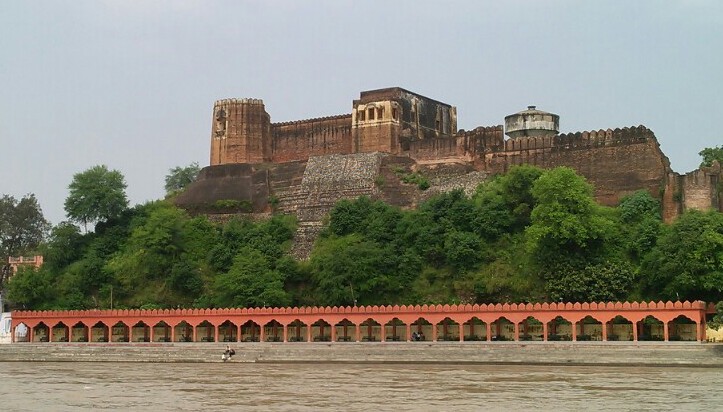
In the 18th century, the site acquired strategic military prominence under the Dogra rulers of Jammu. Construction of the monumental brick-and-stone *Akhnoor Fort* was initiated in 1762 CE by Raja Tegh Singh and completed in 1802 CE by Raja Alam Singh. Perched on a precipitous cliff overlooking the Chenab, the fort guarded the historic river trade routes between Kashmir, Punjab, and Central Asia.
Akhnoor holds an immortal place in the history of Jammu and Kashmir: on June 17, 1822 CE, under the shade of a sacred *Jia Pota* tree on the riverbank beside Akhnoor Fort, the Lion of Punjab, Maharaja Ranjit Singh, personally anointed Maharaja Gulab Singh with the royal Raj Tilak, creating the historic sovereign State of Jammu and Kashmir. Today, conserved by the ASI, Akhnoor unites deep Buddhist antiquity with Dogra royal heritage.
3. Structural Engineering & Architectural Design
The monument complex encompasses two distinct archaeological sectors: the 1st-to-5th century CE Buddhist site of Ambaran and the 18th-century Akhnoor Fort. The Ambaran site reveals a massive brick stupa on a square plinth, surrounded by votive stupas, a monastic vihara with residential cells, and stone water channels.

Akhnoor Fort is designed as an irregular riverfront fortress constructed of burnt kiln bricks and river cobblestones bound with lime mortar. The high curtain walls are punctuated by rounded corner bastions equipped with gun embrasures and battlements commanding the river crossing.
Inside the fort, two-storey palatial apartments feature arched courtyards, decorative wall niches, and vibrant 19th-century Dogra-style wall murals depicting religious legends, royal durbars, and floral patterns. The riverside facade drops sheer into the rushing Chenab River, accessed by ancient stone water gates.
4. Archaeological Excavations, Epigraphy & Conservation
ASI excavations at Ambaran in 1999–2001 unearthed a copper and silver relic casket, gold foil, and world-renowned Kushan terracotta heads.
Conservation stabilized the ancient burnt-brick stupa plinths and installed protective weather roofing over fragile archaeological trenches.
Restoration of the fort battlements repaired river-facing brick arches and stabilized the historic palace durbar rooms.
Entry to both Akhnoor Fort and the Ambaran Buddhist archaeological site is free for all visitors.
5. Master Highlights & Archaeological Marvels
1st-Century Kushan Buddhist Stupa: The ancient monastic site of Ambaran with excavated stupa foundations and relics.

Dogra Riverfront Fortress: 18th-century brick citadel dramatically perched on a high cliff above the Chenab River.
Jia Pota Royal Coronation Site: The sacred riverbank tree where Maharaja Ranjit Singh crowned Maharaja Gulab Singh in 1822.
6. Visiting Hours, Entry Permits & Visitor Guidelines
Open daily from 8:00 AM to 6:00 PM. A combined visit to the fort and the Ambaran excavation site takes about 2 hours.
Late afternoons provide cool river breezes along the fort ramparts and golden sunset reflections across the Chenab River.
Do not climb onto the fragile ancient brick stupa walls at Ambaran.
Do not deface or touch the historic painted plaster murals inside the fort palace rooms.
The river cliff has steep unfenced drops; exercise caution near the outer rampart walls.
7. Site Museum & Interpretation Centers
The Dogra Art Museum in Mubarak Mandi Palace, Jammu, houses original terracotta heads discovered at Ambaran.
The historic town of Jammu, with its Bahu Fort and Raghunath Temple, lies 28 km to the southeast.
8. Climate, Best Seasons & Ideal Visiting Hours
October through March is the best season to visit, with pleasant temperatures ranging from 12°C to 24°C.
The annual coronation commemoration day in June brings colorful cultural events along the Jia Pota ghat.
9. Transit Logistics, Rail, Air & Road Access
Located in Akhnoor town on the Chenab River in Jammu district, 28 km northwest of Jammu city, Jammu and Kashmir.
Jammu Tawi Railway Station (JAT) and Jammu Airport (IXJ) are 32 km away, with frequent taxis and buses along the Jammu-Poonch highway.
10. Regional Heritage Circuits & Sibling Monuments
Akhnoor Fort and Ambaran form the premier antiquity gateway of the Jammu Heritage & River Chenab Trail:
Sacred Architecture & Darshan Protocol Guide
Maximize your spiritual journey: VIP vs Sugam Darshan line reality, locker rules, and historical truth.
- ✓Sugam Darshan & Token Blueprint: Accurate online booking rules, pre-dawn passes, and entry lane realities.
- ✓Zero Commercialization Guard: Avoid bogus intermediaries, fake priest fees, and paid blessing scams.
- ✓Locker, Footwear & Mobile Safety: Verified cloakroom locations, authorized phone lockers, and security rules.
- ✓Hidden Architectural Marvels: Inscriptions, subterranean sanctums, and forgotten stone carvings.
🛡️ Personally curated by PK Gupta & the Hidden Routes research desk. Delivered directly to your Email & WhatsApp within 4–8 hours.
11. Frequently Asked Questions
What is the ancient Buddhist site of Ambaran in Akhnoor?
Ambaran is a 1st-to-5th century CE Kushan Buddhist monastery and stupa site, the oldest and northernmost Buddhist archaeological site in the Jammu plains.
What significant historical coronation occurred at Akhnoor?
On June 17, 1822 CE, Maharaja Ranjit Singh crowned Maharaja Gulab Singh as ruler of Jammu under the Jia Pota tree beside Akhnoor Fort.
What river flows directly beneath Akhnoor Fort?
The mighty Chenab River (ancient Vedic Asikni) flows directly beneath the cliffs of Akhnoor Fort.
What archaeological treasures were discovered at Ambaran?
Excavations revealed precious Kushan terracotta sculptures, gold foil, and a sacred relic casket containing ancient bone relics.
How far is Akhnoor from Jammu city?
Akhnoor is located approximately 28 km northwest of Jammu city, easily accessible in 45 minutes via the four-lane highway.