
1. Overview: The Living Prehistoric Rainforest of the Nilgiris
Perched high in the southwestern corner of the Nilgiri Biosphere Reserve in Palakkad district, Silent Valley National Park (സൈലന്റ് വാലി നാഷണൽ പാർക്ക്) encompasses 237.52 square kilometres of the most pristine and undisturbed tropical rainforest ecosystem remaining on the Indian subcontinent. Protected on all sides by towering ridgelines rising to over 2,000 metres—including the Nilgiri plateau to the north and the Vattapara crest to the south—the valley remained virtually untouched by human habitation or timber logging for tens of millions of years.
The name Silent Valley was coined by British botanists in the 19th century who noted an extraordinary auditory phenomenon: the eerie, complete absence of the piercing mating call of cicadas (*Cicadidae*), insects that otherwise fill tropical Indian jungles with deafening daytime buzzing. Mythologically, the local indigenous population calls the valley Sairandhrivanam ("The Forest of Sairandhri"), referencing Draupadi from the Mahabharata who hid in this dense wilderness alongside the Pandava princes during their secret exile.
Flowing through the entire 24-kilometre length of the national park is the legendary Kunthi River (Kunthipuzha). Originating at an elevation of 2,400 metres near the Mukurthi peak, the river's water is celebrated across India for its singular purity: because the dense floor of mosses, leaf-litter, and ancient tree root networks acts as a natural hydrological sponge, the Kunthi River never turns muddy, turbid, or silty, running sparkling clear even during torrential southwest monsoon downpours.
2. Historic Battle: The Save Silent Valley Movement That Saved India's Forests
Silent Valley holds a monumental place in global environmental history as the crucible of India's first major grassroots ecological crusade—the Save Silent Valley Movement of the 1970s and 1980s:
The Proposed Dam: In the early 1970s, the Kerala State Electricity Board (KSEB) proposed the construction of a 240-megawatt hydroelectric dam across the Kunthi River. The reservoir would have permanently submerged 8.3 square kilometres of primeval evergreen forest, drowning invaluable genetic resources and wiping out the fragile habitat of the endangered Lion-tailed Macaque.
A Landmark Grassroots Awakening: Led by the Kerala Sasthra Sahithya Parishad (KSSP), renowned poet and activist Sugathakumari, pioneering ornithologist Dr. Salim Ali, and environmentalists nationwide, an unprecedented movement erupted. Scientists proved that the forest contained irreplaceable medicinal plants, wild crop ancestors, and evolutionary relics found nowhere else on Earth. The movement captured international headlines, gaining the support of the International Union for Conservation of Nature (IUCN) and the World Wildlife Fund.
The Victory: In 1983, recognizing the catastrophic ecological cost of the dam, Prime Minister Indira Gandhi took the historic executive decision to scrap the hydroelectric project. In November 1984, the area was formally notified as Silent Valley National Park, and on September 7, 1985, Prime Minister Rajiv Gandhi personally inaugurated the national park at Sairandhri, dedicating it to the preservation of India's natural heritage.
3. Evolutionary Treasury: Lion-Tailed Macaques & Endemic Species
Silent Valley represents one of the world's most critical biodiversity hotspots, harboring an astonishing density of rare and endemic flora and fauna:
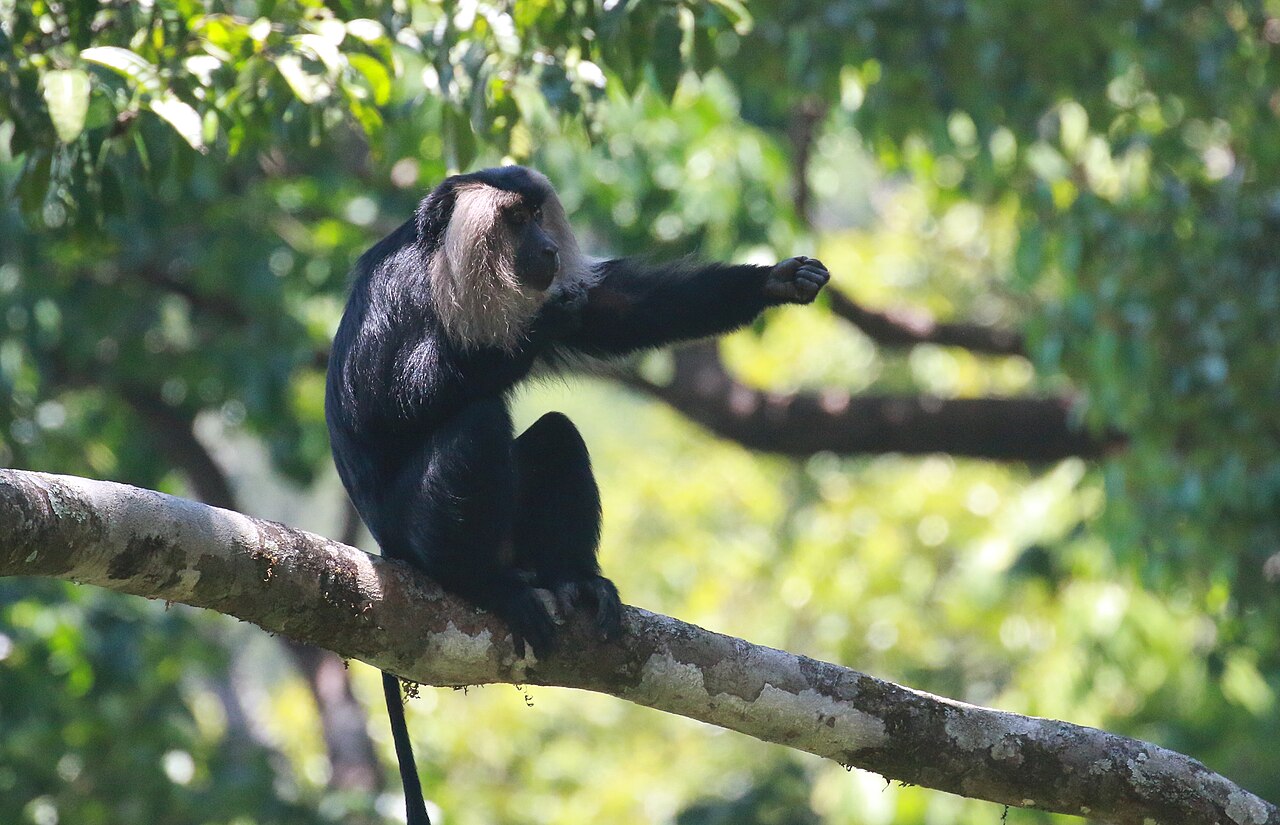
The Lion-Tailed Macaque (Macaca silenus): Silent Valley is the most vital global stronghold for this critically endangered primate. Characterized by its jet-black fur, striking silver-white mane framing the face, and a lion-like tail tassel, this shy arboreal monkey feeds exclusively on high-canopy fruits, seeds, and insects. Silent Valley holds the largest viable, contiguous population of lion-tailed macaques in the world.
Other Rare Fauna: The park shelters healthy populations of Bengal tigers, leopards, wild dogs (dholes), Asian elephants, Indian pangolins, sloth bears, Nilgiri tahrs on the high crags, and the elusive Malabar Civet. Over 211 species of birds have been cataloged here, including the rare Ceylon Frogmouth, Great Indian Hornbill, Malabar Pied Hornbill, Nilgiri Laughingthrush, and Broad-tailed Grassbird.
Prehistoric Botanical Wealth: The forest contains towering canopy trees like Cullenia exarillata, Palaquium ellipticum, and Mesua ferrea (Ironwood), some exceeding 50 metres in height and several centuries in age. Over 100 species of wild orchids, carnivorous pitcher plants, and rare ferns thrive in the humid microclimate beneath the canopy.

4. The Safari Experience: Mukkali Base Camp to Sairandhri Watchtower
To preserve the pristine forest from tourist degradation, access to Silent Valley is strictly regulated by the Kerala Forest Department through an exemplary eco-tourism model:
Base Camp at Mukkali: All visitors must first report to the Silent Valley Wildlife Information Centre at Mukkali, the park's administrative base camp on the Palakkad-Mannarkkad highway. Private vehicles are strictly forbidden from entering the park beyond Mukkali.
The 4x4 Forest Jeep Safari: At Mukkali, visitors board authorized Forest Department 4-wheel-drive jeeps accompanied by trained tribal eco-guides. The safari covers a rugged 23-kilometre dirt track winding through buffer forests, crossing rocky streams, and climbing gradually to the Sairandhri Reception Centre deep inside the reserve.
Sairandhri 100-Foot Watchtower: At Sairandhri stands a 100-foot-tall steel observation tower. Climbing the spiral stairs elevates visitors above the forest canopy, revealing an awe-inspiring, unbroken sea of rolling emerald rainforest stretching to the horizon, with misty peaks piercing cloud layers in the distance.
The Kunthi River Suspension Bridge: From Sairandhri, an escorted 1.5-kilometre guided trek descends through primeval forest to the historic steel suspension bridge spanning the rushing waters of the Kunthi River. Standing above the crystal-clear mountain torrent as sunlight filters through giant tree ferns is an unforgettable encounter with pure wilderness.
5. Safari Timings, Online Booking & Forest Regulations
Planning a visit to Silent Valley requires adherence to strict conservation guidelines:
- Safari Timings: Daily safari slots operate from Mukkali between 8:00 AM and 1:00 PM. All jeeps must exit the core park area and return to Mukkali before 5:00 PM. Overnight stays in Sairandhri are strictly prohibited for regular tourists.
- Permits & Pricing: The Forest Department jeep safari fee covers vehicle hire (approx. ₹2,000–₹2,500 per jeep accommodating up to 6 passengers), mandatory tribal eco-guide charges, and nominal per-person park entry permits. Booking in advance via the official Kerala Forest portal (silentvalley.gov.in) is advisable on weekends.
- Zero-Plastic Zone: Silent Valley enforces an absolute ban on single-use plastics. Disposable water bottles, snack wrappers, and polythene bags are checked and prohibited at Mukkali. Visitors must carry reusable water bottles.
- Silence & Respect: Loud music, smoking, alcohol, and stepping off designated trails into the core jungle are strictly forbidden and punishable by forest protection laws.
6. Transit Routes: Reaching Mukkali Base Camp
Mukkali is the sole entry gateway to Silent Valley National Park:
| Transit Gateway | Distance | Duration | Recommended Driving Route |
|---|---|---|---|
| Palakkad Junction (PGT) | 60 km | 1.5 hours | NH-966 via Olavakkode, Kongad, and Mannarkkad to Mukkali |
| Coimbatore Airport (CJB) | 95 km | 2.5 hours | Via Anaikatti ghat road and Agali through the Attappadi valley |
| Kozhikode Airport (CCJ) | 100 km | 2.5 hours | Via Malappuram, Perinthalmanna, and Mannarkkad to Mukkali |
| Mannarkkad Town | 20 km | 30 minutes | Closest commercial hub with hotels and frequent bus links to Mukkali |
7. Best Time to Visit Silent Valley
The climate inside the rainforest is remarkably temperate, with humidity remaining high year-round:
Post-Monsoon & Winter (October to March) — Prime Safari Window
This is the most comfortable and rewarding season to visit. Rain is infrequent, daytime temperatures average 20°C–24°C, forest trails are dry and accessible, and wildlife—including the lion-tailed macaque troops—are frequently sighted feeding on fruiting canopy trees around Sairandhri.
Monsoon Months (June to September) — Heavy Rains & Leeches
Silent Valley receives over 5,000 mm of annual rainfall during the southwest monsoon. Forest trails become flooded, Kunthi River swells into a dangerous torrent, and terrestrial leeches are omnipresent. Safaris may be temporarily suspended during severe storm alerts.
Curated Field Dossier & Offline Google Maps Pin Pack
Bypass tourist traps with verified local logistics, exact parking coordinates, and field-tested routes.
- ✓Exact GPS Pin Pack: Unmarked parking spots, best dawn photography vantage points, and hidden trailheads.
- ✓Crowd-Avoidance Timing Matrix: Exact hour-by-hour windows to explore with zero tourist chaos.
- ✓Vetted Local Dhabas: 100% authentic, hygiene-checked regional food stops not on commercial maps.
- ✓Scam & Overcharge Shield: Verified taxi rates, auto fares, and local guide fee guidelines.
🛡️ Personally curated by PK Gupta & the Hidden Routes research desk. Delivered directly to your Email & WhatsApp within 4–8 hours.
Travel Intelligence & Frequently Asked Questions
How can I book a safari to Silent Valley National Park?
Jeep safaris can be booked in person at the Forest Information Centre in Mukkali or online via the official Kerala Forest Department website (silentvalley.gov.in). Each safari covers the 23-km drive to Sairandhri, watchtower visit, and guided river trek.
Can I drive my personal car inside Silent Valley?
No. Private vehicles are strictly banned beyond Mukkali to protect the fragile rainforest ecology. Visitors must travel in authorized Forest Department 4x4 jeeps accompanied by a certified eco-guide.
Why is it called Silent Valley?
The park was named Silent Valley by British colonial botanists because of the curious absence of cicadas, whose piercing buzzing sounds are typically ubiquitous throughout tropical South Asian forests.
Are there leeches in Silent Valley?
Yes, especially during and immediately after the monsoon season (June to November). Wearing leech socks (available for purchase at Mukkali base camp) and applying salt or tobacco powder around shoes is recommended.
Can you stay overnight inside Silent Valley National Park?
No, overnight stays at Sairandhri inside the core national park are prohibited. However, comfortable eco-friendly accommodation, dormitory cottages, and inspection bungalows managed by the Forest Department are available outside the gate at Mukkali.