Ancient Foundations: The Global Spice Metropolis of the Antiquity
Described in ancient Greco-Roman literature, Tamil Sangam poetry, and the 1st-century nautical guide 'Periplus of the Erythraean Sea' as 'first emporium of India', Muziris (Muchiri) was the pulsing epicenter of trans-oceanic maritime trade during the classical era. Roman merchant fleets harnessed the annual southwest monsoon winds (the Hippalus wind) to cross the Arabian Sea directly from the Red Sea ports of Egypt, anchoring off the Periyar estuary to purchase Malabar black pepper, Malabathrum cinnamon, beryl gems, and fine silk.
So vast and lucrative was this commerce that the Roman elder Pliny the Elder famously lamented the immense drain of Roman gold and silver bullion paid annually to purchase Indian luxury spices. Ancient accounts even record the presence of a Roman garrison and a temple dedicated to Emperor Augustus on the banks of Muziris to safeguard trading rights.
In 1341 CE, a cataclysmic flood on the Periyar River drastically altered the coastal geomorphology of central Kerala. Silt choked the estuary, burying the ancient wharves under thick sedimentary layers and opening a new harbour outlet at Kochi. For centuries, Muziris slipped into myth until modern archaeological excavations at Pattanam (near North Paravur) began unearthing Roman amphorae sherds, terra sigillata pottery, glass beads, and a 2,000-year-old dugout canoe.
The Cradle of World Faiths: Early Islam and Christianity in India
Kodungallur, the historic successor to Muziris, occupies a sacred place in Indian religious history as the very gateway through which Christianity, Islam, and Judaism first entered the Indian subcontinent. Remarkably, these world faiths arrived not through military conquest, but through peaceful maritime commerce and enlightened royal hospitality.
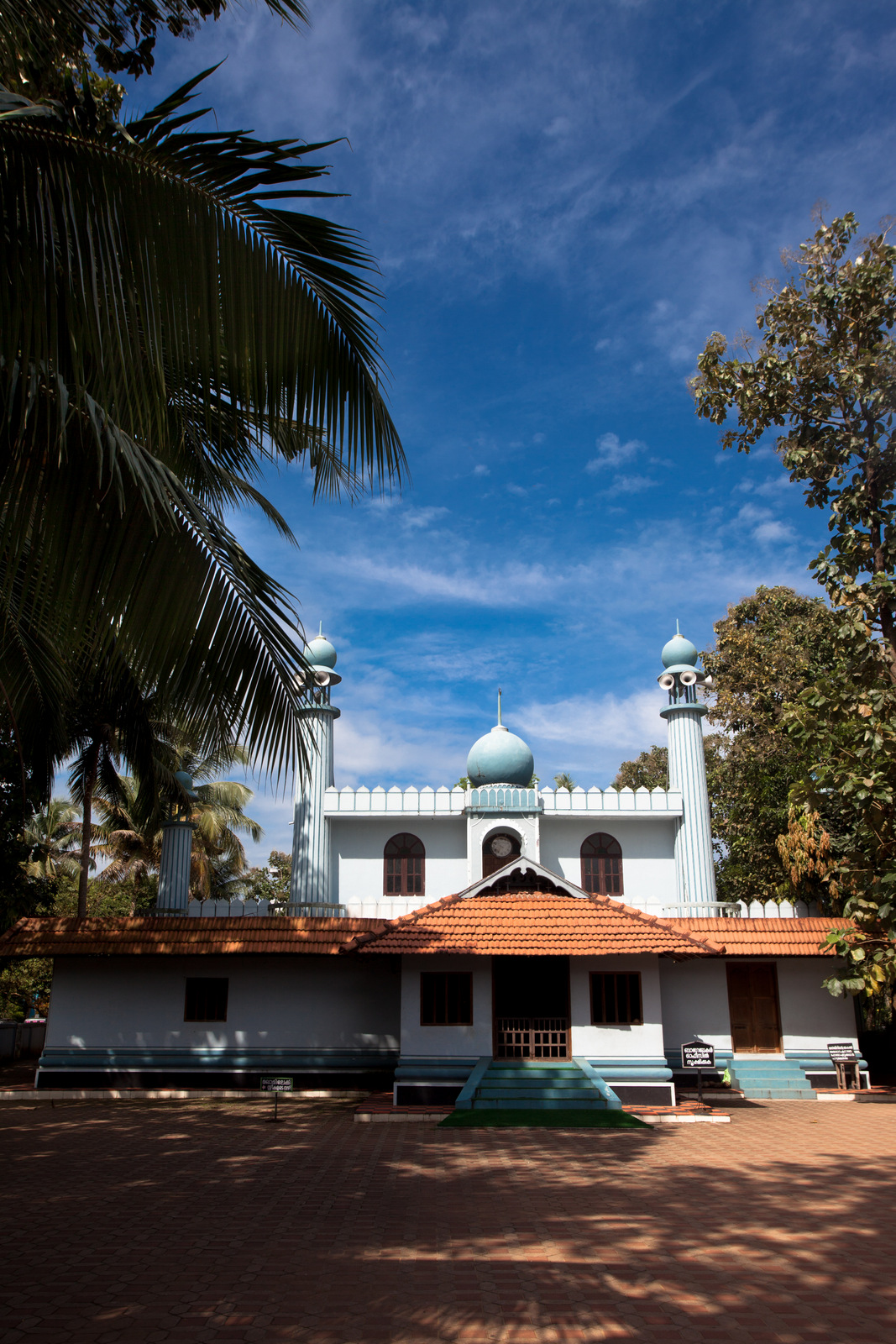
The celebrated Cheraman Juma Mosque, established in 629 CE, stands as an eternal monument to this cultural tolerance. Built in vernacular timbered Kerala style, it preserves a legendary oil lamp (vilakku) burning continuously for centuries, with devotees of all religious backgrounds bringing oil as offerings. Nearby at Azhikode stands the Marthoma Pontifical Shrine, commemorating the arrival of St. Thomas the Apostle in 52 CE, who landed on these sandy shores to establish the earliest Christian communities in India.
A few kilometers away rises the venerable Kodungallur Bhagavathy Temple (Kurumba Bhagavathy Temple), an ancient Shakta shrine famous for its centuries-old Bharani and Thalappoli festivals, where esoteric Tantric rites, sword dances, and rhythmic temple songs echo the deep tribal roots of Kerala's spiritual identity.
Colonial Bastions: Kottappuram Fort and River Wharves
As European colonial powers contested control of the Malabar spice trade, Muziris remained a heavily fortified military checkpoint. In 1503, the Portuguese erected Kottappuram Fort (Cranganore Fort) at the strategic confluence where the Periyar River branches toward the Arabian Sea.
Built with massive laterite stone blocks and lime mortar, the fort controlled all riverine traffic passing between the interior spice hills and the coastal ports. In 1663, the Dutch East India Company captured the fort, strengthening its hexagonal bastions, before it was eventually purchased and dismantled by the kingdom of Travancore to build the famous Nedumkotta (Travancore Lines) fortification against Tipu Sultan's northern invasions.
Extensive archaeological excavations carried out by the Muziris Heritage Project have exposed the massive buried foundations, barracks, cannon emplacements, and water reservoirs of Kottappuram Fort. Today, the landscaped waterfront park around the ruins provides an atmospheric promenade overlooking the serene backwaters where traditional country boats glide peacefully.
Erected in 629 CE by Malik Deenar during the lifetime of Prophet Muhammad, the Cheraman Juma Mosque in Kodungallur is revered as the oldest mosque in India and the second oldest in the world offering Friday prayers continuously. Built under the patronage of the last Chera ruler, Cheraman Perumal, the mosque originally followed traditional Kerala Hindu temple architectural aesthetics with a brass oil lamp that has burned continuously for over a millennium.
Feudal Heritage: The Paliam Palace and Paravur Synagogue
A signature jewel of the Muziris circuit is the Paliam Heritage Enclave in Chendamangalam. For generations, the Paliath Achans—the hereditary prime ministers (Dalawas) of the Kochi royal family—held immense political and administrative authority across the region.
Visitors can explore the two-story Paliam Kovilakam (Dutch Palace), constructed by the Dutch in the 17th century as a token of gratitude for the Paliath Achan's diplomatic alliance. The residence showcases Dutch gables, classical wooden ceilings, and royal heirlooms including historic swords, royal decrees, and private living quarters. Directly opposite stands the Paliam Nalukettu, an authentic 18th-century matrilineal Kerala ancestral mansion with sprawling inner courtyards and open pillared verandas.
Across the river in North Paravur stands the Paravur Jewish Synagogue, one of the largest and most complete historical Jewish complexes in Kerala. Painstakingly restored by the heritage project, the synagogue features an outer gatehouse, Hebrew inscriptions, an elevated women's gallery, and a comprehensive museum narrating the deep mercantile history of the Malabar Jews.

Transit Log, Water Taxis and Exploration Itinerary
The Muziris Heritage Circuit is centered around Kodungallur and North Paravur, situated approximately 24 kilometers north of Cochin International Airport (COK) and 35 kilometers north of central Kochi. The nearest railway stations are Aluva (20 km), Irinjalakuda (16 km), and Thrissur (38 km).
The project operates a modern Hop-On-Hop-Off water taxi boat service along the Periyar backwaters, connecting major heritage nodes including Kottappuram Fort, Azhikode, Paliam Palace, and the Paravur Synagogue. Boarding these scenic river cruises allows travelers to experience the waterways exactly as ancient Roman, Arab, and Dutch navigators did centuries ago.
A comprehensive exploration requires at least two full days. Visitors can stay in heritage boutique homestays in Chendamangalam or seaside resorts near Cherai Beach. The optimal visiting period is from October to March. Key sites are open from 9:30 AM to 5:00 PM (closed Mondays and national holidays).
The Muziris Heritage Project spans over 25 distinct monuments distributed across two districts (Thrissur and Ernakulam) and separated by river waterways. Attempting to see everything on foot is impossible. Travelers should plan visits along thematic boat or road clusters, verifying water-taxi hop-on-hop-off schedules and monument closing days (many museums close on Mondays).
Curated Field Dossier & Offline Google Maps Pin Pack
Bypass tourist traps with verified local logistics, exact parking coordinates, and field-tested routes.
- ✓Exact GPS Pin Pack: Unmarked parking spots, best dawn photography vantage points, and hidden trailheads.
- ✓Crowd-Avoidance Timing Matrix: Exact hour-by-hour windows to explore with zero tourist chaos.
- ✓Vetted Local Dhabas: 100% authentic, hygiene-checked regional food stops not on commercial maps.
- ✓Scam & Overcharge Shield: Verified taxi rates, auto fares, and local guide fee guidelines.
🛡️ Personally curated by PK Gupta & the Hidden Routes research desk. Delivered directly to your Email & WhatsApp within 4–8 hours.
Frequently Asked Questions
What was ancient Muziris?
Muziris was an ancient global spice port on the Periyar delta that flourished from 300 BCE to 1341 CE, serving as the primary emporium where Roman merchant fleets traded gold and wine for Malabar black pepper, cinnamon, and gems.
Why is the Cheraman Juma Mosque historically significant?
Built in 629 CE in Kodungallur, the Cheraman Juma Mosque is considered the oldest mosque in India and one of the oldest in the world, constructed during the lifetime of Prophet Muhammad with the patronage of the last Chera King.
What is the Muziris Heritage Project?
The Muziris Heritage Project is India's largest conservation initiative, restoring over 25 historic monuments, ancient excavation sites, palaces, synagogues, and forts across Ernakulam and Thrissur with hop-on-hop-off water taxis.
What was discovered at the Pattanam excavation site?
Archaeological excavations at Pattanam uncovered 2,000-year-old Roman amphorae fragments, terra sigillata pottery, gemstone beads, a wharf structure, and a dugout canoe confirming direct Roman trade with ancient Kerala.
How far is the Muziris circuit from Kochi and Cochin Airport?
The southern gateway of Muziris at North Paravur is approximately 20 km north of Kochi (Ernakulam), and Kodungallur is about 24 km northwest of Cochin International Airport (COK).
Connecting Kerala Routes & Nearby Highlights
Seamlessly link your journey through Thrissur with these handpicked cultural circuits, coastal trails, and mountain road gateways across Kerala: