
1. Overview: The Cultural Crossroads of the Northern Frontier
Nestled gracefully at the northernmost apex of Kerala where the verdant coastline of Malabar merges into the Tulu and Konkan borders of coastal Karnataka, Kasaragod (കാസർഗോഡ്) is one of the most culturally diverse and historically fascinating district capitals in South India. Known affectionately across the nation as the "Land of Seven Languages" (Sapta Bhasha Sangama Bhoomi), Kasaragod is a living linguistic melting pot where seven distinct tongues—Malayalam, Tulu, Beary, Kannada, Konkani, Marathi, and Urdu—have coexisted in seamless communal harmony for over a thousand years.
Geographically, Kasaragod is blessed with an exquisite tapestry of 12 perennial rivers that flow down from the Western Ghats to form scenic estuarine backwaters and pristine sandy beaches flanked by colossal granite headlands. Historically, the region formed part of the ancient Kolathiri kingdom and later the Bednore Nayaka dynasty of Ikkeri, resulting in an extraordinary concentration of medieval coastal forts—most notably the monumental Bekal Fort to the south and the dramatic river citadel of Chandragiri Fort right on the edge of the city.
From the ancient 7th-century Malik Deenar Mosque at Thalangara to the mythical Ananthapura Lake Temple guarded by a legendary vegetarian crocodile, Kasaragod is an undiscovered treasure trove of heritage, artisanal craft, and tranquil coastal slow-travel.
2. River Citadel: Chandragiri Fort & The Payaswini Estuary
Perched high on a rocky laterite promontory 4 kilometres south of Kasaragod town is the magnificent Chandragiri Fort (ചന്ദ്രഗിരി കോട്ട):
The 17th-Century Nayaka Stronghold: Constructed in the 1640s by Shivappa Nayaka of Bednore, this massive squarish fortress covers over 5 acres. Built using thick blocks of dressed laterite stone, the fort was strategically positioned at the exact confluence where the wide Payaswini (Chandragiri) River empties into the Arabian Sea, functioning as a naval checkpoint to regulate coastal spice transport arriving from the highland estates of Coorg.
The Panoramic Estuary Lookout: Walking along the high western ramparts rewards visitors with one of the most breathtaking panoramic vistas in Kerala: looking down, the glistening silver waters of the river curve around lush emerald coconut islets before breaking through golden sandspits into the turquoise Arabian Sea. Watching local fishermen row traditional wooden canoes across the river mouth as the sun dips below the horizon is an unforgettable spectacle.
3. Sacred Waters: Ananthapura Lake Temple & The Divine Crocodile
Hidden amidst rocky laterite cliffs at Kumbla roughly 12 kilometres northeast of Kasaragod lies the mystical Ananthapura Lake Temple (അനന്തപുര തടാക ക്ഷേത്രം):
The Moola Sthanam of Padmanabha: According to ancient Puranic chronicles, this 9th-century temple is the original seat (Moola Sthanam) of Lord Ananthapadmanabha. The great saint Vilwamangalam Swamiyar was meditating here when Lord Krishna appeared as an impish child; when the saint playfully chided the boy, the divine child vanished through a subterranean cavern that opened beneath the lake, traveling underground all the way to Thiruvananthapuram, where he manifested as the colossal 18-foot reclining deity inside the Sri Padmanabhaswamy Temple.
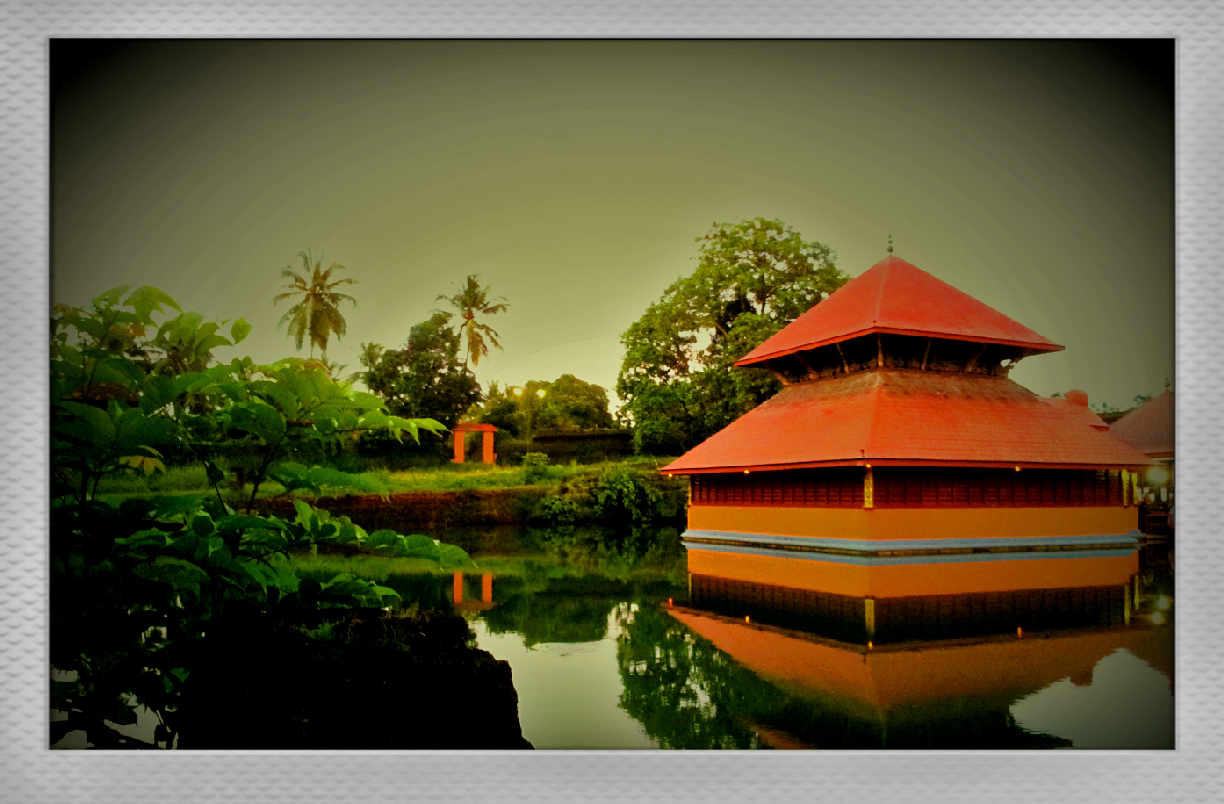
The Temple in the Lake: The rectangular sanctum sanctorum stands directly in the center of a two-acre freshwater lake fed by natural subterranean springs. The outer walls preserve intricate woodwork and 16th-century murals depicting Vaishnavite cosmology.
The Legend of Babiya: For decades, the temple lake was guarded by Babiya, a legendary, docile mugger crocodile who lived in the temple waters for over 70 years until passing away in 2022. Babiya was celebrated across the world as a "vegetarian crocodile" who never harmed fish or humans and survived exclusively on offerings of consecrated temple rice and jaggery (*Nivedyam*) handed to her by the temple priests.

4. Artisanal Heritage: Thalangara Caps & Wooden Uru Ships
Just across the Chandragiri bridge lies Thalangara, an ancient maritime neighborhood celebrated for traditional handicrafts:
Thalangara Thoppi: For over a century, master artisans here have hand-stitched the famous Thalangara Thoppi (delicate embroidered Muslim prayer caps). Crafted from pure cotton muslin cloth using needlework techniques passed down through generations, these caps are highly prized for their breathability in hot climates and are exported across the Persian Gulf.
The Historic Uru Boatyards: The waterfront along the Chandragiri estuary continues the ancient maritime craft of building Urus—colossal hand-crafted wooden cargo and luxury dhows built entirely without metal blueprints using seasoned Malabar teak, wild jackfruit planks, and coconut-fiber caulking, maintaining a trade connection with Arab mariners dating back to the Queen of Sheba.
5. How to Reach Kasaragod: Road, Rail & Airport Routes
Kasaragod has excellent multi-modal transit links connecting Kerala and Karnataka:
| Transit Gateway | Distance | Duration | Route & Connectivity Details |
|---|---|---|---|
| Kasaragod Railway Station (KGQ) | 1 km | 5 minutes | Major railway junction with daily express trains to Mumbai, Goa, Bangalore, and Kochi |
| Mangalore International Airport (IXE) | 60 km | 1.2 hours | Closest airport; smooth four-lane NH-66 drive north through the Talapady border |
| Kannur International Airport (CNN) | 100 km | 2.5 hours | NH-66 south via Kanhangad, Payyanur, and Mattannur |
| Bekal Fort | 16 km | 25 minutes | Direct scenic coastal highway drive southward |
Historical Significance & Cultural Heritage
The Yakshagana Folk Theatre of Kasaragod
Positioned along the cultural borderline with Karnataka, Kasaragod is a major vibrant center for Yakshagana, an ancient traditional theatrical art form combining classical music, dance, spoken dialogue, and dazzling mythological costumes. Unlike southern Kerala where Kathakali dominates, northern Kasaragod celebrates both Tenkutittu (southern) and Badagutittu (northern) styles of Yakshagana.
Performed throughout night-long village celebrations (*Bayalata*) in temple courtyards during winter, the all-male troupes perform dramatic episodes from the Mahabharata and Bhagavata Purana, wearing monumental wooden crowns (*Kirita*), vibrant facial makeup, and heavy silver breastplates. The vibrant dialogic art form reflects the rich linguistic harmony of Kasaragod, often shifting effortlessly between Kannada, Tulu, and Malayalam.
Riverine Backwaters: The Chandragiri River Cruises
Flowing past the historic fort, the Chandragiri River offers delightful, unhurried backwater cruises. Boarding traditional wooden motorized houseboats or open country craft at the Kasaragod boat jetty, travelers cruise past quiet mangrove islets, coastal coconut groves, and riverside fishing villages where traditional coir yarn is spun by hand. The cruise passes beneath the historic railway bridge where the river widens into a serene lagoon before entering the open sea.
Ananthapura Lake Temple: The Sacred Guardian Crocodile
Located just 12 kilometres north of Kasaragod near Kumbla, the Ananthapura Lake Temple is the only lake temple in Kerala, set dramatically in the middle of a rectangular freshwater spring. Believed to be the original seat (*Moolasthanam*) of Lord Anantha Padmanabha of Thiruvananthapuram, the 9th-century temple is internationally famous for its legendary vegetarian guardian crocodiles—first named Babiya—who lived harmlessly in the lake, ate only rice offerings, and guarded the sanctum for decades.
Kasaragod Saree Weaving & Handloom Heritage
Kasaragod has earned a prestigious Geographical Indication (GI) tag for its distinctive Kasaragod Handloom Sarees. Woven on traditional frame looms by master weavers of the Saliya weaving community using pure dyed cotton yarn, these sarees feature intricate jacquard borders and vivid colorfast hues that have been celebrated across South India for more than a century.
Curated Field Dossier & Offline Google Maps Pin Pack
Bypass tourist traps with verified local logistics, exact parking coordinates, and field-tested routes.
- ✓Exact GPS Pin Pack: Unmarked parking spots, best dawn photography vantage points, and hidden trailheads.
- ✓Crowd-Avoidance Timing Matrix: Exact hour-by-hour windows to explore with zero tourist chaos.
- ✓Vetted Local Dhabas: 100% authentic, hygiene-checked regional food stops not on commercial maps.
- ✓Scam & Overcharge Shield: Verified taxi rates, auto fares, and local guide fee guidelines.
🛡️ Personally curated by PK Gupta & the Hidden Routes research desk. Delivered directly to your Email & WhatsApp within 4–8 hours.
Travel Intelligence & Frequently Asked Questions
Why is Kasaragod called the 'Land of Seven Languages'?
Kasaragod is called the Land of Seven Languages because its diverse, multicultural population speaks Malayalam, Tulu, Beary, Kannada, Konkani, Marathi, and Urdu harmoniously due to its position at the intersection of Kerala and Karnataka.
What is unique about the Ananthapura Lake Temple in Kasaragod?
Ananthapura Lake Temple is the only lake temple in Kerala, situated in the center of a natural freshwater spring pond. It is the original seat (Moola Sthanam) of Lord Padmanabha and was famously guarded for over 70 years by Babiya, a docile vegetarian crocodile.
What is the historical significance of Chandragiri Fort?
Built in the 17th century by Shivappa Nayaka of Bednore, Chandragiri Fort is a massive laterite coastal fortress overlooking the confluence of the Payaswini River and Arabian Sea, once regulating high-range spice transport.
Which is the nearest airport to Kasaragod?
Mangalore International Airport (IXE) in Karnataka is the nearest airport, located only 60 km north of Kasaragod city (approx. 1 hour and 15 minutes by taxi along NH-66).
How far is Bekal Fort from Kasaragod city?
Bekal Fort is located approximately 16 kilometres south of Kasaragod city, taking roughly 25 minutes by car, taxi, or local bus along the scenic coastal highway.