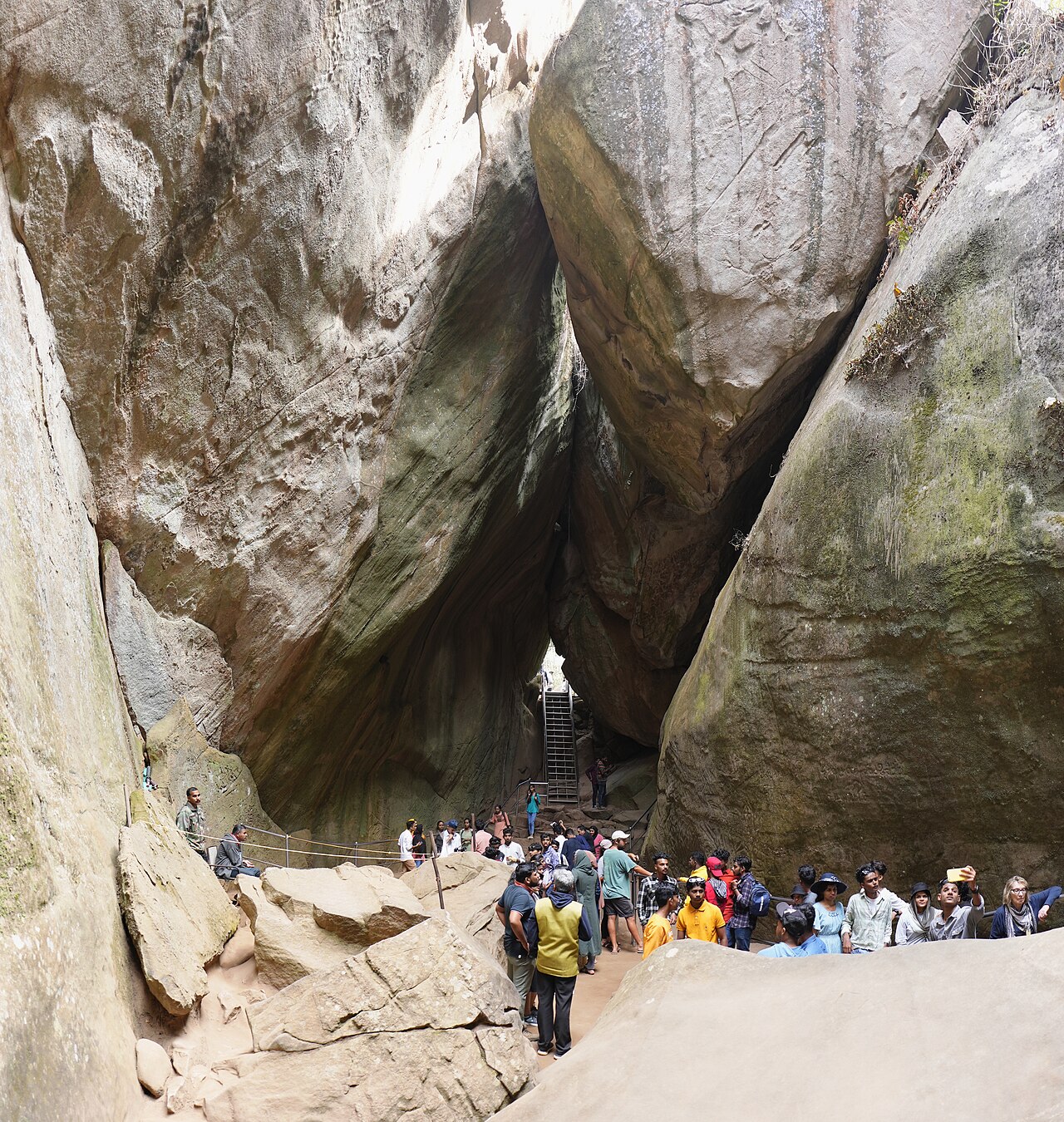
1. Geological Wonder: 'A Stone in Between'
Perched high on the mist-kissed, precipitous granite crest of Ambukuthi Mala (Arrow-Piercing Hill) at an elevation of approximately 1,200 metres (3,937 feet) above sea level, near the historic town of Ambalavayal in eastern Wayanad, Edakkal Caves (എടക്കൽ ഗുഹകൾ) is not a subterranean cave in the conventional geological sense. Rather, it is a magnificent natural rock shelter or fissure cleft created by a colossal geological accident in deep prehistory.
The name Edakkal translates literally in Malayalam to "A Stone in Between" (Eda meaning between, and Kal meaning rock or stone). Sometime in ancient antiquity, tectonic movements or seismic tremors caused a colossal, single granite boulder weighing hundreds of tonnes to split away from the main mountain mass. As it fell, it became wedged tightly between two towering parallel granite cliffs, forming a massive natural stone roof over a 96-foot-long, 22-foot-wide, and 30-foot-high sheltered cavern.
The site remained forgotten by the outside world until 1894, when Fred Fawcett, a keen British police officer and amateur anthropologist serving as the Superintendent of Police of the Malabar District, went on a hunting expedition on Ambukuthi Mala. Guided by local tribal villagers, Fawcett stumbled into the cavern and was stunned to discover that the rock shelter's vertical granite walls were covered with hundreds of astonishing prehistoric petroglyphs. Recognizing their monumental antiquity, Fawcett published detailed scholarly papers in the Indian Antiquary (1901), thrusting Edakkal onto the global archaeological map.
2. The Prehistoric Petroglyphs: 6,000 BCE to 1,000 BCE
Edakkal Caves is internationally celebrated by archaeologists as the only known place in South India with Stone Age rock engravings dating from the Late Neolithic period (circa 6,000 BCE to 1,000 BCE). Unlike cave paintings that use organic pigments, the petroglyphs at Edakkal were laboriously chiseled, gouged, and engraved directly into the hard crystalline granite rock face using sharp quartz stones and primitive iron tools.
Archaeological analysis reveals that the engravings were executed in at least three distinct historical epochs across five millennia:
- Anthropomorphic Figures: The most striking carvings depict mysterious human figures with masked faces, elaborate feathered or spiked headgear, and square bodies. Prominent among them is a heroic male figure holding a bow and arrow, often interpreted by archaeologists as a prehistoric tribal chieftain, shaman, or deity.
- Faunal Depictions: Beautifully stylized representations of wildlife that roamed the prehistoric highlands, including wild elephants, horned bulls (*Gaur*), hunting dogs, deer, and peacocks.
- Ritualistic & Geometric Symbols: Intricate geometric motifs including wheels with spokes (*Chakras*), concentric triangles, criss-cross hatching, sacred swastikas, bows, arrows, and tree-of-life emblems, providing profound insights into the spiritual consciousness, fertility rites, and celestial observations of Neolithic hunter-gatherers.
3. The Indus Valley Connection: Archaeological Revelations
In 2009 and 2012, Edakkal Caves became the epicenter of an electrifying global archaeological debate when prominent epigraphists and archaeologists—most notably Dr. M.R. Raghava Varier, former professor of epigraphy at Calicut University—discovered a rare symbol carved at Edakkal: the depiction of a "man with jar cup".
This distinct anthropomorphic glyph is one of the most frequently recurring graphemes in the undeciphered Indus Valley (Harappan) Script found on steatite seals across Mohenjo-daro and Harappa. The discovery at Edakkal provided tangible, compelling evidence suggesting that the Neolithic cultures of the southern Western Ghats maintained active trade, cultural exchange, or linguistic affinities with the contemporary urban civilizations of the Indus Valley dating back to 2,500 BCE.
Furthermore, ancient Tamil-Brahmi inscriptions discovered at Edakkal dating from the 3rd to 5th centuries CE reference historic rulers of the Chera dynasty—including a famous epigraph mentioning "Sri Vazhumi" (an ancient Chera ruler)—confirming that the sacred shelter continued to serve as a revered spiritual and pilgrimage sanctuary for over three thousand unbroken years.

4. Local Folklore & The Challenging Mountain Ascent
In local Hindu folklore, Ambukuthi Mala is deeply intertwined with the sacred epic Ramayana. According to myth, the mountain was named Ambukuthi (Malayalam for "Pierced by an Arrow") because Lord Rama's twin sons, Lava and Kusha, fired celestial arrows into the mountain during their forest exile. The impact of their divine arrows is said to have split the mountain granite in two, creating the dramatic cleft that formed Edakkal Caves.
Reaching this prehistoric sanctuary requires an invigorating, moderately strenuous physical hike. The expedition unfolds in two stages:
- Stage 1 — The Jeep Road (1 km): From the main parking base at Ambalavayal, a steep 1-kilometre winding paved road leads up to the Forest Department ticket counter. Private jeeps operate continuously to ferry visitors up this steep initial gradient for ₹20 to ₹30 per head.
- Stage 2 — The Iron Staircase Ascent (350+ steps): From the ticket counter, visitors must climb approximately 350 to 400 steep, narrow concrete steps and steel cantilevered staircases bolted directly onto the sheer vertical granite cliff face. As you ascend, the panoramic vistas over Wayanad's coffee valleys, the Karapuzha reservoir, and the distant Nilgiri hills become increasingly breathtaking.
- Entering the Caves: The climb concludes by squeezing through narrow stone passages and descending an internal iron ladder into the cool, sheltered, stone-roofed chamber of the cave.
5. UNESCO World Heritage Ambition & Preservation
Due to its peerless prehistoric significance, Edakkal Caves is on the tentative list for nomination as a UNESCO World Heritage Site. However, this ancient treasure faces severe modern conservation challenges. Over the decades, unregulated mass tourism, moisture seepage, structural vibrations caused by nearby illegal granite quarrying, and vandalism (visitors scratching names onto the fragile prehistoric rock face) caused alarming damage to the petroglyphs.
In response, the Archaeological Survey of India (ASI) and the Kerala State Department of Archaeology have implemented stringent protection protocols:
Preservation Measures & Mandatory Visitor Rules
- Daily Visitor Cap: Entry is strictly limited to approximately 1,920 visitors per day (capped in timed batches) to prevent overcrowding inside the narrow rock fissure.
- Zero-Touch Policy: Touching, brushing against, or leaning on the carved granite rock walls is strictly prohibited. Natural oils and acids from human fingertips cause rapid deterioration of the ancient mineralized carvings.
- No Backpacks or Sharp Objects: Bags, walking sticks, keys, and sharp metal objects must be deposited at the cloakroom before entering the upper cave chamber.
- Quarry Bans: The Kerala High Court has established a strictly enforced buffer zone prohibiting all mechanical granite quarrying and blasting within a multi-kilometre radius of Ambukuthi Mala to prevent micro-fissures in the cave structure.

6. Best Time to Visit, Timings, Fees & Transport
The ideal season to visit Edakkal Caves is from September to May. The winter months (November to February) offer cool mountain breezes, clear visibility, and comfortable climbing temperatures. During peak monsoon months (June to August), the steep granite steps can become dangerously slick, and the climb is occasionally suspended during torrential downpours for visitor safety.
| Parameter | Key Information |
|---|---|
| Visiting Hours | 09:00 AM to 04:00 PM (Weekly Holiday: Mondays Closed). Ticket counter closes around 03:00 PM. |
| Entry Ticket Fee | ₹50 for Indian adults, ₹30 for children (Age 5-12), ₹100 for foreign visitors. |
| Jeep Shuttle Fee | ₹20-₹30 per person each way from parking to ticket counter. |
| Camera Charges | ₹30 for still cameras, ₹150 for video equipment. |
| Physical Accessibility | The climb involves nearly 400 steep steps and metal stairs; not suitable for travelers with severe knee issues, cardiac ailments, or mobility impairments. |
| Nearest Towns | Ambalavayal (5 km); Sulthan Bathery (12 km); Kalpetta (25 km). KSRTC buses run regularly from Sulthan Bathery and Kalpetta to Ambalavayal. |
Curated Field Dossier & Offline Google Maps Pin Pack
Bypass tourist traps with verified local logistics, exact parking coordinates, and field-tested routes.
- ✓Exact GPS Pin Pack: Unmarked parking spots, best dawn photography vantage points, and hidden trailheads.
- ✓Crowd-Avoidance Timing Matrix: Exact hour-by-hour windows to explore with zero tourist chaos.
- ✓Vetted Local Dhabas: 100% authentic, hygiene-checked regional food stops not on commercial maps.
- ✓Scam & Overcharge Shield: Verified taxi rates, auto fares, and local guide fee guidelines.
🛡️ Personally curated by PK Gupta & the Hidden Routes research desk. Delivered directly to your Email & WhatsApp within 4–8 hours.
Travel Intelligence & Frequently Asked Questions
What is the historical importance of Edakkal Caves?
Edakkal Caves is the only known site in South India with Stone Age rock petroglyphs, dating between 6,000 BCE and 1,000 BCE. It features prehistoric carvings of human figures, masked shamans, animals, and geometric symbols with intriguing links to the Indus Valley Civilization.
How difficult is the climb to Edakkal Caves?
The climb is moderately strenuous. After a 1-km steep road (which can be covered by jeep), visitors must climb nearly 400 steep stone steps and metal staircases attached to the granite cliff. Sturdy walking shoes and drinking water are essential.
Who discovered the rock carvings at Edakkal Caves?
The petroglyphs were discovered in 1894 by British police official and amateur anthropologist Fred Fawcett during a hunting expedition on Ambukuthi Mala, who published his findings in 1901.
Is Edakkal Caves open every day?
No, Edakkal Caves is closed to visitors every Monday. On other days, it is open from 09:00 AM to 04:00 PM, with the ticket counter closing at 03:00 PM.
Can we touch the prehistoric carvings at Edakkal Caves?
No, touching the rock walls is strictly prohibited by the Archaeological Survey of India (ASI) to protect the fragile Neolithic carvings from deterioration caused by human skin oils and moisture.