
1. Sand Dune Phenomenon & Fluvial Geomorphology
Talakadu presents one of the most astonishing geological anomalies in peninsular India: an extensive desert-like expanse of shimmering sand dunes rising dramatically alongside the lush riparian banks of the holy Kaveri River. Situated in T. Narasipura taluk of Mysuru district, Talakadu rests on a sharp hairpin bend of the Kaveri, where hydrological currents, historical sand extraction, and shifting wind corridors have deposited massive dunes that span over a square kilometer.
While the surrounding Deccan plains are composed of fertile red loamy soil, Talakadu is smothered under tens of meters of fine alluvial sand, which periodically engulfs ancient stone temples and requires continuous archaeological unearthing. Geologists and hydrologists attribute this unique inland sand dune field to the sharp curvature of the Kaveri combined with historical dam construction at Madhavamantri anicut in the fourteenth century.
The diversion of water velocity exposed extensive sandbars during dry pre-monsoon months, and strong south-westerly winds carried the loose sediment northeastward across the settled dynastic capital. Walking through Talakadu feels otherworldly: shaded canopy trails cut directly through towering sand dunes, with carved stone gopurams, pillared mandapas, and sacred pushkaranis emerging directly from the sandy embankments like sunken maritime relics.
2. The Curse of Alamelamma & Dynastic Hegemony
Talakadu's physical sand dunes are deeply interwoven into Karnataka's folklore through the legendary curse uttered by Rani Alamelamma in 1610 CE. Alamelamma was the wife of Tirumalaraya, the ailing Vijayanagara viceroy of Srirangapatna. Following Tirumalaraya's demise, Raja Wadiyar of Mysuru sought possession of the sacred royal jewelry belonging to Sri Ranganayaki temple. Fleeing Mysuru forces, Alamelamma leaped into the churning waters of the Kaveri at Malangi, allegedly proclaiming her fateful three-line curse in Kannada: 'Talakadu Marulagali, Malangi Maduvagali, Mysooru Doregalige Makkalagadirali'—'May Talakadu turn into barren sand, may Malangi become a treacherous whirlpool, may the Kings of Mysuru bear no natural heirs.'
Historians trace Talakadu's documented antiquity far earlier, beginning with the Western Ganga dynasty, who established it as their imperial royal capital (known as Talavanapura) from the fourth to tenth centuries CE. The city subsequently fell to the Cholas under Rajendra Chola I in 1004 CE, who renamed it Rajarajapura.
In 1116 CE, the legendary Hoysala king Vishnuvardhana wrested Talakadu from the Cholas, commemorated by his assumption of the royal title Talakadugonda ('Conqueror of Talakadu') and the construction of the magnificent Kirtinarayana temple. The sand dunes began actively creeping over the urban center during the decline of the Vijayanagara empire, turning an imperial riverine metropolis into an archaeological palimpsest buried beneath the sands of time.

3. The Panchalinga Shrines: Sacred Shaivite Circuit
Talakadu is renowned across southern India for its venerated Panchalinga Darshana—a rare pilgrimage circuit celebrating five distinct manifestations of Lord Shiva representing the five cosmic faces (Sadyojata, Vamadeva, Aghora, Tatpurusha, and Ishana). The primary temple is the Vaidyeshwara Temple, constructed in granite during the Ganga-Chola transition and expanded by the Hoysalas.
Featuring elaborate dvarapalas holding maces, intricate perforated stone jali windows, and a majestic Nandi mandapa, the sanctum enshrines Shiva as the divine healer (Vaidyanatha). Sand dunes encircle the stone compound, requiring wooden steps and boardwalks for devotee access.
The remaining four sanctums of the Panchalinga circuit are dispersed across the sandy terrain and surrounding villages: the Arkeshwara Temple at Gajalewadi, the Pataleshwara Temple (where the Shivalinga is said to change color from red in the morning to black at night), the Maruleshwara Temple (featuring an enormous Ganga-era Shivalinga), and the Mallikarjuna Temple situated atop the nearby Mudukuthore hillock.
The sacred Panchalinga Darshana at Talakadu occurs only when an extraordinary astrological alignment takes place—on the new moon day (Amavasya) of Kartika month falling on a Monday, with the sun in Scorpio (Vrischika) and the star being Anuradha. During this rare festival occurring once every 7 to 12 years, hundreds of thousands of pilgrims bathe at Gokarna Theertha before visiting all five shrines within a single solar day.
4. Archaeological Excavations & The Resurrected Kirtinarayana Shrine
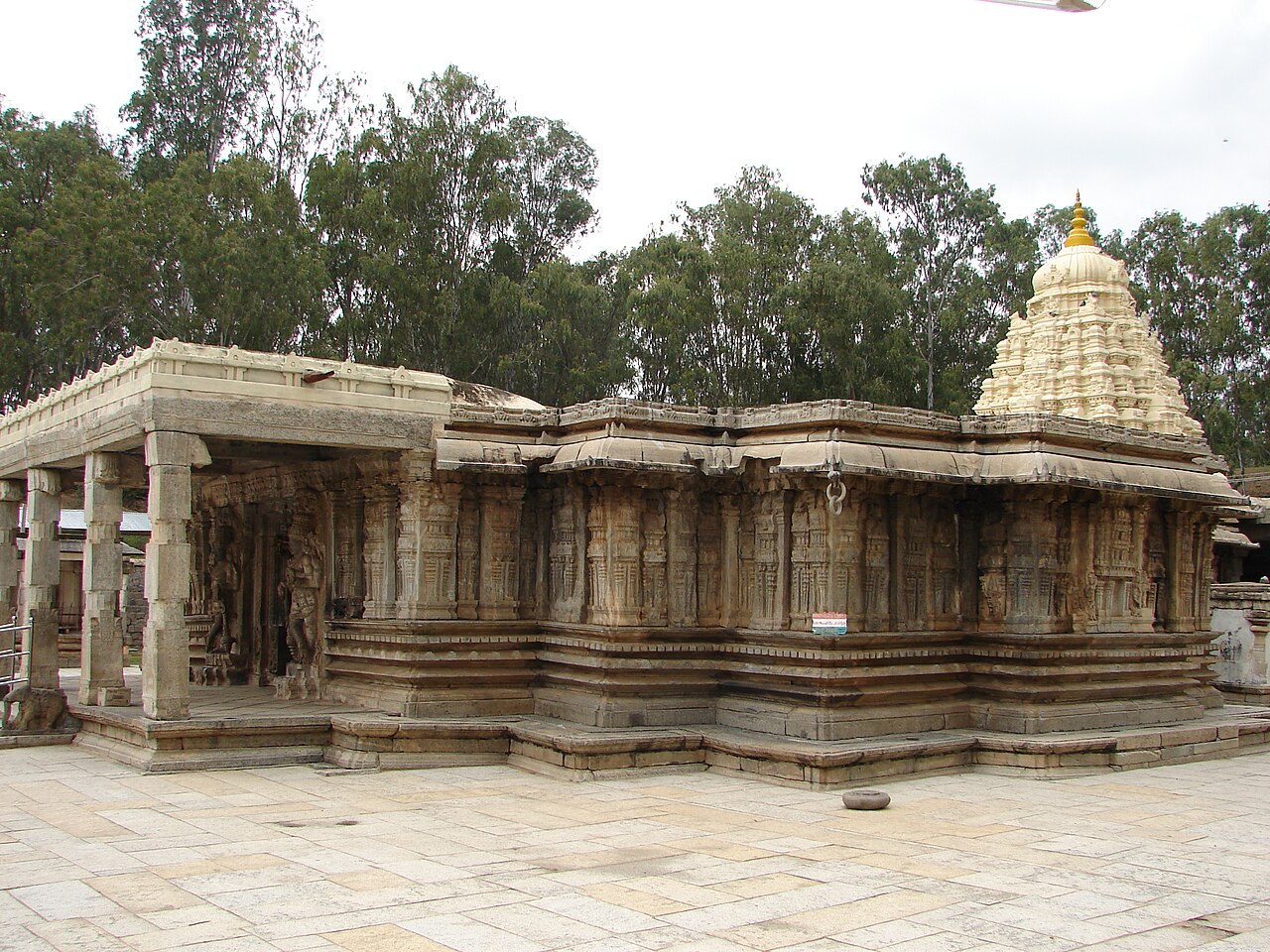
The Archaeological Survey of India (ASI) and the Karnataka State Department of Archaeology have conducted systematic excavations at Talakadu since the early 1990s, revealing complex layers of subterranean architecture. The most dramatic excavation is the Kirtinarayana Temple, a grand Hoysala masterpiece built by King Vishnuvardhana in 1117 CE to celebrate his triumph over the Cholas.
For centuries, only the temple kalasha (finial) protruded from the windblown sand dunes. Painstaking scientific excavations completely disinterred the temple, revealing a magnificent soapstone navaranga, lathe-turned pillars, and an awe-inspiring ten-foot-tall sanctum image of Narayana holding the conch, discus, mace, and lotus.
Excavations have also unearthed remnants of ancient Ganga brick dwellings, early medieval coin hoards, Roman pottery sherds confirming ancient trade linkages, and secondary shrines dedicated to Bhairava and Durga. The ASI has stabilized the surrounding sand dunes using casuarina and eucalyptus plantations, alongside retaining stone walls, ensuring that the excavated monuments remain protected from creeping sanddrifts while preserving the haunting desert-like ambiance that makes Talakadu an incomparable heritage destination.
5. Kaveri River Coracles, Sand Walks & Temple Etiquette
A visit to Talakadu combines deep historical exploration with serene riverine recreation. Beyond the temple compounds, the Kaveri riverfront features gentle sandy shores where visitors can take traditional round coracle (harigolu) boat rides across tranquil eddies shaded by weeping willows and arjun trees. Local boatmen maneuver the woven bamboo vessels with single wooden oars, offering views of the submerged riverbanks and birdlife including kingfishers, brahminy kites, and river lapwings.
Walking across the dunes between the temples requires traversing specialized pedestrian walkways and deep sand paths that can become intensely hot by midday. Visitors are advised to begin their temple circuit early in the morning. Traditional South Indian prasada, tender coconut water, and local Mysuru-style snacks are available near the town entrance.
Footwear must be deposited at designated shoe stands before entering the sand tracks leading to the sanctums, making socks highly advisable during sunny months.
The fine alluvial sand tracks between the temples heat up intensely between 11:30 AM and 3:30 PM; wearing thick cotton socks provides vital thermal protection when walking barefoot. Additionally, bathing in the Kaveri must be restricted to designated safe ghats—the riverbed drops abruptly and underwater eddies near Malangi have treacherous currents.
6. Transit Logistics, Access Routes & Optimal Season
Talakadu is conveniently reached from Mysuru (45 km via SH-33) and Bengaluru (135 km via NH-275 and Malavalli). State transport (KSRTC) buses operate regular services from Mysuru Suburban Bus Stand and T. Narasipura. The nearest major railway hub is Mysuru Junction, while Kempegowda International Airport in Bengaluru provides comprehensive domestic and international flight connectivity.
Taxis and private self-drive vehicles offer the greatest flexibility, allowing travelers to combine Talakadu with nearby heritage sites such as Somanathapura (25 km), the twin waterfalls of Shivanasamudra (30 km), and the historic temple town of T. Narasipura (Tirumakudalu, the confluence of Kaveri, Kapila, and mythical Spatika).
The optimal season to visit Talakadu is from October to March, when Deccan winter temperatures range from a pleasant 18°C to 28°C, making the barefoot sand walk comfortable. The monsoon months (July to September) bring dramatic river swelling and cooler temperatures, though torrential downpours can make the sand tracks soggy. Midsummer (April to May) brings intense heat with temperatures exceeding 36°C, turning the open sand dunes scorching underfoot by late morning.
Curated Field Dossier & Offline Google Maps Pin Pack
Bypass tourist traps with verified local logistics, exact parking coordinates, and field-tested routes.
- ✓Exact GPS Pin Pack: Unmarked parking spots, best dawn photography vantage points, and hidden trailheads.
- ✓Crowd-Avoidance Timing Matrix: Exact hour-by-hour windows to explore with zero tourist chaos.
- ✓Vetted Local Dhabas: 100% authentic, hygiene-checked regional food stops not on commercial maps.
- ✓Scam & Overcharge Shield: Verified taxi rates, auto fares, and local guide fee guidelines.
🛡️ Personally curated by PK Gupta & the Hidden Routes research desk. Delivered directly to your Email & WhatsApp within 4–8 hours.
Frequently Asked Questions
What caused the sand dunes of Talakadu?
Geologically, the dunes formed due to the sharp bend in the Kaveri River combined with windward sand deposition following the 14th-century construction of the Madhavamantri anicut, which exposed river sandbars. Culturally, local lore attributes the sand dunes to the 1610 CE curse of Rani Alamelamma.
How many temples can be visited in Talakadu today?
Visitors can explore several fully excavated temples, prominently the Vaidyeshwara, Pataleshwara, Maruleshwara, and Kirtinarayana temples, alongside the hilltop Mallikarjuna temple at Mudukuthore. Additional secondary shrines remain partially buried in sand.
Can Talakadu be visited as a day trip from Mysuru or Bengaluru?
Yes. Talakadu is an easy 1-hour drive (45 km) from Mysuru and a 3 to 3.5-hour drive (135 km) from Bengaluru. It is frequently paired with Somanathapura's Hoysala temple and Shivanasamudra Falls for a comprehensive day-long heritage circuit.
Are coracle rides safe at Talakadu?
Coracle rides operated by licensed local boatmen in calm river backwaters are safe and enjoyable. Always wear the provided life jackets and avoid venturing into turbulent river sections or deep currents near Malangi.
What are the temple timings at Talakadu?
The excavated temples under ASI and state trust management are generally open for darshan and viewing from 8:00 AM to 6:00 PM daily. Early morning hours between 8:00 AM and 10:30 AM offer the most pleasant temperatures for walking across the sand.