
1. Geographic Setting & The Royal City of Coronation
Pattadakal (historically documented in classical inscriptions as Pattada Kisuvolal, translating to 'The Red Soil Valley of the Royal Diadem') is a world-renowned UNESCO World Heritage archaeological complex situated along the holy banks of the Malaprabha River in the Bagalkot district of northern Karnataka. Located roughly midway between Badami (14 km) and Aihole (13 km), Pattadakal occupies a serene, landscaped river bend where the Malaprabha miraculously flows northward (Uttara Vahini)—a hydrological orientation regarded in sacred Hindu tradition as intensely auspicious for royal ceremonies.
Unlike Badami, which functioned as the fortified political and military administrative capital, and Aihole, which served as the regional experimental academy of stone masonry, Pattadakal was consecrated exclusively as the grand ceremonial coronation site (Pattabhisheka Kshetra) of the Early Chalukya emperors. It was here, on the sacred banks of the Malaprabha, that successive Chalukyan monarchs were anointed with holy theertha waters, crowned with golden diadems, and celebrated their military victories across peninsular India.
The monumental complex comprises nine major Hindu temples and one monolithic Jain sanctuary, constructed primarily during the 7th and 8th centuries CE. Pattadakal represents the ultimate crystallization and triumphant climax of Chalukyan architectural genius, where the experimental building forms pioneered at Aihole and Badami were harmonized into a magnificent, mature imperial style.
2. Virupaksha Temple: The Pinnacle of Dravidian Architecture
The undisputed architectural crown jewel of Pattadakal is the colossal Virupaksha Temple (historically named Lokeshwara Temple), consecrated in approximately 740 CE by Queen Lokamahadevi. The temple was commissioned as a grand imperial monument to commemorate the momentous victory of her husband, King Vikramaditya II, over the Pallava Empire and the capture of their royal capital at Kanchipuram.
To construct this masterpiece, Queen Lokamahadevi imported master architect-sculptor Gunda Anivaritachari (honored in royal inscriptions with the title 'Tribhuvanachari'—Architect of the Three Worlds) from Kanchipuram. The temple was inspired directly by the Kailasanatha Temple at Kanchipuram, yet the Chalukyan builders elevated the design to unprecedented heights of spatial grandeur, structural proportion, and sculptural density.
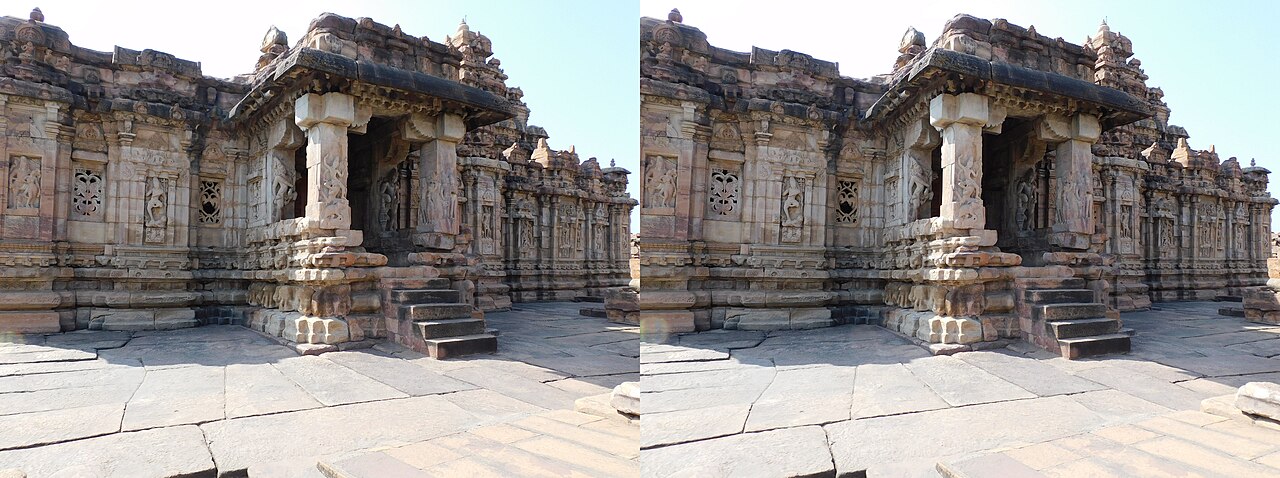
Built within an expansive enclosed courtyard, the Virupaksha complex features a towering entrance gopuram, a massive detached Nandi mandapa housing a colossal polished black stone bull, a 16-pillared assembly hall (sabha-mandapa), an inner vestibule, and a square sanctum topped by a magnificent four-tiered Dravidian vimana tower rising over 65 feet high. Every square inch of the temple walls and interior pillars is carved with breathtaking bas-reliefs illustrating episodes from the Ramayana, Mahabharata, Bhagavata Purana, and the Panchatantra fables.
3. Mallikarjuna & Sangameshwara: Royal Sister Temples
Standing immediately adjacent to the Virupaksha Temple is the Mallikarjuna Temple (historically named Trailokeshwara Temple), consecrated shortly after 740 CE by Queen Trailokyamahadevi, the younger sister of Queen Lokamahadevi and junior consort of King Vikramaditya II. Built to commemorate the same military triumph over the Pallavas, the Mallikarjuna temple closely mirrors the architectural layout of the Virupaksha temple on a slightly more intimate scale.
The interior pillars of the Mallikarjuna mandapa are celebrated for their narrative relief carvings, showcasing scenes of Krishna lifting Mount Govardhana, the churning of the cosmic ocean (Samudra Manthan), and captivating depictions of the sacred Kalpavriksha wish-fulfilling tree. The exterior vimana tower differs subtly from Virupaksha, terminating in a hemispherical circular dome (griva-shikhara) rather than a square Dravidian crown.
Nearby stands the Sangameshwara Temple (originally called Vijayeshwara), constructed between 696 and 733 CE during the reign of King Vijayaditya. As the oldest structural temple within the main Pattadakal enclosure, Sangameshwara represents an austere, early prototype of the pure Dravidian style. Its massive, unadorned sandstone basement moldings and classical multi-tiered vimana exude a timeless sense of monumental strength and architectural purity.
Pattadakal was inscribed on the UNESCO World Heritage List in 1987 as 'Group of Monuments at Pattadakal'. UNESCO recognized the site as an unparalleled harmonious blend of architectural forms from northern (Nagara) and southern (Dravida) India, representing the zenith of early Chalukyan temple art under King Vikramaditya II.
4. The Fusion of Styles: Papanatha, Galaganatha & Kadasiddheshwara
What renders Pattadakal an extraordinary site of universal heritage value is the deliberate, simultaneous co-existence of two completely distinct architectural idioms standing side-by-side within the exact same complex: the southern Dravida style and the northern Nagara (Rekha-Nagara) style.
The finest manifestation of this architectural dialogue is the Papanatha Temple, situated slightly south of the main cluster. Built between the late 7th and early 8th centuries CE, Papanatha is an audacious architectural synthesis: it combines a southern Dravidian floor plan and pillared assembly hall with a soaring northern curvilinear Nagara shikhara tower crowned by an amalaka (fluted stone disc). The exterior walls are decorated with dramatic relief panels depicting the abduction of Sita, the battle between Vali and Sugriva, and the construction of the bridge to Lanka.
Other northern-style monuments include the Galaganatha Temple, featuring a classic curvilinear Nagara tower adorned with an intact amalaka and a dramatic relief of an eight-armed Shiva slaying the demon Andhaka, alongside the elegant Kadasiddheshwara and Jambulingeshwara shrines, which showcase miniature Nagara towers fronted by delicate architraves depicting dancing Shiva within horseshoe-shaped kudu arches.

5. The Imperial Architectural Legacy: Blueprint for Ellora
The architectural influence of Pattadakal extends far beyond the borders of Karnataka, having directly inspired one of the greatest engineering feats in human history: the monolithic Kailasa Temple (Cave 16) at Ellora in Maharashtra. Following the decline of the Chalukyas in 753 CE, their imperial successors, the Rashtrakutas under King Krishna I, sought to replicate the grandeur of the Virupaksha Temple at Pattadakal on an unprecedented scale.
Rashtrakuta master builders copied the ground plan, pillar arrangements, vimana tiers, and sculptural iconography of the Virupaksha Temple with near-mathematical fidelity, carving the entire complex top-down out of a single monolithic basalt mountain at Ellora. Thus, the architectural grammar forged by Chalukyan stonecutters at Pattadakal became the prototype for the zenith of rock-cut excavation in world history.
Approximately 1 kilometre west of the main riverfront complex lies the Jain Narayana Temple, constructed in the 9th century CE during the reign of Rashtrakuta King Amoghavarsha I or his son Krishna II. Built of finely dressed sandstone in the Dravidian style with two large stone elephants guarding the entrance, the temple enshrines a serene seated Tirthankara, proving that Pattadakal continued as an active sacred centre under Rashtrakuta royal patronage.
The expansive open-air monument enclosure at Pattadakal is paved with native sandstone slabs that absorb extreme solar heat during the afternoon. Visitors are required to remove footwear before entering active temple sanctums. Thick cotton socks are strongly advised to protect feet from burning stone surfaces.
6. Practical Visitor Intelligence: Tickets, Festivals & Photography
Pattadakal is managed by the Archaeological Survey of India (ASI) as an internationally protected monument. The complex is open daily from sunrise to sunset (6:00 AM to 6:00 PM). Visitors can purchase admission tickets online via the ASI portal or at the entrance ticket counter. A comprehensive visit to all temples in the riverfront enclosure requires roughly 2 to 3 hours.
Every year in January or February, the Government of Karnataka hosts the prestigious Pattadakal Dance Festival (Pattadakal Utsava). During this three-day cultural extravaganza, the illuminated stone facade of the Virupaksha Temple serves as a majestic open-air backdrop for performances by India's foremost classical dancers (Bharatanatyam, Kathak, Odissi, Kuchipudi) and Hindustani classical musicians.
Licensed ASI tour guides are available at the entrance gate and provide invaluable historical context regarding the competing queens, dynastic inscriptions, and architectural styles. Photography is permitted throughout the open complex, but tripods and commercial filming equipment require advance written permits from the ASI.
7. Seasonal Profiles: Crisp Winter Heritage vs Monsoons
The premier visiting season for Pattadakal spans from October through March. During this winter window, the northern Karnataka plains enjoy brilliant, clear sunny days, low humidity, and pleasant daytime temperatures between 26°C and 30°C with cool evening breezes. The weather is ideal for leisurely walking between the open stone temples and studying the microscopic detail of the pillar carvings.
The summer months from April to June bring intense, dry heat with daytime temperatures soaring between 38°C and 42°C. The open stone courtyards radiate extreme heat, and visits should be restricted strictly to early morning hours (6:00 AM to 9:30 AM).
The monsoon season from July to September brings refreshing rain showers that rejuvenate the Malaprabha River and turn the landscaped lawns of the complex into a vibrant, emerald-green carpet. While rain is intermittent, the sight of the dark stone temples glistening after a rain shower against dramatic storm clouds is breathtaking for photography.
8. Transit Logistics: Reaching Pattadakal from Badami & Hubballi
Pattadakal is located along State Highway 14 in Bagalkot district, situated exactly 14 kilometres east of Badami, 13 kilometres south-west of Aihole, 45 kilometres south of Bagalkot town, and 120 kilometres north-east of Hubballi. Most travelers base themselves in Badami, visiting Pattadakal and Aihole as a seamless circular day excursion.
The nearest railway station is Badami Railway Station (IR: BDM), located 14 kilometres away, served daily by express trains from Bengaluru, Hubballi, Gadag, and Mumbai. Pre-paid taxis and auto-rickshaws can be easily hired from Badami to Pattadakal.
The closest commercial airport is Hubballi Airport (IATA: HBX), located 120 kilometres to the south-west (approximately 2.5 hours by road via NH 218). Frequent KSRTC buses and private shared jeeps operate continuously between Badami, Pattadakal, and Aihole throughout the day.
Curated Field Dossier & Offline Google Maps Pin Pack
Bypass tourist traps with verified local logistics, exact parking coordinates, and field-tested routes.
- ✓Exact GPS Pin Pack: Unmarked parking spots, best dawn photography vantage points, and hidden trailheads.
- ✓Crowd-Avoidance Timing Matrix: Exact hour-by-hour windows to explore with zero tourist chaos.
- ✓Vetted Local Dhabas: 100% authentic, hygiene-checked regional food stops not on commercial maps.
- ✓Scam & Overcharge Shield: Verified taxi rates, auto fares, and local guide fee guidelines.
🛡️ Personally curated by PK Gupta & the Hidden Routes research desk. Delivered directly to your Email & WhatsApp within 4–8 hours.
Frequently Asked Questions
Why is Pattadakal a UNESCO World Heritage Site?
Pattadakal was inscribed as a UNESCO World Heritage Site in 1987 because it represents the zenith of Early Chalukya temple architecture. It is world-renowned for its harmonious co-existence of two distinct styles: the southern Dravidian and northern Nagara temple forms standing side-by-side in a single royal complex.
What is the historical significance of the Virupaksha Temple in Pattadakal?
The Virupaksha Temple (740 CE) was built by Queen Lokamahadevi to celebrate the victory of her husband, King Vikramaditya II, over the Pallava Empire. It is the largest and most ornate temple at Pattadakal, featuring a massive Dravidian vimana, 16 carved pillars, and intricate Ramayana relief panels. It directly inspired the monolithic Kailasa Temple at Ellora.
Why was Pattadakal called the 'Coronation City'?
Pattadakal (ancient Pattada Kisuvolal) was the designated ceremonial city where Chalukya kings were crowned (Pattabhisheka). The site was chosen because the sacred Malaprabha River turns northward (Uttara Vahini) here, an orientation considered spiritually auspicious for royal consecrations.
What is the difference between Badami, Aihole, and Pattadakal?
Aihole was the experimental laboratory where stonecutters tested early temple designs; Badami was the fortified imperial capital famous for its rock-cut cave temples; and Pattadakal was the royal coronation site where mature Dravidian and Nagara styles reached their highest architectural perfection.
When is the Pattadakal Dance Festival held?
The annual Pattadakal Dance Festival (Pattadakal Utsava) is organized by the Government of Karnataka in January or February. Leading classical dancers and musicians from across India perform against the illuminated stone backdrop of the 8th-century Virupaksha Temple.