
1. Rare Dual-Waterway Geography: Sea, River & Highway
Maravanthe is an extraordinary coastal village situated in the Kundapura taluk of Udupi district, celebrated across the world for a rare geographical phenomenon found in only a handful of locations globally. Here, the formidable South Canara coastline narrows into an extraordinarily slender sand spit across which National Highway 66 has been engineered.
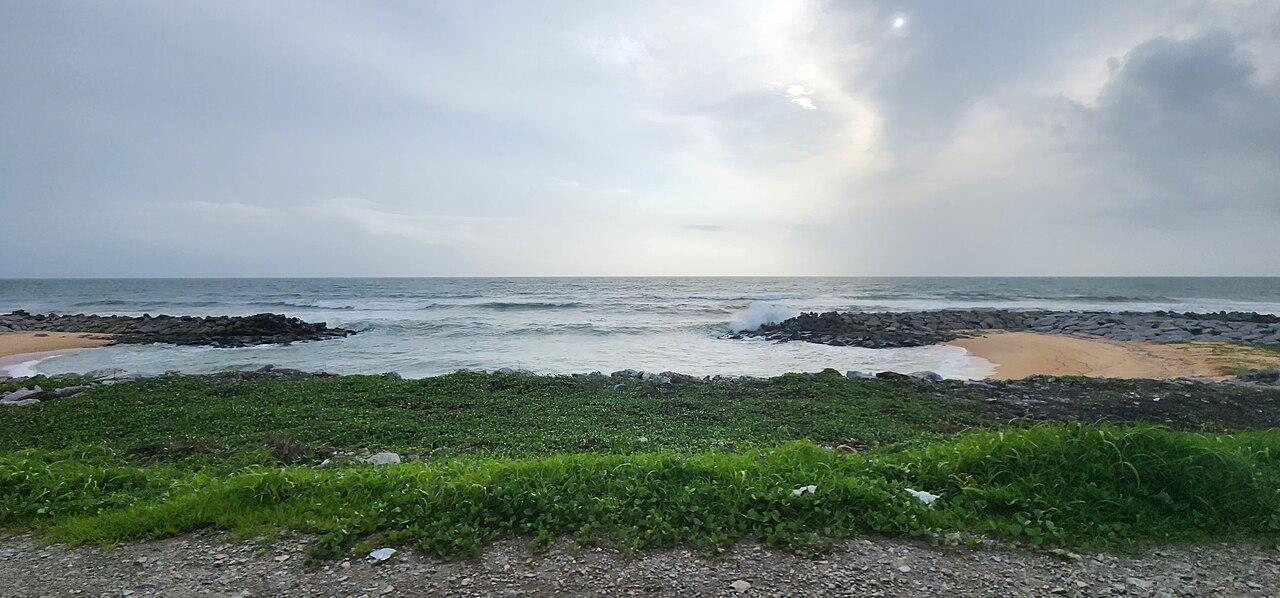
For a stretch of approximately 2 kilometres, travelers driving along the highway are treated to a surreal, simultaneous perspective of two completely distinct bodies of water. On the western side, barely 15 to 20 metres from the asphalt shoulder, the powerful breakers of the Arabian Sea smash against a reinforced granite boulder sea wall. On the eastern side, sitting barely 10 metres from the opposite edge of the road, the serene freshwater Souparnika River flows lazily northward before looping around to join the sea at the Gangolli estuary.
The aesthetic contrast between the two waterways is breathtaking. While the ocean is dynamic, salty, and churns with white foam, the river is tranquil, mirror-smooth, and fringed by emerald coconut palms, mangrove swamps, and betel nut orchards. In the eastern background, rising majestically behind the river like an amphitheatre of green granite, stands the towering silhouette of the Kodachadri mountain peak.
2. The Sacred Souparnika River: Ayurvedic Origins & Myth
The Souparnika River holds deep religious and mythological significance in Karnataka. Originating high in the cloud-draped rainforests of Kodachadri near the ancient Adi Shankara meditation shrine, the river flows past the holy temple town of Kollur, where it circumambulates the sacred sanctum of Goddess Mookambika before making its long journey to the coast.
According to sacred Hindu lore, the golden bird Garuda (the divine eagle mount of Lord Vishnu) performed rigorous penance along the riverbanks to attain spiritual liberation and acquire the divine name 'Suparna'. The river was consequently christened 'Souparnika' in his honor. Local tradition and Ayurvedic scholars believe the water possesses therapeutic and medicinal qualities, having absorbed the organic extracts of hundreds of rare Ayurvedic herbs, wild turmeric, and tree roots as it cascades through the dense Western Ghats reserves.
Near Maravanthe, the Souparnika River loops in an extraordinary hairpin curve known as the 'Maravanthe Loop', running parallel to the sea for several kilometres before merging into the five-river delta (Panchagangavalli) at Gangolli. Travelers can hire traditional wooden motorboats to cruise along the tranquil river channel, observing river fishermen casting hand-knotted cast nets from slender canoes called donis.

3. The Historic Maraswamy Temple & Coastal Fisherfolk Culture
Situated on the sandy sea-facing spit near Maravanthe stands the ancient Maraswamy Temple (also known as the Varahaswamy Temple), a deeply venerated coastal shrine dedicated to three deities: Lord Varaha (the boar incarnation of Lord Vishnu), Lord Shiva, and Lord Narasimha.
The shrine is built of dark weathered granite in the traditional coastal Karavali style, with sloping tiled roofs engineered to withstand torrential monsoon rains. Local fisherfolk revere Lord Varaha as their supreme guardian deity, seeking his divine protection before venturing out into the deep Arabian Sea for seasonal sardine and mackerel harvesting. Special thanksgiving offerings of fresh coconuts and sugarcane jaggery are made during auspicious coastal full-moon days.
Immediately adjacent to Maravanthe lies the idyllic village of Padukone, celebrated as the ancestral home of Indian sporting legends, including badminton icon Prakash Padukone and international actress Deepika Padukone. The village features traditional Mangalore-tiled homes, lush coconut groves, and quiet sandy lanes that preserve the timeless grace of rural Karavali life.
The geographical anomaly of Maravanthe is unmatched in India: for roughly 2 kilometres along National Highway 66, vehicles drive along a narrow strip of land barely 30 metres wide. To the right (west) crash the turquoise breakers of the Arabian Sea, while to the left (east) flows the placid freshwater Souparnika River, framed by the distant blue silhouette of the Kodachadri mountain range.
4. Olive Ridley Sea Turtle Nesting Sanctuary
Beyond its visual grandeur, the golden sandy beaches of Maravanthe and neighbouring Trasi constitute a vital ecological nesting sanctuary for endangered Olive Ridley sea turtles (Lepidochelys olivacea). Every year, between November and February, hundreds of female turtles migrate thousands of kilometres across the Indian Ocean to crawl ashore at night, excavating deep egg chambers in the soft sand above the high-tide line.
The Karnataka Forest Department, in collaboration with local community fishermen collectives, operates an active turtle conservation hatchery program along the Maravanthe beach stretch. Volunteers patrol the beaches nightly during nesting season to locate fresh nests, carefully transferring vulnerable eggs into secure, fenced beach hatcheries to protect them from feral dogs, wild boars, and human poaching.
When the tiny hatchlings emerge from the sand 45 to 50 days later, usually under the cover of darkness, conservationists and nature enthusiasts gather on the beach to release hundreds of energetic baby turtles into the gentle surf, guiding them safely toward the open sea under the glow of red lanterns.
5. Sunset Drama, Viewpoints & River Boating
Maravanthe is celebrated among landscape photographers as one of the finest sunset vantage points on the Indian subcontinent. Between 5:30 PM and 6:30 PM, as the tropical sun sinks toward the Arabian Sea horizon, the sky is set ablaze with intense shades of saffron, amber, and deep magenta, reflected simultaneously across both the rolling ocean waves and the still surface of the Souparnika River.
Special viewing pavilions and widened asphalt bays have been developed along the eastern side of the highway, allowing travelers to park safely and sit on stone benches beneath swaying coconut trees. The rhythmic sound of ocean waves crashing against the granite breakwater creates a hypnotic auditory backdrop for an evening walk.
For a more intimate experience of the aquatic landscape, travelers can embark on guided country boat rides along the Souparnika backwaters. The gentle wooden boats glide past dense mangrove islands, oyster beds, and migratory bird roosting trees where white-bellied sea eagles, brahminy kites, and purple herons hunt in the calm river shallows.
Because Maravanthe beach directly borders the high-speed NH 66 corridor, travelers stopping their vehicles must pull completely into designated viewing bays and exercise extreme caution when crossing the highway. The open ocean beach experiences strong underwater rip currents; swimming deep into the surf is hazardous and discouraged.
6. Practical Visitor Intelligence: Parking, Stays & Rules
Visiting Maravanthe is best incorporated as a scenic road trip stop along National Highway 66 between Udupi/Kundapura and Murudeshwar/Gokarna. Designated vehicle parking slots are available along the river-facing side of the highway near the main beach promenade. Drivers must avoid parking on the active highway lanes.
Swimming in the open sea at Maravanthe requires caution. While the beach is pristine and inviting, the seabed drops off sharply and strong undertows can occur. Visitors should only wade in the shallows where lifeguards are stationed, avoiding the rocky sea-wall boulders which can be dangerously slippery with marine algae.
Accommodations directly along the narrow spit are limited, preserving the natural highway corridor from over-development. Excellent beach resorts, homestays, and riverfront properties are located a few kilometres north at Trasi beach and south at Kundapura town (12 km away), which offers extensive dining and lodging options.
7. Seasonal Profiles: Crisp Winter Roads vs Monsoon Fury
The ideal time to visit Maravanthe is from October through April. The winter months from November to February offer the most comfortable weather, with sunny days averaging 28°C to 31°C, low humidity, calm sea waters, and breathtaking sunset clarity.
The summer season from March to May brings warmer afternoon temperatures around 33°C, but the constant ocean breeze makes evenings delightful. This period is popular for tranquil river boating and peaceful sunrise walks along the Souparnika.
The South-West Monsoon from June to September transforms Maravanthe into an awe-inspiring, high-drama seascape. Towering oceanic swells smash violently against the sea-wall rocks, sending plumes of white spray across the highway shoulder, while the Souparnika River swells to its brim beneath dark, dramatic rain clouds. While beach walking is restricted, driving through Maravanthe during the monsoon is an unforgettable, elemental road trip experience.
8. Transit Logistics: NH 66 Coastal Access & Railheads
Maravanthe is located directly on National Highway 66, positioned 12 kilometres north of Kundapura, 48 kilometres north of Udupi, 55 kilometres south of Murudeshwar, and 105 kilometres north of Mangaluru.
The nearest broad-gauge railhead is Kundapura Railway Station (KUDA) on the Konkan Railway network, located approximately 15 kilometres away. Major express trains from Mumbai, Goa, Bengaluru, and Kerala stop regularly at Kundapura, from where local taxis and KSRTC buses run frequently to Maravanthe.
For commercial flight travel, Mangaluru International Airport (IXE) is the primary gateway, located approximately 105 kilometres to the south (roughly 2.5 hours via the smooth four-lane NH 66 highway). Goa's Dabolim Airport (GOI) is located 250 kilometres to the north. Frequent express buses connecting Mangaluru, Udupi, Bhatkal, and Karwar stop at the Maravanthe beach bus shelter.
Curated Field Dossier & Offline Google Maps Pin Pack
Bypass tourist traps with verified local logistics, exact parking coordinates, and field-tested routes.
- ✓Exact GPS Pin Pack: Unmarked parking spots, best dawn photography vantage points, and hidden trailheads.
- ✓Crowd-Avoidance Timing Matrix: Exact hour-by-hour windows to explore with zero tourist chaos.
- ✓Vetted Local Dhabas: 100% authentic, hygiene-checked regional food stops not on commercial maps.
- ✓Scam & Overcharge Shield: Verified taxi rates, auto fares, and local guide fee guidelines.
🛡️ Personally curated by PK Gupta & the Hidden Routes research desk. Delivered directly to your Email & WhatsApp within 4–8 hours.
Frequently Asked Questions
What is unique about the geography of Maravanthe Beach?
Maravanthe is unique because it features a narrow 2-kilometre strip of land where National Highway 66 runs with two distinct bodies of water on either side: the crashing Arabian Sea barely 20 metres to the west, and the calm freshwater Souparnika River flowing just 10 metres to the east, with the Kodachadri mountain range in the background.
Where does the Souparnika River originate and why is it considered holy?
The Souparnika River originates high in the Kodachadri hills near the Adi Shankara meditation seat, flowing past the sacred Kollur Mookambika Temple before reaching Maravanthe. It is believed to have therapeutic medicinal qualities because it flows through dense forests containing rare Ayurvedic herbs.
Can you swim in the sea at Maravanthe Beach?
Swimming deep into the sea at Maravanthe is generally discouraged due to strong undertows and steep seabed drop-offs. Visitors can wade safely in the shallows near designated sandy areas, but should never attempt to swim near the granite rock sea-walls or during the monsoon.
How far is Maravanthe from Udupi and Murudeshwar?
Maravanthe is located approximately 48 kilometres north of Udupi (about a 1-hour drive via NH 66) and 55 kilometres south of Murudeshwar (about a 1-hour drive via NH 66). It makes an ideal scenic stopover between the two destinations.
Do sea turtles nest at Maravanthe Beach?
Yes, Maravanthe and neighbouring Trasi beaches are important nesting grounds for endangered Olive Ridley sea turtles between November and February. The Karnataka Forest Department operates community-assisted hatcheries along the coast to protect turtle eggs and release hatchlings safely into the sea.