
1. The Monumental Chasm of the Sharavathi River
Jog Falls (historically known as Gerosoppa Falls or Joga) is arguably the most famous and breathtaking natural spectacle in peninsular India. Situated in the dense tropical forests of Sagara taluk in Shivamogga district, the waterfall is born of the sacred Sharavathi River, which flows westward from the Western Ghats toward the Arabian Sea.
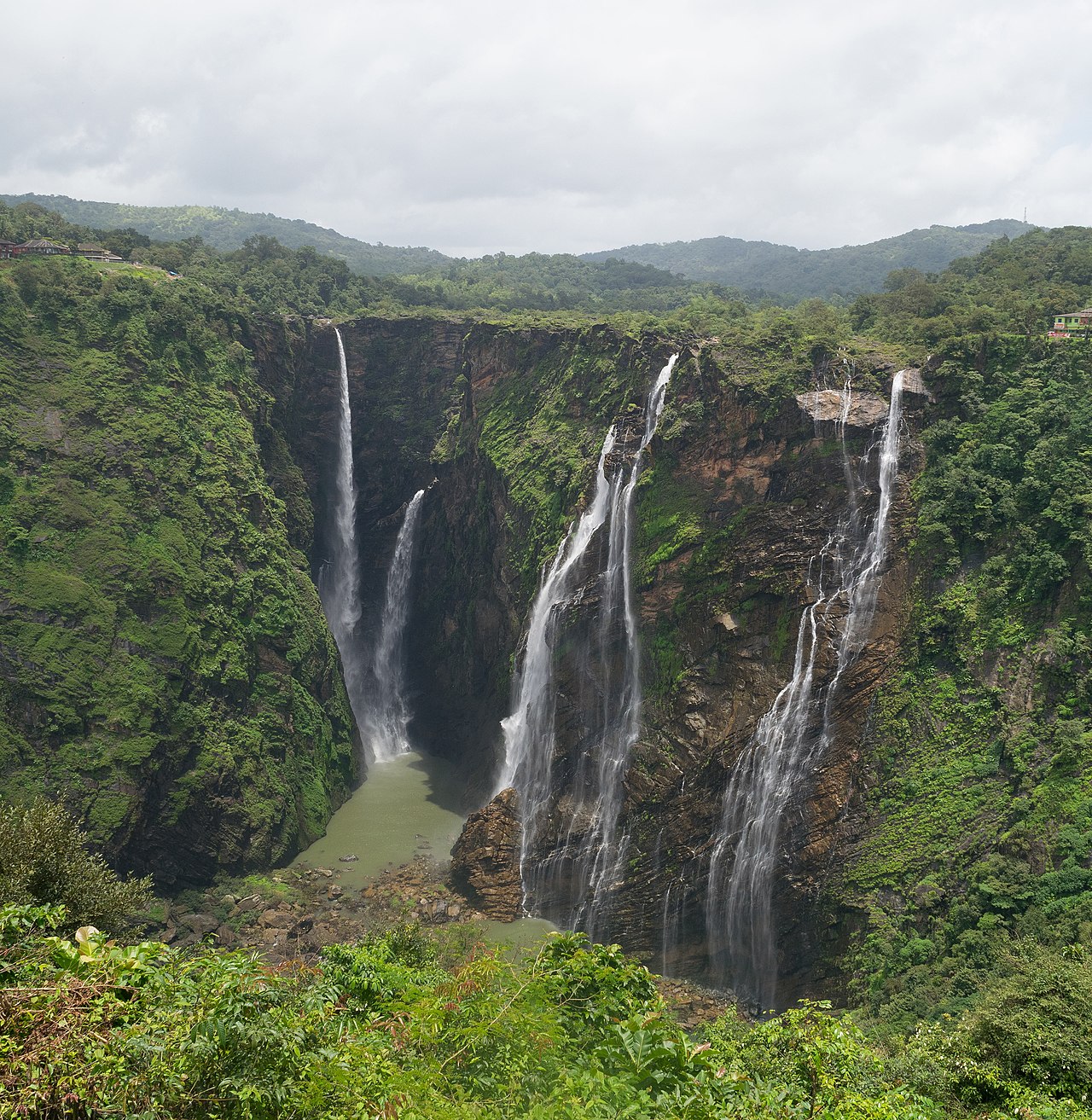
Upon reaching the edge of a massive, 253-meter (830-foot) vertical granitic precipice, the river suddenly drops into a colossal abyss, creating India's second-highest plunge waterfall.
The sheer scale of Jog Falls is staggering: the amphitheater gorge spans over half a kilometer across, framed by vertical black basalt cliffs draped in hanging ferns and wild orchids. During the height of the southwest monsoon, when the upstream Linganamakki Dam gates are opened, the four separate falls merge into an incomprehensible, thunderous wall of white foam that generates towering columns of vapor, drenching visitors on distant viewing galleries in fine rain and producing permanent, shimmering rainbows in the morning sun.
2. Raja, Roarer, Rocket & Rani: The Four Royal Cascades
What renders Jog Falls globally unique among mega-waterfalls is the distinct physical and acoustic personality of its four constituent cascades.
On the far left plunges Raja (The King), an awe-inspiring, majestic column of solid water that drops completely sheer without touching the rock face until it explodes into the deep plunge pool 830 feet below.
Adjacent to Raja is Roarer, which rushes down a steep rock slope before bursting out of a deep granitic fissure at a 45-degree angle, generating a deafening, continuous acoustic roar that reverberates through the valley. Next comes Rocket, where immense volumes of water are forced through a series of narrow stone nozzles, shooting continuous pressurized jets of spray into the air like celestial fireworks. Finally, on the far right flows Rani (The Queen), a gentle, twisting ribbon of water that glides gracefully across the cliff face in a delicate, swirling dance resembling a classical Indian dancer.

3. The 1,400-Step Descent to the Plunge Pool
For adventurous travelers and fitness enthusiasts, the ultimate highlight of Jog Falls is descending the famous 1,400 concrete and stone steps built along the cliff edge down to the foot of the abyss. Maintained by the Jog Management Authority, the stairway zig-zags through lush forest undergrowth where monkeys forage and cool mountain breezes offer relief.
Reaching the bottom rewards climbers with an unforgettable perspective: looking straight up 830 feet at the roaring sheets of water crashing into the jade-green plunge pool.
The sheer velocity of the falling water generates a continuous acoustic tempest and an intense micro-climate, blowing cool pressurized air and refreshing spray hundreds of feet across the gorge. The return ascent requires substantial stamina and should be undertaken at a steady, measured pace with ample water.
Unlike uniform cataracts, Jog Falls divides into four distinct, named cascades: 'Raja' falls in an unbroken, regal sheet of sheer power into the pool 253 metres below; 'Roarer' surges violently out of a rock cleft with deafening acoustics; 'Rocket' shoots through a narrow aperture in pressurized aquatic jets; and 'Rani' glides gracefully in a swirling, lace-like bridal veil.
4. Linganamakki Dam & Mahatma Gandhi Hydroelectric Project
Jog Falls is intimately linked with Karnataka's industrial and engineering history. In 1948, the Government of Mysore commissioned the Mahatma Gandhi Hydroelectric Project (originally the Jog Falls Power Station), which was one of the earliest major clean energy generation projects in post-independence India.
To ensure a year-round, regulated supply of water for power generation, the colossal Linganamakki Dam was constructed 6 kilometers upstream across the Sharavathi River in 1964.
The dam created an immense 326-square-kilometer reservoir that submerged surrounding valleys. Consequently, Jog Falls exhibits dramatic seasonal variability: during the dry winter and summer months, water is conserved for hydroelectric turbines, reducing the falls to slender silver ribbons; but during monsoon overflows (July to October), the sluice gates are unlocked, restoring the waterfall to its primeval, roaring ferocity.
5. Viewing Galleries, Laser Shows & British Heritage Bungalows
Visitors can enjoy panoramic vistas of the falls from several well-designed viewpoints. The primary viewing platform is located at the Karnataka Tourism (KSTDC) Complex, offering an unobstructed, head-on perspective of all four streams, complemented by a landscaped amphitheater and an evening musical laser-and-sound fountain show that illuminates the cascading water in vibrant hues.
Across the chasm near the British-era inspection bungalow stands the Watkins Platform, offering an exhilarating side-profile perspective where visitors can gaze directly down into the abyss where Raja begins its plunge.
The area is also home to historic colonial-era rest houses where British naturalists and viceregal delegations once stayed while marveling at the Sahyadri wilderness.
The 1,400-step descent to the base of the gorge is physically grueling and takes roughly 2 hours of strenuous uphill climbing on the return; individuals with heart conditions, knee ailments, or asthma should view the falls from the safety of the upper viewing platforms. During monsoon spates, swimming at the base is strictly prohibited.
6. Transit Logistics, Access Routes & Optimal Season
Jog Falls is located 30 km from Sagara town, 100 km from Shivamogga city, and 380 km northwest of Bengaluru. Talguppa Railway Station is situated just 14 km away, connecting direct express trains from Bengaluru and Mysuru. Mangaluru International Airport (IXE) is 185 km to the south, and Hubballi Airport (HBX) is 165 km to the north.
Frequent KSRTC express buses ply directly between Sagara, Shivamogga, Honnavar, and the Jog Falls bus terminal.
The absolute best time to witness Jog Falls in its peak fury is during the monsoon months from July to October, when torrential rains fill the Sharavathi River and Linganamakki reservoir. The post-monsoon period from November to January offers pleasant weather, clear skies, and lush green gorge vistas, though the water volume gradually subsides. Summer (March to May) is generally dry, with minimal water flow.
Curated Field Dossier & Offline Google Maps Pin Pack
Bypass tourist traps with verified local logistics, exact parking coordinates, and field-tested routes.
- ✓Exact GPS Pin Pack: Unmarked parking spots, best dawn photography vantage points, and hidden trailheads.
- ✓Crowd-Avoidance Timing Matrix: Exact hour-by-hour windows to explore with zero tourist chaos.
- ✓Vetted Local Dhabas: 100% authentic, hygiene-checked regional food stops not on commercial maps.
- ✓Scam & Overcharge Shield: Verified taxi rates, auto fares, and local guide fee guidelines.
🛡️ Personally curated by PK Gupta & the Hidden Routes research desk. Delivered directly to your Email & WhatsApp within 4–8 hours.
Frequently Asked Questions
What is the best month to visit Jog Falls?
The peak season is during the monsoon between July and October, especially in August and September when upstream dam gates are open and all four cascades roar with maximum water volume.
What are the names of the four cascades of Jog Falls?
The four cascades are named Raja (The King), Roarer, Rocket, and Rani (The Queen), each exhibiting distinct velocity, trajectory, and acoustic characteristics.
How many steps lead to the bottom of Jog Falls?
There are approximately 1,400 concrete steps leading from the viewing gallery to the base of the gorge, taking roughly 30 minutes to descend and 1 to 1.5 hours to climb back up.
What is the nearest railway station to Jog Falls?
Talguppa Railway Station is the nearest railhead, located just 14 km (about 20 minutes by bus or taxi) from Jog Falls, with daily direct trains from Bengaluru.
Are there laser shows and lighting at Jog Falls?
Yes, during weekends and peak tourist seasons, a spectacular laser light and musical fountain show is operated in the evening by the Jog Management Authority, illuminating the falls in vibrant colors.