
1. Unique Biogeography: The Western-Eastern Ghats Bridge
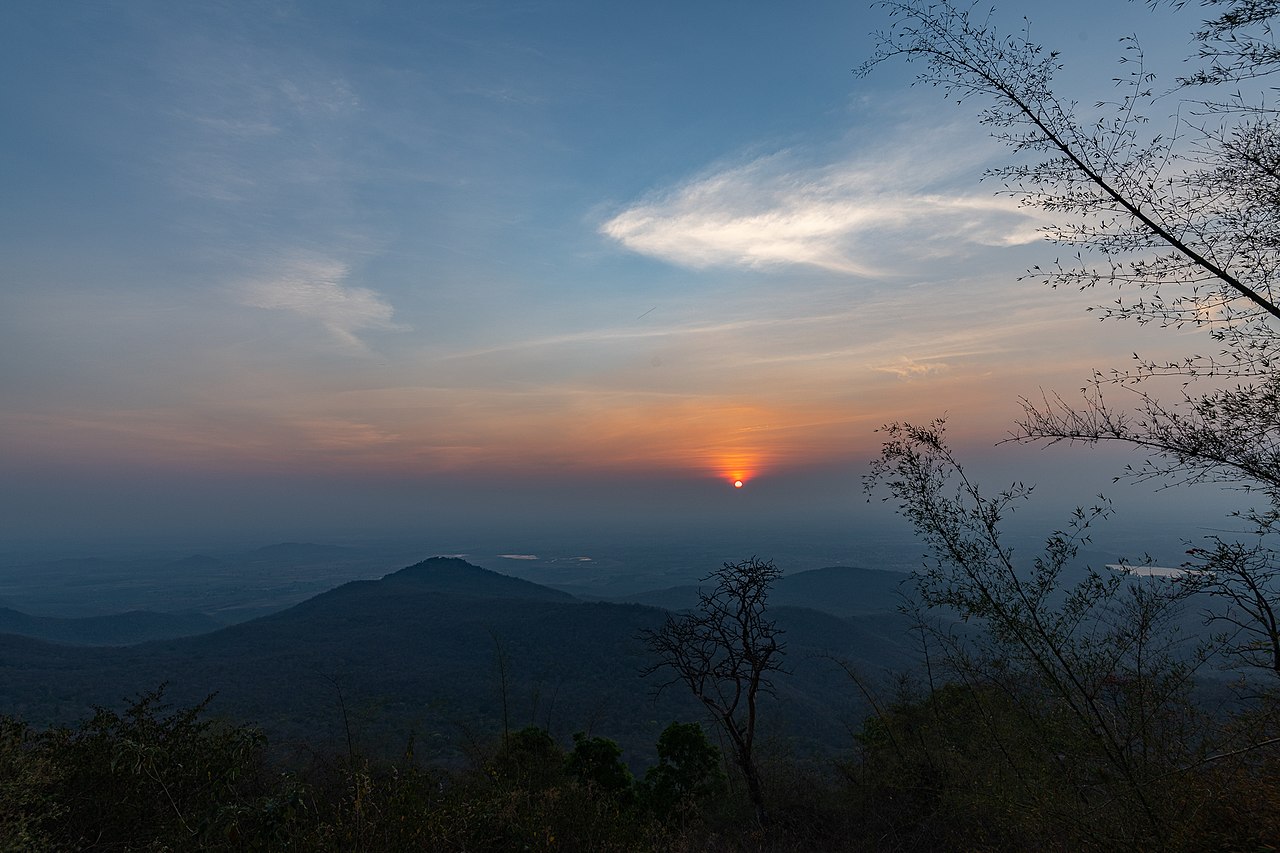
The Biligirirangana Hills (popularly abbreviated as BR Hills or the BRT Wildlife Sanctuary) occupy an ecologically unique biogeographical position in Yelandur and Kollegal taluks of Chamarajanagar district, south-eastern Karnataka. Soaring to a maximum summit elevation of 1,751 metres (5,745 feet) above mean sea level at Kattari Betta, the range forms a vital continental corridor—a biological 'live bridge'—connecting the moist evergreen forests of the Western Ghats to the dry scrub and deciduous woodlands of the Eastern Ghats.
This ecological convergence creates an extraordinary mosaic of habitat types within a single protected reserve. As the elevation ascends from 600 metres along the plains to over 1,700 metres at the summit, the vegetation transitions seamlessly through five distinct bio-climatic zones: dry scrub jungle, southern tropical dry deciduous forest, moist deciduous woodland, riparian gallery forest, and high-altitude montane shola-grassland complexes. This extraordinary ecological diversity sustains an exceptionally high concentration of peninsular flora and fauna.
The geological foundation of the range consists of massive charnockite and granitic gneiss formations dating back to the Archean era. The mountain derives its historic Kannada name 'Biligirirangana Betta' from three terms: 'Bili' meaning white, 'Giri' meaning hill, and 'Ranga' referencing the presiding deity Lord Ranganatha—a direct visual reference to the sheer, 1,000-foot white quartzite and granite cliff face that crowns the central summit like an immense natural fortress.
2. Sri Biligiriranganatha Swamy Temple: The White Cliff Sanctum
Perched dramatically on the razor's edge of a sheer 1,000-foot vertical white rock cliff stands the ancient Sri Biligiriranganatha Swamy Temple, the spiritual epicenter of the mountain range. Consecrated to Lord Ranganatha (an incarnation of Lord Vishnu), the temple is revered as one of the most prominent Vaishnavite pilgrimage shrines in southern Karnataka, holding deep mythological associations with both Vedic scripture and indigenous Soliga tribal lore.
Unlike conventional representations of Lord Ranganatha, who is typically depicted in a reclining posture (Ananthasayana) upon the cosmic serpent Adisesha, the idol at BR Hills is unique: the Lord stands in a rare, commanding erect posture (Sthanaka Murti) holding the divine conch (Shankha) and discus (Chakra), accompanied by his consort Goddess Ranganayaki (affectionately called Kusulumba by local tribes). The temple structure exhibits classic Dravidian and Vijayanagara architectural elements, with carved granite pillars, a multi-tiered gopuram, and an open stone pradakshina path that offers dizzying views directly down into the forest canopy below.
According to sacred regional legend, Lord Rama worshipped Lord Ranganatha at this very summit during his search for Sita. In Soliga mythology, the connection is even more intimate: the Soligas consider Lord Ranganatha to be their divine brother-in-law (Bava), believing that the deity fell in love with and married Kusulumba, a beautiful maiden from the Soliga tribe. During the grand annual chariot festival (Rathotsava) held during Chaitra Poornima in April, Soliga community leaders are granted the sacred hereditary privilege of offering a massive pair of handmade leather sandals (Paduka) to the deity.
3. The Soliga Tribe: Traditional Knowledge & Co-Existence
The human soul of BR Hills is the indigenous Soliga community (translating literally to 'Children of the Bamboo'), a tribal group that has inhabited these mountains for millennia. The Soligas represent one of the world's most successful models of human-wildlife co-existence, having lived alongside apex predators like tigers, leopards, and wild elephants without catastrophic human-wildlife conflict.
Soliga traditional ecological knowledge is extraordinarily sophisticated. They recognize over 300 medicinal plants, classify forest soils based on subtle olfactory and tactile qualities, and practice sustainable non-timber forest product (NTFP) harvesting under strict community taboos. They collect wild honey from the giant rock bee (Apis dorsata) using rope ladders woven from forest creepers, harvest lichen (Parmotrema) sustainably, and collect wild amla (Indian gooseberry) without damaging tree branches.
In 2011, when the sanctuary was formally notified as a Tiger Reserve, the Soligas made history by becoming the first indigenous community in India to successfully secure legally recognized community forest rights under the Forest Rights Act (FRA) within the core zone of a tiger reserve. Rather than displacing the tribe, scientific studies conducted by institutions like the Ashoka Trust for Research in Ecology and the Environment (ATREE) demonstrated that Soliga stewardship actively helps control invasive lantana camara weeds and reduces forest fire risks through traditional cool-burning practices.
Deep inside the BRT sanctuary on the banks of the sacred Bhargavi River stands Dodda Sampige Mara ('The Great Champak Tree'). Estimated by botanists to be over 2,000 years old, this massive living monument rises over 34 metres and is venerated by the indigenous Soliga tribe as the physical abode of Lord Shiva (Maha Biligiriranga). Traditional Soliga rituals are held here during harvest festivals.
4. BRT Tiger Reserve: Wildlife Safaris & Faunal Wealth
Notified as the Biligiriranganatha Swamy Temple (BRT) Tiger Reserve in 2011 and encompassing approximately 540 square kilometres, the sanctuary forms an essential sanctuary for endangered peninsular mammals. The convergence of two major mountain systems supports a remarkably dense and genetically diverse population of over 60 Bengal tigers and a healthy population of leopards.
The sanctuary is particularly famous for its massive herds of Asian elephants. Functioning as a critical migratory corridor connecting the Western Ghats elephant population to the Eastern Ghats tracts of Tamil Nadu (including Sathyamangalam and the Moyar river valley), BRT provides abundant forage including bamboo, wild grasses, and perennial water holes. Travelers embarking on morning and evening open-top jeep safaris conducted by the Forest Department and Jungle Lodges & Resorts (K Gudi Wilderness Camp) regularly encounter large elephant families, herds of Indian gaur, spotted deer (chital), sambar, four-horned antelopes (chousingha), and wild boars.
The avian diversity of BR Hills is equally spectacular, with over 270 bird species recorded. Birders can spot regional endemics and rare raptors including the Malabar whistling thrush, yellow-throated bulbul, crested serpent eagle, Nilgiri wood pigeon, white-bellied treepie, and the elusive Sri Lanka frogmouth nesting in the deep moist deciduous canopy.

5. K Gudi Wilderness Camp & Forest Exploration
Located approximately 16 kilometres south of the temple settlement in the deep interior of the sanctuary lies Kyathadevara Gudi (popularly known as K Gudi), the focal hub for eco-tourism and wildlife safaris. Managed by the renowned state-owned Jungle Lodges & Resorts (JLR), K Gudi Wilderness Camp offers an authentic, low-impact jungle immersion experience.
Accommodations at K Gudi consist of well-appointed tented cottages and log cabins set beneath the canopy of towering terminalia and teak trees. Without televisions, loud music, or bright artificial perimeter lighting, the camp allows guests to fully attune their senses to the nocturnal symphony of the forest: the distant sawing call of a leopard, the deep alarm bark of a sambar, and the mesmerizing calls of nightjars.
Naturalist-led guided nature walks through the buffer zones allow travelers to observe smaller ecological miracles often missed from safari jeeps: intricate termite mounds that regulate soil hydrology, medicinal tree resins used by tribal healers, and dazzling forest butterflies like the southern birdwing, common mormon, and Paris peacock fluttering along stream banks.
The BRT Wildlife Sanctuary forms a critical Asian elephant migratory corridor connecting Bandipur and Nagarahole to the Sathyamangalam tiger reserve in Tamil Nadu. The Forest Department strictly enforces a night traffic ban between 6:00 PM and 6:00 AM across all forest roads. Drivers must never honk, never feed wildlife, and never exit vehicles within the sanctuary.
6. Practical Visitor Intelligence: Safari Bookings & Transit
Visiting BR Hills requires adhering to conservation guidelines designed to safeguard wildlife and tribal sovereignty. The main Biligiriranganatha Swamy Temple is accessible throughout the week, with morning puja rituals commencing at 7:00 AM and evening aarti concluding at 6:30 PM. The final ascent to the temple platform involves climbing roughly 150 stone steps from the parking lot, where local vendors sell forest honey and herbal tea.
Wildlife safaris depart exclusively from the K Gudi forest gate and must be reserved in advance through the Karnataka Forest Department or as part of an accommodation package at Jungle Lodges K Gudi. Safaris operate twice daily: morning safaris from 6:00 AM to 8:30 AM, and afternoon safaris from 3:30 PM to 6:00 PM. Private vehicles are strictly prohibited from driving off designated public transit highways.
The Soliga tribal cooperatives operate a certified honey and organic spice shop near the temple entrance, known as the Vivekananda Girijana Kalyana Kendra (VGKK) sales counter. Travelers can purchase ethically harvested wild rock-bee honey, cold-pressed amla juice, herbal shikakai powder, and hand-woven tribal crafts, with proceeds directly supporting tribal healthcare, education, and community development.
7. Seasonal Profiles: Prime Safari Months vs Monsoon
BR Hills can be visited throughout the year, but different seasons offer distinct ecological rewards. The winter season from October to February represents the peak tourist period. Daytime temperatures hover pleasantly around 20°C to 25°C with crisp, cold nights dipping to 12°C. The forest undergrowth is moderately dry, visibility is excellent, and animal sightings around watering holes are frequent and rewarding.
The summer months of March through May are warmer, with daytime highs reaching 28°C to 30°C. While the deciduous forests shed their leaves, creating an amber, dry landscape, this season is celebrated by serious wildlife photographers and biologists. As natural seasonal streams dry up, animals congregate predictably around perennial water reservoirs, offering unparalleled opportunities for observing tigers, leopards, and elephant herds.
The monsoon season from June to September brings life-giving rains that rejuvenate the forest. The landscape transforms into a vibrant green paradise, waterfalls swell, and the air is filled with the scent of damp earth and blooming orchids. While safari tracks can become muddy and animal sightings are more elusive in dense foliage, the tranquil beauty of the mountain shrouded in rain-mist is deeply restorative.
8. Transit Logistics: Reaching BR Hills from Mysuru & Bengaluru
BR Hills is located approximately 85 kilometres south-east of Mysuru and 175 kilometres south of Bengaluru. The road journey from Bengaluru takes roughly 4 hours via the newly upgraded Bengaluru-Mysuru Expressway up to Maddur or Mysuru, branching onto National Highway 209 (now NH 948) through Malavalli, Kollegal, and Yelandur, before ascending the scenic 20-kilometre ghat road to the temple summit.
The nearest broad-gauge railway hub is Mysuru Junction (MYS), which enjoys daily direct rail connectivity with major Indian cities including Bengaluru, Chennai, Mumbai, and Hyderabad. From Mysuru, travelers can hire private taxis or board regular KSRTC buses that operate between Mysuru, Chamarajanagar, and BR Hills.
The nearest commercial flight options are Mysuru Airport (MYQ) at Mandakalli (located 80 km away with regional connections), and Kempegowda International Airport Bengaluru (BLR), located approximately 210 kilometres away. Travelers driving rental vehicles should plan their arrival before 6:00 PM to comply with the mandatory night traffic ban across sanctuary gates.
Curated Field Dossier & Offline Google Maps Pin Pack
Bypass tourist traps with verified local logistics, exact parking coordinates, and field-tested routes.
- ✓Exact GPS Pin Pack: Unmarked parking spots, best dawn photography vantage points, and hidden trailheads.
- ✓Crowd-Avoidance Timing Matrix: Exact hour-by-hour windows to explore with zero tourist chaos.
- ✓Vetted Local Dhabas: 100% authentic, hygiene-checked regional food stops not on commercial maps.
- ✓Scam & Overcharge Shield: Verified taxi rates, auto fares, and local guide fee guidelines.
🛡️ Personally curated by PK Gupta & the Hidden Routes research desk. Delivered directly to your Email & WhatsApp within 4–8 hours.
Frequently Asked Questions
Why is the ecosystem of BR Hills considered unique in India?
BR Hills (Biligiriranganatha Swamy Temple Wildlife Sanctuary) is ecologically unique because it serves as a biological bridge connecting the Western Ghats to the Eastern Ghats. This convergence of two major mountain systems creates five distinct forest zones within a single reserve, supporting an extraordinary diversity of flora and fauna.
What is Dodda Sampige Mara in BR Hills and how old is it?
Dodda Sampige Mara ('The Great Champak Tree') is a colossal, ancient Champak tree situated deep inside the sanctuary on the banks of the Bhargavi River. Estimated by botanists to be over 2,000 years old and standing over 34 metres tall, it is venerated by the indigenous Soliga tribe as the sacred physical embodiment of Lord Shiva.
Who are the Soliga people of BR Hills?
The Soligas are an indigenous tribal community who have inhabited the Biligirirangana Hills for thousands of years. Known as the 'Children of the Bamboo', they possess deep ecological knowledge of the forest, harvest wild honey and medicinal herbs sustainably, and have lived in harmony alongside wild tigers and elephants for generations.
What are the timings and rules for wildlife safaris in BR Hills?
Wildlife jeep safaris in BR Hills operate from the K Gudi (Kyathadevara Gudi) Forest Department base twice daily: from 6:00 AM to 8:30 AM in the morning and from 3:30 PM to 6:00 PM in the afternoon. Safaris must be booked through the Forest Department or as part of an accommodation stay at Jungle Lodges K Gudi.
Is there a night driving ban on roads through BR Hills?
Yes, to protect nocturnal wildlife and prevent roadkills along critical elephant and tiger corridors, the Karnataka Forest Department strictly enforces a night traffic closure from 6:00 PM to 6:00 AM across all forest roads within the sanctuary.