3.33 SQ KM • Coastal Saline Grassland • Bustard Refuge
Gaga Wildlife Sanctuary
A rare coastal saline grassland and savanna reserve in Kalyanpur taluka of Devbhumi Dwarka, Gujarat — established as a crucial conservation stronghold for the Great Indian Bustard, wintering MacQueen's bustards, demoiselle cranes, and desert foxes.
Overview: The Coastal Grassland Haven of the Gulf of Kutch
Covering 3.33 square kilometers of flat saline grasslands, low scrub, and coastal mud depressions in Kalyanpur taluka of Devbhumi Dwarka district, Gaga Wildlife Sanctuary represents one of Gujarat's most specialized and ecologically vital micro-reserves.
Established in November 1988 under the Wildlife (Protection) Act of 1972, the sanctuary is situated on the southern shore of the Gulf of Kutch. It was created specifically to safeguard the rapidly vanishing **coastal grassland biome** and provide an inviolate wintering and breeding haven for some of India's most critically endangered grassland avifauna—most notably the **Great Indian Bustard (GIB)** (Ardeotis nigriceps) and the migratory **MacQueen's Bustard / Houbara** (Chlamydotis macqueenii).
Historically part of the extensive royal grasslands of the former princely state of Nawanagar and the Okhamandal administrative territory, the region benefits from maritime micro-climates driven by southwest Arabian Sea winds that bring high humidity during the monsoon, triggering rapid grass growth across the saline plains.
Despite its compact geographic footprint, Gaga forms an indispensable stepping-stone habitat along the Central Asian Flyway. Its open horizon of perennial halophytic grasses, saline salt pans, and seasonal shallow wetlands supports thousands of **Demoiselle Cranes (Karkara)**, **Common Cranes**, **Flamingos**, **Desert Foxes**, and **Striped Hyenas**.
Grassland Ecology & Halophytic Vegetation
The sanctuary's micro-habitat consists of low-lying saline clay plains (*khar*) and slightly elevated sandy-loam ridges (*vidis*). The flora has evolved to survive high soil salinity, maritime winds, and severe summer desiccation:
Grassland Flora & Soil Zonation in Gaga Sanctuary
Habitat Zone
Characteristic Plant Species
Wildlife & Foraging Significance
High-Ridge Grasslands (Vidis)
Marvel Grass (Dichanthium annulatum), Sandbur (Cenchrus ciliaris), and Aristida.
Prime nesting and foraging cover for bustards, courser, and quails; abundant grasshopper prey.
Saline Depressions (Khar)
Dropseed Grass (Sporobolus helvolus), Suaeda maritima, and Salicornia.
Winter feeding grounds for migrating waders and feeding grounds for desert foxes.
Acacia & Pilu Scrub Fringes
Gorad (Acacia senegal), Babul, and Pilu (Salvadora persica).
Provides daytime shade for jackals, nilgais, and nesting branches for predatory harriers and eagles.
Historically managed under the traditional Saurashtra *Vidi* system (protected fodder reserves reserved by princely rulers for drought relief), Gaga's grasslands represent an ancient continuum of soil-plant-herbivore dynamics where selective grazing and monsoon regeneration create high nutritional biomass.
The grassland soil is rich in diverse invertebrate life, including migratory locusts, desert grasshoppers (*Acrida exaltata*, *Hieroglyphus banian*), and darkling ground beetles. This abundant insect prey base provides the dense caloric intake essential for migrating bustards and breeding floricans.
Avian Assemblages & Rare Grassland Specialists
Gaga is internationally significant for hosting grassland birds adapted to wide-open, tree-sparse landscapes:
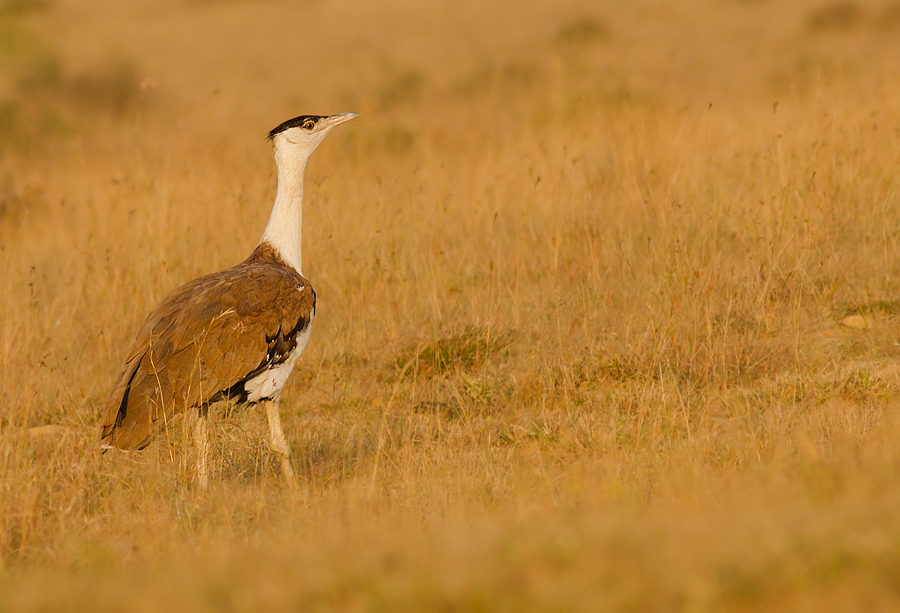
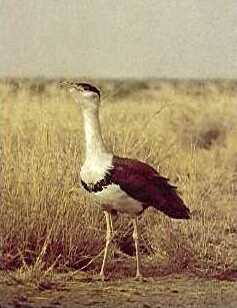
Great Indian Bustard
Ardeotis nigriceps • Critically Endangered
Magnificent, tall ground-dwelling bird with horizontal body posture and black crown, highly sensitive to habitat disturbance.
MacQueen's Bustard
Chlamydotis macqueenii • Winter Migrant
Cryptic, sandy-buff winter visitor arriving from Central Asian breeding steppes to forage on beetles, shoots, and desert berries.
Demoiselle Crane (Kunj)
Grus virgo • Migratory Congregation
Thousands congregate in massive flocks on the open salt flats of Gaga every winter, filling the morning air with resonant trumpet calls.
Lesser Florican
Sypheotides indicus • Critically Endangered
Smallest bustard species; during the monsoon breeding season, territorial males perform breathtaking vertical leap displays above the tall grass.
Desert Fox (White-footed)
Vulpes vulpes pusilla • Arid Predator
Slender fox with large ears and a white-tipped bushy tail, digging complex underground dens in sandy ridges to hunt rodents and beetles.
Indian Courser
Cursorius coromandelicus • Resident Wader
Elegant terrestrial plover with rufous underparts and prominent eye-stripes, sprinting rapidly across open gravel pans to catch insects.
During peak winter migration between November and February, the intertidal margins adjoining Gaga host thousands of Eurasian Curlews (Numenius arquata), Bar-tailed Godwits, Greater Flamingos, and migratory raptors such as the Pallid Harrier and Short-eared Owl.
Mammals & Grassland Habitat Conservation
In addition to avian diversity, Gaga shelters thriving populations of Nilgai (Blue Bull), Golden Jackal, Indian Wolf, Indian Hare, and Striped Hyena.
Because open grasslands are often misclassified as "wastelands", Gaga Sanctuary plays a vital role in ecological advocacy. The Forest Department conducts regular invasive *Prosopis juliflora* eradication to preserve the open grassy views that bustards require for predator detection, while collaborating with surrounding pastoral communities to maintain regulated rotational grazing.
Visitor Information, Birdwatching & Timings
Gaga offers a tranquil, open-sky safari experience for serious birdwatchers and wildlife photographers:
Field Guide & Safari Logistics
Best Visiting Months: November to February. Early mornings (06:30 AM to 09:30 AM) offer exceptional lighting and peak crane and raptor activity.
Entry Formalities: Entry permits can be obtained from the Gujarat Forest Department Range Office at Kalyanpur or Bhatia.
Binoculars & Spotting Scopes: High-powered optics (minimum 8x42 binoculars or 20-60x spotting scopes) are strongly recommended due to the vast, open grassland terrain.
Eco-Ethics: Visitors must remain on designated vehicle tracks to avoid crushing ground bird nests and fragile desert crusts.
How to Reach Gaga Wildlife Sanctuary
Gaga is conveniently accessible from the Jamnagar-Dwarka state highway:
Gateway Transit Routes
From Dwarka City: Approx. 50 km east via Okhamadhi and Bhatia along SH-6 (approx. 1 hour by car).
From Jamnagar City: Approx. 85 km west via Khambhalia and Kalyanpur (approx. 1.5 hours).
From Porbandar: Approx. 75 km north via Harshad and Kalyanpur along coastal highway.
By Train:Bhatia Railway Station (BHTA) (~12 km) and Dwarka Railway Station (DWK) (~50 km) offer good rail links.
Nearest Airport:Jamnagar Domestic Airport (JGA) (~90 km) and Porbandar Airport (PBD) (~75 km).
✓ Handcrafted on Demand • Zero Automated Fluff⚡ 4–8h Delivery via Email & WhatsApp📍 Focus: Gaga Wildlife Sanctuary
Curated Field Dossier & Offline Google Maps Pin Pack
Bypass tourist traps with verified local logistics, exact parking coordinates, and field-tested routes.
✓
Exact GPS Pin Pack: Unmarked parking spots, best dawn photography vantage points, and hidden trailheads.
✓
Crowd-Avoidance Timing Matrix: Exact hour-by-hour windows to explore with zero tourist chaos.
✓
Vetted Local Dhabas: 100% authentic, hygiene-checked regional food stops not on commercial maps.
✓
Scam & Overcharge Shield: Verified taxi rates, auto fares, and local guide fee guidelines.
₹99₹49980% OFF
🛡️ Personally curated by PK Gupta & the Hidden Routes research desk. Delivered directly to your Email & WhatsApp within 4–8 hours.
🔒 Secure Razorpay Checkout💳 UPI & International Cards
Ecology, Conservation History & Field Guide: Gaga Wildlife Sanctuary
Preserving 3.33 sq km of Coastal Saline Grassland & Thorn Scrub across Devbhumi Dwarka District (Kalyanpur Taluka) — established in 1988 as a sanctuary of international ecological significance.
Gaga Wildlife Sanctuary is one of India's smallest yet ecologically vital protected grassland pockets, established primarily to conserve the critically endangered Great Indian Bustard (Ardeotis nigriceps) and the Lesser Florican (Sypheotides indicus). Located in the Saurashtra coastal belt near the Arabian Sea and Gulf of Kutch, the sanctuary consists of flat saline grasslands (locally called 'Vidis') interspersed with Capparis, Salvadora, and Acacia thorn scrub. The open plains support breeding populations of the MacQueen's bustard (Houbara bustard) in winter, alongside Indian wolves, golden jackals, desert cats, and Indian spiny-tailed lizards.
Great Indian bustard.jpg — Natural habitat of Gaga Wildlife Sanctuary.Sonchiriya.jpg — Diverse wildlife species within the protected reserve.
Wilderness Experience & Guided Safari Trails
The sanctuary is a paradise for serious ornithologists and wildlife photographers seeking rare grassland avifauna. During the winter months from November to February, the grasslands teem with migratory raptors, including pallid harriers, Montagu's harriers, Eurasian marsh harriers, and imperial eagles.
Gaga Wildlife Sanctuary's conservation strategy relies on maintaining the delicate balance of indigenous saline perennial grasses like Dicanthium annulatum and Sehima nervosum, which provide crucial nesting concealment for ground-dwelling birds. The Gujarat Forest Department conducts seasonal predator tracking and works closely with local pastoral maldharis to prevent overgrazing during the critical July-to-October breeding season of the lesser florican. Winter raptor surveys have documented significant roosts of tawny eagles, short-toed snake eagles, and red-necked falcons hunting across the open VIDI grasslands.
Visitor Planning & Field Logistics
Located 100 km from Jamnagar and 60 km from Dwarka along State Highway 94. The nearest railhead is Bhatia (15 km) and Jamnagar Railway Station. Prior permission from the Range Forest Officer is recommended. The best visiting window is from November to February during morning hours when bird activity is highest.
Explore Devbhumi Dwarka District — Sacred Shrines & Coastal Wonders
Gaga Wildlife Sanctuary is located in the heart of Devbhumi Dwarka district. Combine your grassland expedition with a pilgrimage to the revered Dwarkadhish Temple, visit the sacred island of Bet Dwarka, enjoy scuba diving at India's first Marine National Park, and relax at the Blue Flag certified Shivrajpur Beach.
Gaga Wildlife Sanctuary is famous for its 3.33 sq km coastal saline grassland habitat, protecting the critically endangered Great Indian Bustard, wintering MacQueen's bustards, demoiselle cranes, and desert foxes.
Where is Gaga Sanctuary located?
The sanctuary is located in Kalyanpur taluka of Devbhumi Dwarka district, Gujarat, approximately 50 kilometers east of Dwarka city near the Gulf of Kutch.
When is the best time to visit Gaga Sanctuary?
The best time to visit is from November to February, when thousands of migratory demoiselle cranes and wintering bustards congregate across the grasslands.
Which is the nearest railway station to Gaga?
Bhatia Railway Station is the nearest railhead, located approximately 12 kilometers from the sanctuary.