
Strategic Geography: The Unconquerable Bastion of the Mandovi
Perched atop a rugged, table-like laterite promontory rising 85 meters above the sea in southwestern Bardez, Fort Aguada commands what was historically the most critical maritime chokepoint in western India. From this elevated bluff, the fortress looks directly across the narrow mouth of the Mandovi River to Cabo Raj Bhavan and Mormugao, effectively sealing the sea approaches to the colonial capital of Old Goa.
Constructed out of durable red laterite stone quarried directly from the hilltop, the fortress covers the entire southwestern tip of the peninsula. Its multi-tiered defensive design was divided into two distinct military sectors: the Lower Fort (stretching along the sea at Sinquerim with coastal artillery batteries and naval water replenishment docks) and the Upper Fort (the sprawling citadel, barracks, cistern, and command headquarters atop the plateau).
The fortress walls follow the natural contours of the cliff, featuring deep dry moats carved out of solid rock, angled bastions designed to deflect cannon fire, and arched embrasures that once mounted 79 heavy bronze and iron guns capable of cross-firing across the river with Reis Magos and Gaspar Dias.
The Mammoth 2.3-Million-Gallon Freshwater Cistern
Buried beneath the upper parade ground of Fort Aguada is a subterranean engineering marvel: an immense vaulted cistern capable of storing 2,375,000 gallons of sweet mountain spring water. Divided into five cavernous chambers supported by heavy masonry pillars, this reservoir was designed to supply entire armadas of Portuguese galleons and allow the fortress garrison to withstand multi-year naval sieges.
Maritime History: The Springs of Aguada and the Dutch Wars
Fort Aguada was commissioned in 1612 during the reign of King Philip II of Portugal (Philip III of Spain), under the direct supervision of Viceroy Ruy Lourenço de Távora. Its construction was prompted by urgent geopolitical danger: between 1604 and 1606, powerful Dutch East India Company (VOC) naval squadrons had repeatedly blockaded the Mandovi River, threatening to strangle Portuguese trade in Goa.
The fortress took its name from the Portuguese word *Água* (water), referencing the abundant natural freshwater springs that bubbled from the hillside. Portuguese merchant fleets, caravels, and East Indiamen (*naus*) sailing between Lisbon, Mozambique, Macau, and Nagasaki anchored in the sheltered cove below the fort to fill their wooden barrels with sweet drinking water.
So formidable was Fort Aguada's architectural design and defensive firepower that it was never captured by enemy forces throughout its three-and-a-half centuries of active military duty, successfully repelling assaults by Dutch armadas, Maratha forces under Sambhaji, and regional sultans.

Naval Architecture: The 1864 Four-Tier Cylindrical Lighthouse
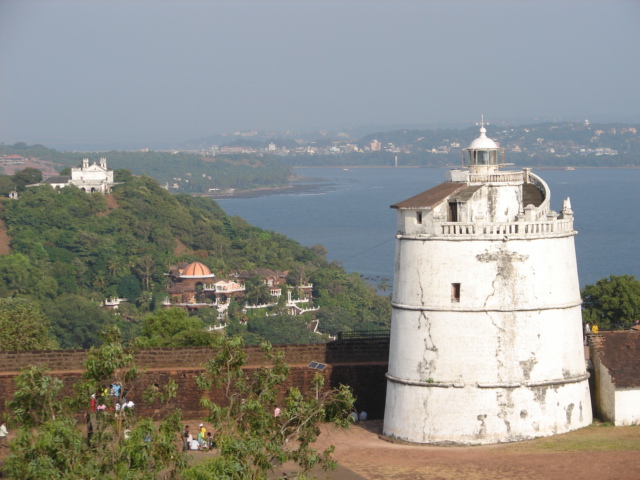
Rising majestically in the center of the upper fort parade ground is the historic Fort Aguada Lighthouse, erected in 1864 under the governance of José Ferreira Pestana. It is celebrated as the oldest lighthouse of its kind in Asia and the second-oldest in the entire subcontinent.
The lighthouse features a striking, four-tiered circular tower constructed of dressed laterite masonry and lime mortar, tapering gracefully as it ascends to an enclosed glass lantern room. Originally illuminated using a massive oil-burning lamp with rotating silvered parabolic mirrors, the light flashed every seven seconds, casting its beam 28 nautical miles across the Arabian Sea to guide international shipping.
Although superseded in 1976 by a modern concrete lighthouse tower built on the outer cliff, the 1864 four-tier beacon remains preserved as an extraordinary monument of 19th-century maritime navigation and industrial architecture.
Steep Laterite Ramparts & Intense Midday Plateau Heat
The fort ramparts feature sheer drops down to the ocean rocks with historic low stone parapets; supervise children closely and do not climb outer defensive walls. The open upper plateau is completely exposed to intense solar radiation; carry drinking water, hats, and sun protection.
Freedom Heritage: From Portuguese Prison to Aguada Freedom Museum
During the later centuries of Portuguese rule, portions of the lower and upper fort were converted into a high-security prison: the infamous Aguada Central Jail. Under the Salazar dictatorship in the 1940s and 1950s, prominent Goan freedom fighters—including Dr. Ram Manohar Lohia, T.B. Cunha, Purushottam Kakodkar, and scores of Satyagrahis—were imprisoned here for demanding democratic liberty and civil rights.
Following Goa's liberation in 1961, the facility continued to serve as the state's central jail until 2015, when inmates were transferred to a modern facility at Colvale. The historic jail complex was subsequently restored by the Goa Tourism Development Corporation (GTDC) and transformed into the magnificent Aguada Central Jail Freedom Museum.
The museum features interactive galleries, original prison cells where freedom fighters were held, archival photographs, audio-visual exhibits detailing the underground struggle against colonial rule, and the evocative 'Martyrs' Memorial' commemorating the sacrifices of Goan patriots.
Transit Log, Operating Protocols and Travel Guidelines
Fort Aguada is located 15 kilometers northwest of Panaji, 16 kilometers from Mapusa, and 40 kilometers north of Dabolim International Airport (GOI). Thivim Railway Station is 24 kilometers east, while Manohar International Airport at Mopa is 38 kilometers north. Paved roads lead right up to the upper fort parking plaza.
The Upper Fort and historic lighthouse grounds are open to the public daily from 9:30 AM to 5:30 PM (entry ticket required). The Aguada Freedom Museum in the lower prison complex operates on similar hours with specialized museum entry. Ample paid parking, visitor amenities, and informational signboards are available.
Visiting Fort Aguada takes approximately two to three hours. It pairs seamlessly with an afternoon swim at the sheltered beach cove of Sinquerim at the foot of the hill, or a scenic drive northward through the dunes of Candolim and Calangute.
Curated Field Dossier & Offline Google Maps Pin Pack
Bypass tourist traps with verified local logistics, exact parking coordinates, and field-tested routes.
- ✓Exact GPS Pin Pack: Unmarked parking spots, best dawn photography vantage points, and hidden trailheads.
- ✓Crowd-Avoidance Timing Matrix: Exact hour-by-hour windows to explore with zero tourist chaos.
- ✓Vetted Local Dhabas: 100% authentic, hygiene-checked regional food stops not on commercial maps.
- ✓Scam & Overcharge Shield: Verified taxi rates, auto fares, and local guide fee guidelines.
🛡️ Personally curated by PK Gupta & the Hidden Routes research desk. Delivered directly to your Email & WhatsApp within 4–8 hours.