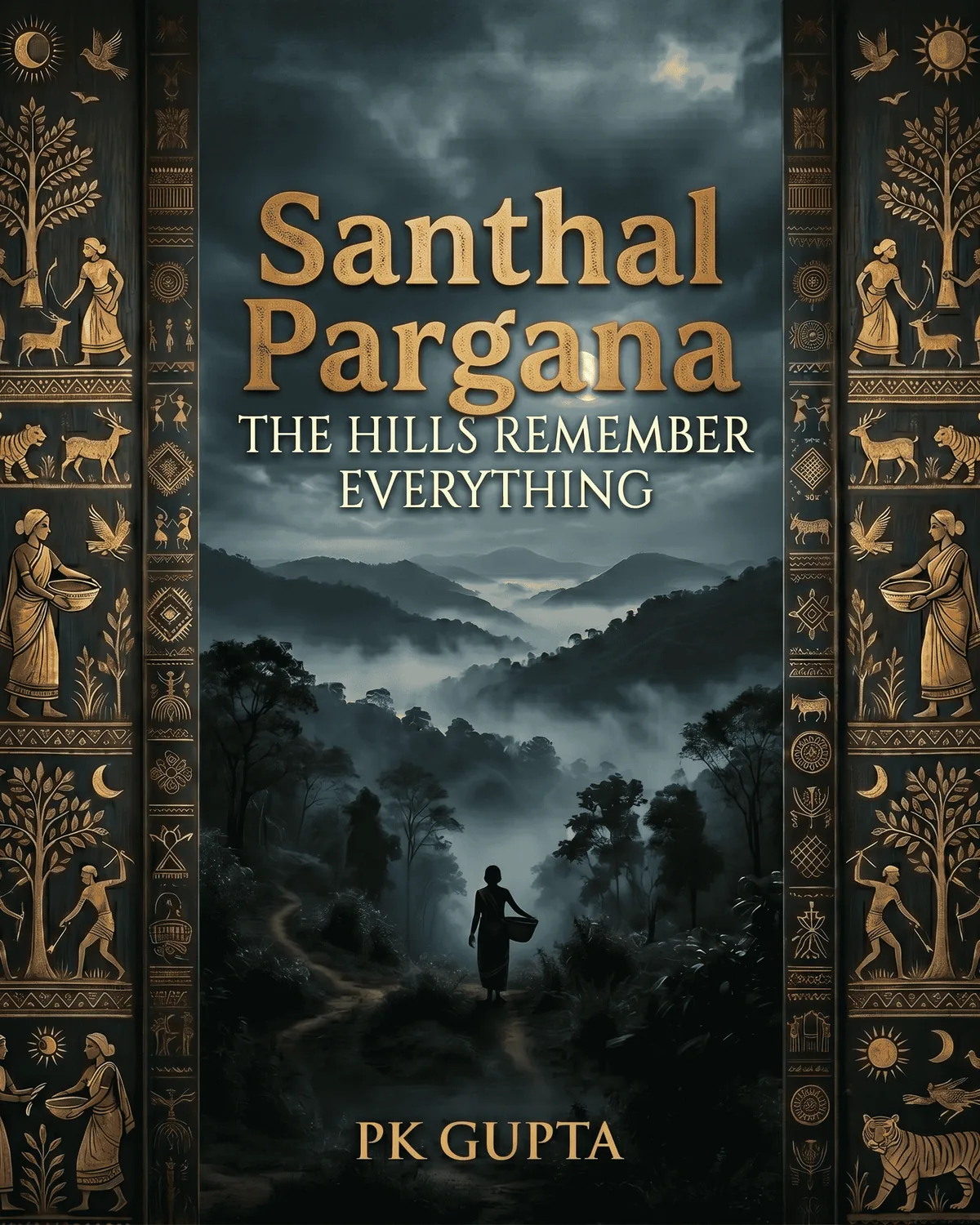
⚡ “A Regional Story. 100% Real Facts.” · Free Shipping PAN India · Paperback & Kindle Live
“Real places. Real people. Real history. Told like a story.”
A deeply researched journey through ancient landscapes, mountain communities, migration, resistance, culture and memory — told with the momentum of a story.
This is history written as a story.
Not a list of dates. Not a collection of dry facts.
A journey through a landscape where ancient geology meets living memory, where forests became fortresses, migration transformed the land, and resistance became part of a people's identity.
The research is real. The places are real. The people are real. The events are real.
But the experience of reading it is a story.
“You don't just read about Santhal Pargana. You walk through it.”
118 million years of deep geological time. Molten basalt fissures cooling into flat-topped fortress plateaus, primeval forests, and ancient stone sanctuaries.
Masters of the high ridges and mountain guerrilla defense. Deep botanical knowledge, poisoned bamboo arrows, and a rugged territory that outside empires repeatedly failed to subdue.
A quiet, monumental migration. Clearing dense tiger-inhabited valleys to turn wilderness into lush agriculture, building villages, and carving a sovereign world from the green depths.
Predatory mahajans, British courts, and mounting pressure. The gathering at Bhagnadih, the divine call of Sido and Kanhu, and the roar of a revolution that shook the Raj.
The quiet heroes who held the world together. Monsoonal river barriers, the sacred Jaher Than groves, Ol Chiki script sovereignty, and oral traditions preserved across generations.
Dumka, Deoghar, Godda, Jamtara, Sahibganj, Pakur. Modern Jharkhand statehood, the legal shield of the SPT Act, and an enduring ecological legacy that continues to speak.
“The demons were engineers.— From Chapter 1: The Jurassic Bedrock & The Ancient Smelters
The dark magic was metallurgy.”
Discover the untold dimensions, ecological warfare, and forgotten metallurgy behind Jharkhand's tribal heartland.
Explore the book's investigation into the Asur iron-working tradition — where ancient folklore describing Asuras and 'dark magic' is revealed to be sophisticated indigenous furnace metallurgy and metallurgical science.
The British redcoats arrived with muskets and artillery, but the high basalt ridges and deep sal ravines belonged to the Paharias. Discover how topography became an unconquerable military weapon.
The suppression of the Hul was not the end of resistance. It transformed into continuous legal resistance, Act XXXVII, the Santhal Pargana Tenancy Act, and the century-long fight for Jharkhand statehood.
The six modern administrative districts — Dumka, Pakur, Godda, Sahibganj, Deoghar, Jamtara — are not bureaucratic creations, but parts of an ancient, continuous cultural and ecological organism.
From 118-million-year-old basalt lava to sacred groves and living oral memories: discover how the land itself preserves the memory of its original inhabitants when official records fall silent.
“When the forest spoke, the empire listened.”
Compound interest of 50% to 500% under predatory mahajans. The kamioti debt bondage system turns generational farmers into bonded labor, backed by distant colonial courts.
Over 10,000 Santhals gather under the sal trees, summoned by the four Murmu brothers — Sido, Kanhu, Chand, and Bhairav — declaring a divine mandate for complete sovereignty.
The Hul sweeps across the Rajmahal foothills, Birbhum, and Murshidabad. Police stations fall, corrupt moneylenders flee, and Santhal Raj is proclaimed across the valleys.
Though suppressed with martial law, the Hul forces the British to acknowledge administrative failure, carving out the separate non-regulation Santhal Pargana district in December 1855.
“Resistance is not a moment.”
READ THE STORY BEHIND THE HUL — ₹499The Journey Through Time: From 118-million-year-old basalt volcanism to the 1855 Hul revolution and modern Jharkhand statehood.
Lava pours out of Cretaceous volcanic fissures as the Indian plate drifts north, cooling into massive sheets of basalt that form the flat-topped Rajmahal Traps.
Warren Hastings appoints Augustus Cleveland as Collector of Bhagalpur. Cleveland ends military pacification, learns Malto, and institutes tax exemptions and tribal assemblies for Paharia chiefs.
The East India Company draws a boundary line around the Rajmahal foothills, creating a government reserve of 1,366 sq miles and inviting Santhals to clear the forests for tax-paying cultivation.
Over ten thousand Santhals gather at Bhagnadih called by Sido and Kanhu Murmu. They issue the rebel Parwana to throw off plains moneylenders (dikus) and British administrators.
The British declare martial law to suppress the rebellion. Recognizing administrative failures, the government passes Act XXXVII, separating the tribal heartland into a new administrative district.
Pandit Raghunath Murmu designs a native alphabet for the Santali language, modeling letters on natural objects. This provides linguistic and intellectual sovereignty to tribal education.
Decades of political agitations culminate in the partition of Bihar, establishing Jharkhand as a separate tribal-dominated state on Birsa Munda's birth anniversary.
The book is structured into 6 thematic units spanning geology, tribal origins, colonial policies, the 1855 uprising, and the modern roadmap. Browse summaries of all 20 chapters.
Unearthing the geological foundations of Sahibganj, Pakur, and Godda.
The story of Santhal Pargana begins 118 million years ago. During the Cretaceous period, volcanic eruptions poured massive sheets of basalt across the landscape, forming the Rajmahal Traps. This hard stone created a natural fortress of flat-topped ridges and steep valleys that resisted outer conquest and protected tribal isolation for centuries.
While the high basalt peaks remained a wild, mysterious frontier (referred to in the Ramayana as the edge of the Dandakaranya forest), neolithic tools in the Ajay and Mayurakshi valleys show thousands of years of human habitation. By the 6th century BCE, the foothills were integrated into the ancient kingdom of Anga.
The Sauria Paharia archers and their clash with the East India Company.
Focuses on the Sauria and Mal Paharias, the Dravidian Malto-speaking original dwellers of the peaks. Guarding their forest homes with poisoned arrows, they developed a unique way of life centered around kurwa (shifting cultivation) and deep co-existence with the forest.
Explores the ancient posa and ghatwali tribute system between Paharia chiefs and Mughal plains zamindars. Raids on plains villages were not mere looting but a traditional assertion of sovereign rights over the foothills, which the Mughals accommodated to keep the Telia Garhi pass open.
Following Buxar (1764), British redcoats suffered crushing guerrilla defeats in the jungle traps. Realizing force was futile, Warren Hastings appointed Augustus Cleveland in 1779, who built peace using mutual respect, learning Malto, and instituting tax exemptions for the hillmen.
The migration of Santhals and the creation of Damin-i-Koh.
Chronicles the quiet migration of the Santhal people from Midnapur, Birbhum, and Bankura. Fleeing heavy British land taxes and zamindar rents, they carried their iron axes to clear the dense, tiger-frequented valleys at the base of the Rajmahal hills.
In 1832, the British demarcated the Damin-i-Koh boundary, inviting Santhals to clear the forests for agricultural land. Santhal populations exploded from 3,000 to over 82,000 in two decades. However, this fertility drew a massive influx of diku traders and moneylenders (mahajans).
Debt bondage and the spark of the 1855 Santhal Hul.
Outlines the predatory kamioti system of lifelong debt-bondage under compound interest rates of 50% to 500% from mahajans. The remote British courts, using Urdu and Persian and located far away, offered no justice and supported the moneylenders.
On June 30, 1855, over ten thousand Santhals gathered at Bhagnadih, called by four Murmu brothers: Sido, Kanhu, Chand, and Bhairav. Claiming a divine mandate from the Thakur (God), they declared a war of independence to end moneylender exploitation and establish a Santhal Raj.
The violent clash of arms and the silent witnesses of the land.
Details the military escalation of the Hul. The Santhals overran police outposts and stations, but the British declared martial law and brought in heavy reinforcements. Enfield rifles and artillery crushed the uprising, resulting in the deaths of over 15,000 Santhals and the burning of villages.
Focuses on the often-overlooked history of Santhal women scouts, messengers, and nurses. Following the mass deaths and arrests of Santhal men, women clear the fields, replant crops, and hold families together amidst colonial pacification and famine.
Follows the ecological history of the Ajay, Mayurakshi, and Gumani rivers. In 1855, they were monsoonal barriers protecting rebel flanks. In the 20th century, the construction of Massanjore Dam (Canada Dam) flooded valleys and displaced Santhal villages in the name of development.
From administrative reorganization to the script and mining rights.
The arrival of Scandinavian and British missionaries who documented Santali dictionaries, but also triggered internal cultural debates between converts and traditional Bonga worshipers in the Jaher Than (Sacred Groves), spawning the Kherwar revival movement.
The late-nineteenth-century coal rush in Chitra and Mugma. Displaced farmers became a new industrial class working deep, hazardous seams, laying the foundations for the regional trade union struggle.
The invention of the Ol Chiki script in 1925 by Pandit Raghunath Murmu. Designed from shapes in nature (hills, rivers, plows), Ol Chiki provided linguistic and cultural sovereignty, breaking dependence on Devanagari and Bengali.
Examines the delicate coexistence of Santhals, Paharias, Jolhas (weavers), Kamars (blacksmiths), and potters in the hills, building a regional craft-based ecosystem that survived cheap industrial imports.
The modern struggles of the Sauria and Mal Paharias. Tax exemptions isolated them from mainstream schooling and medicine, leaving them demographic survivors facing high rates of malaria and malnutrition.
Ties the Quit India movement of 1942 (led locally by Lal Hembrom) to the Jharkhand statehood movement, charting the rise of JMM and Soren's agitations up to the separate state declaration on November 15, 2000.
Examines the division of Santhal Pargana into six modern districts (Dumka, Pakur, Jamtara, Sahibganj, Deoghar, Godda) and the legal defenses of the Santhal Pargana Tenancy Act (SPT Act) against corporate land sale pressure.
A closing reflection on memory as a weapon of resistance. The hills, basalt beds, and groves are living libraries, reminding us that nature is a community to belong to, not a resource to dismantle.
“If these pages make you curious, the journey goes much deeper.”
This is not a history written from the safety of archives, though the archives have been searched. It is a history written from the mud, the basalt, and the high ridge paths of the Santhal Pargana. It is born of a decade of walking, of listening to the wind in the sal forests, and of sitting on the string cots of villages whose names do not appear in the district gazetteers.
For too long, the history of this region has been treated as a footnote—an administrative complication in the grand narrative of the British Empire, or a colorful tribal rebellion to be summarized in three paragraphs in a textbook. But the Santhal Pargana is not a footnote. It is a crucible. Here, some of the earliest human communities in the subcontinent found a sanctuary. Here, the Paharias perfected the art of the mountain guerrilla, holding their peaks against Mughal mansabdars and British collectors alike. And here, the Santhals undertook one of the most monumental migrations in modern Indian history, transforming tiger-stalked wilderness into agricultural gold, only to find themselves trapped in a net of debt and law that they had no choice but to tear down with their bare hands.
This book is an attempt to tell that story in its entirety—not just the battles and the treaties, but the deep ecological and cultural currents that ran beneath them. It is the story of how a landscape shapes its people, and how those people, in turn, defend the memory of their land.
Every copy is produced to archival print standards, reflecting the permanence and memory of the history it carries.
327 pages in 6 × 9 inch format, printed on premium lightweight cream paper designed to reduce glare and offer comfortable long-form reading.
Includes a detailed chronology of key regional events, historical regional maps, a glossary of Santali and Paharia terms, research methodology, and further reading lists.
Every paperback ships with a high-density printed bookmark displaying traditional Adivasi Sohrai and Khovar mural art patterns from local artists in Dumka.
Whether you love deep history, Indian heritage, or unforgettable true stories.
— but hate dry textbooks filled with disconnected dates and lifeless lists.
— but want stories beyond the usual imperial palaces, royal courts, and familiar monuments.
— especially narratives deeply rooted in real people, real struggles, and authentic landscapes.
— and want to understand tribal heritage, language, and sacred ecology beyond festivals and photographs.
— and want to uncover a deeply consequential Indian region that most mainstream books overlook.
— a singular book walking the line between deep researched history, regional landscape, culture, and gripping literary narrative.
“This doesn't feel like reading a history book.
It feels like being taken into the region and watching its story unfold.”
All your questions answered before you place your order. Transparency in every page.
We offer Free Standard Shipping across India. Orders are processed within 1–2 business days. Dispatches ship via reliable courier partners (Delhivery, BlueDart, or India Post) and take 3–5 days to arrive depending on your location.
Payments are secured by Razorpay, supporting all major credit/debit cards, UPI (GPay, PhonePe, Paytm), Net Banking, and digital wallets. We do not store your card numbers or credentials.
The Paperback Edition features a high-density matte cover, cream book paper, and custom maps. The Kindle Edition delivers instantly worldwide and is readable on any Kindle device or smartphone app.
Ordered by mistake? You can request a full refund within 24 hours of ordering, as long as it has not been dispatched. If the paperback arrives physically damaged, email us within 48 hours for a free replacement.
As soon as your package leaves our fulfillment center, a tracking link is sent directly to your registered email and phone number. For any queries, email our team at editor@hiddenroutes.in.
A percentage of proceeds from this publication goes to support archiving oral histories in Pakur and Jamtara, and compensating local artists whose tribal motifs are featured on the official bookmark gift.
“The hills have not finished their story. They never do.”
Some stories disappear when the last person who remembers them is gone.
Others survive in stone. In forests. In rivers. In songs. In names. In the memory of a people.
This is one of those stories.
The Hills Remember Everything
A Regional Story. 100% Real Facts. · By PK Gupta“UNCOVER THE UNSEEN.”